- 440 pages
- English
- ePUB (mobile friendly)
- Available on iOS & Android
eBook - ePub
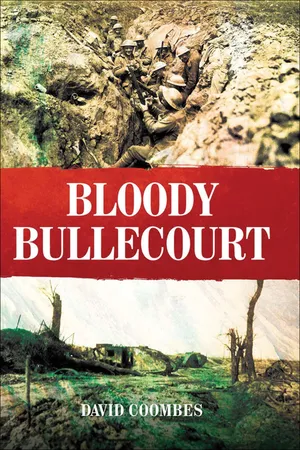
Bloody Bullecourt
About this book
In April-May 1917 the sleepy hamlet of Bullecourt in Northern France became the focus of two battles involving British and Australian troops. Given the unique place in Australia's military history that both battles occupy, surprisingly little has been written on the AIF's achievements at Bullecourt. Bloody Bullecourt seeks to remedy this gasping omission.The First Battle of Bullecourt marked the Australians' introduction to the latest battlefield weapon—the tank. This much-lauded weapon failed dismally amid enormous casualties. Despite this, two infantry brigades from the 4th Australian Division captured parts of the formidable Hindenberg Line with minimal artillery and tank support, repulsing German counterattacks until forced to withdraw.In the second battle, launched with a preliminary artillery barrage, more Australian divisions were forced into the Bullecourt 'meat-grinder' and casualties scored over 7,000. Once more, soldiers fought hard to capture parts of the enemy line and hold them against savage counterattacks.Bullecourt became a charnel-house for the AIF. Many who had endured he nightmare of Pozires considered Bullecourt far worse. And for what? While Field Marshal Sir Douglas Haig considered its capture 'among the great achievements of the war', the village that cost so many lives held no strategic value whatsoever.
Trusted by 375,005 students
Access to over 1.5 million titles for a fair monthly price.
Study more efficiently using our study tools.
Information
CHAPTER 1
‘A great deal of work to do.’
THE WESTERN FRONT, 1917
By the beginning of 1917 Lieutenant General Sir William Birdwood, the British officer who commanded I ANZAC Corps, was growing increasingly uncomfortable with the role his Australians were expected to play in battles on the Western Front. In addition to the large numbers of Australian casualties incurred in seemingly fruitless and poorly planned battles such as Fromelles and Pozieres, there was also the more intangible problem of command structure to consider.1
At Gallipoli, Birdwood had exercised a somewhat independent command, usually with little interference from General Sir Ian Hamilton, the commander of the Mediterranean Expeditionary Force. Hamilton, unwisely as it transpired, had directed the expedition from his headquarters aboard the battleship HMS Queen Elizabeth, where his primary concern lay with the progress of the main landing party of British troops further south at Cape Helles.
Arriving in France Birdwood discovered that his corps was just one of 18, comprising 44 infantry and five cavalry divisions, dispersed throughout five British armies. Despite this, the benefits quickly became evident. Australian officers and soldiers soon learnt the art of so-called technological warfare from their British counterparts — as well as all its horrors. At schools established by the British, the Australians were instructed in the finer points of advancing across no man’s land, supposedly under the protection of their own artillery barrage. There were also lessons in the proper use of machine-guns and trench mortars; how to respond to a gas attack; the pitfalls of failing to throw ‘bombs’ (hand grenades) correctly; methods to avoid detection by snipers and, for competent marksmen, the opportunity to learn the most efficient way to kill exposed enemy troops.
The disadvantages of the AIF’s command structure were also clear to Birdwood and to most other senior Australian officers. I ANZAC Corps generally comprised troops whose primary purpose was to fight the enemy while others belonged to ‘combat support units’. But, as Jeffrey Grey points out, ‘for logistic and much higher administrative support the Australians, like the Canadians, relied upon the British.’ Probably more significantly, Australian soldiers were combined with ‘British formations, and in keeping with British doctrine, the ANZAC Corps were also supplied with tanks and heavy artillery from British resources, and British staff officers filled some of the technical and specialist posts on their headquarters which the Australians lacked the resources to supply themselves.’2 At first the arrangement worked well. But — particularly following the increased casualties in subsequent fighting around the Somme — some Australian junior officers and their men began to lose confidence in British staff officers and to question the wisdom of having the British plan their battles. It was also not lost on Australian survivors of the Gallipoli campaign that they were now pitted against a more competent and lethal enemy. Good soldier the Turk may have been, but he did not have the training, skills and weaponry of his German counterpart.
By January 1917 all five Australian divisions were on the Western Front. The most recent addition, Major General (later General Sir) John Monash’s 3rd, had only moved into the line in November 1916 and, while probably the most comprehensively trained, was not as battle hardened as the others. Yet even the most battle-hardened men suffered in the bitter European winter — the worst for almost 40 years — with freezing rain and relentless snow which turned the terrain to an endless quagmire of sticky mud. Even in the early weeks of winter large numbers of frostbite and trench-foot cases were reported, with each Australian division losing around 200 men a week with trench foot. Birdwood intervened, reminding all junior officers that their ‘thoughts and efforts should always be to look after [their] men first.’ While some platoon and company commanders may have been offended at what appeared to be needless ‘mothering’, most nonetheless ‘began checking that their men regularly aired their feet and rubbed them with whale oil, that they wore dry socks, that their boots were unlaced at the top, that they discarded puttees, that they loosely wrapped sandbags around their ankles.’3

The Western Front 1914–1918 with details of trench lines. Note the position of Bullecourt and the small area of north-eastern France — approximately 75 by 45 miles — which was under the control of the BEF.
As a consequence, cases of trench foot diminished. However many troops froze to death and there were others who simply could not cope with the extreme cold. And, if early January was bad, worse was to come. In late January, according to one Australian soldier, ‘it froze hard ... Even by day, the bitter winds cut through greatcoats and sheepskins ... One awoke at evening to another night of Herculean labours, of peril and misery, as the silent quest rose to a silent heaven, “How long, O Lord?” from thousands of souls which had lost faith for a little in both their God and their country, from neither of which came aid.’4
Largely through the efforts of I ANZAC Corps’ Chief of Staff, Major General Cyril Brudenell White, Australian soldiers at the front gradually received some assistance in coping with the bitter weather. Roads were repaired and duckboard tracks laid near the line to enable iron and timber, used in dugouts and revetting, to be transported to the front. Warm woollen clothing and waterproof coats became more freely available. Almost 65,000 sheepskin jackets were hastily despatched from Australia. The length of time battalions were forced to spend in the line was reduced. All Australian units occupying a front-line position were rotated every six days or so, which meant ‘at the worst a single man seldom does more than forty-eight hours continuous front trench duty in every twelve days.’5
Hot food and canteen consumables were also on hand when in the line. Behind the front, men returned to warmish Nissen hutments while sporting and recreational facilities had not been forgotten. Subsequent frosts caused the sticky mud to harden, giving the troops more cause for joy. However most Australians found the absence of what they regarded as ‘proper’ light difficult. ‘We all wish we could see the sun,’ noted a sergeant from the 27th Battalion in February 1917, adding ruefully, ‘that we have not seen since October last.’6 As if the freezing conditions were not sufficient, squads of Australian soldiers were expected to participate in the much-despised trench raids which brought further casualties for little or no gain. Little wonder that, for many Australians, the winter of 1917 ‘was the hardest of the war ... Several shot themselves, more malingered, and one or two deserted to the enemy, an offence usually unheard of in the AIF.’7
Through it all, Monash remained undaunted, emphasising that raids increased ‘morale’ and acted as a ‘powerful stimulant for all ranks’. He also observed that his divisional sector covered only five of the more than 90 miles of British front-line trenches, and was
… held defensively by only one platoon of each of four companies, of each of four battalions, while all the other nine battalions, all the artillery and engineers [remained out of the line] ... The front line is not really a line at all, but a very complex and elaborate system of field works, extending back several thousand yards, and bristling with fire trenches, support and communication trenches, redoubts, strong points, machinegun emplacements, and an elaborate system of dugouts, cabins, posts, and observation cells.’
This meant very little to Australian soldiers who, even in late February, were still suffering from the extreme weather conditions. Most undoubtedly would have agreed with Monash’s sentiments that ‘life in the front [line] ... is very arduous and uncomfortable.’8
Alongside this was the constant danger of being killed by a German sniper and some of the inexperienced newcomers were soon found dead. ‘It was not wise to put his head over the parapet in daylight,’ wrote one veteran. ‘Fritz’s snipers are pretty keen, and anyhow it gives the position of the post away.’9
In March 1917 however, the drab life of the trenches was to come to an end. Earlier, before the snow had begun to thaw, the German High Command had developed an innovative new strategy which would indirectly bring Australian troops into another great battle close to an obscure French village. What then had brought the Australians to this part of France, and why were so many to fight and die around Bullecourt?
***

Field Marshal Sir Douglas Haig, Commander-in-Chief of British and Commonwealth Forces on the Western Front from late 1915 to 1919 (AWM A03713).
Despite over 30 months of fighting in France and Flanders, the Western Front had changed very little since December 1914. Stretching from the English Channel coast to the border with Switzerland, the terrain had borne witness to some fearful and costly battles, particularly in 1916. The first day of the Somme campaign (Saturday 1 July), for example, has been universally labelled the greatest calamity in the British army’s noble history. At 7.30 am approximately 100,000 troops attempted the dash across no man’s land. By the end of the day, of the 57,470 casualties, 19,240 men had been killed, all for the gain of a little over one mile. Australian troops were soon ordered into the battle. All the while conditions on the Somme battlefields continued to worsen. Heavy rain and almost non-stop artillery fire had turned the ground to a virtual swamp. By mid-October the British front line had advanced very little. With the onset of winter and the mounting toll of casualties all but destroying his ‘New Armies’, General (later Field Marshal) Sir Douglas Haig finally recognised the folly of continuing the attack, and ordered its cessation.10
***
The coming of New Year 1917 saw the strategic situation in France and Flanders alter dramatically. While the Somme battles may have marked the beginning of the end for the British ‘New Armies’, the Germans had fared little better. Poor tactics, including unnecessary counter-attacks, had also drained their divisions of men and equipment; given that the Germans were fighting on two fronts, these were resources that they could ill afford to lose. By early 1917 however, the Russian armies on the Eastern Front were close to defeat and revolution erupted in Petrograd (St Petersburg) which soon spread to Moscow. With little resistance from the once powerful Russian army, more German divisions could be redeployed to the Western Front.
Prior to this redeployment, the German High Command has already recognised that the Allies would, in all likelihood, launch another major attack in the spring to take advantage of the German shortfall in men, and that they would probably break through. To best utilise those troops and weapons that remained, the High Command ordered a general withdrawal to a shorter front which could be better defended, sited well behind the former German line. At first the withdrawal was gradual. Step by cautious step, enemy soldiers pulled back to previously constructed temporary defensive positions, all the while covered by a rearguard of elite infantry units.11 German strategy on the Western Front for the coming year was all but dictated by the construction of those stronger positions behind the old front line.
The British named the new defences the ‘Hindenburg Line’, a collective name for the various stellungs already divided into codenames by the Germans. The strongest and most elaborate was the Siegfriedstellung which ran south from Arras to St Quentin then down to Laon and the Aisne. Straightening this bulge (or salient) released more German troops to defend a shortened line around the Somme. In some places along the Hindenburg Line the withdrawal saw the Germans surrender as much as 45 miles of territory. More significantly however, the shorter front released the equivalent of 13 infantry divisions.
At the same time the Germans were implementing a new defensive doctrine of flexible (or ‘elastic’) defence in depth. The Hindenburg Line provided a region of defensive zones rather than the former single continuous line of well-defended strongpoints. A network of two or three deep trenches, usually following the lie of the land, was protected by mile after mile of up to nine deep belts of barbed wire, in most places many feet thick. Every part of the line had a forward ‘outpost zone’ covering around 2700 yards which comprised the first and second principal trenches (or strongpoint line) while an expertly sited system of machine-gun emplacements (sometimes thick concrete pillboxes), located in the best tactical positions, provided an overlapping arc of ceaseless fire criss-crossing no man’s land. Attacking infantry stood little chance of surviving this maelstrom.
German artillery pits were well camouflaged and sited to provide the highest possible firepower for mobile guns and anti-tank weapons. Strengthened underground bunkers ensured enemy troops were relatively comfortable in even the worst weather conditions while keeping them safe from all but the heaviest artillery bombardments. A labyrinth of communication (‘switch’) trenches connected the rear and forward trenches. If attacking troops managed to break through, reinforcements could move forward quickly, thereby catching hapless survivors in something akin to a salient. Further behind the forward trenches were more dugouts and concrete bunkers for headquarters staffs, medical officers and, most importantly, the counter-attack infant...
Table of contents
- Cover
- Title
- Copyright
- Dedication
- CONTENTS
- Acknowledgements
- Introduction
- Chapter 1 The Western Front, 1917
- Chapter 2 The Arras Offensive
- Chapter 3 The Offensive Spirit
- Chapter 4 Planning the Attack
- Chapter 5 Final Preparations
- Chapter 6 The First Attack
- Chapter 7 The Withdrawal
- Chapter 8 Aftermath and Recriminations
- Chapter 9 The Lagnicourt Counter-Attack
- Chapter 10 Plans and Preparations for the Second Attack
- Chapter 11 The Second Attack: 3–6 May
- Chapter 12 The Second Attack: 7–17 May
- Chapter 13 Aftermath
- Postscript Bullecourt Today
- Endnotes
- Bibliography
Frequently asked questions
Yes, you can cancel anytime from the Subscription tab in your account settings on the Perlego website. Your subscription will stay active until the end of your current billing period. Learn how to cancel your subscription
No, books cannot be downloaded as external files, such as PDFs, for use outside of Perlego. However, you can download books within the Perlego app for offline reading on mobile or tablet. Learn how to download books offline
Perlego offers two plans: Essential and Complete
- Essential is ideal for learners and professionals who enjoy exploring a wide range of subjects. Access the Essential Library with 800,000+ trusted titles and best-sellers across business, personal growth, and the humanities. Includes unlimited reading time and Standard Read Aloud voice.
- Complete: Perfect for advanced learners and researchers needing full, unrestricted access. Unlock 1.5M+ books across hundreds of subjects, including academic and specialized titles. The Complete Plan also includes advanced features like Premium Read Aloud and Research Assistant.
We are an online textbook subscription service, where you can get access to an entire online library for less than the price of a single book per month. With over 1.5 million books across 990+ topics, we’ve got you covered! Learn about our mission
Look out for the read-aloud symbol on your next book to see if you can listen to it. The read-aloud tool reads text aloud for you, highlighting the text as it is being read. You can pause it, speed it up and slow it down. Learn more about Read Aloud
Yes! You can use the Perlego app on both iOS and Android devices to read anytime, anywhere — even offline. Perfect for commutes or when you’re on the go.
Please note we cannot support devices running on iOS 13 and Android 7 or earlier. Learn more about using the app
Please note we cannot support devices running on iOS 13 and Android 7 or earlier. Learn more about using the app
Yes, you can access Bloody Bullecourt by David Coombes in PDF and/or ePUB format, as well as other popular books in History & European History. We have over 1.5 million books available in our catalogue for you to explore.