"A fast paced story . . . If this is the only book you can buy of the Battle of the Bulge, this is the one to go for. Highly commended."—
Firetrench
On 16 December 1944 Hitler's last great offensive commenced, pushing through the difficult terrain of the Ardennes in Belgium. Its objectives were the Meuse bridges and, beyond them, Antwerp. Hitler's aim was to cut off the northern British and American armies and force them to surrender or retreat.
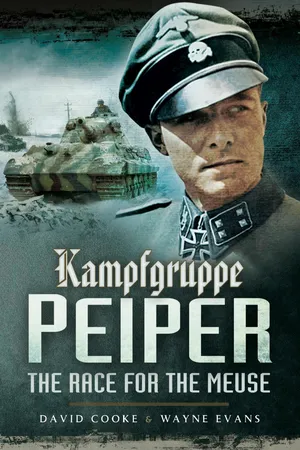
At the forefront of the German assault was Kampfgruppe Peiper of the SS Leibstandarte Adolf Hitler Division. It was the most powerful force in the German order of battle. Travelling along roads hardly suitable for cars, let alone Tiger tanks, the kampfgruppe had to cross numerous streams and rivers to reach its objectives. It was delayed by a handful of American combat engineers who blew up bridges, then it was brought to a halt by American reinforcements. As the tide turned, the kampfgruppe fought for its life, holding out for several days in a desperate rearguard action against increasing odds.
David Cooke and Wayne Evans use contemporary accounts and a wealth of maps and illustrations to tell the story of Kampfgruppe Peiper in unprecedented detail.
"This well written volume makes fascinating reading. The superb text is accompanied by a full walking and driving battlefield tour, making this publication an invaluable addition to any military enthusiast's library."—Roll of Honour
- 224 pages
- English
- ePUB (mobile friendly)
- Available on iOS & Android
eBook - ePub
About this book
Trusted by 375,005 students
Access to over 1.5 million titles for a fair monthly price.
Study more efficiently using our study tools.
Information
Chapter One
WACHT AM RHEIN
Operation Wacht am Rhein (Watch on the Rhine), in December 1944, was Hitler’s last great offensive in the west. His plan was to cut a swathe through the Ardennes, cross the Meuse and drive on to Antwerp, thus cutting off the British 21st Army Group and the American 9th Army from their supply sources. This, it was hoped, would lead to mass surrender or a second Dunkirk. Following such a major disaster the Allies would be forced to sue for peace. Then Hitler could turn his whole attention on the Soviets.

Hitler plans a shock for the Allies in the west.

North-west Europe, December 1944.

The planned objective of the Ardennes offensive.
The Allied High Command was in a quandary. Eisenhower wanted to continue advancing on a broad front, but the supply situation would not allow this without a pause to build up resources. Montgomery put forward a plan for a single thrust to cross the Rhine at Arnhem and drive on into the Ruhr. This led to Operation Market-Garden, the largest airborne operation of the war. With Market-Garden’s failure to capture the road bridge at Arnhem, Eisenhower reverted to the broad-front strategy.
North of the Ardennes lies the Huertgen Forest. American forces attacked the Germans entrenched in its inhospitable terrain, which the autumn rains had turned into a quagmire. Several American divisions were severely mauled before the battle ground to a halt. The Allies continued to push against the West Wall, but made little progress.
The Ardennes was a quiet sector of the front, and little movement had taken place for several months. It was so quiet that the Americans used it as a rest zone for divisions that had been battered in the fighting in the Huertgen Forest, and as a quiet area to introduce fresh divisions, newly arrived from the United States, to the rigours of the front line. This meant that the German offensive would face two worn divisions, with many new replacements, and two completely untried divisions, with inexperienced commanders. The Germans were aware of this and kept the area quiet, with little active patrolling and a minimum of artillery fire, and succeeded in lulling the Allied commanders into a false sense of security.
With this in mind, Wacht am Rhein was planned under the greatest secrecy. Even its name, Watch on the Rhine, gave the idea of a purely defensive operation. Very few people, including many senior officers, were informed about it until a few days before the offensive was to begin, and all communications were made by hand. Mention of the operation in radio or telephone communications was strictly forbidden and any transgressions of this order were to be dealt with most severely. This meant that the Allies’ main source of intelligence about German intentions, Ultra, was useless. ‘Ultra’ was the codename for the radio interception and codebreaking work done at Bletchley Park, in Buckinghamshire, the source of which was known to only the most senior Allied commanders. Some senior German commanders argued against the scope of the offensive and suggested a ‘small solution’, which entailed a much more limited offensive breaking through the Allied lines in two places and forming a pocket. Hitler would have none of it. He wanted an all-or-nothing offensive that would win the war on the western front in one fell swoop.
Few of Hitler’s commanders believed that the offensive could succeed, but by this stage of the war Hitler’s plans were beyond discussion. He believed he was a great strategist and that he had saved Germany from the mistakes of many of his frontline generals. The German officer corps was living in a state of fear after the July bomb plot, in which disaffected officers had attempted to assassinate Hitler. After the round of reprisals following the plot, any disagreement was seen by Hitler as treason, and any German officer suspected of being defeatist would be dealt with swiftly, usually, in the case of senior officers, by being removed from their posts.
The attack was codenamed Autumn Mist. Its first wave would comprise seven panzer and thirteen infantry divisions, and these would be followed up by a further two panzer and seven infantry divisions. The whole force was divided into three armies: 5th and 6th Panzer Armies and 7th Army.
The northern flank of the offensive was formed by 6th Panzer Army, commanded by Sepp Dietrich. Dietrich’s first line was formed of two corps, LXVII Corps, formed of two volksgrenadier divisions and I SS Panzer Corps with two panzer, one fallschirmjager (parachute) and two volksgrenadier divisions. In the centre was General Hasso Manteuffel’s 5th Panzer Army and General Erich Brandenberger’s 7th Army formed the southern flank. 6th Panzer Army would carry out the main attack, with 5th Panzer Army providing protection for its southern flank. Seventh Army would advance alongside 5th Panzer and deploy in an east-west line to protect the southern flank of the whole breakthrough.
The role of 6th Panzer Army
The initial breakthrough would be made by the four volksgrenadier divisions and one fallschirmjager division of the LXVII and I SS Panzer Corps. Once the breakthrough had been made I SS Panzer Corps’ two panzer divisions – I SS Panzer Division Leibstandarte Adolf Hitler and 12th SS Panzer Division Hitler Jugend (Hitler Youth) – would push to and cross the Meuse close to Liege. Kampfgruppe Peiper would be the lead element of the Leibstandarte, and was planned to be the spearhead of the whole offensive, and the first to cross the Meuse. Once I SS Panzer Corps had achieved its objective the follow-up troops of II SS Panzer Corps – 2nd SS Panzer Division Das Reich and 9th SS Panzer Division Hohenstaufen – would exploit to the north-west and capture Antwerp. While the panzer divisions swept towards the west the infantry divisions would form an east–west line, in a similar manner to the 7th Army, to protect the northern shoulder of the breakthrough.
The panzer divisions would move along a number of routes (Rollbahns). The Hitler Jugend would use the most northerly of these routes, Rollbahns B and C, while the Leibstandarte would use Rollbahns D and E. Rollbahn A was an offshoot of Rollbahn B and was intended to allow forces to relieve a parachute force, which will be discussed later. It has been written in the past that the German commanders were under strict orders to stick to their assigned routes, but in reality this does not seem to have been the case. As will be seen, Obersturmbannführer Jochen Peiper switched between routes on a number of occasions, as the situation dictated. For example, his initial breakthrough was to the south of his assigned route, while his final push through La Gleize and Stoumont was on a road between two of the planned routes.

Oberstgruppenführer Josef (Sepp) Dietrich, commander of the 6th Panzer Army. When he commanded the Leibstandarte and I SS Panzer Corps he always sent his officers into combat with the instruction to ‘bring my boys back’.

Assigned march routes of I SS Panzer Corps.
The Leibstandarte was commanded by Oberführer Wilhelm Mohnke, a veteran officer who had served throughout the war in both the Leibstandarte and the Hitler Jugend divisions. He decided to divide his division into four separate battlegroups (kampfgruppen – KG). Each kampfgruppe took the name of its respective commander. Kampfgruppe Peiper, the subject of this book, was based around the 1st SS Panzer Regiment (Pz.Rgt 1) and was commanded by Obersturmbannführer Jochen Peiper. Kampfgruppe Hansen was formed from the three battalions of the 1st SS Panzergrenadier Regiment (Pz.Gren.Rgt 1), whereas Kampfgruppe Sandig comprised two battalions of the 2nd SS Panzergrenadier Regiment (Pz.Gren.Rgt 2). Sandig’s other battalion was attached to Kampfgruppe Peiper. The two kampfgruppe were commanded by Obersturmbannführer Max Hansen and Sturmbannführer Rudi Sandig respectively. The final kampfgruppe was formed around Sturmbannführer Gustav Knittel’s 1st SS Panzer Reconnaissance Battalion (Panzer Aufklarungs Abteilung, or Pz.AA.1). Each kampfgruppe had divisional troops such as anti-aircraft and engineers attached to them. The organization of each kampfgruppe will be discussed in the next chapter.
Peiper would lead the advance along Rollbahn C, supported by Rudi Sandig. On the more southerly Rollbahn D, Kampfgruppe Hansen would lead the way, followed closely by Schnellgruppe Knittel. Knittel had orders to switch between routes as he saw fit, to exploit the speed of his armoured cars and half-tracks (Schutzen-panzerwagens, or SPWs).
The terrain through which the German offensive was to take place was mainly heavily wooded hills divided by swift-running rivers. It was far from ideal, with mechanized forces mainly restricted to the roads, some of which are difficult to negotiate in a car, let alone a King Tiger. That said, it had been the starting point for the highly successful German offensive against France in 1940, when German panzer forces had surprised the French with their appearance at Sedan after crossing the ‘impassable’ terrain of the Ardennes. It was for exactly this reason that the Americans used the Ardennes as a rest and recuperation area for divisions that had been battered in the fighting in the Huertgen Forest. It was also used as a gentle introduction to frontline life for inexperienced divisions, such as the 106th Division, which had recently arrived in Europe and had yet to receive its baptism of fire. Defending the line in front of the 6th Panzer Army was the 99th Division, another new division, with its three regiments. To its south was the 106th Division deployed on the Schnee Eifel. There was a 5-kilometre gap between the two divisions, the Losheim Gap, which was covered by only a single cavalry squadron, the 18th, based around Manderfeld. This gap was a major weakness in the American line and would be exploited by the German attack.

Oberführer Wilhelm Mohnke commanded the 1st SS Panzer Division Leibstandarte Adolf Hitler.
Due to the secrecy of the operation, orders were not issued until very close to the event. Sepp Dietrich was not briefed on 6th Panzer Army’s role until 29 November. Divisional commanders were then given their orders on 6 December, with a subsequent briefing by Hitler at the Adlerhof on the 1...
Table of contents
- Front Cover
- Title Page
- Copyright Page
- Contents
- Preface
- Glossary
- Chapter 1 Wacht Am Rhein
- Chapter 2 Kampfgruppe Peiper: Organization and Equipment
- Chapter 3 16 December 1944: Peiper Frustrated
- Chapter 4 17 December 1944: Breakthrough
- Chapter 5 18 December 1944: Those Damned Engineers
- Chapter 6 19 December 1944: Furthest Point
- Chapter 7 20 December 1944: Peiper Cut Off
- Chapter 8 21 December 1944: A Shortening of Lines
- Chapter 9 22 December 1944: The Pressure Builds
- Chapter 10 23 December 1944: The End is Nigh
- Chapter 11 24 December 1944: The Long Walk
- Chapter 12 Trials and Retribution
- Battlefield Tour
- Appendix A: SS Ranks and Their British and US Equivalents
- Further Reading
Frequently asked questions
Yes, you can cancel anytime from the Subscription tab in your account settings on the Perlego website. Your subscription will stay active until the end of your current billing period. Learn how to cancel your subscription
No, books cannot be downloaded as external files, such as PDFs, for use outside of Perlego. However, you can download books within the Perlego app for offline reading on mobile or tablet. Learn how to download books offline
We are an online textbook subscription service, where you can get access to an entire online library for less than the price of a single book per month. With over 1.5 million books across 990+ topics, we’ve got you covered! Learn about our mission
Look out for the read-aloud symbol on your next book to see if you can listen to it. The read-aloud tool reads text aloud for you, highlighting the text as it is being read. You can pause it, speed it up and slow it down. Learn more about Read Aloud
Yes! You can use the Perlego app on both iOS and Android devices to read anytime, anywhere — even offline. Perfect for commutes or when you’re on the go.
Please note we cannot support devices running on iOS 13 and Android 7 or earlier. Learn more about using the app
Please note we cannot support devices running on iOS 13 and Android 7 or earlier. Learn more about using the app
Yes, you can access Kampfgruppe Peiper by David Cooke,Wayne Evans in PDF and/or ePUB format, as well as other popular books in History & German History. We have over 1.5 million books available in our catalogue for you to explore.