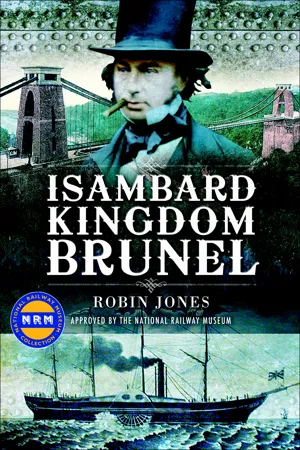
A biography of the nineteenth-century Englishman who was "one of the most ingenious and prolific figures in engineering history" (
Nature).
Civil and mechanical engineer Isambard Kingdom Brunel's accomplishments were extraordinary—involving the Great Western Railway, the SS
Great Britain, the Clifton Suspension Bridge, prefabricated hospital buildings for use during the Crimean War, and more. Born in Portsmouth in 1806, he followed in his French father's professional footsteps—and went on to play a major role in the Industrial Revolution.
Brunel the great engineer would habitually throw out the rule book of tradition and established practice and start again with a blank sheet of paper, taking the technology of the day to its limits and then going another mile. But there was also Brunel the visionary, who knew that transport technology had the power to change the world, and that he had the ability to deliver those changes. Finally, there was Brunel the artist, who rarely saw technology as just functional, and strove to entwine the fruits of the Industrial Revolution with the elegance and grace of the neoclassical painter. His bridges, tunnels and railway infrastructure have entered a third century of regular use, and the beauty of their design and structure has rarely been equaled.
The three decades from the 1830s to the 1850s saw an explosion of technical excellence, and it was Brunel who in so many cases lit the blue touch paper. He did not always get it right the first time, and it was left to others to reap the fruits of his many labors. Nevertheless, his actions fast-forwarded the march of progress by several decades. This biography tells his impressive story.
Includes color photographs
- 224 pages
- English
- ePUB (mobile friendly)
- Available on iOS & Android
eBook - ePub
Isambard Kingdom Brunel
About this book
Trusted by 375,005 students
Access to over 1.5 million titles for a fair monthly price.
Study more efficiently using our study tools.
Information
Chapter 1
BRUNEL
Rediscover the Legend
I sambard Kingdom Brunel. Three names. Three people in one. Born in Portsmouth on 9 April 1806, there was Brunel the great engineer, who would habitually throw out the rulebook of tradition and established practice, and start again with a blank sheet of paper, taking the technology of the day to its limits – and then going another mile.
Then there was Brunel the visionary, who knew that transport technology had the power to change the world, and that he had the ability to deliver those changes.
Finally, there was Brunel the artist – who rarely saw technology as just functional, and strove to entwine the fruits of the Industrial Revolution with the elegance and grace of the neo-classical painter.
His bridges, tunnels and railway infrastructure have entered a third century of regular use, and the beauty of their design and structure has rarely been equalled.
The three decades, from the 1830s to the 1850s, saw an explosion of technical excellence, and it was Brunel who in so many cases lit the blue touchpaper.
He did not always get it right first time, and it was left to others to reap the fruits of his many labours. Nevertheless, his actions fast-forwarded the march of progress by several decades.
In 2006, Britain celebrated the 200th anniversary of Brunel’s birth, with a multitude of events large and small. It turned out to be a wonderful year, in which Isambard’s many legacies were re-examined – and revisited.
Four years later, celebrations were again staged to mark the 175th anniversary of the Great Western Railway, arguably Isambard Brunel’s finest achievement.
Each of his landmarks are national treasures in themselves. There is the spectacular Royal Albert Bridge at Saltash, the magnificent glass-roofed terminus of Paddington, Maidenhead bridge with its elliptical arches that many said would never stand up, the stupendous Clifton Suspension Bridge, completed shortly after his death, to his design by a team of admirers, Bristol’s original Temple Meads station, the Dawlish sea wall railway route – everyone’s favourite section of the national network, and many more.
However, I hope that readers will use this volume as a travel guide to explore some of the lesser-known delights that he has bequeathed to us: the wonderful Bristol & Exeter Railway station at Bridgwater, the Wilts, Somerset & Weymouth Railway booking office at Bradford-on-Avon, and the lofty Devil’s Bridge ‘flying bridge’ at Bleadon near Weston-super-Mare, to name but a few.
An excellent starting point is one of London’s true hidden gems, the Brunel Engine House Museum at Rotherhithe, and its wonderful displays about the Thames Tunnel through which you can travel by underground train below.
Didcot Railway Centre in Oxfordshire is a must, with its demonstration broad-and mixed-gauge running line and award-winning replica Fire Fly locomotive.
Don’t miss out STEAM – Museum of the Great Western Railway in Swindon, which takes you on a unique journey through time to tell the story of God’s Wonderful Railway and the man who created it, with North Star, the engine that made the line work, taking pride of place.
Then there’s Bristol’s Floating Harbour, one of the world’s greatest waterfronts and, with many multi-million-pound development schemes in progress, getting better by the week. The jewel in its crown is, of course, the SS Great Britain, a vessel everyone should visit at least once in their life.
Brunel was the catalyst, which the Industrial Revolution needed to take it further to the next stage. He was by no means the only pioneer of his day, but perhaps more than anyone else, with the aid of the steam engine, provided the link between that great era of discovery and invention, and the modern world.
Why do we remain so fascinated by Brunel and his inventions?
Maybe it is because he symbolises the swashbuckling hero we are all seeking in perpetuity, the person who really does have the power to bring the future to today.
Robin Jones

Chapter 2
MARC BRUNEL
The Revolution Begins
What I find most amazing about Marc Isambard Brunel is that Hollywood has never seen fit to produce a blockbuster movie about him. His story of world-shaping success has all the ingredients that you might expect from a late-18th century James Bond or Indiana Jones; a larger-than-life character who so often would throw caution to the wind, in the pursuit of a greater goal, regardless of the risks – with a classic fairytale romance thrown in.
Rejecting the life of a priest at an early age and cheating the guillotine, in Scarlet Pimpernel fashion, during the French Revolution – as would his future bride – Marc Brunel escaped to the United States, where he made his name, before losing his fortune in England and winning it back again.
Not only that, but – most importantly – there would be a futuristic tunnel involved along the way – an essential ingredient in most Bond films. This one, however, would not be the fictional big-screen den of some sinister mastermind who wanted to take control of the world, but one which would genuinely change it in more ways than the young Marc could ever have imagined.
Furthermore, he would have a son who would not only follow in his engineering footsteps, but who, nearly two centuries after his birth, would take second place behind Sir Winston Churchill in a nationwide poll to find the greatest Briton of all time, even beating Shakespeare – not bad for someone who was half French.
Marc Brunel was born on 25 April 1769 in the hamlet of Hacqueville, near Rouen in France, the son of a wealthy farmer, Jean Charles Brunel, and his second wife, Marie Victoria Lefevre.
As soon as he could read and write, the young Marc displayed a talent for drawing, mathematics and mechanics.
His father, however, was having none of Marc’s aspirations to become an engineer and join the new breed of pioneers spawned by the Industrial Revolution, on the other side of the English Channel.

Samuel Drummond’s portrait of Marc Brunel in later life, showing the Thames Tunnel, his greatest achievement. BRUNEL ENGINE HOUSE
The fall of the Bastille on 14 July 1789. The ensuing Reign of Terror not only brought royalist Marc Brunel and his future wife together, but led to him fleeing France and making his fortune as an engineer in New York.

The block mills in Portsmouth’s dockyard where Marc Brunel set up shop on behalf of the Royal Navy, following his arrival from the USA. PORTSMOUTH HISTORIC DOCKYARD

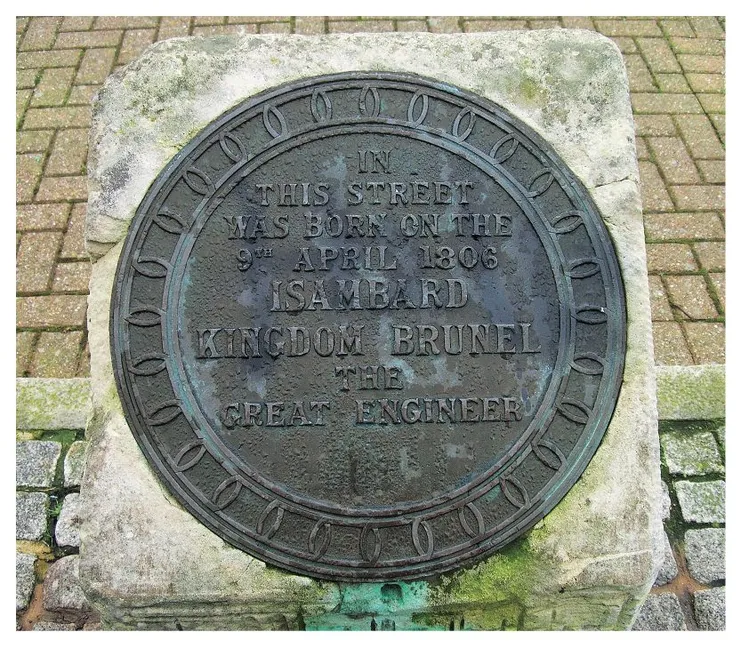
The plaque, which marks the spot where Isambard Kingdom Brunel was born in Portsea. PORTSMOUTH HISTORIC DOCKYARD
Jean Charles insisted that his son had a career in the church, and so at the age of 11, he was sent to a seminary in Rouen.
There, the Superior saw that Marc’s talents in drawing and woodwork would be better engaged elsewhere, especially as he had no religious leaning. So, it was arranged for him to stay with an elder cousin, Madam Carpentier, whose husband, a retired ship’s captain, had become the American consul in Rouen.
While living with the Carpentiers, Marc attended the Royal College in Rouen, and excelled at mathematics, geometry, mechanics and drawing.
His scholarly success led him to a place as a cadet on the naval frigate Marechal de Castries and a six-year career at sea.
In January 1792, Marc returned home to find his native country embroiled in the worst excesses of the French Revolution. A Norman, and a staunch royalist sympathiser, he was at odds with the aims of the murderous Jacobins.
When, in January 1793, he made scathing remarks in a speech about the brutal Robespierre, during a visit to the Café de l’Echelle in Paris, he was lucky to escape a howling, revolutionary mob by the skin of his teeth, hiding in an inn for the night.
In Rouen, he found that the Carpentiers had a new guest, 17-year-old Sophia Kingdom.
She was the youngest of 16 children of Portsmouth naval-contractor, William Kingdom, who had died some years before. Her family had decided to send her to France with a friend, Monsieur de Longuemarre, and his English wife.
Feeling the heat because of his sympathies with the Ancien Régime in France, and with Rouen in Jacobin hands, Marc fled the country for the USA, alone, but with the elaborate help of friends, amid justifiable fears for his safety.
He obtained a passport, after falsely claiming he was buying grain for the Navy, sailed away on the aptly named Liberty, and then established himself as a surveyor, architect and civil engineer in New York.
There, Marc built the old Bowery Theatre, in its day, the largest theatre in North America. He also built many other buildings, including an arsenal and a cannon foundry, as well as improving the defences between Staten and Long Island, and surveying a canal between Lake Champlain and the Hudson River at Albany.
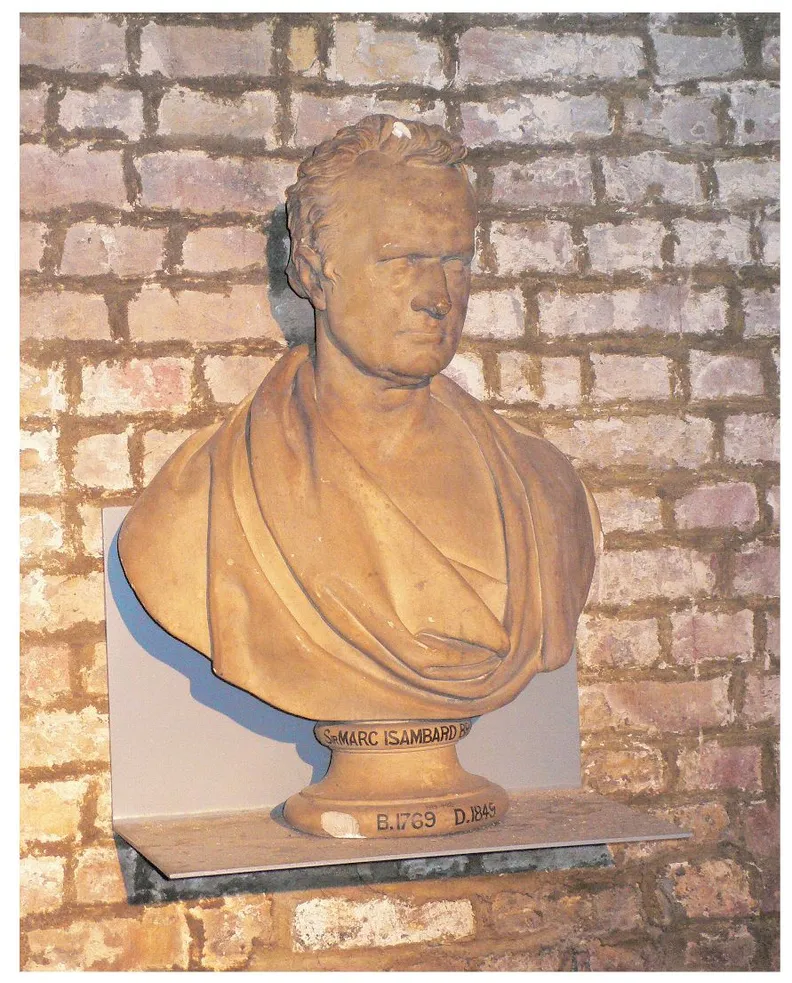
Bust of Mark Brunel in the Brunel Engine House museum, above Thames Tunnel at Rotherhithe. ROBIN JONES
He eventually took US citizenship and became chief engineer to the city of New York.
One of his designs won the competition for a new US capitol building to be built in Washington DC, but it was found too costly to implement and another plan was chosen instead.
While Marc prospered on the far side of the pond, Sophia remained in grave peril for her life.
Following the execution of Louis XVI and Marie Antoinette, Britain declared war on France, and all British nationa...
Table of contents
- Title Page
- Copyright Page
- Table of Contents
- Chapter 1 - BRUNEL
- Chapter 2 - MARC BRUNEL
- Chapter 3 - THE THAMES TUNNEL
- Chapter 4 - REACH FOR THE SKY
- Chapter 5 - A HEAD FOR STEAM
- Chapter 6 - BIGGEST IS BEST
- Chapter 7 - THE RAILWAY ADVENTURE BEGINS
- Chapter 8 - LET’S BUILD OUR OWN
- Chapter 9 - BOX AND BEYOND
- Chapter 10 - TEMPLE MEADS
- Chapter 11 - THE ‘FLYING DUTCHMAN’ IS HERE
- Chapter 12 - LOCOMOTIVES
- Chapter 13 - ‘THE ATMOSPHERIC CAPER’
- Chapter 14 - BRUNEL’S SECOND PADDINGTON
- Chapter 15 - BROADENING HORIZONS
- Chapter 16 - GO GREAT WESTERN – TO NEW YORK
- Chapter 17 - HOW THE WEST WAS FINALLY WON
- Chapter 18 - THE GREAT EASTERN
- Chapter 19 - VICTORY OF THE NARROW MINDED
- Chapter 20 - FIRE FLY
- Chapter 21 - BRINGING BRUNEL BACK DOWN TO SIZE
Frequently asked questions
Yes, you can cancel anytime from the Subscription tab in your account settings on the Perlego website. Your subscription will stay active until the end of your current billing period. Learn how to cancel your subscription
No, books cannot be downloaded as external files, such as PDFs, for use outside of Perlego. However, you can download books within the Perlego app for offline reading on mobile or tablet. Learn how to download books offline
Perlego offers two plans: Essential and Complete
- Essential is ideal for learners and professionals who enjoy exploring a wide range of subjects. Access the Essential Library with 800,000+ trusted titles and best-sellers across business, personal growth, and the humanities. Includes unlimited reading time and Standard Read Aloud voice.
- Complete: Perfect for advanced learners and researchers needing full, unrestricted access. Unlock 1.5M+ books across hundreds of subjects, including academic and specialized titles. The Complete Plan also includes advanced features like Premium Read Aloud and Research Assistant.
We are an online textbook subscription service, where you can get access to an entire online library for less than the price of a single book per month. With over 1.5 million books across 990+ topics, we’ve got you covered! Learn about our mission
Look out for the read-aloud symbol on your next book to see if you can listen to it. The read-aloud tool reads text aloud for you, highlighting the text as it is being read. You can pause it, speed it up and slow it down. Learn more about Read Aloud
Yes! You can use the Perlego app on both iOS and Android devices to read anytime, anywhere — even offline. Perfect for commutes or when you’re on the go.
Please note we cannot support devices running on iOS 13 and Android 7 or earlier. Learn more about using the app
Please note we cannot support devices running on iOS 13 and Android 7 or earlier. Learn more about using the app
Yes, you can access Isambard Kingdom Brunel by Robin Jones in PDF and/or ePUB format, as well as other popular books in Technology & Engineering & Science & Technology Biographies. We have over 1.5 million books available in our catalogue for you to explore.