- 112 pages
- English
- ePUB (mobile friendly)
- Available on iOS & Android
eBook - ePub
Joseph Stalin
About this book
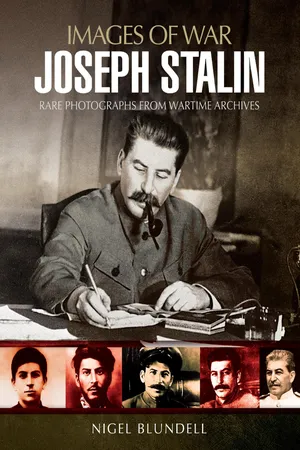
Joseph Stalin was a monster. He sacrificed his friends and allies in pursuit of power, murdered thousands with sadistic brutality to maintain it and callously obliterated millions more of his own people over a quarter century of his leadership. Yet almost as frightening as the horrendous crimes he committed is the idolatry that allowed this ogre to flourish. Just like fellow monster of the twentieth century Adolf Hitler, Stalin saw himself as a master of destiny, a role that to him excused the vilest atrocities. And, bafflingly, just like his Nazi counterpart, he was allowed to dominate his nation and overrun others with the enthusiastic support of the majority of the citizens whom he had subjugated. Stalin was lauded as a national savior right up until his death, which was marked by mourning crowds so vast that untold numbers perished in the crush. This unquestioning adulation is not only a mystery to todays historians but a cause for alarm. For, under the Soviet Unions present regime, there are signs that the Stalin cult is being resurrected as the Russian bear again sharpens its claws. This concise book presents a cautionary study, in words and historic photographs, of the peasants son from Georgia who as a choirboy seemed destined for the priesthood but who grew up to be a street-fighting revolutionary using torture and terror as tools to attain power. It asks how the coarse, brutish drunkard that he became could nevertheless have been lauded abroad as a cultural giant and spellbind so many millions at home as an object of worship. It provides clues as to how Stalin the military incompetent came to be seen as a statesman of equal standing to war leaders like Churchill and Hitler (whose lives are covered by companion volumes in the Pen & Sword Images of War series). And it points to the danger of rewriting history to allow the resurrection of Stalin as a father of his people in the twenty-first century rather than a bloodstained idol with feet of clay.Also Available by Nigel Blundell, from the Images of War series, Images of War Winston Churchill and Images of War Adolf Hitler.
Trusted by 375,005 students
Access to over 1 million titles for a fair monthly price.
Study more efficiently using our study tools.
Information
Nothing about the life and character of Joseph Stalin was straightforward – not even his name and the date of his birth. The man who would one day rule the vastest country on earth was born in the winter of 1879 in a small poverty-stricken enclave of Georgia, which was then part of the Russian Empire. His birth name in Georgian was Ioseb Besarionis dze Jughashvili, the Russian version of which was the almost equally tongue-twisting Vissarionovich Dzhugashvili. As was customary, he later adopted a string of briefer nicknames, mostly chosen to glamourise his wayward youth, his favourite being ‘Koba’ (meaning ‘the indomitable’) after the Robin Hood-like hero of a popular novel. He did not use the tile Joseph Stalin (translated by him as ‘Man of Steel’) until he was in his thirties.
Stalin’s nomenclature is muddled enough but even his date of birth has been a cause of confusion. Throughout his years in power, he had it recorded as 21 December 1879, as published in his official biography and the day on which nationwide celebrations took place. Only after the collapse of the Soviet Union was it revealed in baptismal records that the real date of his birth was three days earlier, on 18 December.
On that dark wintry day, the lusty cries of the newborn infant told his mother Ekaterina Dzhugashvili all she needed to know: that he was a strong, healthy child, perfect except that the second and third toes of his left foot were joined together. With his safe arrival in the world, her dearest wish had come true. This was her fourth pregnancy yet none of the other babies had lived. She resolved that Iosif Vissarionovich would grow up to be a priest by way of thanks to God.
Home was little more than a shack in Gori, a small town 60 kilometres from the Georgian capital Tblisi (then known as Tiflis). There was one room only and the few sticks of furniture in it were simply crafted out of wood. Stalin’s hovel still exists today, dwarfed by a marble mock-temple built to honour the birthplace during his era in power.
Ekaterina, or ‘Keke’ as she was better known, was determined that her adored only son would escape the grinding poverty she had known all her life. To this end, she slaved as a washerwoman and at other menial labours, saving enough money to buy him an education. She was poor and illiterate but even she could see that this was the only possible means of liberation from a dire existence.
Her boundless motherly love of little Iosif, whom she nick-named Soso, was beyond question but didn’t prevent her from meting out beatings to her mischievous son. However, the swipes he suffered from her were nothing compared to the thrashings he endured from his father.
Vissarion Djugashvili inflicted vicious punishment on his only son, much of it apparently carried out for the sheer pleasure it gave him. Vissarion was a cobbler but he sacrificed his skills in favour of heavy drinking. In addition to the brutal beatings he took himself, the young Stalin witnessed his loutish father attack his beloved mother. Yet Keke was no wilting flower. Although slight and pale, she lashed out at her errant husband many times while they lived together. It was during one such bout of violence between the couple that an outraged Stalin grabbed a kitchen knife and hurled it at Vissarion. Stalin instantly ran off and sought refuge from his father’s wrath with a neighbour.

Stalin was born on 18 December 1879 in a tiny flat rented by his parents in this house in Gori, Georgia.


A sketch and photograph of Stalin’s mother Ekaterina Geladze, wife of Vissarion Dzhugashvili. He was a bootmaker and she a washerwoman.
When times got hard, Vissarion took a job in a boot factory away from home, although he returned periodically to terrorise his wife and son. When he died in a drunken brawl in 1890, he was something of a tramp. His passing was nothing short of a blessed relief for Stalin.
If poverty and abuse were not enough to contend with, Stalin had other disadvantages in childhood. An attack of smallpox which almost killed him left him severely pock-marked. The scars were so deep that photographs taken of him much later were doctored to disguise the disfigurement. In addition, his left arm was shorter than his right by four inches, possibly due to an accident in which he was run over by a carriage while watching a religious festival.
Stalin was not going to let any of this stand in his way. The traumas of childhood did not make him withdrawn, as is often the case. When he began school in September 1888, rather than being bullied, he was himself the aggressor. Schoolmates have testified that the young Stalin was awestruck by the wild and spectacular terrain of Georgia, although he had no particular respect for the wildlife within it. He frequently passed the time by hurling stones at birds.
But there was a softer side to the boy. He loved books and sought out classic adventure stories that were banned in the classroom. Revealing an artistic nature, he loved to sketch. He sang in the church choir and was praised for his melodic tenor tones. He also impressed his teachers by his remarkable memory, being able to recite large chunks of the Bible. These were, however, qualities he largely suppressed long before he reached power for fear they were regarded as weaknesses or indulgences. What was also left unmentioned was that the future leader of Russia, who never lost his strong Georgian accent, only learned to speak Russian at the age of nine.
Following a six-year spell at the Gori church school, in 1894 Stalin graduated two years ahead and was awarded a scholarship to the Orthodox Theological Seminary in Tiflis to embark on the training his mother always vowed he would have. He was a boarder which meant that he was exposed to the harsh regime of the seminary around the clock. The studies were demanding and Stalin accrued a working knowledge of classical languages as well as Orthodox theology. He also devoured a wide range of books on subjects banned by the seminary, often getting himself into trouble in the process. Stalin was by now schooled far beyond the dreams of most Georgian boys.

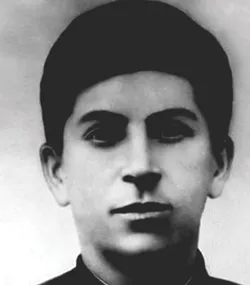
Two early images of the schoolboy Vissarionovich Dzhugashvili, later known as Josef Stalin.

In 1898 Stalin took the pseudonym Koba and joined a Marxist study circle among railway workers meeting in this house in Tiflis.

A pre-Revolution photograph of the town of Tiflis (later Tbilisi).
It was while he was preparing for the priesthood in this repressive environment that Stalin got his first taste for the politics of change. Seminaries, top heavy with regulations and renowned for the cruelty of their masters, were paradoxically popular breeding grounds for revolutionaries. Secret meetings were held to discuss the theories of Marxism and to debate the need for revolution. By 1898 Stalin was a member of a local Georgian Marxist organisation called Mesame Dasi or Group Three. His behaviour worsened. He refused to work and was rude to the monks who tried to teach him. The following year, he left the seminary; if he was not expelled, he most certainly departed under a cloud. It was a move his mother regretted for the rest of her days – even when her son held sway over the entire Russian empire.
* * *
By the turn of the century Russia was on the verge of revolutionary turmoil. Terrorist assassination of high-ranking civil servants was chronic. Trades unions, officially banned, were nevertheless demanding better pay and conditions for the country’s extremely impoverished industrial workers. The peasants had experienced a famine in 1897. There was no parliament in which grievances could be vented. The secret police, the Okhrana, were able to make arbitrary arrests and imprison people without trial.
Stalin had by now realised that Russia was ripe for revolution. The country’s monarch had not foreseen it – but was to learn his lesson the hard way. Tsar Nicholas II had come to the throne in 1896, confessing to his future brother-in-law Grand Duke Alexander: ‘I am not prepared to be a tsar. I never wanted to be one. I know nothing of the business of ruling.’
Tsar Nicholas was married to a German princess, Alexandra Feodorovna of Hesse-Darmstadt, a grandchild of Britain’s Queen Victoria. This handsome, imperious woman was an unpopular figure but worshipped by her husband and, within the walls of their palaces, the couple were idyllically happy. They had four daughters and then a son, Alexei. Their joy at the birth of the heir to the Russian throne soon turned to dismay when they realised he suffered from haemophilia. The condition, inherent in the royal families of Europe, was a disabling one. Every bump or scratch would gush with blood and even the most e...
Table of contents
- Cover
- Title
- Copyright
- Introduction
- Chapter
- Principal Dates
Frequently asked questions
Yes, you can cancel anytime from the Subscription tab in your account settings on the Perlego website. Your subscription will stay active until the end of your current billing period. Learn how to cancel your subscription
No, books cannot be downloaded as external files, such as PDFs, for use outside of Perlego. However, you can download books within the Perlego app for offline reading on mobile or tablet. Learn how to download books offline
Perlego offers two plans: Essential and Complete
- Essential is ideal for learners and professionals who enjoy exploring a wide range of subjects. Access the Essential Library with 800,000+ trusted titles and best-sellers across business, personal growth, and the humanities. Includes unlimited reading time and Standard Read Aloud voice.
- Complete: Perfect for advanced learners and researchers needing full, unrestricted access. Unlock 1.4M+ books across hundreds of subjects, including academic and specialized titles. The Complete Plan also includes advanced features like Premium Read Aloud and Research Assistant.
We are an online textbook subscription service, where you can get access to an entire online library for less than the price of a single book per month. With over 1 million books across 990+ topics, we’ve got you covered! Learn about our mission
Look out for the read-aloud symbol on your next book to see if you can listen to it. The read-aloud tool reads text aloud for you, highlighting the text as it is being read. You can pause it, speed it up and slow it down. Learn more about Read Aloud
Yes! You can use the Perlego app on both iOS and Android devices to read anytime, anywhere — even offline. Perfect for commutes or when you’re on the go.
Please note we cannot support devices running on iOS 13 and Android 7 or earlier. Learn more about using the app
Please note we cannot support devices running on iOS 13 and Android 7 or earlier. Learn more about using the app
Yes, you can access Joseph Stalin by David A. S. Semeraro in PDF and/or ePUB format, as well as other popular books in History & Military Biographies. We have over one million books available in our catalogue for you to explore.