This WWII history presents the remarkable story of the Manx people and their homeland in the Irish Sea throughout the epic conflict.
Few people are now aware of the extraordinary role the Isle of Man played in assisting the allied war effort. Yet for six years, a place best known as a holiday playground became a heavily armed fortress. Hundreds of airmen, soldiers, and sailors were trained in readiness for combat. Thousands of enemy aliens were imprisoned behind the barbed wire of its camps, alongside those of British birth who were deemed to be a threat to security.
Top secret radar was developed, and the Island's merchant fleet played a vital role at Dunkirk and D-Day. On battlefields around the world, gallant Manxmen fought bravely, whilst at home there was a surprising tolerance for those with pacifist beliefs. Likewise, though there was increased government control in almost all areas of life, these were times of great advancement for Manx democracy.
The story is told in the words of those who were there, some of whom speak for the first time about their experiences. Their accounts bring a freshness and immediacy to this remarkably vivid narrative.
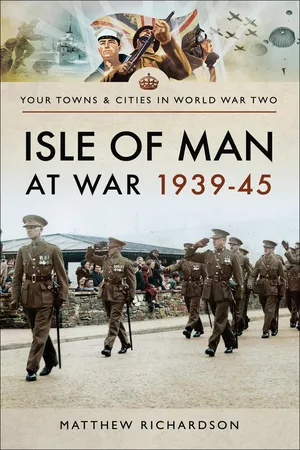
- 168 pages
- English
- ePUB (mobile friendly)
- Available on iOS & Android
eBook - ePub
Isle of Man at War, 1939–45
About this book
Trusted by 375,005 students
Access to over 1.5 million titles for a fair monthly price.
Study more efficiently using our study tools.
Information
Print ISBN
9781526720733
Subtopic
British HistoryCHAPTER ONE
1939: Who Will Win?
While the outbreak of war in 1914 had taken many people by surprise, there was almost a sense of inevitability about the conflict that broke out twenty-five years later. The warning signs had been apparent to anyone who cared to look, and certainly from the time of the Munich Crisis Hitler’s ambition and lust for expansion were obvious. Early in 1939 the Lieutenant Governor Lord Granville had issued a booklet asking the people of the Isle of Man to register for voluntary service in whatever capacity they could. In addition to the Territorial Army, volunteers were needed for the Loyal Manx Association (which supported the police as special constables), and Auxiliary Fire Service, as well as assisting at Noble’s hospital or on the land to increase agricultural output. However, it was perceived to the dismay of many that the outlook of Tynwald was still one of ‘it won’t happen here.’
In June of that year, the shape of things to come was made glaringly apparent to the people of the island during the famous TT motorcycle races. It was without doubt the most politicized meeting ever to have taken place in the history of the event, and the swastika flying among the other national flags above the grandstand was an ominous portent. The Germans had fielded a national team that year, with the express intention of securing a propaganda victory for Hitler and the Nazis. Such was the media profile of the TT at this time that it would rank alongside the 1936 Berlin Olympics and the world heavyweight boxing title in terms of sporting coups achieved by Germany in these years. German army dispatch rider Georg Meier stormed to victory aboard a supercharged BMW in the Senior race, a task made all the easier because British rivals Norton were by now so heavily engaged in war work that they did not field a team and handed their machines to privateers. As a reward, Meier was promoted by Hitler to the rank of lieutenant. Earlier in the week, the Italian team of Benelli had taken victory in the Lightweight race, and the news was cabled directly to Mussolini in Rome. Only in the Junior race was British pride maintained, with a win by British firm velocette (albeit with an Irishman, Stanley Woods, in the saddle).

In the early part of 1939 there was growing concern that the Isle of Man was ill-prepared for war. This editorial comment is from the Isle of Man Times of 4 February that year.

Cartoonist Dusty Miller captures the mood of the 1939 TT as a three-cornered fight, with Adolf Hitler and Mussolini competing against John Bull. The title was ‘Who Will Win?’. (Courtesy of Helen and Jack Cain)
On 24 August 1939 the island’s only Territorial Army formation, the 15th (Isle of Man) Light Anti-Aircraft Regiment Royal Artillery, was mobilized for permanent service, a clear sign of the worsening political situation. The unit had been in existence for just over a year, since the expansion of the Territorial Army by the Westminster government in 1938, and though the response of young Manxmen had been heartening with three batteries recruited remarkably quickly, at the time of mobilization its new drill hall at Tromode was not even finished. A parallel development, the construction of a new airfield at Jurby as part of the RAF expansion scheme, was nearer completion. Thousands of tons of spoil from the Laxey mines deads had been transported in a fleet of lorries in order to level the site, and to provide hardcore for the runways. RAF Jurby would be open within a matter of weeks.

Irish TT rider Stanley Woods. He scored the only British win at the 1939 TT races, riding a Velocette. The Senior trophy was won by BMW, while the Lightweight was taken back to Italy by Benelli. (Author’s collection)
After years of simmering tension, the German invasion of Poland on 1 September was to be the final straw, and when the Führer refused to accede to the Anglo-French ultimatum and withdraw his troops, on 3 September Great Britain found herself once again at war. The first casualty on the Isle of Man was that September’s Manx Grand Prix meeting, which was immediately cancelled, with the Manx Motor Cycle Club suffering a heavy financial loss as a result. The same month and also as a consequence of the outbreak of war the island’s first civil aerodrome, Hall Caine airfield near Ramsey, was closed (though it was shortly to be taken over as a satellite airfield for RAF Jurby). It was then used as a Relief Landing Ground, and to support air-to-air gunnery target towing operations. The target towing aircraft would overfly Hall Caine at 2,000ft, heading out to the ranges over Ramsey Bay. After the trainee air gunners had done their best, the target towing aircraft (usually a Fairey Battle, Hawker Henley or Westland Wallace) would fly back to Hall Caine and drop the drogue over the airfield. A control officer was deployed from Jurby to oversee operations and report the ‘scores’ back by telephone. Later, with the opening of RAF Andreas in 1941, Hall Caine would cease to be used as a Relief Landing Ground, but it would continue to support the target towing operations for a while. Later still, after the RAF vacated the airfield, it would be obstructed to prevent possible use by enemy aircraft.

Another Dusty cartoon shows two ex-servicemen discussing the approaching conflict.
As in the previous conflict, on the outbreak of war the Royal Navy requisitioned some of the Isle of Man Steam Packet fleet, notably the King Orry which as in the First World War became HMS King Orry. Most of her crew were replaced by Royal Navy personnel, with the exception of her engineering staff who were retained because of their familiarity with the ship’s engines. Only the Rushen Castle and Peveril continued to provide a regular link with the UK, as most of the other ships were chartered by the Admiralty. Retaining their Manx crews, they were kept busy as troopships, ferrying the soldiers of the British Expeditionary Force (BEF) to France under its commander Field Marshal Lord Gort VC.

Members of the 15th Light Anti-Aircraft Regiment (Manx Regiment) parade past the Lieutenant Governor Lord Granville around the time of the regiment’s mobilization. (Courtesy of the Manx Aviation Preservation Society/Manx Regiment Museum)
For those who were old enough to remember, it was all vividly redolent of the previous conflict with Germany twenty-five years earlier. Under the headline ‘My Boy is Off to France’, one newspaper carried an account by a proud but worried Douglas father of his son’s departure for the front in October:
I gripped his hand...
‘Goodbye my boy, and good luck!’
‘Goodbye dad,’ he answered...
‘Goodbye mum.’
And then a bit shyly – ‘Give me a kiss. I know I’m a man now, but I feel somehow I’d like a kiss from you. It’s only been a short leave home, but now I’m off – don’t know where exactly, but most likely the front line, as I’m in the infantry...
A final handshake...
‘Goodbye son, I know you’ll have courage to carry out your duty.’
The door closed, and he was gone.
I, who am left, will be with him in thought, and will follow him in imagination.1
Conscription arrived on the island in the same month, and men of suitable age were required to register for service in the armed forces at Ramsey, Peel, Castletown and Douglas. Compulsory military service had been introduced in the United Kingdom as early as May 1939, but an attempt by the lieutenant governor to push legislation extending it to the Isle of Man through the House of Keys shortly afterwards had failed. Many MHKs had objected to the lack of consultation, with the Manx Labour Party particularly opposed. However, in October 1939 a motion to adopt compulsory military service along United Kingdom lines was passed, with several Labour members now speaking in support. The Manx legislation adopted the same system of reserved occupations and exemptions as the UK, the principle being that every male of military age had to register, and the local tribunal would then decide if they would best serve the war effort by remaining in their own job or joining the armed forces. An attempted anti-conscription rally in Peel in November met with little sympathy from the local population, but a similar meeting in Colby attracted around 100 people. After they were blocked from using the Level Hall over fears that the meeting contravened the Defence of the Realm Act, it went ahead outside. The speakers, a mixture of Manx Labour Party members and conscientious objectors, were all at pains to stress that they did not object to conscription as such, but rather the ‘undemocratic’ way in which it had been introduced to the Isle of Man. More concerning for the authorities was the fact that when the first Manx cohort to be called up was medically examined, it was found that 70 per cent were classified as Grade 1, whereas the equivalent in England was 80 per cent; a worrying indictment of Manx public health.
With the coming of autumn, blackout restrictions began to make themselves felt, sometimes with humorous consequences: vehicles travelling at night had to have masks fitted to their headlights, and this coupled with the fact that all road signs had been removed in order to delay an invading enemy, led to many confusing incidents. On one occasion a driver from Ramsey who thought he was heading south towards Castletown found himself at the Point of Ayre.
As Christmas approached, there was a feeling of pride among many that a fund had already been established through which to send a present to every Manx serviceman who was away from home at that time. Overall, however, there was a sense of uncertainty as to how the war would affect the island. The insular government was in receipt of income tax revenues from the previous year, but no one could be certain what incomes would be like in the year to come. Individuals also were apprehensive about the way in which new wartime regulations and restrictions would affect themselves and their businesses. Perhaps the biggest development politically was the establishment of Tynwald’s War Committee, as a reflection of the Cabinet style of government in Westminster. However, the fact that it was centred around the lieutenant governor was testament to the authority that the post still carried in the Isle of Man at the time.

The War Committee of Tynwald. The establishment of the committee laid the foundations for the ministerial form of government that would emerge on the Isle of Man in the post-war years.
CHAPTER TWO
1940: A Great Armed Camp
The year 1940 is widely regarded as one of the darkest hours in British history. Following the collapse of France, for the first time since the Norman Conquest (or perhaps the Spanish Armada) the country had been in serious danger of invasion. Yet amid the darkness there was a glimmer of light – the ‘miracle of Dunkirk’ – which saved the BEF and kept Britain in the war. The Isle of Man played more than a fair part in this great undertaking; at the same time providing accommodation for the many thousands of enemy aliens who were to be arrested as potential threats to national security. In addition, the island would send reinforcements and recruits for the army and act as a training ground for thousands of others.
The year began quietly enough though. This was the era of the ‘Phoney War’, when on the ground there was no actual fighting as each side eyed the other warily. For people on the Isle of Man, their immediate concern was closer to home. With the harsh experience of the First World War still fresh in the minds of many, particular importance was attached to finding substitute industries which could potentially replace the expected shortfall in income from tourism. An early but short-lived wartime Manx industry was net-making. Upon the outbreak of war the Ministry of Supply had announced the urgent need for...
Table of contents
- Cover
- Title
- Copyright
- Contents
- Acknowledgements
- Introduction
- Chapter One: 1939: Who Will Win?
- Chapter Two: 1940: A Great Armed Camp
- Chapter Three: 1941: IOM Go To It!
- Chapter Four: 1942: Ringing of Church Bells
- Chapter Five: 1943: Tipping the Balance
- Chapter Six: 1944: The Highest Courage
- Chapter Seven: 1945: A Job Well Done
- Epilogue
- Endnotes
- Bibliography
Frequently asked questions
Yes, you can cancel anytime from the Subscription tab in your account settings on the Perlego website. Your subscription will stay active until the end of your current billing period. Learn how to cancel your subscription
No, books cannot be downloaded as external files, such as PDFs, for use outside of Perlego. However, you can download books within the Perlego app for offline reading on mobile or tablet. Learn how to download books offline
Perlego offers two plans: Essential and Complete
- Essential is ideal for learners and professionals who enjoy exploring a wide range of subjects. Access the Essential Library with 800,000+ trusted titles and best-sellers across business, personal growth, and the humanities. Includes unlimited reading time and Standard Read Aloud voice.
- Complete: Perfect for advanced learners and researchers needing full, unrestricted access. Unlock 1.5M+ books across hundreds of subjects, including academic and specialized titles. The Complete Plan also includes advanced features like Premium Read Aloud and Research Assistant.
We are an online textbook subscription service, where you can get access to an entire online library for less than the price of a single book per month. With over 1.5 million books across 990+ topics, we’ve got you covered! Learn about our mission
Look out for the read-aloud symbol on your next book to see if you can listen to it. The read-aloud tool reads text aloud for you, highlighting the text as it is being read. You can pause it, speed it up and slow it down. Learn more about Read Aloud
Yes! You can use the Perlego app on both iOS and Android devices to read anytime, anywhere — even offline. Perfect for commutes or when you’re on the go.
Please note we cannot support devices running on iOS 13 and Android 7 or earlier. Learn more about using the app
Please note we cannot support devices running on iOS 13 and Android 7 or earlier. Learn more about using the app
Yes, you can access Isle of Man at War, 1939–45 by Matthew Richardson in PDF and/or ePUB format. We have over 1.5 million books available in our catalogue for you to explore.