- 128 pages
- English
- ePUB (mobile friendly)
- Available on iOS & Android
eBook - ePub
About this book
In early 1965 the United States unleashed the largest sustained aerial bombing campaign since World War II, against North Vietnam. Through an ever escalating onslaught of destruction, Operation Rolling Thunder intended to signal Americas unwavering commitment to its South Vietnamese ally in the face of continued North Vietnamese aggression, break Hanois political will to prosecute the war, and bring about a negotiated settlement to the conflict. It was not to be. Against the backdrop of the Cold War and fears of widening the conflict into a global confrontation, Washington policy makers micromanaged and mismanaged the air campaign and increasingly muddled strategic objectives and operational methods that ultimately sowed the seeds of failure, despite the heroic sacrifices by U.S. Air Force and Navy pilots and crews Despite flying some 306,000 combat sorties and dropping 864,000 tons of ordnance on North Vietnam 42 per cent more than that used in the Pacific theater during World War II Operation Rolling Thunder failed to drive Hanoi decisively to the negotiating table and end the war. That would take another four years and another air campaign. But by building on the hard earned political and military lessons of the past, the Nixon Administration and American military commanders would get another chance to prove themselves when they implemented operations Linebacker I and II in May and December 1972. And this time the results would be vastly different.
Trusted by 375,005 students
Access to over 1 million titles for a fair monthly price.
Study more efficiently using our study tools.
Information
1. A PLACE CALLED VIETNAM
Few places in Asia, other than possibly the Korea peninsula, have been as severely buffeted by the unpredictable winds of the Cold War than Vietnam. As with Korea, Vietnam would pull the United States into a conflict it never wanted, understood or was prepared to fight. Despite an overwhelming commitment of American lives and treasure, victory on the battlefield in Vietnam would also be just as elusive for the United States. More significantly, the Vietnam experience would have a profound impact on the American national psyche and U.S. foreign and military policy that still endures today.
It wasn’t always this case, for in the summer of 1964 most Americans were more preoccupied with a presidential campaign and the recently passed civil rights legislation than in developing events in far off Southeast Asia in a place called Vietnam. This was somewhat surprising given the critical post-World War II role of the United States in supporting French military efforts to quash Ho Chi Minh’s communist nationalist insurgency. It is even more telling as Americans came perilously close to being drawn directly into war ten years earlier as the besieged French garrison at Dien Bien Phu battled for its life. Ultimately, American combat troops would indeed be committed to a war in Southeast Asia when 3,500 men of the 9th Marine Expeditionary Brigade waded ashore at Da Nang, South Vietnam on March 8, 1965.
The Legacy of French Indochina
The roots of America’s military intervention in Vietnam can be traced back some 20 years previous to the end of World War II as France sought to reestablish control over its former colonial empire in Indochina in the face of rising Vietnamese nationalism. Critically, this re-conquest, for that is surely what it was, would set in motion a series of events that would steadily pull the United States deeper into war through a series of escalating commitments and by placing American prestige and leadership in Southeast Asia on the line. Just as unexpectedly too, the conflict in Vietnam would grow to become a central flashpoint in the Cold War for the next three decades.
The French involvement in Southeast Asia can be traced back to the height of European imperialism and colonial expansion at the end of the 19th century. From an established presence in Saigon and Cochin China at the southern end of the Vietnamese peninsula, the French rapidly expanded their presence northward in the 1880s and 1890s to include the Annam (central) and Tonkin (northern) regions of Vietnam, as well as all of present-day Cambodia and Laos to form the Indochinese Union, more commonly known as French Indochina. With this vast territory under French rule, French administrators sought to exploit the wealth and labor of Indochina for the greater good of France while maintaining a degree of peace and stability by coopting local elites and suppressing dissent. The Japanese military occupation of Indochina in September 1940 brought not only an end to this state of affairs, but also energized a growing sense of indigenous nationalism and self-determination that was stoked by the Allies in their all-out effort to defeat Japan.
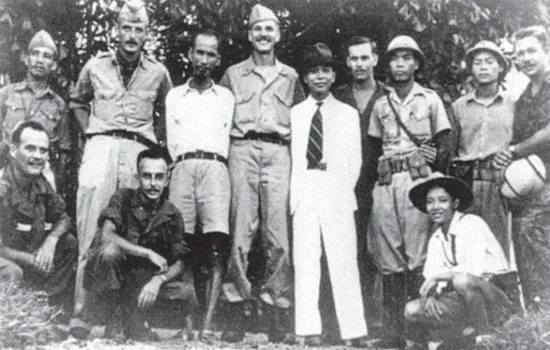
American Office of Special Services (predecessor to the CIA) officers supported Ho Chi Minh and his nationalist Viet Minh forces against the Japanese occupation of Vietnam during World War II.
Thus, not surprisingly, Ho Chi Minh and his Indochinese Communist Party unilaterally declared the creation of the Democratic Republic of Vietnam in Hanoi, as the Japanese were signing their formal surrender on September 2, 1945 aboard the USS Missouri in Tokyo Bay. Naturally this did not go over well with the French who were planning their post-war return. With the help of British forces, France systematically reoccupied Cochin China and reestablished control over most southern cities by the end of 1945. Following negotiations with the Chinese Nationalists, who secured the area north of the 16th parallel under terms of the Potsdam Conference, French forces also began returning to Tonkin in the north in March 1946. The situation was tense however, as an uneasy modus vivendi prevailed. Viet Minh forces would remained ensconced in parts of Hanoi and Haiphong alongside French troops as negotiations proceeded over the future of Vietnamese independence.
This put the United States in quite a quandary. Should it throw its weight behind Ho Chi Minh, who fought with Allied forces against the Japanese occupation in the name of Vietnamese self-determination and the late President Franklin Roosevelt’s anti-colonialist principles? Or should it support the imperial aspirations in Southeast Asia of France, a vital yet fragile ally that would be critical in stemming the spread of communism in post-war Europe? Initially the Truman administration sought to walk a fine line between the two positions by labelling Indochina an internal French matter, while tactfully trying to nudge Paris to grant more self-government and increased autonomy to the people of the region. In the end, however, the strategic importance of strengthening the Franco–American relationship and resisting the global tide of communism expansion forced Truman’s hand.

The making of French Indochina.
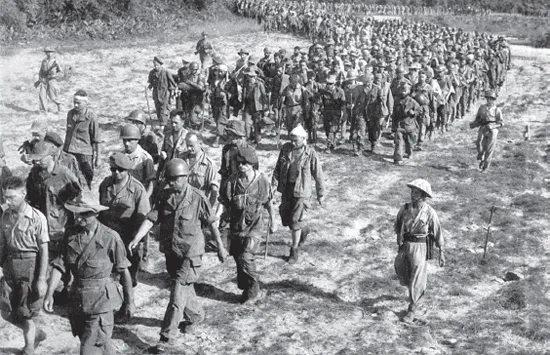
The French defeat at Dien Bien Phu and the signing of the Geneva Peace Accords in 1954 signaled the ending of France’s involvement in Vietnam, but created a political and military void that the United States reluctantly began to fill.
Moreover, with the outbreak of fighting between the Viet Minh and French in Hanoi in December 1946 the die was cast. The First Indochina war had begun and the Americans would throw their full support behind France. What was once a campaign of French colonial reconquest would quickly become an internationalized Cold War battleground, sucking the United States, China, and the Soviet Union into its deadly vortex. Ultimately, the capitulation of the French garrison at Dien Bien Phu in May 1954 and the signing of the Geneva Peace Accords in July 1954 would be the closing act for French Indochina. Peace would remain elusive however, as would the fate of Vietnamese people with the former colony expediently partitioned in two at the 17th parallel to create two competing poles of power. Ho Chi Minh’s Democratic Republic of Vietnam controlled the territory to the north, while the French-created State of Vietnam controlled the territory to the south. More important, the French withdrawal would set the stage for American entry into an even wider and more deadly conflict in the next decade.
Passing the Torch
Following the collapse of French Indochina, the United States had become the de facto guarantor of South Vietnamese independence and in Washington’s view the lynchpin against the rising tide of unchecked communist aggression in Southeast Asia. Not only was the State of Vietnam and the now independent states of Laos and Cambodia directly threatened, but neighboring Thailand was vulnerable and possibly even Indonesia and the Philippines were under threat. If the south of Vietnam fell to the communists the remaining countries of the region were likely to fall like dominos. As U.S. Secretary of State John Foster Dulles declared in July 1954, “The thing from now on is not to mourn the past but to seize the future opportunity to prevent the loss of northern Vietnam from leading to the expansion of Communism throughout Southeast Asia and the Southwest Pacific.”1 Everything possible now needed to be done by the Eisenhower administration to prevent this from happening.
American aid had already been flowing into Indochina since 1950 in support of the French war effort and by the time of Dien Bien Phu the United States had supplied some $1.5 billion in economic and military assistance.2 Enormous quantities of war matériel—including uniforms, small arms, munitions, and more than 30,000 trucks, 1,800 combat vehicles, nearly 500 aircraft, and even two World War II-vintage aircraft carriers—had failed to stem the tide of the communist Viet Minh advance. But now things were going to be different as Washington moved to fortify the Saigon regime as a bulwark against the communist onslaught. The first direct U.S. military aid began to arrive in Saigon in January 1955 along with an expanded training and advisory role for the U.S. Military Assistance Advisory Group (MAAG). The Americans were now taking charge.
In Ngo Dinh Diem the Americans found their man following his overthrow of the French-installed chief of state, the former emperor Bao Dai, in October 1955 and the creation of the Republic of Vietnam, more commonly known as South Vietnam. Although an ardent Francophile, Diem was glad to see the discredited French depart the scene and seize this new opportunity for advancing Vietnamese independence. He was also a strident anti-communist and authoritarian leader who rarely hesitated to crush his political opponents, both communist and non-communist alike. By the late 1950s Diem had stamped out the most visible opposition to his rule and driven the remaining elements underground, all the while touting the “democratic miracle” that was unfolding in South Vietnam. Although not always approving of Diem’s and his inner family circle’s strong-arm tactics, Washington nonetheless welcomed the sense of stability he brought to the country and his no-nonsense, hardline stance against the communist north.
Despite some reservations about the ...
Table of contents
- Cover
- Title
- Copyright
- CONTENTS
- List of Maps
- Glossary
- 1. A Place Called Vietnam
- 2. A Gathering Storm
- 3. The Air Campaign Unfolds
- 4. A Building Whirlwind
- 5. Fury from Above
- 6. Once More into the Breach
- 7. Post-Mortem
- Notes
- Bibliography
- Acknowledgements
- Plate section
Frequently asked questions
Yes, you can cancel anytime from the Subscription tab in your account settings on the Perlego website. Your subscription will stay active until the end of your current billing period. Learn how to cancel your subscription
No, books cannot be downloaded as external files, such as PDFs, for use outside of Perlego. However, you can download books within the Perlego app for offline reading on mobile or tablet. Learn how to download books offline
Perlego offers two plans: Essential and Complete
- Essential is ideal for learners and professionals who enjoy exploring a wide range of subjects. Access the Essential Library with 800,000+ trusted titles and best-sellers across business, personal growth, and the humanities. Includes unlimited reading time and Standard Read Aloud voice.
- Complete: Perfect for advanced learners and researchers needing full, unrestricted access. Unlock 1.4M+ books across hundreds of subjects, including academic and specialized titles. The Complete Plan also includes advanced features like Premium Read Aloud and Research Assistant.
We are an online textbook subscription service, where you can get access to an entire online library for less than the price of a single book per month. With over 1 million books across 990+ topics, we’ve got you covered! Learn about our mission
Look out for the read-aloud symbol on your next book to see if you can listen to it. The read-aloud tool reads text aloud for you, highlighting the text as it is being read. You can pause it, speed it up and slow it down. Learn more about Read Aloud
Yes! You can use the Perlego app on both iOS and Android devices to read anytime, anywhere — even offline. Perfect for commutes or when you’re on the go.
Please note we cannot support devices running on iOS 13 and Android 7 or earlier. Learn more about using the app
Please note we cannot support devices running on iOS 13 and Android 7 or earlier. Learn more about using the app
Yes, you can access Air War Over North Vietnam by Stephen Emerson in PDF and/or ePUB format, as well as other popular books in History & Military & Maritime History. We have over one million books available in our catalogue for you to explore.