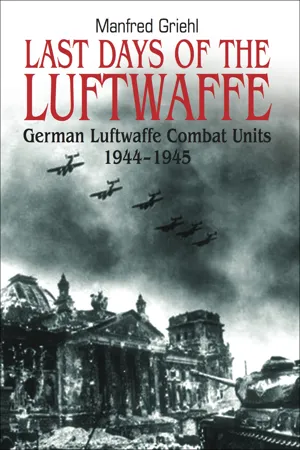
Drawn from newly-available historical archives, this German air force history is "packed with many fascinating revelations." (
IPMS/USA)
The end of the Second World War in Europe was an epoch of complete social, cultural and technological upheaval. In the realm of military and aviation history this period was revolutionary. The eclipse of the piston-engine, and the introduction of electronic detection equipment, rockets and airborne weapons in previously unknown quantities changed the face of the air war and paved the way for post-war developments in aviation technology.
Many details of this crucial phase of the war remained hidden for many years in top-secret files, but in this fascinating new history Manfred Griehl makes use of recently declassified sources, alongside his own vast collection of photographs, to provide a fresh look at the story of the Luftwaffe. Among the many aspects he covers are the new models of Bf 109 and Fw 190; the Me 262 jet plane; the establishment of He 162 squadrons; Stukas and Fw 190 fighter-bomber operations on the Eastern Front; Me 262 Blitzbombers in the West, the recruitment of 1928-born Hitler Youth into the two hundred glider schools; the increasing importance of remote-controlled air-to-air rockets; and the development of heavy bombs, remote-controlled bombs, atom bombs and Germany's chemical and bacteriological arsenal.
Brimming with intriguing discoveries, such as the existence of the real-life Luftwaffe kamikaze squadron, this meticulously researched and fully illustrated book will be of interest to historians and enthusiasts alike.
- 320 pages
- English
- ePUB (mobile friendly)
- Available on iOS & Android
eBook - ePub
About this book
Trusted by 375,005 students
Access to over 1.5 million titles for a fair monthly price.
Study more efficiently using our study tools.
Information
Chapter One
ON THE ROAD TO THE ABYSS
The coming collapse of the Luftwaffe could be seen relatively early, although at the highest level, in particular for Reichsmarschall Göring, this was not accepted. After the disaster at Stalingrad, the overall war situation deteriorated and with it the general situation for the Luftwaffe. Offensive capacity declined as a result of the heavy losses over the Eastern Front and the aircrew losses sustained during the attempts to supply encircled troop conglomerations. During the fighting in the East and Italy, the Allies found it increasingly easy to win territory and so force the Wehrmacht completely to the defensive.
From the summer of 1943, the US Eighth Air Force demonstrated that the Allies could successfully attack important ground targets everywhere in Europe with high precision even by day and in unprecedented numbers. RAF four-engined bombers attacked one major German city after another, mostly by night, their purpose being to demoralise the German people, particularly the labour force, and bring about the greatest possible war weariness in the medium term.
The increased use of long-range escort fighters and ever better protected four-engined bombers such as the B-17 and B-24 was decisive for the course of the air war. In this way the Allies forced the squadrons of the once ‘invincible’ Luftwaffe step by step onto the defensive, even over Reich home territory. The fire storm at Hamburg showed the Luftwaffe leadership the strength of the enemy against which it was pitted, and more and more towns disintegrated into ash and rubble. The beginning of the end had been reached.
As 1944 dawned, large enemy bomber formations were attacking the production centres of the German aviation industry even by day. Heavy bomb-loads were dropped on shipyards, power stations and above all fuel refineries so important for a war effort in which all had been wagered on mechanisation. Nevertheless the number of completed fighters still rose noticeably. The monthly increase in production from 1,000 to 3,000 single-engined machines was intended eventually to force the Western Allies to abandon their bombing policy.
Aircraft Production Programmes 223 and 224 had this aim but increased production of fighters was not possible at once. One difficult problem was the shortage of aluminium and other necessary raw materials for aircraft manufacture. Fuel production and the adequate training of aircrews also declined from 1944. The decrease in training flights was proportional to the lack of operational successes experienced later. An infrastructure disintegrating under constant bombing and a gradual flattening out of fuel production provided little prospect of cheer from mid-1944. Lines of communication, particularly the railways, were the constant target of air raids and low-level attacks, while attacks on inland shipping and other traffic, especially in the West, ensured delays to raw materials and other supplies.

The Ju 88 S and T, here a T-3 reconnaissance version with exhaust flame dampers, were no match for Allied fighters from the autumn of 1944.
Operation Steinbock, the resumption of the bombing offensive in the West, proved little more than a flash in the pan over England. In comparison, the ever-growing enemy air forces were so superior that they could strike with great precision wherever and whenever they chose. On account of the shortened training schedules, losses during tactical training rose. This was partly due to the lack of flying instructors and training aircraft with dual controls. In the summer of 1944 the training period of Luftwaffe fighter pilots was only 35 per cent of its former length, and the training units also faced severe shortages of fuel. Pilots newly operational were often referred to as ‘three-day wonders’ by veterans because so many failed to survive their first sorties.
The massive delays which occurred before the large-scale introduction of jets, and the numerous related technical hitches, spawned serious doubts in the possibility of final victory. The advent of a miracle weapon was a factor even amongst a section of the Reich government which provided hope for a favourable change in the situation, and became important in evaluating the military situation to the very end.
Reorganisation of Luftwaffe Armaments
There was only one way to counter the comprehensive aerial strength of the enemy because of the limited possibilities of production in Germany. Tactical superiority was to be regained by high performance aircraft – ‘quality instead of quantity’. Faced with shortages of materials and no chance of a major increase in production, the fighter squadrons were to receive more efficient machines to clear the skies over the Reich of Allied P-47s and P-51s and their four-engined bombers. Time was the problem. It was impossible within a few weeks and months to design, turn out and make operational a stream of new aircraft. The later experience with the He 162 Volksjäger would prove the point.

The Ju 188 A and E were only rarely involved in operations during the last months of the war.
Even initial production of flak rockets was not completed, as long planned, by mid-1944, nor air-to-air rockets and weapons such as the futuristic revolver-cannon MG 213. In August 1944 OKL (Luftwaffe High Command) announced the future equipment of Luftwaffe squadrons for the period to December 1945. The nine and one-third bomber Geschwader in late summer 1944, most equipped with the Ju 88 and Ju 188, would be cut to eight, and in all probability two more would be disbanded during 1945 so that by the end of 1945 only six Geschwader would survive, equipped with the Ju 388 K-1. All Do 217-equipped units were to be disbanded by October 1944 at the latest. Ju 388 K-1s would replace the Ju 88 A-17s at KG 26. Between December 1944 and May 1945 three Gruppen of that unit were meant to get improved Ju 188s and Ju 388s for torpedo-bomber operations over the North Sea and Arctic waters. The fourth Gruppe would probably not come to operational strength because of the production situation at September 1944. The Gruppen to be disbanded were those flying the He 177 A-5 with remote control installations and the Do 217 K-3 with the Hs 293 A Kehl missile guidance system. As it could not be determined to what extent these aircraft would be required for missions in future, all 135 bombers would go provisionally into the OKL Reserve. A number of these were decommissioned on airfields in Denmark and Norway after the heavy losses suffered over Normandy and western France, some being cannibalised for their DB-605 engines for re-use in new machines. There would also be no further Fw 200 C units operating.

The Ju 388 had good flying characteristics, but development was stopped at the beginning of 1945.

Few operations were flown with the Do 217 M towards the war’s end. Allied air superiority forced them into the night reconnaissance role.
The further reduction of He 111 front-line groups would depend on demand: since the production of the He 111 H had been discontinued, the only fresh aircraft being delivered to units would arrive from the repair shops. III./KG 3 would receive ten aircraft monthly in connection with the V-1 flying bomb programme. If and how the He 111 H-20s with other bomber groups would be operational on the Eastern Front was left open.
OKL wanted the Me 262 A-1a/bo or A-2 available in two bomber Geschwader. From December 1944 a third Geschwader would be formed, and this strength would be maintained. The Me 262 Blitzbomber would be reduced to two Gruppen at the latest by March 1945 since KG 76 was being expanded into the first jet bomber Geschwader. III./KG 76 was planned as the first operational Gruppe with the Ar 234 C-3 or C-5. The first Do 335 bomber Gruppe was expected to be ready in July 1945: the Luftwaffe planners believed that this would be the first, and probably only bomber unit to have this aircraft before the year was out. The Ju 287 was to be the first heavy jet bomber with the Luftwaffe. The first Gruppe was expected to be ready from July 1945, the second to follow at the year’s end by the latest. Although up to 20 per cent shortages due to delivery problems had been allowed for, it would have needed a great effort to meet these estimates by the scheduled dates, not least because some Ju 88 S-3s, Ju 388 K-1s, Me 262 A-1s and Do 335 A-1s were needed as training machines.
The dismantling and partial re-equipping of the bomber squadrons would continue to the end of 1945. Two Gruppen of LG 1 would receive the Ju 388 K-1 instead of Ju 88 A-4. KG 2 would be disbanded if the Do 335 A-1 was not available short-term: 14./KG 3 would be disbanded by October 1944, the V-1-equipped III./KG 3 by September 1945 at the latest. The same went for KG 4, whose I. to III. Gruppen, mostly flying the He 111 H-20 and H-16, would cease to operate between April and June 1945. KG 6 would lose its Ju 88 S-3s and Ju 188s in favour of the Ju 388 K-1 in stages from February 1945, remaining operational until at least December 1945, while KG 26 would receive the Ju 388 M-1 for anti-torpedo operations replacing its Ju 88 A-17s and Ju 188 A-3s.
OKL wanted the remainder of KG 27 disbanded by January 1945 and KG 30 by the end of that year. KG 40 was to remain in reserve, where the former bomber groups would be converted to the Me 262 fighter. The operational period of KG 51 with the Blitzbomber would be short: by the end of 1945 the recently converted units would be disbanded and replaced by KG 76.
KG 53 equipped with He 111 H-11, H-16 and H-22 would be dissolved in March 1945. It was intended to replace the Ju 88s of at least two Gruppen of KG 54 with the Me 262. KG 55 was to be disbanded by November 1945. I./KG 66 was the only Luftwaffe pathfinder unit and would remain in service, receiving the Ju 388 K-1 from August 1945. II. and III./KG 76 would test the Ar 234 B-2 for its suitability as a fast bomber. KG 100 with its He 177 A-5s would remain intact although no immediate operations were on hand for its PC 1400 X or Hs 293 missiles. As the last test unit...
Table of contents
- Title Page
- Copyright Page
- Table of Contents
- FOREWORD
- ABBREVIATIONS
- INTRODUCTION
- Chapter One - ON THE ROAD TO THE ABYSS
- Chapter Two - FIGHTERS WITH PROPELLERS
- Chapter Three - NEW HOPE
- Chapter Four - THE ‘PEOPLE’S FIGHTER’
- Chapter Five - JABOS AND BLITZBOMBERS
- Chapter Six - CANNON FODDER
- Chapter Seven - THE WAFFEN-SS GET INVOLVED
- Chapter Eight - MIDGET AIRCRAFT AND LOCAL FIGHTERS
- Chapter Nine - SELF-SACRIFICE
- Chapter Ten - MISTEL OVER THE EASTERN FRONT
- Chapter Eleven - LAST TRUMP OF THE AIR DEFENCE
- Chapter Twelve - WEAKPOINT
- Chapter Thirteen - WRECKED DREAMS
- Chapter Fourteen - PLANS FOR A NEW LUFTWAFFE
- Chapter Fifteen - THE FINAL ACCOUNT
- INDEX
Frequently asked questions
Yes, you can cancel anytime from the Subscription tab in your account settings on the Perlego website. Your subscription will stay active until the end of your current billing period. Learn how to cancel your subscription
No, books cannot be downloaded as external files, such as PDFs, for use outside of Perlego. However, you can download books within the Perlego app for offline reading on mobile or tablet. Learn how to download books offline
Perlego offers two plans: Essential and Complete
- Essential is ideal for learners and professionals who enjoy exploring a wide range of subjects. Access the Essential Library with 800,000+ trusted titles and best-sellers across business, personal growth, and the humanities. Includes unlimited reading time and Standard Read Aloud voice.
- Complete: Perfect for advanced learners and researchers needing full, unrestricted access. Unlock 1.5M+ books across hundreds of subjects, including academic and specialized titles. The Complete Plan also includes advanced features like Premium Read Aloud and Research Assistant.
We are an online textbook subscription service, where you can get access to an entire online library for less than the price of a single book per month. With over 1.5 million books across 990+ topics, we’ve got you covered! Learn about our mission
Look out for the read-aloud symbol on your next book to see if you can listen to it. The read-aloud tool reads text aloud for you, highlighting the text as it is being read. You can pause it, speed it up and slow it down. Learn more about Read Aloud
Yes! You can use the Perlego app on both iOS and Android devices to read anytime, anywhere — even offline. Perfect for commutes or when you’re on the go.
Please note we cannot support devices running on iOS 13 and Android 7 or earlier. Learn more about using the app
Please note we cannot support devices running on iOS 13 and Android 7 or earlier. Learn more about using the app
Yes, you can access Last Days of the Luftwaffe by Manfred Griehl in PDF and/or ePUB format, as well as other popular books in History & Military & Maritime History. We have over 1.5 million books available in our catalogue for you to explore.