- 256 pages
- English
- ePUB (mobile friendly)
- Available on iOS & Android
eBook - ePub
About this book
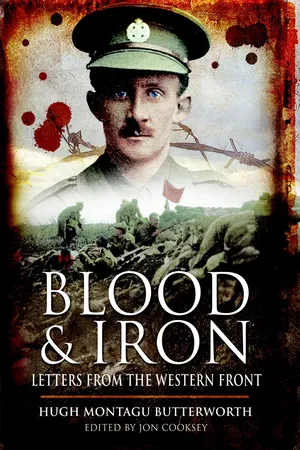
Until now Hugh Butterworth was just one of the millions of lost soldiers of the Great War, and the extraordinary letters he sent home from the Western Front have been forgotten. But after more than ninety years of obscurity, these letters, which describe his experience of war in poignant detail, have been rediscovered, and they are published here in full. They are a moving, intensely personal and beautifully written record by an articulate and observant man who witnessed at first hand one of the darkest episodes in European history. In civilian life Butterworth was a dedicated and much-loved schoolmaster and a gifted cricketer, who served with distinction as an officer in the Rifle Brigade from the spring of 1915. His letters give us a telling insight into the thoughts and reactions of a highly educated, sensitive and perceptive individual confronted by the horrors of modern warfare. He was killed on the Bellewaarde ridge near Ypres on 25 September 1915, and his last letter was written on the eve of the action in which he died.
Trusted by 375,005 students
Access to over 1.5 million titles for a fair monthly price.
Study more efficiently using our study tools.
Information
Hugh Montagu Butterworth Born 1 November 1885 Died in Battle 25 September 1915
‘I’m not particularly afraid of death, but I dislike the thought of dying because I
enjoy life so much, and I want to enjoy it such a lot more. This dug-out life gives
one plenty of time to think, I tell you, and the danger is, one gets down to a
minor key and stays there.... Anyway I feel that I’ve expiated every crime I’ve
ever committed. I fancy that when we warriors fetch up at the Final Enquiry
they’ll say, “Where did you perform?” We shall reply. “Ypres salient.”
They’ll answer, “Pass, friend”, and we shall stroll along to the
sound of trumpets and sackbuts.’
enjoy life so much, and I want to enjoy it such a lot more. This dug-out life gives
one plenty of time to think, I tell you, and the danger is, one gets down to a
minor key and stays there.... Anyway I feel that I’ve expiated every crime I’ve
ever committed. I fancy that when we warriors fetch up at the Final Enquiry
they’ll say, “Where did you perform?” We shall reply. “Ypres salient.”
They’ll answer, “Pass, friend”, and we shall stroll along to the
sound of trumpets and sackbuts.’
Letter from the Front near Bellewaarde, Ypres, 16 July 1915
Introduction
Railway Wood on the Bellewaarde Ridge, near Ypres, September 2007. As the group of twenty or so travellers gathered around a small, white cross overlooking a peaceful, sun-drenched Belgian pasture, one of their number, Hugh Montagu Butterworth, pulled a sheet of paper from his pocket and began to read the following words, written almost exactly ninety-two years earlier by his half-brother also named Hugh Montagu Butterworth:
Belgium, September 1915.
(I am posting this myself just before leaving. Perhaps I shan’t be killed!!)
I am leaving this in the hands of the transport officer, and if I get knocked out, he will send it on to you. We are going into a big thing. It will be my pleasant duty to leap lightly over the parapet and lead D Company over the delectable confusion of old trenches, crump holes and barbed wire, that lies between us and the Bosche, and take a portion of his front line. Quo facto I shall then proceed to bomb down various communication trenches and take his second line. In the very unlikely event of my being alive by then I shall dig in like blazes and if God is good, stop the Bosche counter-attack, which will come in an hour or two. If we stop that I shall then in broad daylight have to get out wire in front under machine-gun fire and probably stop at least one more counter attack and a bomb attack from the flank. If all that happens successfully and I’m still alive, I shall hang on till relief. Well, when one is faced with a programme like that, one touches up one’s will, thanks heaven one has led a fairly amusing life, thanks God one is not married, and trusts in Providence. Unless we get more officers before the show, I am practically bound to be outed as I shall have to lead all these things myself. Anyway if I do go out I shall do so amidst such a scene of blood and iron as even this war has rarely witnessed.
Second Lieutenant Hugh Montagu Butterworth of the 9th Battalion, the Rifle Brigade, did not survive. He was killed in action, as he had foretold on the eve of battle, on 25 September 1915, during one of the three bloody diversions to the Battle of Loos, which opened the same morning 30 miles to the south. Did he die in vain?
That last letter is a stunning document – honest, realistic and resigned – and yet there is a final nod to the heroic and to an end that befits a temporary ‘warrior’ of his social standing who had sworn to do his duty for his King and Country.
Hugh’s letters had been intended for his colleagues and pupils at his beloved Wanganui Collegiate School on the North Island of New Zealand, where he had taught and coached cricket for seven happy years before the war. He had written them to the school but his colleague and great friend John Allen, who had arrived at Wanganui just a year before Hugh and who would go on to become Headmaster during the 1930s, was the man Hugh had entrusted with opening the envelopes. It had been another colleague of Hugh’s, H E Sturge, who had written Hugh’s obituary in the school magazine, the Wanganui Collegian, in December 1915 and even as he had been writing that memorial tribute John Allen had decided to publish Hugh’s letters as a lasting legacy in association with Mr Sturge. We can pinpoint exactly the moment when the seed of the idea to publish Hugh’s letters was sown. In a letter to the editor of the Wanganui Collegian of December 1915, John Allen wrote:
Dear Sir,
I wish to take this opportunity of informing present and past members of the School that I intend, with the assistance of Mr Sturge, to publish in book form the series of letters which Mr Butterworth wrote to me from Flanders between May and September. They are intensely interesting: we feel that there are many who would value them very highly as a permanent possession. We hope that they will be ready next term. Applications for copies can be made to either Mr Sturge or myself.
Yours sincerely.
J. ALLEN.
The volume, which eventually bore the title, ‘LETTERS, written in the trenches near Ypres between May and September 1915, by H M Butterworth, 9th Rifle Brigade, who fell in action on September 25, 1915’, was printed by Whitcombe and Tombs Ltd, of Wellington, New Zealand, and appeared in early 1916. Copies were purchased by, or sent to, family and friends and the scope and importance of its contents have been largely forgotten ever since, save for the appearance of short extracts which found their way into other publications, undergraduate studies and discussions and debates on various Great War related web forums.1
In 1930 the illustrator, novelist and dramatist Laurence Housman, younger brother of A E Housman, edited and published abridged extracts from two of Hugh’s letters, separated by several days, in the volume War Letters of Fallen Englishmen.2 Adding to a torrent of books on the war – memoir, fiction, autobiography and collected letters – that were published between 1928 and 1934, Housman noted in his introduction that the letters that he had selected represented ‘two voices’. On the one hand there was the voice of a large majority, which, although firmly convinced that their actions were right – or at least right in the sense that there was an inevitability about them – showed ‘their ‘detestation of war in its operation’, yet at the same time some expressed ‘the keen satisfaction it gives them as an individual experience – mainly as a test of themselves, of their power to conquer fear, to live at the full push of their energies, mental and physical. To them, individually, active warfare gives life a fuller expression: ‘for it is a life lived daily in the power to face death’.3
On the other hand, Housman recognised that amongst the letters he had collected were those of a minority, equally worthy of respect and yet representative of other types of mind and character. These were of men who had not been,
... born fighters, men who have had a hard struggle to conquer their individual fears, temperaments and disgusts, and have not come through with elation or even conviction. In some of these letters there is a cry of a violated conscience or at least of poignant doubt. In many – in some of the best – is the record of a diminishing hope: of men who went into war with ideals, from which the reality (military and political combined) slowly crushed out the life.4
Reading the sweep of Hugh’s letters from late May 1915 to the eve of his death in late September the same year, it is clear that his voice could be heard clearly as an advocate of both camps. In some letters we hear exuberant examples representing that ‘majority voice’ but, as the war progresses and his battalion become involved in some of the worst fighting of 1915 in the Ypres Salient, we listen intently and with mounting concern as he grapples with his internal fears, doubts and uncertainties.
Housman’s work, and therefore the same extracts from Hugh’s Letters, surfaced again in 2002 in a reprint by the University of Pennsylvania Press with a specially commissioned introduction by historian Jay Winter. The ambiguities evident in Hugh’s Letters reflect a theme picked up by Jay Winter when studying Housman’s collection. Winter contends that Housman’s volume was, like many works of the time, party of the ‘memory boom’, an attempt to retrieve the voices of what has become termed the ‘Lost Generation’; men and women who were the natural successors to positions of power, influence and creativity in British society. He views War Letters of Fallen Englishmen as fundamentally a pacifist document and yet argues that the very content of the letters selected by Housman highlights the ‘limitations of pacifist appeals in the inter-war years’, much as the term ‘Lost Generation’ – when applied to the post-war gaps in the ranks of the social classes that ran Britain and the Empire – became a self-serving argument and a ‘demographic explanation for Britain’s dismal economic and political record between the wars’.5
Most of the men who served came home to their families or settled down and started families and although many struggled to cope with the debilitating effects of wounds or gas, many more went back to their jobs and ‘stuck it’ during the lean and hungry years of the Depression, just as they had in the trenches and somehow hung on to contribute to Britain’s economy as best they could.
There are valid arguments as to why the concept of the ‘Lost Generation’ may be flawed and whilst it is handy to regard it as a smokescreen for those who would not face up to the realities behind Britain’s social, economic and political woes of the 1920s and 1930s, it is also an inescapable fact that when the war claimed the lives of its participants it also claimed their promise and their potential. One could look at the two Butterworth cousins, Hugh and George, as examples and muse on that thought. Hugh Butterworth had given so much to so many as a teacher in New Zealand by the time he joined the Army in 1915 and several of his pupils would indeed go on to achieve great things and very high office in public life. What more would he have given had he been spared? What of the promise and potential of his cousin George, already a talented and respected composer and a friend of Vaughan Williams before he joined up? What great works would have been produced if he had survived? Would he have been hailed in the same breath as Elgar and Vaughan Williams as one of Britain’s greatest composers? What if, what if?
For Jay Winter at least, the republication of Housman’s collected War Letters of Fallen Englishmen served a broader purpose in that at least it enabled its audience to appreciate the complexities and ambiguities in war literature as well as the frailties of the pacifist movement in the years 1900 – 1950.
A very short fragment of one of Hugh’s letters initially selected by Housman in 1930 appeared in the late 1980s in a book entitled British Butchers and Bunglers of World War One by Australian author John Laffin. It is not the purpose of this introduction to enter into a detailed analysis of that work. Suffice to say that Laffin’s chosen title conveys as much about his central thesis of the failure of leadership on the part of those in positions of high command in the British Army as one perhaps needs to know with regard to the present work.
All historians who commit their thoughts to paper make judgments regarding the selection and editing of their source material and in this regard Laffin is no different to any other. Where he has been criticised, however, it has been on the grounds of his biased selection of evidence or in the misrepresentation of his sources. What John Laffin was certainly not attempting to demonstrate was his appreciation of the ‘complexities and ambiguities’ in war literature, particularly when applied to Hugh’s own words given those he chose to extract from Housman’s earlier work.
The scrap of Hugh’s letter used by Laffin appeared in a chapter entitled ‘What the Soldiers Say’, in which the author used various extracts from many soldiers to support his assertion that they amount to:
an exposé of what it was that the ‘Great Captains’ expected men to endure in the name of God, King and Country – and their own egotism.... In a few cases, the soldier writers of these letters are explicit in their indictment of senior leadership. In many cases the indictment is implicit. In all cases they reveal the truth about the reality of war and the futility of British tactics. The soldiers’ testimony against their commanders is damning.6
In the light of the above it is worth reproducing here the extract exactly as it appears in British Butchers and Bunglers:
Early August 1915. We’re out temporarily but shall probably be back tomorrow night. We had an awful time. The whole show lasted about 96 hours and is probably by no means over yet. We may quite easily be shoved into the attack almost at once. This letter fails hopelessly. I can’t express what we felt or give you a real idea what Hell looks like. We lost two hundred and fifty men.
Laffin abridged the first six lines of the second of Hugh’s letters to be published in Housman’s War Letters and stitched them together with the first three lines of the last paragraph, missing out two paragraphs and several hundred words in between. Crucially, he did not set the letter in context. What Laffin did not reveal was that Hugh’s letter dealt specifically with his impressions of his involvement in the German liquid fire attack at Hooge on 30 July 1915. The ‘whole show’ which, according to Hugh, lasted for ninety-six hours, was not a British attack cobbled together by those ‘Great Captains’ of which he was so dismissive but a dogged British defence in the teeth of a terrific German onslaught in which flamethrowers were used as terror weapons on a large scale for the first time.
The British at Hooge were fighting for their lives to hold on to a key position – militarily vital ground – which dominated the Ypres Salient. In such circumstances there was little wonder that casualties were very heavy, for this was trench warfare fought at a high tempo and a terrific intensity. That Hugh found it difficult to ‘express’ what he felt should not surprise readers – although he did a pretty good job when one is able to digest the whole piece.
John Laffin spoke of the letters in his selection as revealing the ‘truth about the reality of war’ and the ‘futility of British tactics’, but he excised from the same letter Hugh’s references to his riflemen ‘repelling the attack’ which Hugh admits was hard to verify given the ‘noise, dust and general tumult’ and the confusion, chaos and fluidity of the situation given that stretches of trench changed hands several times.
Laffin argued that each of the extracts revealed ‘something about the unpleasantness, at best, and the vile horror at worst, of the war’ and indeed Hugh admits that the battalion had ‘an awful time’. However, Laffin missed out a section Jay Winter would almost certainly classify as demonstrating the ‘complexities and ambiguities’ inherent in much war literature. With Hugh’s men ‘right over’ the parapet and ‘firing like blazes’ he goes on to describe himself bestriding the trench:
half on the parapet and half on the parados with a revolver in one hand and a rifle near the other and a cigarette going well, using the most unquotable language. Do you know that really was a good moment. I can’t pretend to like bombardments, nor war generally, but that really was a moment when one ‘touched top’ (as opposed to touching bottom) but you’ll feel that it was an interesting moment in one’s life.
Clearly Hugh’s overwhelming emotion regarding the ‘reality of war’ in that split second was anything other than a feeling of futility.
Another short extract from Hugh’s first letter in the Housman anthology was used as source material as recently as 2006 in an undergraduate study by a student at Rochester University in New York State to support the thesis that social class influenced the attitudes of other ranks.7 Tantalising snippets had thus been read but the full story of Hugh’s war as recounted in his own words in his Letters had not been heard for many decades.
In September 2007, up on the Bellewaarde Ridge, the group stood mute as the final few words of Hugh Butterworth’s valedictory – given voice again by his brother after a silence of more than ninety...
Table of contents
- Title Page
- Copyright Page
- Table of Contents
- Foreword
- Preface
- Acknowledgements
- Hugh Montagu Butterworth Born 1 November 1885 Died in Battle 25 September 1915
- Introduction
- Chapter One - Born into Sport
- Chapter Two - ‘Fairly Useful’ – School Days
- Chapter Three - ‘Univ’ and New Zealand – A New Start
- Chapter Four - The Rifle Brigade
- Chapter Five - Into the Salient
- Chapter Six - ‘Such a Scene of Blood and Iron’ – The Attack
- Chapter Seven - In Memoriam
- LETTERS
- Appendix 1 - 9th (Service) Battalion the Rifle Brigade Killed in Action or Died of Wounds, 25 September – 12 October 1915
- Appendix 2 - German Reserve Infantry Regiment 248 Verlustlisten No. 289, 25 October 1915
- Notes
- Bibliography
- Index
Frequently asked questions
Yes, you can cancel anytime from the Subscription tab in your account settings on the Perlego website. Your subscription will stay active until the end of your current billing period. Learn how to cancel your subscription
No, books cannot be downloaded as external files, such as PDFs, for use outside of Perlego. However, you can download books within the Perlego app for offline reading on mobile or tablet. Learn how to download books offline
Perlego offers two plans: Essential and Complete
- Essential is ideal for learners and professionals who enjoy exploring a wide range of subjects. Access the Essential Library with 800,000+ trusted titles and best-sellers across business, personal growth, and the humanities. Includes unlimited reading time and Standard Read Aloud voice.
- Complete: Perfect for advanced learners and researchers needing full, unrestricted access. Unlock 1.5M+ books across hundreds of subjects, including academic and specialized titles. The Complete Plan also includes advanced features like Premium Read Aloud and Research Assistant.
We are an online textbook subscription service, where you can get access to an entire online library for less than the price of a single book per month. With over 1.5 million books across 990+ topics, we’ve got you covered! Learn about our mission
Look out for the read-aloud symbol on your next book to see if you can listen to it. The read-aloud tool reads text aloud for you, highlighting the text as it is being read. You can pause it, speed it up and slow it down. Learn more about Read Aloud
Yes! You can use the Perlego app on both iOS and Android devices to read anytime, anywhere — even offline. Perfect for commutes or when you’re on the go.
Please note we cannot support devices running on iOS 13 and Android 7 or earlier. Learn more about using the app
Please note we cannot support devices running on iOS 13 and Android 7 or earlier. Learn more about using the app
Yes, you can access Blood & Iron by Hugh Montagu Butterworth, Jon Cooksey in PDF and/or ePUB format, as well as other popular books in History & Historical Biographies. We have over 1.5 million books available in our catalogue for you to explore.