- 240 pages
- English
- ePUB (mobile friendly)
- Available on iOS & Android
eBook - ePub
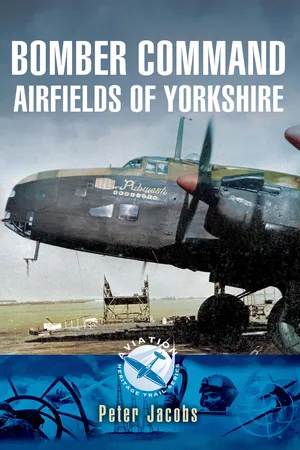
Bomber Command Airfields of Yorkshire
About this book
As part of the Aviation Heritage Trail series, the accomplished military author and former RAF Officer Peter Jacobs takes us to the county of Yorkshire and to its many bomber airfields of the Second World War.From the opening day of hostilities, RAF Bomber Command took the offensive to Nazi Germany and played a leading role in the liberation of Europe. Yorkshires airfields played a key part throughout, initially as home to the Whitley squadrons of No 4 Group and then to the four-engine Halifax heavy bombers; indeed, Bomber Commands first night operation of the war was flown from one of the countys many bomber airfields. Then, as the bombing offensive gathered pace, Yorkshire welcomed the new all-Canadian No 6 (RCAF) Group, after which all of Bomber Commands major efforts during the hardest years of 1943/44 against the Ruhr, Hamburg and Berlin involved the Yorkshire-based squadrons.Most of Yorkshires wartime bomber airfields have long gone, but many have managed to retain the flying link with their wartime past. For example, the former RAF airfields of Finningley and Middleton St George, and the factory airfield of Yeadon, are now the sites of international airports, while Breighton, Burn, Full Sutton, Pocklington and Rufforth are still used for light aircraft flying or gliding and Elvington is home to the magnificent Yorkshire Air Museum.From airfields such as these came countless acts of personal courage and self-sacrifice, with two men being awarded the Victoria Cross, Britains highest award for gallantry. Stories of both men are included, as are tales of other personalities who brought these airfields to life. The stories of thirty-three airfields are told in total, with a brief history of each accompanied by details of how to find them and what remains of them today. Whatever your interest, be it aviation history or more local, the county of Yorkshire has rightly taken its place in the history of Bomber Command.
Trusted by 375,005 students
Access to over 1 million titles for a fair monthly price.
Study more efficiently using our study tools.
Information
PART I
Airfields of 4 Group
Re-formed on 1 April 1937 (it had previously existed for a year at the end of the First World War), 4 Group was initially headquartered at Mildenhall in Suffolk. Almost immediately, the headquarters relocated to Linton-on-Ouse in Yorkshire and by the outbreak of the Second World War the group had eight Whitley squadrons based at four airfields (Dishforth, Driffield, Leconfield and Linton-on-Ouse) under its Air Officer Commanding (AOC) Air Vice-Marshal Arthur Coningham.
4 Group flew its first operation of the war on the opening night of hostilities when ten Whitleys dropped propaganda leaflets over Germany, but it was not until the night of 19/20 March 1940 that the group’s first raid on a land target took place when thirty Whitleys (from 10, 51, 77 and 102 Squadrons) joined twenty Hampdens of 5 Group to bomb the German seaplane base at Hörnum.
After German forces invaded France and the Low Countries in May, the gloves were off and with the threat of a German invasion of southern England becoming increasingly likely, 4 Group took part in attacks against the invasion ports across the Channel, as well as against oil targets in Germany. Its squadrons even flew raids against Berlin during August and September, although these were relatively small-scale and largely ineffective.
By now, 4 Group had re-located its headquarters to Heslington Hall, to the south-east of York, where it would remain for the rest of the war. During 1941, the group took part in attacks against the German battleships Scharnhorst and Gneisenau and helped to keep these mighty warships in harbour at Brest until February 1942 when they finally managed to break out in a high-speed dash through the Channel and back to their port at Kiel.

Bombing up a Whitley during the early phase of the Second World War. When hostilities broke out, 4 Group had only eight Whitley squadrons at four airfields. (via Ken Delve)
By early 1942, 4 Group had grown to eleven operational squadrons operating a mix of Halifaxes, Wellingtons and Whitleys. All but two of these were operating from seven different airfields in Yorkshire and County Durham: Croft, Dalton, Driffield, Leeming, Linton-on-Ouse, Middleton St George and Pocklington. Command of the group had passed to Roderick Carr and when Bomber Command ordered its allout effort against Cologne at the end of May 1942, 4 Group was able to commit 147 aircraft to the Thousand Bomber force. According to The Bomber Command War Diaries by Martin Middlebrook and Chris Everitt, the breakdown of this figure gives 131 Halifaxes, nine Wellingtons and seven Whitleys, showing how the Halifax had now become the group’s main frontline bomber.
When the Pathfinders formed, its new commander, Donald Bennett, was a former 4 Group squadron commander. Bennett had earlier commanded 77 Squadron (Whitleys) and 10 Squadron (Halifaxes) at Leeming. His new force was established with four squadrons, one from each of Bomber Command’s main groups, with the Halifaxes of 35 Squadron being 4 Group’s contribution.
Yorkshire had now become home to the Australians of 466 (RAAF) Squadron, initially a Wellington squadron but later to be equipped with Halifaxes and based at Leconfield. When the all-Canadian 6 (RCAF) Group formed in Yorkshire at the beginning of 1943 four of 4 Group’s airfields – Leeming, Linton-on-Ouse, Middleton St George and Topcliffe – were transferred to the new group. 4 Group would also lose Marston Moor and its satellites (Acaster Malbis, Riccall and Rufforth) to 7 (Training) Group later in the year, but in return for these losses new airfields had opened at Breighton, Burn, Full Sutton, Holme-on-Spalding Moor, Lissett, Melbourne and Snaith.
4 Group continued to contribute large numbers of aircraft to Bomber Command’s strategic offensives throughout 1943 – against the Ruhr, Hamburg and Berlin – after which it took part in the build-up to Operation Overlord and then supported the subsequent Allied breakout from Normandy towards Germany, including attacks against the German V-weapon sites in northern France. During this period Yorkshire became home to a second Australian Halifax squadron, 462 (RAAF) Squadron at Driffield, and Bomber Command’s only Free French heavy bomber squadrons (346 and 347 Squadrons) based at Elvington.

The Halifax replaced the Whitley from 1941 to become the mainstay of 4 Group. The group would soon become an all-Halifax force. (Yorkshire Air Museum)
The Halifax proved a versatile aircraft and as the British Second Army advanced towards Arnhem, the squadrons of 4 Group were used to ferry large quantities of petrol across the Channel as an urgent re-supply. In one week, the Halifaxes ferried nearly half a million gallons of fuel.
In February 1945 Roderick Carr handed over as AOC to Air Vice-Marshal John Whitley, a well-known and experienced officer with 4 Group having commanded 149 Squadron, then Linton-on-Ouse and Lissett before taking command of 43 Base. 4 Group’s last operation of the war was flown on 25 April 1945 against gun batteries on the Frisian island of Wangerooge, which controlled the approaches to the German naval ports of Bremen and Wilhelmshaven.
With the war over, 4 Group was transferred to Transport Command with its headquarters moving to Abingdon in Oxfordshire. According to figures from the Ministry of Defence, 4 Group flew a total of 61,577 operational sorties during the war, more than 40 per cent of which were flown during the group’s operational peak in 1944.
CHAPTER 1
Acaster Malbis
Location – North Yorkshire, five miles south of York.
Status – Relief Landing Ground. 41 Base – sub-station of Marston Moor.
When talking about airfields of Yorkshire, the name of Acaster Malbis is rarely heard. Even in its heyday during the Second World War, there were fewer than 300 RAF personnel based at this smallest of stations.
It was not until late 1941 that work began on an area of land close to the River Ouse between the villages of Acaster Malbis and Acaster Selby to develop a grass airfield for the use of RAF fighters. By early 1942, the airfield was considered ready for opening and was allocated to Fighter Command as a satellite for nearby Church Fenton. Acaster Malbis was first used by 601 Squadron of the Royal Auxiliary Air Force, flying the American-built P39 Airacobra, but the squadron only remained for three months due to technical problems with the aircraft. Furthermore, the airfield had been built close to the western bank of the Ouse in an area full of dykes. Drainage was always a problem, particularly when the river was full or even flooded, causing the airfield to become waterlogged, as was the fog and mist caused by the river. Not surprisingly, it did not take long to discover that the airfield was not suitable for operations, particularly during any lengthy period of heavy rain and cold temperatures.
Considered unsuitable for further use by fighters, Acaster Malbis was transferred to Flying Training Command. From April 1942 until the end of the year, the airfield became home to Airspeed Oxfords but even training aircraft struggled to operate from the airfield and so, eventually, it was decided that Acaster Malbis was to undergo major reconstruction; it was either that or the RAF would have to move out altogether. The decision to upgrade the airfield was, to say the least, a strange one as it was never going to solve the problems that were essentially caused by the airfield’s location. Nonetheless, construction work went ahead during 1943 rather than to give up on the site altogether and having earlier been rejected by two other commands, Acaster Malbis re-opened in November 1943 as a Class A bomber airfield and allocated to 4 Group.

Acaster Malbis is one of the remotest of Yorkshire’s wartime bomber airfields, with very few reminders of its past and most of the land having long reverted to agriculture. This is the north-west corner of the former airfield where part of the perimeter track can still be found. (Author)
The new airfield had three concrete runways with the main, 2,000 yards long, running from the north-east to the southwest. There were thirty-six hard standings for the dispersal of aircraft, three maintenance hangars and several other buildings, including enough domestic accommodation to house more than a thousand personnel. However, the airfield was never going to be suitable to sustain the operation of heavy bombers for any length of time, and so Acaster Malbis was only used as a relief landing ground for 4 Group’s main training base at Marston Moor, now designated 41 Base, and its two satellites at Riccall and Rufforth.
Halifaxes soon became regular visitors to Acaster Malbis to practise circuits and approaches. During the latter period of the war the airfield was used by 91 Maintenance Unit for the storage of bombs before they were taken to the operational airfields nearby. From the end of 1944 the airfield was also home to 4 Group’s Aircrew School for ground training and other nonflying aspects of training whilst crews waited for a posting to a squadron.
Towards the end of the war Acaster Malbis was transferred to 7 (Training) Group and when the war was over the MU moved out and flying ceased, after which the airfield closed in 1946. The site was, however, used for a number of years for the disposal of bombs and ammunition from the surrounding airfields in Yorkshire, a task that was not completed until the 1950s. The land was then sold, although private flying carried on into the 1980s. Large sections of the runways were then dug up and most of the airfield’s buildings disappeared.
The former airfield of Acaster Malbis is one of the remotest and least easy to find of all Yorkshire’s former wartime bomber airfields. There are very few reminders of its past with most of the land having long reverted to agriculture, although part of the land is used for light industry. The site of the former airfield can be found just over a mile to the south of the village of Acaster Malbis by heading south from the village, just on the western side of the River Ouse, along Mill Lane. Then continue southwestwards along Intake Lane until you reach the T-junction with Broad Lane. Turn left here in a southerly direction towards the village of Acaster Selby. York Saw Mill is immediately on your right, after which the lane takes a sharp right and then 400 yards or so later a sharp left. Almost immediately after you go round this left-hand bend you will see a gate and public footpath on your left. This is the north-west corner of the former airfield. The footpath follows the perimeter track, which is still evident, but do not take a car onto the perimeter track as the entrance gate can be locked at any time; there is space to park a car outside the entrance gate. If you continue south along the lane towards Acaster Selby, you will see Ebor Trucks on your left, which marks the area where hangars and buildings once stood, and continuing south along the lane takes you through what was the western part of the airfield, while Scaffold Dike and the River Ouse on the far side of the former airfield mark its eastern extremity.
CHAPTER 2
Breighton
Location – East Riding of Yorkshire, five miles to the north-east of Selby.
Status – Satellite airfield. 44 Base – sub-station of Holme-on-Spalding Moor.
Not one of the RAF’s pre-war airfields, Breighton’s early life as a bomber station differed to others in Yorkshire as it was with 1 Group that the airfield first served rather than the county’s other airfields of 4 Group.
It was during 1941 that construction work was carried out on land between the villages of Breighton, from which the airfield takes its name, and Bubwith. Although built as a bomber airfield with three hardened runways, the runways met at a common intersection rather than being of the standard A-type design. The main runway was aligned approximately east–west, while a second runway ran from the south-west to the north-east and the third ran almost north–south. The eastern extension of the main east–west runway took the runway as far as the B1228. Other than that, the airfield was built as normal, with a perimeter track and thirty-six hard standings for aircraft dispersal. The technical site, which included two hangars, was in the north-west corner of the airfield, near the village of Gunby, while a third hangar was on the southern boundary and adjacent to the original southern threshold of the north-south runway.
Breighton opened in January 1942 as a satellite of Holme-on-Spalding Moor and immediately allocated to 1 Group, Bomber Command. The first resident unit to move in was the Australian 460 (RAAF) Squadron, then equipped with the Wellington IV. The crews immediately moved in to the new airfield from their former base at Molesworth in Huntingdonshire. The squadron had been formed from C Flight of 458 Squadron just a few weeks before and after settling down to its new home flew its first operations from the airfield on the night of 12/13 March 1942. Five aircraft joined Bomber Command’s Main Force to attack the port of Emden in north-west Germany. One Wellington failed to return.

Somewhat unusually, the runways at Breighton met at a common intersection rather than being of the standard A-type design. Other than that the airfield had been constructed to the standard bomber design. (via Ken Delve)
The squadron suffered its first loss from Breighton at the end of April but the Wellingtons were not destined to stay long as by the summer they were gradually being phased out of operational service in favour of the new four-engine heavier bombers being introduced. In August, the squadron began taking delivery of the Halifax II four-engine heavy bomber but the squ...
Table of contents
- Cover
- Title
- Copyright
- Contents
- Acknowledgements
- Introduction
- Part I: Airfields of 4 Group
- Part II: Airfields of 6 (RCAF) Group
- Part III: Other Bomber Airfields of Yorkshire
- Appendix 1: Bomber Command Order of Battle (Operational Squadrons Based in Yorkshire Only) – 1 September 1939
- Appendix 2: Bomber Command Order of Battle (Operational Squadrons Based in Yorkshire and County Durham only) – January 1944 (Battle of Berlin)
- Appendix 3: Bomber Command Order of Battle (Operational Squadrons Based in Yorkshire and County Durham Only) – January 1945
- Bibliography
Frequently asked questions
Yes, you can cancel anytime from the Subscription tab in your account settings on the Perlego website. Your subscription will stay active until the end of your current billing period. Learn how to cancel your subscription
No, books cannot be downloaded as external files, such as PDFs, for use outside of Perlego. However, you can download books within the Perlego app for offline reading on mobile or tablet. Learn how to download books offline
Perlego offers two plans: Essential and Complete
- Essential is ideal for learners and professionals who enjoy exploring a wide range of subjects. Access the Essential Library with 800,000+ trusted titles and best-sellers across business, personal growth, and the humanities. Includes unlimited reading time and Standard Read Aloud voice.
- Complete: Perfect for advanced learners and researchers needing full, unrestricted access. Unlock 1.4M+ books across hundreds of subjects, including academic and specialized titles. The Complete Plan also includes advanced features like Premium Read Aloud and Research Assistant.
We are an online textbook subscription service, where you can get access to an entire online library for less than the price of a single book per month. With over 1 million books across 990+ topics, we’ve got you covered! Learn about our mission
Look out for the read-aloud symbol on your next book to see if you can listen to it. The read-aloud tool reads text aloud for you, highlighting the text as it is being read. You can pause it, speed it up and slow it down. Learn more about Read Aloud
Yes! You can use the Perlego app on both iOS and Android devices to read anytime, anywhere — even offline. Perfect for commutes or when you’re on the go.
Please note we cannot support devices running on iOS 13 and Android 7 or earlier. Learn more about using the app
Please note we cannot support devices running on iOS 13 and Android 7 or earlier. Learn more about using the app
Yes, you can access Bomber Command Airfields of Yorkshire by Peter Jacobs in PDF and/or ePUB format, as well as other popular books in History & British History. We have over one million books available in our catalogue for you to explore.