- 144 pages
- English
- ePUB (mobile friendly)
- Available on iOS & Android
eBook - ePub
Blitzkrieg in the West
About this book
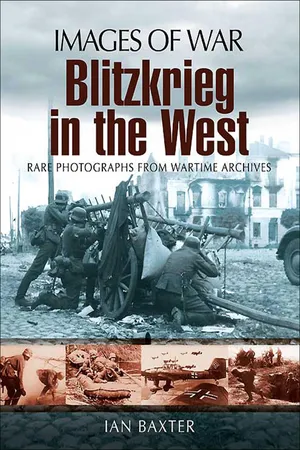
"This superbly illustrated book captures the dramatic action of May and June 1940. The speed and ferocity of the German onslaught took the Allies by surprise as Hitlers land and air forces annihilated the inferior opposition. After 9 months stalemate the collapse was cataclysmic and Holland and Belgium quickly fell leaving the British and French forces outflanked and outfought. Panic set in and huge numbers of civilian refugees clogged the roads making the Allies withdrawal even more precarious. The miracle of Dunkirk saved vast numbers of British and French forces but could not prevent the surrender of France, leaving Britain to fight on virtually alone. The splendid photographs in this Images of War series book tell the story of this extraordinary period of history. They include previously unseen images of Rommels Ghost Division."
Trusted by 375,005 students
Access to over 1.5 million titles for a fair monthly price.
Study more efficiently using our study tools.
Information
Chapter One
Preparing for Blitzkrieg
On 9 May 1940 Adolf Hitler finally decided to attack the west and told his Western Front commanders to signal to all units that were preparing to attack across the frontiers of Holland, Belgium and Luxembourg to move to their assembly areas for attack. Later that evening, the codeword, ‘Danzig’ alerted all German forces that they were to attack in the early hours of 10 May.
The key objective of the attack in the west was the use of the mighty Panzerwaffe units of Army Group A, which were tasked with striking south through Luxembourg and the wooded terrain of the Ardennes which, up to then, had been regarded as impassible for armour. However, Hitler was determined to use the ‘old Schilieffen plan’ which had been used by the German Army for their attack on France in 1914. In this plan, the German Army placed the main weight of their offensive on the northern wing marching through Belgium. It was here, 26 years later, that the British Expeditionary Force, or BEF, together with the French Army, had expected to meet the main forces of the Wehrmacht. But on the flat lands of Belgium, German commanders were determined that this war of attrition would not be like the dehumanizing years of trench warfare of 1914-18, but would embrace a new concept, as tried and tested in Poland in September 1939 – Blitzkrieg.
Hitler was resolute that if he was going to win the war rapidly in the west the new Blitzkrieg tactic would be instigated quickly and effectively. Whilst he had been aware that his forces had overwhelming superiority in modern equipment against a country like Poland, he knew that France and her allies had a slight advantage in terms of both numbers of troops and material.
Yet, in spite pessimism from many of his Western Front commanders he knew by adopting the Blitzkrieg tactics his army would use highly mobile operations involving the deployment of motorized infantry, air power, and armour in coordinated attacks allowing his forces to gain rapid penetration followed by the encirclement of a bewildered and overwhelmed enemy.
For the attack against the west the German Army were divided into three army groups – Army Group A, B and C. The main strike would be given to Army Group A, which would drive its armoured units through the Ardennes, and then swing round across the plains of northern France and then make straight for the Channel coast, thereby cutting the Allied force in half and breaking the main enemy - concentration in Belgium between Army Group A advancing from the south and Army Group B in the north. The task of Army Group B was to occupy Holland with motorized forces and to prevent the linking up of the Dutch army with Anglo-Belgian force. It was to destroy the Belgian frontier defences by a rapid and powerful attack and throw the enemy back over the line between Antwerp and Namur. The fortress of Antwerp was to be surrounded from the north and east and the fortress of Liege from the north-east and north of the Meuse.

Wehrmacht riflemen rest in a field prior to the attack in the west. For the attack against the west the German Army were divided into three army groups – Army Group A, B and C. The main strike would be given to Army Group A, which would drive its armoured units through the Ardennes, and then swing round across the plains of northern France and then make straight for the Channel coast, thereby cutting the Allied force in half and breaking the main enemy concentration in Belgium between Army Group A advancing from the south and Army Group B in the north. The task of Army Group B was to occupy Holland with motorized forces and to prevent the linking up of the Dutch army with Anglo-Belgian force.
Army Group C, which was the most southern most of the three army groups, was to engage the garrison of the Maginot Line, penetrating it if possible.
Distributed between the three army groups the Germans deployed twenty-nine divisions under Army Group B in the north and forty-four division, including the bulk of the armour, under Army Group A in the centre. Army Group C with seventeen divisions covered the southern flank and threatened the French position on its eastern flank.
Distributed between the three army groups was the armour, which would lead the drive through Belgium, Holland and then into France.In total a staggering 2,072 tanks. In total there were 640 Pz.Kpfw.I’s, 825 Pz.Kpfw.II’s, 456 Pz.Kpfw.III’s, 366 Pz.Kpfw.IV’s, 151 Pz.Kpfw.35(t) and 264 Pz.Kpfw.38(t). The reserves comprised of some 160 vehicles to replace combat losses and 135 Pz.Kpfw.I’s and Pz.Kpfw.II’s which had been converted into armoured command tanks, which resulted them losing their armament. The vehicles that had been distributed among the ten Panzer divisions were not distributed according to formation of the battles they were supposed to perform. The 1.Panzer-Division, 2.Panzer-Division and 10.Panzer-Division each comprised of 30 Pz.Kpfw.I’s, 100 Pz.Kpfw.II’s, 90. Pz.Kpfw.III’s and 56 Pz.Kpfw.IV’s. The 6 Panze...
Table of contents
- Title Page
- Copyright Page
- Table of Contents
- Introduction
- About The Author
- Chapter One - Preparing for Blitzkrieg
- Chapter Two - Battles of Holland and Belgium
- Chapter Three - Road to Dunkirk
- Chapter Four - ‘Operation Red’ Blitzkrieg through France
- Chapter Five - The End Comes
- Order of Battle
Frequently asked questions
Yes, you can cancel anytime from the Subscription tab in your account settings on the Perlego website. Your subscription will stay active until the end of your current billing period. Learn how to cancel your subscription
No, books cannot be downloaded as external files, such as PDFs, for use outside of Perlego. However, you can download books within the Perlego app for offline reading on mobile or tablet. Learn how to download books offline
Perlego offers two plans: Essential and Complete
- Essential is ideal for learners and professionals who enjoy exploring a wide range of subjects. Access the Essential Library with 800,000+ trusted titles and best-sellers across business, personal growth, and the humanities. Includes unlimited reading time and Standard Read Aloud voice.
- Complete: Perfect for advanced learners and researchers needing full, unrestricted access. Unlock 1.5M+ books across hundreds of subjects, including academic and specialized titles. The Complete Plan also includes advanced features like Premium Read Aloud and Research Assistant.
We are an online textbook subscription service, where you can get access to an entire online library for less than the price of a single book per month. With over 1.5 million books across 990+ topics, we’ve got you covered! Learn about our mission
Look out for the read-aloud symbol on your next book to see if you can listen to it. The read-aloud tool reads text aloud for you, highlighting the text as it is being read. You can pause it, speed it up and slow it down. Learn more about Read Aloud
Yes! You can use the Perlego app on both iOS and Android devices to read anytime, anywhere — even offline. Perfect for commutes or when you’re on the go.
Please note we cannot support devices running on iOS 13 and Android 7 or earlier. Learn more about using the app
Please note we cannot support devices running on iOS 13 and Android 7 or earlier. Learn more about using the app
Yes, you can access Blitzkrieg in the West by Ian Baxter in PDF and/or ePUB format, as well as other popular books in History & Military & Maritime History. We have over 1.5 million books available in our catalogue for you to explore.