- 192 pages
- English
- ePUB (mobile friendly)
- Available on iOS & Android
eBook - ePub
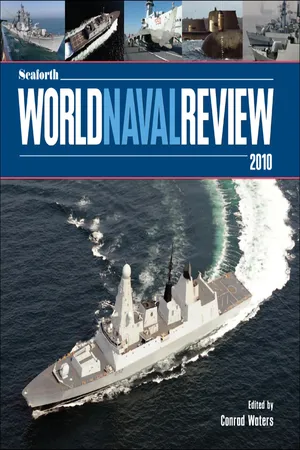
Seaforth World Naval Review 2010
About this book
The World Naval Review is designed to fill the need for an authoritative but affordable summary of all that has happened in the naval world in the previous twelve months. It combines the standing features of regional surveys with one-off major articles on noteworthy new ships and other important developments. Besides the latest warship projects, it also looks at wider issues of importance to navies, such as aviation and electronics, and calls on expertise from around the globe to give a balanced picture of what is going on and to interpret its significance. Intended to make interesting reading as well as providing authoritative reference, there is a strong visual emphasis, including specially commissioned drawings and the most recently released photographs and artists' impressions.For anyone with an interest in contemporary naval affairs, whether an enthusiast or a defence professional, this annual is set to become required reading.
Trusted by 375,005 students
Access to over 1.5 million titles for a fair monthly price.
Study more efficiently using our study tools.
Information
1 OVERVIEW
INTRODUCTION
‘The sinews of war are infinite money’ wrote the renowned Roman statesman and orator Marcus Tullius Cicero during the first century BC. These words still hold good somewhat over 2,000 years later when reviewing the current state of the world’s navies. Whilst the continued global economic dominance of the United States has ensured the ongoing maintenance of the Pax Americana across the world’s oceans, the focus of international commercial activity and trade has been shifting steadily eastwards to the rapidly developing countries of the Asia-Pacific region. Although the full extent of the shift in the military balance will take longer to become apparent, it is already clear that the major Asian nations have formed a clear view of the advantages inherent in achieving ‘blue water’ maritime influence. At the moment, this awareness is largely made evident by the acquisition of the most up-to-date naval technology available from manufacturers in Europe, Russia or the US, albeit for installation in ships built increasingly in regional facilities. However, indigenous capabilities are expanding on the back of the rapid expansion of local industry. It is therefore not impossible to envisage a time when Mumbai, Ulsan and Shanghai come to rival the likes of Glasgow, Kiel or Newport News as the originators of the most potent warship designs.
Table 1.0.1: REGIONAL MILITARY EXPENDITURES 1988–2007

The extent to which the balance of military spending has shifted in the period since the end of the Cold War is demonstrated by the information collated by the independent and widely respected Stockholm International Peace Research Institute (SIPRI). Key figures are highlighted in Table 1.0.1.1 Overall global defence expenditure – at around US$1,200bn – has changed little in real terms in the period since the end of the Cold War. Within this figure, expenditure in Western and Central Europe has been broadly flat at just under US$300bn, whilst outlays in North America have increased from US$525bn to nearly US$600bn. However, spending by the Asian-Pacific nations has virtually doubled to US$200bn, thereby compensating for the collapse in the defence budgets of the former Soviet powers. Although it is important to view this information in some sort of context – the data suggests that the military spending of all the nations of Asia and Oceania combined remains little more than a third the amount committed by the United States – the general trend is clear. It is also worth noting that the SIPRI figures are based on market rather than ‘real world’ purchasing power parity exchange rates. In effect, the indicated level of spending in the higher-cost countries of the developed world buys less advantage than the headline figures suggest.
The way that changed spending patterns have impacted the maritime balance of power can also be considered through an examination of force numbers. Although pure numerical comparisons are always subject to considerable hazard – for example, how meaningful is it to compare a state-of-the-art Type 45 destroyer with its 1950s Type 41 Leopard class predecessors still serving in Bangladesh’s fleet – the data in Table 1.0.2 does provide scope for a number of observations.

Asian navies have become more influential in world maritime affairs. Here China’s new Type 052B destroyer Guangzhou and Pakistan’s older Type 21 frigate Badr are seen during a Pakistan-hosted multinational exercise in the Indian Ocean in an image that also depicts ships from Bangladesh and the USN. (US Navy)
■ Although nearly all the major fleets have shrunk in size since the end of the Cold War, the relative strength of the major Asian maritime nations has increased during this time. This undoubtedly reflects the budgetary environment already discussed. There has also been a significant shift in the balance of these regional fleets away from coastal and patrol forces in favour of more complex and deployable fleet units.
■ The decline in Russian naval power since the end of the communist era is readily apparent. Overall fleet size is less than a third of its peak total. Recent signs of a resumption of Russian global deployments coupled with hyperbole from the country’s politicians about the restoration of its former maritime influence have lead to suggestions that this decline is being reversed. However, it is difficult to envisage a return to a situation even close to the previous status quo without a generation’s worth of sustained effort that is probably beyond Russia’s current economic potential. It should also be noted that nearly all the current naval units listed are ageing Soviet-era designs, with the rundown local shipbuilding industry seemingly unable to complete replacements in any quantity.
■ Although the United States Navy (USN) has also experienced a significant reduction in size, it still remains the dominant blue water maritime power by a considerable margin. This is all the more so when the technological capabilities of its units are taken into account.
■ Looking at the broader picture, there has been a general shift in fleet composition, largely in line with the changed global political environment. This is most evident in the significant decline in Cold War-orientated submarine forces, as well as in the flotillas of patrol escorts that were configured to counter them. In contrast, there has been considerable investment in major amphibious vessels as a result of the greater emphasis being placed on expeditionary warfare and the desirability of being able to intervene in the offshore waters of the littoral. Technological considerations have also seemingly played a part. For example, the decline in fast attack craft possibly reflects the vulnerability of this type to helicopter and other countermeasures revealed during the Second Gulf War.2 Similarly, whilst the decline in mine countermeasures vessels might appear strange given increased interest in amphibious operations, this is partly explained by the development of modularised remote mine-hunting systems and airborne alternatives.
This first edition of the new Seaforth World Naval Review attempts to provide an up-to-date overview of what is – necessarily – an evolving situation. Its methodology is to look at the current naval scene from three principal perspectives.

Pure numerical comparisons are always subject to considerable hazard. The Philippine Second World War vintage Cannon class patrol frigate Rajah Humabon (ex USS Atherton), above, and Oman’s modern Qahir class QahirAl Amwaj (below) are both light surface escorts of broadly similar size but their capabilities are not comparable. (US Navy / Conrad Waters)

FLEET REVIEWS
The initial area of focus is on specific navies. The four regional review sub-sections provide an overview of the current composition of the world’s major fleets, major operational developments and the strategic objectives that are driving future force levels and associated procurement decisions. A common theme is the extent to which the desire to maintain – or even increase – warship numbers has to be set against other, often conflicting, objectives. These include – particularly in the more advanced navies of the Western nations – the need to balance pure technological proficiency against affordability if numerical targets are to be achieved. Another interesting trade-off – possibly most keenly felt by the developing maritime powers – is the extent to which the time and cost penalties associated with developing indigenous design and build facilities should be prioritised over more readily available ‘off the shelf’ acquisitions. Often the answers to these questions are not purely driven by military considerations, with commercial and political issues also playing a part. To help put these challenges into perspective, the main geographical reviews are supported by more detailed supplements discussing the procurement and construction programmes being implemented by four of the world’s largest fleets. Scott Truver’s review of the USN indicates the extent to which even the most generously-resourced fleets face problems in striking a match between cutting-edge capability and the deployment of an adequate number of ships. This is resulting in some significant changes to acquisition priorities, as evidenced by the decision to curtail construction of the Zumwalt (DDG-1000) class destroyers at just three ships in favour of the tried and tested Arleigh Burke (DDG-51) design. The strains inherent in this search for cost-effectiveness become even more acute when budgets are more limited, as Richard Beedall’s overview of current British Royal Navy transformational shipbuilding projects makes clear. China’s People’s Liberation Army Navy (PLAN) appears to benefit from a more favourable financial backdrop and Dawei Xia’s article describes some of the impressive new ships it is putting into service. The development of a substantial merchant shipbuilding sector has doubtless helped this process. In spite of a significant history of warship construction, the rival Indian Navy appears to be facing more of a struggle commissioning its more recent indigenous designs. However, as described by Mrityunjoy Mazumdar, there is a strong local willingness to develop the necessary infrastructure needed to support the requirements of an increasingly influential naval power.

An artist’s impression of the DDG-1000 class destroyer Zumwalt. The USN’s decision to curtail construction of the design at just three units demonstrates that even the most generously-resourced fleets have to live within their means. (Northrop Grumman)
SIGNIFICANT WARSHIPS
The current naval scene is next examined in the context of some of the more significant new warship designs that are now being put into service. The time taken to design, construct and commission major warships seems to be expanding as technological complexity increases. For example, preliminary studies into the replacement of Britain’s Invincible class support carriers began in the early 1990s but it is likely to be 2015 before the first of the replacement Queen Elizabeth class enters service.3 As a result, all but the most recently-built ships have their origins in the requirements of the Cold War and it is only now that a response to the asymmetric threats of early twenty-first century warfare is becoming apparent in warship design. A particularly good example of this new generation of warships is the USN’s first littoral combat ship Freedom (LCS-1), which is described by Scott T...
Table of contents
- Cover
- Title Page
- Copyright
- Contents
- Section 1: Overview
- Section 2: World Fleet Reviews
- Section 3: Significant Ships
- Section 4: Technological Reviews
Frequently asked questions
Yes, you can cancel anytime from the Subscription tab in your account settings on the Perlego website. Your subscription will stay active until the end of your current billing period. Learn how to cancel your subscription
No, books cannot be downloaded as external files, such as PDFs, for use outside of Perlego. However, you can download books within the Perlego app for offline reading on mobile or tablet. Learn how to download books offline
Perlego offers two plans: Essential and Complete
- Essential is ideal for learners and professionals who enjoy exploring a wide range of subjects. Access the Essential Library with 800,000+ trusted titles and best-sellers across business, personal growth, and the humanities. Includes unlimited reading time and Standard Read Aloud voice.
- Complete: Perfect for advanced learners and researchers needing full, unrestricted access. Unlock 1.5M+ books across hundreds of subjects, including academic and specialized titles. The Complete Plan also includes advanced features like Premium Read Aloud and Research Assistant.
We are an online textbook subscription service, where you can get access to an entire online library for less than the price of a single book per month. With over 1.5 million books across 990+ topics, we’ve got you covered! Learn about our mission
Look out for the read-aloud symbol on your next book to see if you can listen to it. The read-aloud tool reads text aloud for you, highlighting the text as it is being read. You can pause it, speed it up and slow it down. Learn more about Read Aloud
Yes! You can use the Perlego app on both iOS and Android devices to read anytime, anywhere — even offline. Perfect for commutes or when you’re on the go.
Please note we cannot support devices running on iOS 13 and Android 7 or earlier. Learn more about using the app
Please note we cannot support devices running on iOS 13 and Android 7 or earlier. Learn more about using the app
Yes, you can access Seaforth World Naval Review 2010 by Conrad Waters in PDF and/or ePUB format, as well as other popular books in History & Military & Maritime History. We have over 1.5 million books available in our catalogue for you to explore.