- 352 pages
- English
- ePUB (mobile friendly)
- Available on iOS & Android
eBook - ePub
About this book
This new history of the Royal Navy, published to coincide with the Golden Jubilee of the White Ensign Association, is a full and exciting account of all the many campaigns, operations and deployments conducted around the world from the Cold War and the Cod Wars to the Falklands War and the Gulf Wars. It has been written and compiled from privileged access to secret and confidential Admiralty Plans and Commanding Officers' reports and contains a wealth of previously unpublished material. The story of how the Royal Navy has adapted to meet the many new challenges of the modern world and how it has carried out its vital roles from manning the nation's strategic nuclear deterrent to guarding the vital offshore oil and gas facilities as well as protecting Britain's worldwide interests is a truly fascinating one, while the development of ships, submarines, aircraft, weapons, tactics and strategies as well as the changes in personnel and life at sea are brought to life by contributions from people who served over the period. Profusely illustrated throughout with many previously unpublished photographs and paintings, this beautifully-produced volume is a magnificent golden jubilee tribute to the Royal Navy.
Information
CHAPTER 1
Genesis of the Modern Navy 1957–1959
THE COLD WAR – NUCLEAR, NATO AND NAVAL STRATEGY – THE POST-SUEZ DEFENCE REVIEW AND FLEET REDUCTIONS – CYPRUS EMERGENCY – MIDDLE EAST CRISIS AND OPERATION FORTITUDE – FIRST COD WAR – OPERATION GRAPPLE AND NUCLEAR WEAPONS
FIRST SEA LORDS Admiral of the Fleet the Earl Mountbatten of Burma and Admiral Lambe
SECOND SEA LORDS Admirals Lambe and Holland-Martin
NAVAL MANPOWER 121,500
MERCANTILE MARINE 5,508 merchant ships1
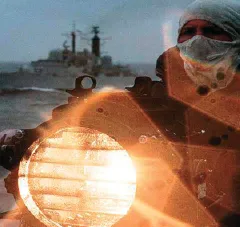
A traditional challenge being flashed from a Royal Navy destroyer
(NN)
(NN)
At dawn on a clear day in the western Mediterranean two warships, a US cruiser and a British destroyer, were on a converging course some sixty miles south-east of Gibraltar. The sea was flat calm with the early morning sun rising over the eastern horizon. The ships were approaching each other at a combined speed of over twenty-eight knots. When they had closed to within visual range a challenge was flashed from the signal deck of the larger warship, a US heavy cruiser of the 6th Fleet. A short while later, on receipt of the correct identification signal, a brief further message was flashed from the US cruiser: ‘Greetings to the second biggest navy in the world!’ She then courteously dipped her ensign in the traditional salute to the Royal Navy.
An equally brief reply was flashed back from the bridge of the Royal Navy destroyer as she hove to on the cruiser’s starboard bow: ‘Greetings to the SECOND BEST navy in the world!!’ The destroyer then dipped her ensign, acknowledging the salute from the US cruiser.2
This story of the exchange of signals between the Royal Navy and the United States Navy in the Mediterranean, some time after the end of World War II, poignantly summed up the dramatic change of status of the Royal Navy. For nearly 200 years, from the Seven Years War (1756–63) to World War II, the Royal Navy had been the supreme maritime power, exercising command of the sea and dominating the world’s oceans. She had played the key role in supporting and defending the British Empire. At the end of World War II the Royal Navy had 8,940 ships and vessels of all types in commission and 864,000 people in uniform, yet the United States Navy was even bigger. Despite this the traditions, expertise and standards set and maintained by the ‘Senior Service’ of the world’s leading maritime nation remained second to none.
Although the United States Navy had overtaken the Royal Navy in terms of size, Britain still held her position as the world’s greatest maritime nation. The Royal Navy and Merchant Navy combined outnumbered the total number of warships and registered merchant ships belonging to the United States. Britain’s merchant fleet was to remain the world’s largest until well into the 1960s.3 Britain clearly remained a great maritime trading nation dependent on the sea. Over forty years later, in 2001, the First Sea Lord, Admiral Sir Alan West, stated that ‘The Royal Navy was still the second most powerful Navy in the world and certainly the best.’4
The early post-war years were overshadowed by Britain’s rapid economic, industrial and political decline as she struggled to shoulder the crippling burden of paying the cost of the war and rebuilding her shattered industries and infrastructure. The national debt had soared to a record level and Britain was unable to pay the ‘Lend-Lease’ debt to America at the end of World War II. Britain was forced to take on a further loan of $3,750 million to be repaid in fifty equal payments until 2001.
In step with the huge economic and political decline was the continued break-up of the British Empire. By the mid-1950s only a relatively small number of colonies and protectorates were left of an empire which at its peak, in 1921, had covered a quarter of the surface of the globe, and included a quarter of the world’s population. It was known as ‘the empire on which the sun never set’.
Britain’s true place in the new world order was finally recognised in the Defence White Paper of 1957 (Cmnd. 230), which resulted from a fundamental defence review ordered in response to Britain’s rapidly declining economic situation. It was a defining moment for the armed forces of the United Kingdom marking the major shift in defence policy from large expensive conventional forces to smaller specialised forces more reliant on nuclear weapons and missiles. It was a watershed for the Royal Navy, being the turning point from the old traditional imperial navy towards the modern Royal Navy of the nuclear age.
NATO, NUCLEAR DEFENCE POLICY AND NAVAL STRATEGY
At the end of the fifties the government of the United Kingdom had four prime requirements for their naval and military planners to meet: defence of the realm, maintenance of defence commitments to NATO and the mainland of Europe, support of the colonies and overseas interests, and finally the protection of Britain’s worldwide trade. Whilst the first two requirements were met in conjunction with allies, the last two were covered solely by the armed forces of the UK, primarily the Royal Navy.
The Cold War By 1957 the ‘Third World War’, commonly known as the ‘Cold War’, had reached its eighth year. Predominantly a political and economic war of force deployment, manoeuvre and military technology, it was fought slowly and with much less intensity than its two immediate predecessors between 1914 and 1945. Nevertheless it was a perilous and dangerous confrontation, which seriously threatened the Western world with catastrophic destruction. It dominated all defence planning and expenditure, and nuclear weapons became the key components of the overall strategy.
HMS Vanguard
The Last of the Vanguard Class Battleships
The Vanguard was the very last of the battleships and had been replaced by the aircraft carrier as the capital ship of the fleet.
Launched: | 30 November 1944 |
Commissioned: | 9 August 1946 |
Displacement: | 46,000 tonnes |
Length: | 246.8m |
Propulsion: | 8 Admiralty 3-drum water-tube boilers, 4 Parsons single reduction steam turbines, 4 shafts |
Armament: | 8 BL 15 in guns in 4 twin mountings, 16 QF 5.25 in guns in 8 twin mountings, 54 40mm Bofors AA guns in 9 sextuple mountings, 2 40mm Bofors AA guns in twin mounting, 11 40mm Bofors AA guns in single mountings and 4 QF 47mm saluting guns |
Complement: | 1,500 |
No. in class: | 1 |
NATO As the political situation in Europe had steadily deteriorated and the threat from the Soviet Union had relentlessly increased, the Western allies explored their common defence needs. The Washington Treaty of 1949, built on the ‘Western Union’ Brussels Treaty of 1948, established NATO as the security alliance for the collective self-defence of the West. By the end of that year NATO had formulated its defence strategy (the Strategic Concept for the Defence of the North Atlantic Treaty Area-DC 6). DC 6 set out the basic principles of military co-operation and force co-ordination to provide collective defence in the event of an attack against any member state.
Military Strategy DC 6 was then refined and modified to respond to the growing might of the Soviet armed forces, mostly land and air forces. The NATO Military Committee set out the allied military planning framework in Plan MC 14, and the detailed military strategy (MC 14/1) was finally approved in December 1952.
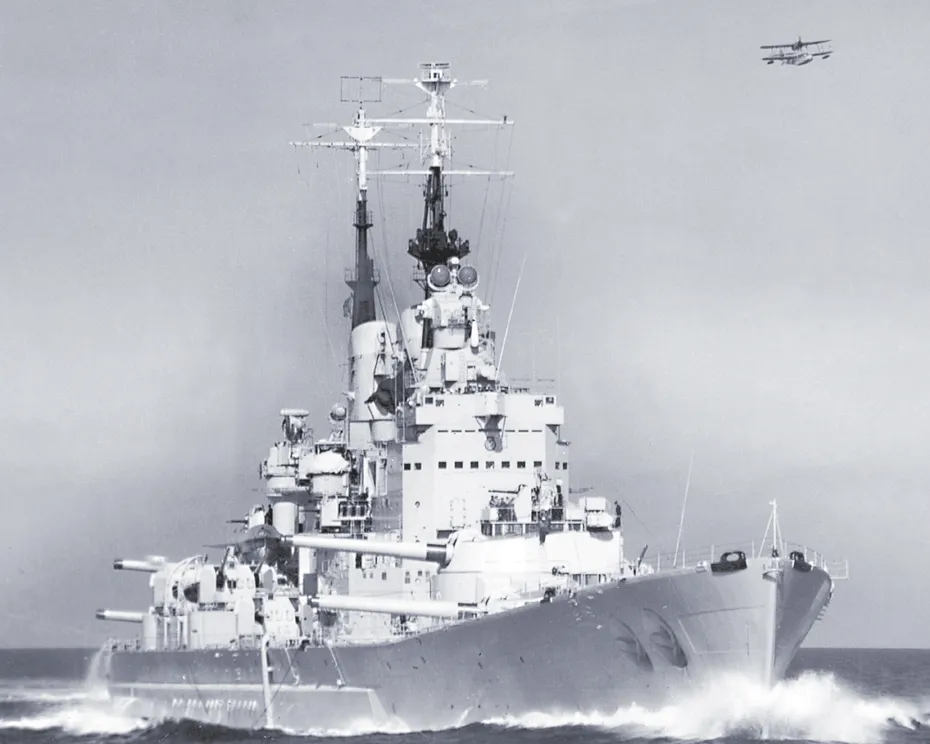
The battleship Vanguard, flagship of the Reserve Fleet
(RNM)
(RNM)

The Royal Yacht Britannia leadingthe Fleet
(RNM)
(RNM)
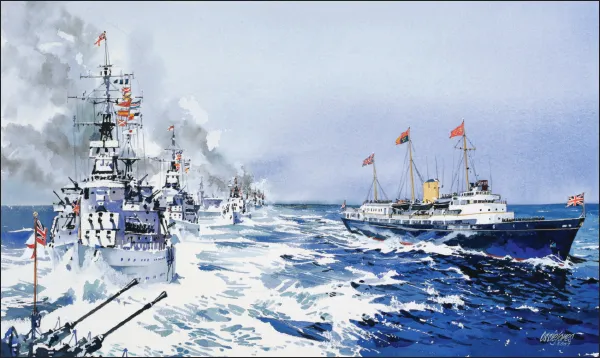
Cruisers firing the traditional royal salute
(OJ) (CH) (RC)
(OJ) (CH) (RC)

Operation Steadfast
(NN)
(NN)
Nuclear Strategy By the mid-fifties the West had become thoroughly alarmed by the massive build-up of Soviet and Warsaw Pact conventional forces and realised it would have little alternative but to depend on nuclear weapons in order to counter them. Fears of Warsaw Pact aggression and expansionism were further fuelled by Soviet intervention in Hungary and the Lebanon in 1956. Consequently in 1957 the Allies formulated the fundamental NATO strategy of ‘massive retaliation’, known as the ‘trip wire’ strategy, whereby the Alliance would use nuclear weapons to respond to any major Soviet attack. By concentrating on nuclear weapons the NATO Allies reduced the need to inflate their defence spending on expensive conventional forces in order to try and match the huge Soviet arms build-up. As regards naval strategy, the effect of a short war scenario was to reduce the reliance of NATO and Europe on resupply across the Atlantic and hence lessen the importance of ASW (anti-submarine-warfare) ships. The NATO strategy was however inherently dangerous, as the Soviets had already developed a hydrogen bomb, and in 1957 they successfully launched their first satellite, ‘Sputnik’ with an SS-6 Sapwood ICBM (intercontinental ballistic missile).
In 1958 Khrushchev demanded the withdrawal of all Western occupying forces from Berlin. Next, after the Cuban Revolution in 1959, he formed an alliance with Fidel Castro and was in a position to start deploying forces in close proximity to the United States. East-West tension was steadily rising by the turn of the decade.
UK Defence Review 1957 In the Suez Crisis of 1956 Britain and France had launched Operation Musketeer against Egypt in response to President Nasser’s nationalisation of the Suez Canal. The military operation had been a success but severe economic pressure from the USA had forced a cease-fire and an embarrassing climb-down by Britain and France. Anthony Eden, the British Prime Minister, resigned on 9 January 1957 and was replaced by Harold Macmillan. One of Macmillan’s early actions was to order Duncan Sandys, his new Defence Minister, to carry out a fundamental defence review. The main driver of the review was the need to achieve huge savings in the defence budget in order to ease the many pressures on the failing British economy. The result was the Defence White Paper (Cmnd. 230), published in April 1957 and entitled ‘Defence: Outline of Future Policy’. The White Paper set out huge cuts in equipment and reductions in uniformed manpower acro...
Table of contents
- Cover
- Title Page
- Copyright
- Contents
- Foreword: Admiral HRH the Prince of Wales KG, KT, OM, GCB, AK, QSO, ADC, Patron of the White Ensign Association
- Preface: Commodore Sir Donald Gosling KCVO, RNR, President of the White Ensign Association
- Introduction: Admiral the Lord Boyce GCB, OBE, DL, Chief of the Defence Staff 2001–2003
- Chapter 1: Genesis of the Modern Navy 1957–1959
- Chapter 2: Post-Imperial Peace-Keeping 1960–1964
- Chapter 3: The Strategic Nuclear Deterrent and Beira Patrol 1965–1969
- Chapter 4: Evacuations, Withdrawals and the Group Deployment Concept1970–1974
- Chapter 5: NATO Maritime Strategy in the North Atlantic and Out-of-Area Group Deployments 1975–1979
- Chapter 6: Operation Corporate: The Falklands Campaign 1980–1982
- Chapter 7: Reprieve, Consolidation and Orient Express 1983–1985
- Chapter 8: Forward Maritime Strategy and the End of the Cold War 1986–1989
- Chapter 9: The Peace Dividend and the First Gulf War 1990–1992
- Chapter 10: Operation Grapple in the Adriatic 1993–1995
- Chapter 11: Ocean Wave 97 Deployment and Operation Bolton 1996–1998
- Chapter 12: Operations Bolton, Palliser and Anaconda 1999–2001
- Chapter 13: The Second Gulf War – Operation Telic 2002–2004
- Chapter 14: Operations Telic and Herrick and the Fleet Review 2005–2006
- Chapter 15: Ongoing Operations in Iraq and Afghanistan 2007–2009
- Epilogue
- Maps
- Notes
- Sources
- Ships of the Royal Navy
- Royal Navy Operations 1957–2009
- The British Empire and the Royal Navy
- First Sea Lords, Presidents and Chairmen of the White Ensign Asssociation
- Glossary of Terms and Abbreviations
- Acknowledgements
Frequently asked questions
Yes, you can cancel anytime from the Subscription tab in your account settings on the Perlego website. Your subscription will stay active until the end of your current billing period. Learn how to cancel your subscription
No, books cannot be downloaded as external files, such as PDFs, for use outside of Perlego. However, you can download books within the Perlego app for offline reading on mobile or tablet. Learn how to download books offline
Perlego offers two plans: Essential and Complete
- Essential is ideal for learners and professionals who enjoy exploring a wide range of subjects. Access the Essential Library with 800,000+ trusted titles and best-sellers across business, personal growth, and the humanities. Includes unlimited reading time and Standard Read Aloud voice.
- Complete: Perfect for advanced learners and researchers needing full, unrestricted access. Unlock 1.4M+ books across hundreds of subjects, including academic and specialized titles. The Complete Plan also includes advanced features like Premium Read Aloud and Research Assistant.
We are an online textbook subscription service, where you can get access to an entire online library for less than the price of a single book per month. With over 1 million books across 990+ topics, we’ve got you covered! Learn about our mission
Look out for the read-aloud symbol on your next book to see if you can listen to it. The read-aloud tool reads text aloud for you, highlighting the text as it is being read. You can pause it, speed it up and slow it down. Learn more about Read Aloud
Yes! You can use the Perlego app on both iOS and Android devices to read anytime, anywhere — even offline. Perfect for commutes or when you’re on the go.
Please note we cannot support devices running on iOS 13 and Android 7 or earlier. Learn more about using the app
Please note we cannot support devices running on iOS 13 and Android 7 or earlier. Learn more about using the app
Yes, you can access Safeguarding the Nation by John Roberts in PDF and/or ePUB format, as well as other popular books in History & Military & Maritime History. We have over one million books available in our catalogue for you to explore.