eBook - ePub
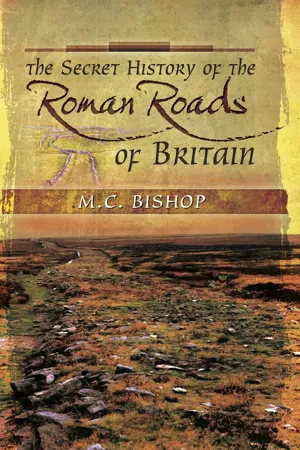
The Secret History of the Roman Roads of Britain
And Their Impact on Military History
- 210 pages
- English
- ePUB (mobile friendly)
- Available on iOS & Android
eBook - ePub
About this book
There have been many books on Britain's Roman roads, but none have considered in any depth their long-term strategic impact. Mike Bishop shows how the road network was vital not only in the Roman strategy of conquest and occupation, but influenced the course of British military history during subsequent ages. The author starts with the pre-Roman origins of the network (many Roman roads being built over prehistoric routes) before describing how the Roman army built, developed, maintained and used it. Then, uniquely, he moves on to the post-Roman history of the roads. He shows how they were crucial to medieval military history (try to find a medieval battle that is not near one) and the governance of the realm, fixing the itinerary of the royal progresses. Their legacy is still clear in the building of 18th century military roads and even in the development of the modern road network. Why have some parts of the network remained in use throughout?The text is supported with clear maps and photographs. Most books on Roman roads are concerned with cataloguing or tracing them, or just dealing with aspects like surveying. This one makes them part of military landscape archaeology.
Trusted by 375,005 students
Access to over 1 million titles for a fair monthly price.
Study more efficiently using our study tools.
Information
Chapter 1
The Prehistory of Roman Roads
Preamble
What did the Roman find when he arrived in the first century AD? He found a trackway already 2,000 years old. It was not engineered, and would have abounded in hollows, ruts and obstructions of all kinds. At intervals along the route there were the banks and ditches of the Early Iron Age period, demarcating the territorial boundaries. Here was a route which he could use. From the several more or less parallel tracks he chose that which was most direct and most suitable, and straightened it where necessary. The Viatores1
Compare and contrast that view with this:
It is sometimes said that most main Roman roads in Roman Britain are based on pre-existing British tracks. While it is, indeed, certain that there were such tracks, and that they had clearly developed widely before the Roman conquest, even a general account would be uselessly fragmentary, since virtually nothing is known of them in detail. The well-attested examples, however, do not coincide in general with the Roman roads, which were unquestionably designed as instruments of conquest, as in other provinces. Collingwood and Richmond2
There is a popular misconception that the Romans brought the idea of roads to Britain (Plate 1), but nothing could be further from the truth. Every few years, scholars rediscover the idea of pre-Roman roads in British archaeology and then seemingly forget about it again. Dramatic headlines greeted the recent discovery of what appeared to be Iron Age road surfaces at Sharpstone Hill (Staffordshire); likewise, at the time of writing, a brand new book makes dramatic claims about the prehistoric origins of ‘Roman’ roads. However, earlier generations of historians and archaeologists had little trouble in dealing with the concept of roads before the Romans. Indeed, this very notion led Alfred Watkins to propose his Old Straight Track theory which, for all its flaws, recognized the importance of roads in prehistory. One of the most interesting approaches to Roman road studies in recent years has been a diachronic study of Akeman Street from the prehistoric into the Roman periods. What Sharpstone Hill provided was convincing archaeological evidence brought to the attention of a wider public.3
However, it is not necessary to cite large numbers of excavated examples of prehistoric roads in order to show that roads were not a Roman invention. To demonstrate this, we need only consider what might be termed Plautius’ Dilemma, which (hypothetically expressed in the modern form of a multiple choice question) is this:
You are the commander of the Roman invasion force of about 40,000 troops. Arriving at the coast of Britain in AD 43. Do you
a) begin building all-weather roads to move your troops towards their ultimate goal of Colchester,
b) start marching them (and their baggage train) across country towards that destination, or
c) make use of existing roads to achieve the same ends?
It does not take a genius to work out that a) will take too long (see below page 19), b) will take almost as long and be completely impractical for wheeled transport (historically, armies have never marched across country when it can be avoided), and that c) implies and requires the existence of pre-Roman roads of some sort. Assuming – for the sake of argument, as it is by no means universally agreed upon by scholars – that Plautius landed on the south-east coast of Kent at Richborough, was there an existing route available to him?4
The so-called Pilgrim’s Way was a ridgeway along the North Downs. Originating at Winchester, it passed through Guildford, Farnham, Snodland, Charing, to Canterbury, and originally continued as far as Dover (Figure 1). Despite its name, this was probably not the route used by Chaucer’s pilgrims in the Canterbury Tales (who will more likely have followed the metalled Roman road – Margary 1). Four of the five places mentioned by Chaucer (Deptford, Greenwich, Sittingbourne, and Boughton) are indeed situated on the Roman road (as is the point of origin, Southwark) and another (assuming Bob-Up-And-Down to be Harbledown) probably was. However, the ridgeway does provide the most natural route from the south-east coast to the lowest Thames crossing and its use by the Roman invading force has long been accepted as a possibility by modern writers.5

Figure 1: A ridgeway? The Pilgrim’s Way (and its Roman successors).
So how did the Roman conquest of Britain progress from that point? It is not unreasonable to suggest that it continued in the same vein – using existing routes. Therefore, before we consider the Roman network, we must examine this prehistoric system and how it relates to its Roman successor.
Types of prehistoric roads and tracks
The existence of prehistoric trackways (Figure 2) is certainly accepted and referred to by modern writers – although the antiquity of the so-called ridgeways has been called into question – and in recent times some have even been excavated, most prominently the wooden trackways of the Somerset Levels. There are indeed writers on the subject of Roman roads who acknowledge the debt the Roman system owes to its native predecessor, including Hillaire Belloc. Nevertheless, the idea that roads that could be used by wheeled transport were already in existence at the time of the Roman conquest is seldom voiced, despite the fact that such early vehicles are indeed archaeologically attested: the earliest wooden wheel from Scotland (and, it so happens, Britain), for instance, dates to c. 1255–815 BC. However, one scholar (who had better remain nameless) remarkably even went so far as to suggest that wheeled Bronze Age vehicles were purely for the purposes of display, since no roads existed, so it seems clear that the role of the road in prehistoric Britain has not been overemphasized.6

Figure 2: The prehistoric trackways of central southern England according to Hippesley Cox (1944).
Given that excavation of them is so rare, proving that a route is prehistoric is by no means easy. It is not as if one can trace the outline of a footprint and identify it as pre-Roman. Some of the upland trackways and ridgeways in Britain have a fairly obvious antiquity if they can be identified over long distances but have not been made into modern roads. Moreover, in the case of both such ‘obvious’ candidates and their less-obvious brethren, close association with prehistoric monuments may be a good indicator of a direct and tangible relationship (although it does tend to beg the question ‘which came first: route or monument?’). Matters are made even more complicated by the tendency of all roads to ‘creep’ laterally across the landscape, and we shall be returning to that problem later in a Roman context (below, page 104). Nevertheless, it is probably true that we ought to be thinking more in terms of prehistoric ‘routes’, with often more than one track running parallel and their use perhaps dictated by seasonal conditions.7
Fortunately, some trackways are demonstrably prehistoric. As we have just seen, wooden footpaths across the Somerset Levels have been excavated and, by means of dendrochronology, these can be dated very accurately to the Bronze Age and even into the Neolithic. Although not used by wheeled traffic, they nevertheless demonstrate a familiarity with routes and the need to produce them where they did not already exist. It would surely be unreasonable to believe that these were the only such tracks in prehistoric Britain. Indeed, in Ireland, a 3.5–4 metre-wide wooden plank trackway (at Corlea in County Longford), dating to 146 BC, appears to have been specifically designed to take wheeled vehicles. It is difficult to avoid the suspicion that trackways preserved by exceptional environmental conditions – such as bogs – may be just the visible component of a largely invisible network of trackways and routes across the British Isles. Possible (but by no means certain) Bronze Age and Iron Age bridges have been identified on the Thames at Eton and Vauxhall.8
In fact, rural pre-Roman roads are known and, once again, some have even been excavated. A track has been identified crossing the Bronze Age landscape of Holne Moor in Devon. Further north, a type of Iron Age settlement, known as a ‘ladder settlement’, was in fact a linear landscape focused on a trackway of some kind (which happens to look like a ladder laid out on the ground when viewed from the air). Excavation of an example at Melton (E Yorks) failed to find any evidence of metalling but did locate roadside ditches and confirmed the complex nature of this Iron Age and Romano-British rural settlement. At Mount Pleasant, near Crambeck (N Yorks), a similar settlement showed such continuity from the Iron Age into the Roman period (Figure 3), laid out along a side road leading to the main Roman road from York to Malton in North Yorkshire (Margary 81a). Not only was the surface metalled (albeit using the living rock), but wheel ruts were evident in the pre-Roman surface. The fact that the road served as a link to the Roman-period road points to it having served the same purpose in the earlier period: clearly, one might conclude that not only the side road but the road from York to Malton itself pre-dated the Roman invasion. Minor roads like these were certainly a feature of the Romano-British landscape, but it is becoming clear that these are the legacy of an earlier period. It is perhaps worth noting that examples of such pre-Roman roads associated with rural settlements tend to be slightly sinuous and not straight. In this, they contrast with formally-constituted ‘Roman’ roads (although many evidently continued in use into the Roman period) and, crucially, with the proposed ley line routes favoured by Watkins as prehistoric roadways.9
It has already been mentioned that a number of long-distance trackways are known that are commonly presumed to be prehistoric in origin. These include famous routes like the Ridgeway (now formalized as a National Trail from Overton Hill in Wiltshire to Ivinghoe in Buckinghamshire) and the Icknield Way (from Ivinghoe to Knettishall in Norfolk). As Rackham has pointed out, a principal reason for identifying these as prehistoric used to be the rather misguided notion that early people only settled (and travelled) on high ground, since all the valleys would be full of woodland and impassable rivers. We now know this to be untrue (not least because of evidence like that from the excavations in the Somerset Levels), but as most of them do pass close to prehistoric monuments, the claim that they are prehistoric is probably true. At the same time, it might be argued that it would be very difficult indeed for a route to pass through much of Britain without passing close to at least a few prominent monuments (Plate 2).10

Figure 3: Trackway with a ladder settlement at Mount Pleasant, Crambeck (after Abramson et al. forthcoming).
At least two trackways in the Peak District have been identified, passing a number of prehistoric monuments, including henges and hillforts, such as Arbor Low. The connection between prehistoric (and Roman) routes with prehistoric monuments is prominent and probably more than coincidental, as we shall see.11
Deduced examples
In some instances, the existence of a prehistoric route is indicated by its partial re-use by a Roman road. At Roecliffe, near Boroughbridge in North Yorkshire, a Roman fort guards a probable river crossing for a north–south route running parallel to the Roman Dere Street (Margary 8b), which itself crossed the Ure ...
Table of contents
- Front Cover
- Dedication
- Title Page
- Copyright Page
- Contents
- List of Figures
- List of Plates
- Acknowledgements
- Preface and Introduction
- Chapter 1 The Prehistory of Roman Roads
- Chapter 2 Conquest and Construction
- Chapter 3 Development and Use
- Chapter 4 After the Romans
- Chapter 5 Rediscovery
- Chapter 6 Conclusions
- Chapter 7 Further Reading
- Appendix 1 Margary’s Road Numbers
- Appendix 2 Early Medieval Battlefields and Roman Roads
- Appendix 3 Medieval Battlefields and Roman Roads
- Appendix 4 Post-Medieval Battlefields and Roman Roads
- Appendix 5 Possible Roman Roads in North-East England and South-East Scotland
- Notes
- Bibliography
Frequently asked questions
Yes, you can cancel anytime from the Subscription tab in your account settings on the Perlego website. Your subscription will stay active until the end of your current billing period. Learn how to cancel your subscription
No, books cannot be downloaded as external files, such as PDFs, for use outside of Perlego. However, you can download books within the Perlego app for offline reading on mobile or tablet. Learn how to download books offline
Perlego offers two plans: Essential and Complete
- Essential is ideal for learners and professionals who enjoy exploring a wide range of subjects. Access the Essential Library with 800,000+ trusted titles and best-sellers across business, personal growth, and the humanities. Includes unlimited reading time and Standard Read Aloud voice.
- Complete: Perfect for advanced learners and researchers needing full, unrestricted access. Unlock 1.4M+ books across hundreds of subjects, including academic and specialized titles. The Complete Plan also includes advanced features like Premium Read Aloud and Research Assistant.
We are an online textbook subscription service, where you can get access to an entire online library for less than the price of a single book per month. With over 1 million books across 990+ topics, we’ve got you covered! Learn about our mission
Look out for the read-aloud symbol on your next book to see if you can listen to it. The read-aloud tool reads text aloud for you, highlighting the text as it is being read. You can pause it, speed it up and slow it down. Learn more about Read Aloud
Yes! You can use the Perlego app on both iOS and Android devices to read anytime, anywhere — even offline. Perfect for commutes or when you’re on the go.
Please note we cannot support devices running on iOS 13 and Android 7 or earlier. Learn more about using the app
Please note we cannot support devices running on iOS 13 and Android 7 or earlier. Learn more about using the app
Yes, you can access The Secret History of the Roman Roads of Britain by M.C. Bishop in PDF and/or ePUB format, as well as other popular books in History & Military & Maritime History. We have over one million books available in our catalogue for you to explore.