"The most iconic tank for the Red Army in World War II . . . a pictorial history of the design, development and usage of the T-34 and its derivatives." —
Military Archive Research
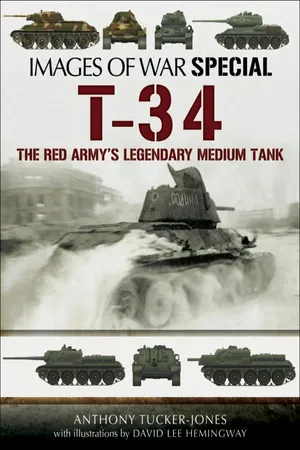
It could be said that the T-34 was the tank that won the Second World War. In total, 57,000 were produced between 1941 and 1945. Stalin's tank factories outstripped Hitler's by a factor of three to one, and production of the T-34 also exceeded that of the famed American M4 Sherman. Not only did this output swamp German panzer production, the T-34 was a robust, no-frills war-winning design—easy to manufacture and reliable. Its sloping armor was innovative at the time, and its wide tracks suited it to off-road warfare. Crucially, it required little maintenance in comparison to German tanks, and its chassis was used as the basis for a range of assault guns: the SU-85, SU-100, and SU-122.
Anthony Tucker-Jones's photographic history of this exceptional armored vehicle follows its story through the course of the war, from its combat debut against the Wehrmacht during Operation Barbarossa, through the Red Army's defeats and retreats of 1941 and 1942, to the tide-turning victories at Stalingrad and Kursk, and on through the long, rapid Soviet advance across Ukraine and Byelorussia to Berlin. As well as a range of rare archive photographs and those of a surviving example of the T-34, the book features specially commissioned color illustrations.
"There is a plethora of information for the modeler and armor enthusiasts . . . I really don't think you would go wrong with this book. Recommended." —inSCALE
- 160 pages
- English
- ePUB (mobile friendly)
- Available on iOS & Android
eBook - ePub
About this book
Information
Chapter One
Birth of a War Winner – T-34/76
Ironically it was a much-modified American tank design that indirectly gave rise to the birth of the T-34. Certainly very few features on the T-34 were original, as most of them had already appeared in one shape or another on earlier Soviet or foreign tanks. However, it was the right combination in one vehicle that was the great achievement of a young Soviet engineer by the name of Mikhail Koshkin and his team.
Koshkin was sent to the Kharkov Locomotive Factory (also known as the Komintern Factory) in Ukraine in 1936. The factory’s design bureau had been involved in modernising the BT fast tank and was under instruction to design a new medium tank, designated the A20, utilising the BT’s dual wheel/track facility. Alexander Morozov, who had designed the new V-2 diesel engine, was responsible for the power train; Nikolai Kucherenko and P. Vasihev led the suspension team, while M. Tarshinov was responsible for the armour.
Koshkin must have been uneasy about his appointment as head of the Kharkov design bureau. The vacancy had only come about because Comrade A. Firsov and many of his team responsible for the BT tank programme had been arrested following one of Stalin’s purges. Koshkin and his colleagues were also faced by the deeply entrenched vested interests of the other factories producing light and heavy tanks for the Red Army. In particular, the tank design bureau in Leningrad sought favour with Kliment Voroshilov, the Defence Commissar, by eventually naming their heavy tank the KV. Ironically Koshkin had started his career in Leningrad.
The draft design for the first Soviet ‘shell-proof’ tank, with greatly inclined armour, armed with a 45mm gun and weighing 17.7 tons, was completed in November 1937. General Dmitri Pavlov, head of the Directorate of Armoured Forces, wanted Soviet tanks to be shell-proof, specifically against the 37mm anti-tank gun. Likewise the engine needed updating as the petrol engine in service had a habit of catching fire; what was needed was a diesel engine with a low flashpoint.
Ironically, although General Pavlov concluded – wrongly – from the Spanish Civil War that massed armour was ineffective, he was in part responsible for the genesis of the T-34. Although he consigned the Red Army’s tanks to an infantry support role (which spelt disaster in 1941), he at least helped provide a tank that would ensure final victory.
The Spanish Civil War had shown that the anti-tank weapon had dominance over the tank on the battlefield. Making a tank shell-proof involved not only safeguarding it from small arms fire and shell splinters, but also from small-calibre artillery and anti-tank weapons. What the Red Army needed, in light of the performance of the Soviet BT-7 and T-26 tanks in Spain, was a tank that could withstand a shell from a 37mm anti-tank gun at any range and from a 76mm gun at 1,000m. Initial improvements were achieved by upgrading the BT-7.
The Soviet BT fast tank was a copy of the American Christie and the modernised version replaced the modified Soviet aero tank engine with a V-2 diesel unit that had been developed specifically for use in tanks. This gave increased range, cut down on maintenance and, crucially, offered better cold weather performance. The crews were doubtless happy with the change to diesel, it being less flammable than petrol. Another upgrade to the BT-7M, which would later be reflected in the T-34, was improved shot deflection achieved by replacing the boat-shaped hull front with an angled, sloping nose plate. A hull gun was also fitted, together with a 76.2mm partially stabilised turret gun.
The BT-7M was followed by the experimental BT-IS (investigator tank), which was fitted with sloping hull sides that extended over the top of the tracks to the full width of the vehicle. A sloping turret was also fitted. Both the BT-7M and the BT-IS greatly influenced the A20, which also had a sloped hull and retained the BT’s feature of being able to run on either the tracks or the road-wheels. This option, however, greatly increased the weight of the tank and caused difficulties in mass production and maintenance.
Koshkin and Morozov presented a wooden mock-up of the A-20 to the Defence Council of the Soviet Peoples’ Commissars in May 1938. Neither man was enthusiastic about the dual wheel/track capability. Koshkin had concluded that the Red Army seldom used the BT tank in the wheeled mode, which imposed severe design difficulties and weight problems on the manufacturers. Russia’s roads were such that being able to run the tank on just its wheels did not really offer any great advantages. Likewise during combat the crews were unlikely to bother changing the tracks to suit the conditions.
During a presentation to Stalin, the designers reasoned that the new tank needed at least 30mm of armour and a 76.2mm gun rather than the current standard 45mm tank gun. Crucially, though, the A20 turret could not take a larger-calibre weapon. This led to an enlarged design known as the A30, to be armed with a 76.2mm gun. Koshkin also pressed his case for abandoning the dual wheel/track feature, suggesting the A-32 would run only on tracks, which meant the armour could be increased to 60mm.
While Stalin seems to have been content to take advice from his experts, he cannot have been greatly encouraged by the Red Army’s existing medium and heavy tank designs. The multi-turreted T-35 heavy tank was a lumbering 50-ton monster and only sixty had been built. The Red Army’s only medium tank, the multi-turreted T-28, looked more like a heavy tank and was just as unwieldy.
As a result Koshkin and the Kharkov design team found themselves developing not one tank but three: the A-20, the A-30 and the A-32. The A-30 was quickly abandoned because its A20 turret could not take a larger weapon. But although the Soviet high command had accepted Koshkin’s proposal for the A-32 and authorised a prototype, they had not given up on the A-20. Both prototypes were completed at Kharkov at the beginning of 1939 and were subsequently displayed to the Armoured Directorate. The latter recommended the increase in armour on the A-32 and the more powerful gun, in accordance with Pavlov’s wishes.
Fortunately for the Red Army it already had a 76.2mm weapon in the form of the USV-39 (in later modification the ZiS-3) designed by Vasiliy Grabin. The Model 1936 and Model 1939 were the standard divisional field guns.* General B.L. Vannikov, head of Soviet armaments, was fulsome in his praise of this weapon:
The tank variant of the ZiS gun considerably outclassed the German tank guns in firing range and penetrating ability. The combination of a number of good tactical and technical qualities of the ZiS gun (light weight, small dimensions, convenience in operation, etc.) made it possible to outstrip the Germans and to design the T-34 tank with a 76mm calibre gun which had a high armour-piercing capability and good accuracy over great distances.
There was some discussion about arming the T-34 with an even larger gun. Marshal Kulik, head of the Main Artillery Directorate, suggested a 107mm weapon; this won approval with Stalin, who was familiar with a First World War field gun of similar size. In theory this would have been a war winner; in reality it was nonsense. Vannikov was aghast; such a tank gun did not exist and if it did it would need a much bigger turret. As a first step he suggested it would be simpler to increase the muzzle velocity of the 76mm gun and then progress to an 85mm gun. Kulik was of the opinion that tanks were a waste of time, as the artillery would simply knock them out. At every stage he opposed giving tank production a greater share of resources. Vannikov’s dogged opposition to Kulik resulted in him being arrested and imprisoned just before Hitler’s invasion of the Soviet Union. Subsequently Stalin had the good sense to release and reappoint him.

This photo shows (from left to right) the clear evolution of the BT-7M through the A-20 and T-34 Model 1940 to the T-34 Model 1941. This development reflected Koshkin’s proposals that the tank should only run on very wide tracks and that the sloped armour should be increased, along with the size of the gun.

The initial T-34 Model 1940 entered full-scale production in the autumn of 1940. It is recognisable by the rolled plate turret and the distinctive short L-11 76.2mm gun mounted in a cast cradle welded to a flush outside mantle. It also had a large single hatch, seen here in the open position.

A T-34 Model 1940 with the cast turret designed by V. Buslov and V. Nitsenko. Easier to produce than the initial rolled plate welded type, these cast turrets were produced at Gorkiy. They retained the single turret hatch.
On the eve of the Second World War in 1939 the A-32 prototype was extensively trialled, which led to modifications to the transmission. This final redesign by Koshkin’s team was known as Project T-34; it ran only on tracks, using the clutch and transmission brake system of steering. The suspension consisted of large distinctive road-wheels on sprung pivot arms as well as the pivoted front road-wheels seen in the earlier Christie-based designs. It was a simple tank with a rough but serviceable finish that was ideal for mass production. It had all-round sloping armour and was armed with the 76.2mm anti-tank gun, which was a much larger calibre than most tanks used at that stage.
Thanks to Kulik’s opposition to any sort of tank development, the initial model T-34 was fated to be armed with an inadequate main gun. There were three contenders: the L-11 from the Kirov factory in Leningrad, and the F-32 and the F-34 from Factory no. 92 at Gorkiy (formerly Nizhny Novgorod). Although the latter was the superior weapon and was ready for production, Kulik ensured that his Kirov factory got the work. Vasiliy Grabin, head of the design bureau at Gorkiy, took matters into his own hands and ordered the creation of a reserve stock of F-34s.
Kulik’s failure to authorise full production of the F-34 meant that the T-34 Model 1940 was armed with the L-11 and the KV-1 Model 1940 with the F-32. All subsequent models of both tanks were armed with the superior F-34, much to Kulik’s fury. The F-34 gun stayed in service until it was replaced by the D-5T and ZiS-S-53 85mm guns in the T-34/85. Kulik’s ineptitude also resulted in a shortage of 76.2mm shells, which meant that many T-34s and KV-1s went into battle without their full complement of ammunition.
The T-34 tank weig...
Table of contents
- Cover
- Title Page
- Copyright
- Contents
- Introduction: A War Winner
- Acknowledgements
- Prologue: Grievous Casualties
- Chapter One: Birth of a War Winner – T-34/76
- Chapter Two: A Winning Upgrade – T-34/85
- Chapter Three: T-34 Variants
- Chapter Four: Too Few Too Late
- Chapter Five: Moscow Miracle
- Chapter Six: T-34s in Ukraine
- Colour Plates
- Chapter Seven: T-34s in White Russia
- Chapter Eight: T-34s on the Seelow Heights
- Chapter Nine: T-34 Tank Aces
- Chapter Ten: T-34 Killers
- Chapter Eleven: Cold War T-34s
- Epilogue: Koshkin versus Kotin
- Further Reading
Trusted by 375,005 students
Access to over 1.5 million titles for a fair monthly price.
Study more efficiently using our study tools.
Frequently asked questions
Yes, you can cancel anytime from the Subscription tab in your account settings on the Perlego website. Your subscription will stay active until the end of your current billing period. Learn how to cancel your subscription
No, books cannot be downloaded as external files, such as PDFs, for use outside of Perlego. However, you can download books within the Perlego app for offline reading on mobile or tablet. Learn how to download books offline
Perlego offers two plans: Essential and Complete
- Essential is ideal for learners and professionals who enjoy exploring a wide range of subjects. Access the Essential Library with 800,000+ trusted titles and best-sellers across business, personal growth, and the humanities. Includes unlimited reading time and Standard Read Aloud voice.
- Complete: Perfect for advanced learners and researchers needing full, unrestricted access. Unlock 1.5M+ books across hundreds of subjects, including academic and specialized titles. The Complete Plan also includes advanced features like Premium Read Aloud and Research Assistant.
We are an online textbook subscription service, where you can get access to an entire online library for less than the price of a single book per month. With over 1.5 million books across 990+ topics, we’ve got you covered! Learn about our mission
Look out for the read-aloud symbol on your next book to see if you can listen to it. The read-aloud tool reads text aloud for you, highlighting the text as it is being read. You can pause it, speed it up and slow it down. Learn more about Read Aloud
Yes! You can use the Perlego app on both iOS and Android devices to read anytime, anywhere — even offline. Perfect for commutes or when you’re on the go.
Please note we cannot support devices running on iOS 13 and Android 7 or earlier. Learn more about using the app
Please note we cannot support devices running on iOS 13 and Android 7 or earlier. Learn more about using the app
Yes, you can access T-34 by Anthony Tucker-Jones,David Lee Hemingway in PDF and/or ePUB format, as well as other popular books in History & Military & Maritime History. We have over 1.5 million books available in our catalogue for you to explore.