- 176 pages
- English
- ePUB (mobile friendly)
- Available on iOS & Android
eBook - ePub
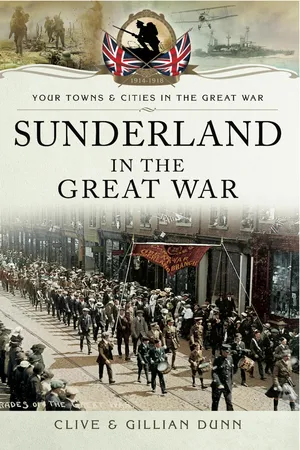
Sunderland in the Great War
About this book
Looks at how the Great War affected Wearsiders from the initial enthusiasm for sorting out the German Kaiser in time for Christmas 1914, to the gradual realization of the enormity of human sacrifice the families of Sunderland were committed to as the war stretched out over the next four years including local Zeppelin attacks and experiences of those fighting for the DLI and other regiments. The Great War affected everyone. At home there were wounded soldiers in military hospitals, refugees from Belgium and later on German prisoners of war. There were food and fuel shortages and disruption to schooling. The role of women changed dramatically and they undertook a variety of work undreamed of in peacetime. Meanwhile, men serving in the armed forces were scattered far and wide. Extracts from contemporary letters reveal their heroism and give insights into what it was like under battle conditions.
Trusted by 375,005 students
Access to over 1.5 million titles for a fair monthly price.
Study more efficiently using our study tools.
Information
Chapter One
1914:The calm before the storm
Patriotism, proclamations and preparations
SUNDERLAND HAD PROSPERED during the nineteenth and early twentieth centuries as a shipbuilding town and producer of coal, pottery and glass. The early part of 1914 had seen an escalation of international tensions with the continued naval arms race between the Germany of Kaiser Wilhelm II and Great Britain. On 28 June 1914, during a state visit to Sarajevo, Archduke Franz Ferdinand and his wife Sophie, the Duchess of Hohenberg, were assassinated by Gavrilo Princip, a member of the Serbian Black Hand Gang. After this, events rapidly moved towards war, although this was not known at the time. Austria was eager for war and, with the knowledge that Germany would support her, sent a harsh ultimatum to Serbia, knowing full well that the Serbians would not agree to it. In the event Serbia agreed to most of the points raised, but not all. This partial acceptance was not enough for Austria-Hungary. As a consequence, it invaded Serbia.
Europe at this time was divided into an armed camp, with Germany and Austria-Hungary on one side and France and Russia on the other. Great Britain initially took the view that it did not want to be drawn into a European war, but that was a hope that would not be fulfilled. With the invasion of Serbia, Russia mobilized her forces on 31 July. Germany then sent an ultimatum to Russia stating that if the latter did not stop mobilization then it too would be forced to mobilize its forces and declare a state of war. At the same time, Germany informed France of its intentions towards Russia and wanted to know what France would do; would it remain neutral? The Russians did not reply to Germany’s ultimatum so, on 1 August 1914, Germany declared war. On the same day, France mobilized its troops. The next day, German troops invaded Luxemburg and that night a note was sent to the Belgian government stating that the latter must violate Belgian territory and demanded that Belgium remained neutral. This note required an answer within twelve hours. The Belgians sent their refusal by 7.00 am on 3 August. Later that day, Germany declared war on France. The next day, Britain lodged protests with Germany about its invasion of Belgium and sent her an ultimatum to safeguard Belgian neutrality. When no reply was received Britain declared war on Germany at 11.00 pm on 4 August.

A general view of High Street, Sunderland.
While all this was happening, the people of Sunderland were following events avidly, with life still going on as normal, this being a bank holiday weekend. The War Office issued the following statement on 4 August: ‘With reference to this [Monday] afternoon’s announcement of the government of their decision to mobilize. It is officially stated that the proclamation will be signed to-day, and the necessary orders for the Reserves to return to the colours and the Territorials to be embodied will then be issued.’ War was in the air.
That night at midnight, thousands of people crowded around the Echo offices in Bridge Street, Sunderland, awaiting developments. All copies of the special edition of the newspaper quickly sold out as people clamoured for news. Shortly after midnight, word came that a state of war existed between Great Britain and Germany. At first there was silence while people took in the gravity of the situation; then there was a cheer, and people dispersed to their homes singing the national anthem.
With the start of the first full day of war things began happening in the town. There was an expectancy that the war would be over by Christmas but also the worry that the Germans may invade the country. Britain had traditionally relied upon the Royal Navy to protect her shores from invasion. However, an exercise in 1913 to test the defences of England proved that it would be possible for an enemy to land the equivalent of 48,000 troops between Blyth and Sunderland before the Navy could intervene. This prompted a lot of rethinking in the planning circles. The War Office took over the grain warehouses at the South Docks and other places such as the Thompson Memorial Hall, Pilot House on the north pier, the café on the lower promenade and Mrs Just’s premises on the lower promenade.

General Post Office.

View from Wearmouth Bridge.
The local Territorial Force battalion, 7/Durham Light Infantry, were away at camp, at Conway in North Wales, with the rest of the Durham Light Infantry Brigade. Camp was interrupted with the announcement that the country was at war and all units had to return home. This came as a shock to some of those serving. Private Joe Robson of C Company 7/Durham Light Infantry later recalled:
We were all settled down for the camp when at 3 o’clock in the morning of 4 August the buglers sounded reveille. War was declared. We were mobilized. Orders were issued to get your gear on, full pack and 250 rounds of ammunition. The cooks had been woken up and they did what they could for us before we left. They were cooking meat and potatoes. They put a potato in one hand a lump of meat in the other and we were then shoved into the train. We came straight back to Sunderland arriving about 6 o’clock; we had been on the train from about 4 o’clock that morning. When we arrived back at Sunderland we were marched back to the Garrison Field at Livingston Road.

A Pierrot concert at Roker before the war.
Crowds greeted the return of the battalion. The battalion marched back to the Drill Hall at Livingstone Road, now the site of the Gill Bridge Police station, where they awaited further instructions. Some thought that they would be going straight to the front to fight the Germans. At that time the Territorial Force was for home defence only.
Private Robson continues his story:
We stood around for about two hours; they did not know what to do with us. We were just young lads wondering what we were going to do; we thought we were going straight to war. The CO sent out some men to get bottles of beer, bottles of pop or sandwiches or a pie. When they came back I had a pie and a bottle of pop. This was about 9 o’clock, we were absolutely worn out with our packs on. We grounded our rifles until we had eaten our food. We had just finished when it must have been about 10 o’clock, the commander got in front of us on his horse and said, ‘You can all go home but don’t take your clothes off; you can be called up any minute.’
We were glad to get home; ’course it was all trams then. I lived in St Lukes Terrace at this time. My mother was a widow. I had lost my father when I was two years old. She used to look after me. When I got home I told my mother we’ve got to keep our clothes on, we might be called up at any minute.
So I took my pack off my back, my pouches with the 250 rounds of ammunition and water bottle, and laid them on the floor. I did not take my tunic or trousers off. I took my boots off and put my slippers on. I lay on the settee all night and nobody came. Nobody came the next day. I thought I would be at home for a while so I decided I’ll go to bed that night. I was just going to get ready, I was worn out, it was about 9 o’clock and they came round and said we had to report to the Garrison Field.

Private Joe Robson, C Company, 7/Durham Light Infantry.

Conway camp, 7/Durham Light Infantry.

General view of Conway camp in August 1914, where the Territorials spent their fortnight’s training.
The troops were deployed according to a prearranged plan around the town guarding vital installations such as the docks and bridges. The whole of the Northumbrian Division was deployed along the coast, from South Shields to the Tees. Crowds used to go to Roker to watch the troops dig trenches, which formed part of the coastal defence. Some of the earth from the trenches was used to strengthen earthworks at Abbs Point Battery. Although there was a novelty about the troops and what they were doing, there was also a serious side to things. No one could enter the docks without a pass. Some people out for an evening walk received a shock when they were challenged by a sentry with a bayonet fixed to his rifle when they got too close to any defences. Other restrictions had an effect on the town’s population. By order of the military the electric lights on Roker Promenade were switched off and would not be turned on again without further orders. The steps leading down to Hendon Beach were removed. However, the locals did help to look after the troops. When it became known that the garrison of Seaburn Farm had not eaten that day because their rations had not arrived, they made sandwiches for them.
But it was not just on land that incidents happened. On the evening of 9 August, the Scottish collier SS Startforth on entering the harbour was challenged by a sentry on the pier. No reply was returned so the sentry turned out the guard, who fired a volley at the ship, wounding two on board. James Holmes Jackson was shot in the leg and his thigh was broken. When the ship docked he was taken to hospital. The other casualty, Matthew Ross, the captain, was only slightly injured. In their defence, the crew claimed they had replied to the sentry, but their reply had not been heard.
There was excitement when the local heavy battery of the Durham Royal Garrison Artillery took their 4.7-inch guns through the town to Cleadon Hills to form part of the defences, both against raids from the sea and also from the air.
Adverts now started to appear for recruits. One for the Royal Naval Air Service asked for men of between eighteen and thirty years of age who ‘should have experience of one or more of the following: (a) general upkeep, construction or repair of aircraft; (b) carpenter’s work, joinery, cabinet making; (c) boat building; (d) fabric work (airship or aeroplane); (e) fitting and turning; (f) care, maintain and repair of petrol engines; (g) coppersmith’s work; (h) electrician’s work; (i) cycle mechanics; (j) motor driving.’As the war progressed some of these qualifications would have been relaxed with on-the-job training.
Sunderland had its own barracks, which had been built during the middle of the nineteenth century. At this time they were not used as such and the houses there were let. People living in those houses were now told to find other accommodation as soon as possible as the barracks were to be taken over by the military again.
Just prior to the declaration of war the Royal Navy deployed to its war stations, the main part of the fleet going to Scapa Flow in the Orkneys. The Navy was faced with a new menace: that of submarines. Early in the war one U-boat managed to enter Scapa Flow, which caused a certain amount of panic. To combat this threat, blockships were sunk in strategic places. Two such had been built in Sunderland: the 2,418-ton steamer SS Almeria and the 1,941-ton steel single-screw steamer SS Rhonda, built in 1888 and 1889 respectively. In addition to blockships the Navy used anti-submarine nets. The SS Rhonda was kept in position throughout the Second World War as well, but was considered a hazard to shipping and was blown up in 1962.

A destroyer built in 1896, typical of the pre-war naval ships produced on the Wear.
Forward planning was also taking place. The 6 and 12 Durham Volunteer Aid Detachments (VAD) began to look for premises for temporary hospitals, in anticipation of casualties. In consequence of the generous nature of the town’s people, two hospitals were formed. The 6/VAD hospital was at the Jeffrey Memorial Hall, Monk Street, and the 12/VAD hospital was at Gray Road. Mrs Ernest Vaux and Mrs Ernest Wright were quartermasters of the latter. Mrs Vaux was the wife of Lieutenant Colonel Ernest Vaux, commanding officer of 7/Durham Light Infantry. Volunteer Aid Detachments came about following the Boer War, when it was thought that in the event of a major European war the peacetime army medical services would not be able to cope with the expected influx of casualties. The Territorial Force came into being on 1 April 1908, and on 16 August 1909, the War Office issued a ‘Scheme for the Organization of Voluntary Aid in England and Wales’, which set up both male and female Voluntary Aid Detachments around the country. The size of detachments varied but mainly consisted of a commandant, medical officer, quartermaster and twenty-two women, two of whom were nurses. The roll of the VADs was to staff auxiliary hospitals and convalescent stations. Pre-war training consisted of a minimum of one meeting per month, where basic first aid was taught. The VAD organization was run by the Joint War Committee of the British Red Cross Society and the Order of St John.

HMS Haughty, a 27-knott A Class destroyer, built at Doxford’s in 1895.
Other things were happening in the town. The police had received instructions from the military to arrest all Germans capable of bearing arms. On 8 August, a large crowd gathered to watch the proceedings when sixty Germans were brought in. In addition to these measures enemy vessels in the harbour were detained, but it was hoped that the government would come to an arrangement for the exchange of vessels held by the Central Powers. While these measures were taking place in Sunderland, similar things were happening in Europe. Captain Sydney Butchart, of Thornhill Gardens in Sunderland, tried to join his ship at Trieste, Austria, which was on passage to India. He arrived after war had been declared and was prevented from boarding; instead he had to return home by rail. During the journey he had some unpleasant experiences, one of which being that his luggage was confiscated, as had been the case with a lot of other travellers. Needless to say, Captain Butchart was glad to get back home to Sunderland. Captain Butchart was a member of the River Wear Watch Commissioners; he died on 20 October 1916 at the grand old age of seventy-three.
On 12 August, Lord Kitchener issued his famous appeal for men for six divisions for the duration of the war. It was also becoming apparent that men from all occupations throughout the town were leaving to join either the colours or the Territorials. The Gas Company announced it would keep positions open for any of their employees called up and that they would make up any difference in pay. Likewise, eleven tramway men were called up and it was expected another fifteen were to go. The tram company said that normal service would continue, but people were not to expect any special services to run.
With a number of policemen either being called back to the colours, being mobilized as part of the Territorial Force or simply joining up, the Home Secretary was becoming concerned for the preservation of law and order throughout the country. A circular was issued to all local authorities with the aim of recruiting a force of unpaid special constables. The force was to consist of those men who were either too old or unable to serve in the Army, Navy or Territorial Force and who were desirous of serving their country. Steps were taken to start the recruitment and to ...
Table of contents
- Cover
- Title Page
- Copyright
- Dedication
- Contents
- Foreword
- Chapter 1: 1914: The calm before the storm: Patriotism, proclamations and preparations
- Chapter 2: 1915: The year of innocence: Recruiting, rationing and requisitioning
- Chapter 3: 1916: Conscription, Zeppelin raids and shipwrecks
- Chapter 4: 1917: U-boats, hospitals, air crashes – and a royal visit
- Chapter 5: 1918: The storm before the calm: Of ships and funds and a tank called Nelson
- Chapter 6: 1919: Coming to terms and a time to reflect: Peace, parades, memorials and pageants
Frequently asked questions
Yes, you can cancel anytime from the Subscription tab in your account settings on the Perlego website. Your subscription will stay active until the end of your current billing period. Learn how to cancel your subscription
No, books cannot be downloaded as external files, such as PDFs, for use outside of Perlego. However, you can download books within the Perlego app for offline reading on mobile or tablet. Learn how to download books offline
Perlego offers two plans: Essential and Complete
- Essential is ideal for learners and professionals who enjoy exploring a wide range of subjects. Access the Essential Library with 800,000+ trusted titles and best-sellers across business, personal growth, and the humanities. Includes unlimited reading time and Standard Read Aloud voice.
- Complete: Perfect for advanced learners and researchers needing full, unrestricted access. Unlock 1.5M+ books across hundreds of subjects, including academic and specialized titles. The Complete Plan also includes advanced features like Premium Read Aloud and Research Assistant.
We are an online textbook subscription service, where you can get access to an entire online library for less than the price of a single book per month. With over 1.5 million books across 990+ topics, we’ve got you covered! Learn about our mission
Look out for the read-aloud symbol on your next book to see if you can listen to it. The read-aloud tool reads text aloud for you, highlighting the text as it is being read. You can pause it, speed it up and slow it down. Learn more about Read Aloud
Yes! You can use the Perlego app on both iOS and Android devices to read anytime, anywhere — even offline. Perfect for commutes or when you’re on the go.
Please note we cannot support devices running on iOS 13 and Android 7 or earlier. Learn more about using the app
Please note we cannot support devices running on iOS 13 and Android 7 or earlier. Learn more about using the app
Yes, you can access Sunderland in the Great War by Clive Dunn,Gillian Dunn in PDF and/or ePUB format, as well as other popular books in History & British History. We have over 1.5 million books available in our catalogue for you to explore.