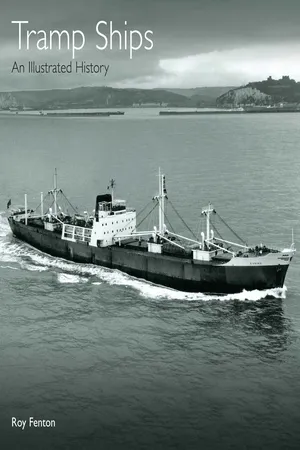
With 300 stunning photographs, this pictorial history of tramp trade ships illustrates the evolution of these charming, itinerant merchant vessels.
The tramp ship was the taxi of the seas. With no regular schedules, it voyaged anywhere and everywhere, picking up and dropping off cargoes, mainly bulk cargoes such as coal, grain, timber, china clay and oil. Older and slower vessels tended to find their way into this trade, hence the tag 'tramp'—but new tramps were also built for the purpose. In this beautiful volume featuring 300 photographs, Roy Fenton illustrates the Tramp Ship's evolution over the course of more than 100 years, from the 1860s, when the steam tramp developed from the screw collier, until it was largely replaced by the specialist bulk carrier in the 1980s.
Fenton offers fascinating background information on the design and building of tramps. He describes the machinery, from simple triple-expansion turbines to diesel engines. Their operation and management and the life of the officers and crews are also covered. This illustrated history journeys through the last years of the 19th century, the two world wars, and the postwar years. Photo captions provide each ship's dimensions, owners, and builder. Each ship's career is outlined with notes on trades and how they changed over a ship's lifetime.
Trusted by 375,005 students
Access to over 1.5 million titles for a fair monthly price.
The first practical steamers that could compete with sail for carrying bulk cargoes, the so-called screw colliers, appeared in the 1850s and were specifically intended for the coal trade on the east coast of Britain. They established that steam could capture trades in relatively low-value commodities, largely through adopting three features: economical steam engines, substantial water ballast capacity for unladen voyages, and iron hulls that had ample holds and hatchways to facilitate loading and discharge.
The screw colliers quickly proved capable of making voyages well outside the coastal trade. The Crimean War (1853–6) saw these early bulk carriers pressed into government service, voyaging – albeit in stages – as far as the Black Sea. Coal interests were not slow to realise the potential of the steam bulk carrier, and in 1857 began to build large screw colliers, of 200–250 feet overall, to carry coal to foreign ports. Crew agreements from this period signal that this began long-distance voyages by colliers, with coal despatched to the Baltic, to the Bay ports of France, to the Mediterranean and to the Black Sea, and where possible bringing home grain or a timber cargo. It is easy to see how the design was enlarged to produce ocean-going steam tramps, embodying the principal characteristics of the collier: economy, reliability, capacity and water ballast capabilities.
Screw colliers were not the only influence on tramp ship design. Large, ocean-going iron ships were being built with two (or more) decks, essentially to offer greater longitudinal strength as their length grew. As builders and owners looked to larger ships for tramping, they adopted the two-deck design out of necessity, although the additional deck could complicate loading and discharge of bulk cargoes. In various forms, two-deck ships will be encountered throughout the history of the ‘classic’ tramp ship.
Tramp steamers are recorded as operating from Sunderland as early as 1860 and in the ensuing decade from London, Newcastle, Cardiff and Whitby. In a significant number of cases, these earliest tramps were constructed by yards that had pioneered, or at least contributed to, the building of screw colliers, notably Palmers’ at Jarrow and Howden-on-Tyne, Mitchell at Low Walker on the Tyne, and various Wearside yards. And in a number of instances, men that had owned or managed colliers in the east coast coal trade – such as Lambert, Harris & Dixon, and J & C Harrison – moved into the longer-distance tramp trades.
The early development of the screw collier has been described and illustrated in another volume in this series, Coasters:An Illustrated History, and this chapter will discuss how it evolved into the single-deck, deep-sea tramp and then look at some early two-deck tramp ships.
Note: An asterisk in a caption indicates the vessel shown in the photograph.
Large screw colliers
The 1860s saw British coal interests invest in larger screw colliers, equally suitable for the huge coal trade between the Tyne and Wear and the Thames or the developing coal export trades out of the north English rivers. Tanfield* of 1865 has a direct connection with the pioneer of them all, John Bowes of 1852, in that she was built and engined by the same builder, Palmer Brothers, although not at Jarrow but at their second yard at Howden. Tanfield shared with John Bowes her engines-aft layout, which was not to become commonplace once again in the bulk trades until almost one hundred years later, her length of 203 ft necessitated a navigating position amidships.
Collier ownership in the 1850s and the 1860s typically involved 64th shares spread among various players in the coal trade. On her registration in January 1865, Tanfield was half owned by coal merchant Richard Cory, while the coal-owning Joicey family were minor shareholders. In 1896, Tanfield became part of the new fleet established under the title William Cory & Son Ltd, which was to remain a major coastal coal shipper for almost as long as the trade lasted. This was a consolidation of a number of fleets in the coastal coal trade, the Cory family’s buy-out being conditional on the owners of the fleets it purchased forsaking the east coast coal trade. This had the effect of launching the deep-sea careers of several owners who became significant players in tramping, including Lambert Brothers and J & C Harrison. Soon after Tanfield’s forty-eighth birthday, her old iron hull was sold to breakers in Boulogne.
Gradually the engines of screw colliers were positioned further forward in the hull, the trend becoming apparent in New Pelton* of 1871. Having a hold aft of the engine room made the vessel easier to trim when loaded. There were also concerns about the strength of the hull, and positioning heavy masses such as engines and boilers away from the stern was felt to reduce stresses. That the engines-amidships layout persisted in the ocean-going tramp for one hundred years suggests that these concerns were real, because disadvantages of the engines-amidships layout included the need for an extended propeller shaft, and a shaft tunnel that significantly reduced the capacity of the after holds.
New Pelton shared much with Tanfield, including Palmer Brothers as builder and the Cory and Joicey coal merchant/mine owner combination of initial registered owners. Palmers also supplied her machinery, a two-cylinder simple engine that expanded the steam just once. In common with Tanfield and many contemporaries, New Pelton had her engine replaced or – more probably – modified in 1878. In her ‘new’ compound engine, steam from a replacement, higher pressure boiler was expanded in high and low pressure cylinders, extracting significantly more of its energy to turn her screw. At the same time, New Pelton was lengthened from 180 ft to 211 ft, and is shown almost certainly after this modification.
In another parallel with Tanfield, in 1912 New Pelton was sold by her final owners, William Cory & Son Ltd, to the same Boulogne ship breakers. (C A Hill)
Early deep-sea tramps
Although built for the coal trade out of British east coast ports, the 200-ft, single-deck Raithwaite Hall* of 1868 had a long career that took her far away from her birthplace at West Hartlepool. The builder of her iron hull was Denton, Gray & Co, but thanks to the novelty of steam engines contemporary registration documents had no space to record the builder of her original, two-cylinder steam machinery. However, it is known that in 1874, Thomas Richardson & Sons of Hartlepool replaced this with, or perhaps simply rebuilt it as, a compound engine.
The original owners of Raithwaite Hall were members of the Pyman family, mentioned several times in this book, and in several combinations they operated her out of West Hartlepool and Newcastle in conjunction with their coal exporting business until 1906. She was then sold to William France, Fenwick & Co Ltd of London, who would have mainly employed her in the coastal coal trade, where steamers of her size were now common.
In 1909 came a major change in employment. The Dwina Ltd bought the old craft and stationed her in the entrance to the Shatt el Arab waterway to lighten incoming ships that could not otherwise cross the 20-ft bar. The shallow Raithwaite Hall and two even older steamers would take off sufficient cargo and would accompany the deep-sea ship to her destination. In the photograph Raithwaite Hall wears the livery of parent company Frank Strick & Co Ltd.
Work of The Dwina Ltd ended in 1929, when a deep-water channel was dredged through the bar. Now sixty-years-old, Raithwaite Hall was sold to ship breakers. (Harold Appleyard collection)
The chance of Nellie Wise* of 1873 being photographed owes much to her misfortune in 1908. Like Raithwaite Hall, she was built by Denton, Gray & Co of West Hartlepool, predecessor to one of the great British tramp builders, William Gray & Co. Her original Hartlepool owner was William H Wise, although in 1880 she moved to, and was to remain in, London ownership, a succession of owners honouring the old tradition of not altering a ship’s name.
At 230 ft, Nellie Wise was only marginally larger than the typical east coast collier, but the engine amidships arrangement was now entrenched, as was the use of two-cylinder compound engines, hers made in nearby Stockton-on-Tees by Blair & Co Ltd. Her total water ballast capacity was a respectable 208 tons, split between fore and aft peak tanks and her double bottom. Although not apparent from the photograph, she has a three-island hull, with forecastle, bridge deck and poop. This is obscured by the high bulwarks alongside the after hatch.
In contrast to the east coast colliers that ventured into the longer distance trades, the career of Nellie Wise saw her move in the opposite direction. Her owners since 1887, Green, Holland & Sons, sold out in 1896 to William Cory & Son Ltd, which retained Nellie Wise in the coastal coal trade. On a ballast voyage in January 1908 from London to the Tyne she stranded just north of her birthplace, and although refloated was fit only for scrap.
Raised quarterdeck design
Despite appearances, George Fisher* was probably in no danger on arrival at Bristol. Most likely her list is due to her deck cargo of esparto grass having taken on more water to starboard during a storm and adversely affecting her trim.
The well deck of Nellie Wise has evolved into a raised quarterdeck design, and from this angle can be seen her 51-ft long bridge deck, beyond which a 73-ft quarterdeck stretches to her stern. This deck increased the depth of the aftermost hold, partly compensating for the cargo space lost to the propeller shaft. This may account for her 25 per cent larger gross tonnage than Nellie W...
Table of contents
Front Cover
Title Page
Copyright
Contents
Preface
Introduction
1. Collier into Deep-Sea Tramp
2. Tramps Mature in the 1880s
3. Design Diversity 1890–1914
4. ‘Patent’ Tramps
5. Competition for British Builders
6. First World War Standards
7. Enter the Motor Tramp
8. Depression and Economy: Steamers 1920–1940
9. The Second World War
10. Last Breath of Steam
11. Swansong of the Tramp
12. The Last Tramps?
13. Tramp into Bulk Carriers
Bibliography
Frequently asked questions
Yes, you can cancel anytime from the Subscription tab in your account settings on the Perlego website. Your subscription will stay active until the end of your current billing period. Learn how to cancel your subscription
No, books cannot be downloaded as external files, such as PDFs, for use outside of Perlego. However, you can download books within the Perlego app for offline reading on mobile or tablet. Learn how to download books offline
Perlego offers two plans: Essential and Complete
Essential is ideal for learners and professionals who enjoy exploring a wide range of subjects. Access the Essential Library with 800,000+ trusted titles and best-sellers across business, personal growth, and the humanities. Includes unlimited reading time and Standard Read Aloud voice.
Complete: Perfect for advanced learners and researchers needing full, unrestricted access. Unlock 1.5M+ books across hundreds of subjects, including academic and specialized titles. The Complete Plan also includes advanced features like Premium Read Aloud and Research Assistant.
Both plans are available with monthly, semester, or annual billing cycles.
We are an online textbook subscription service, where you can get access to an entire online library for less than the price of a single book per month. With over 1.5 million books across 990+ topics, we’ve got you covered! Learn about our mission
Look out for the read-aloud symbol on your next book to see if you can listen to it. The read-aloud tool reads text aloud for you, highlighting the text as it is being read. You can pause it, speed it up and slow it down. Learn more about Read Aloud
Yes! You can use the Perlego app on both iOS and Android devices to read anytime, anywhere — even offline. Perfect for commutes or when you’re on the go. Please note we cannot support devices running on iOS 13 and Android 7 or earlier. Learn more about using the app
Yes, you can access Tramp Ships by Roy Fenton in PDF and/or ePUB format, as well as other popular books in History & Military & Maritime History. We have over 1.5 million books available in our catalogue for you to explore.