- 192 pages
- English
- ePUB (mobile friendly)
- Available on iOS & Android
eBook - ePub
About this book
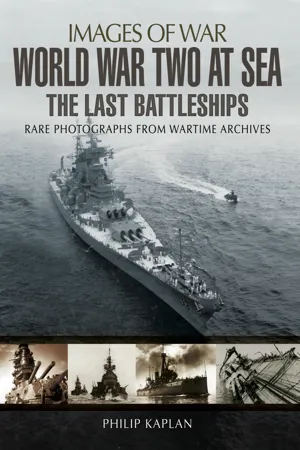
This wide-ranging naval history features rare wartime battleship images combined with thrilling first person accounts from servicemen.
During the Second World War, big-gun battleships represented the ultimate power of the world's greatest navies. In this book, veteran battleship crew members describe their unforgettable experiences aboard these iconic vessels. Here are the vivid recollections of a Royal Navy officer at Jutland; tales of the loss of the German warship Scharnhorst in the arctic; combat experience inside a sixteen-inch gun turret aboard an Iowa-class battleship during the Gulf War; and many others.
Included too is the story of the great German battleship Bismarck, which sank the pride of the British fleet; the story of HMS Hood; and that of the USS Missouri, on whose deck the final surrender document of the Second World War was signed.
The text is combined with a compelling selection of historic images representing the era of the great battleships from the early years through the First and Second World Wars, Korea, Vietnam, the Gulf War, and the preservation of a handful of these vessels as museum pieces today.
During the Second World War, big-gun battleships represented the ultimate power of the world's greatest navies. In this book, veteran battleship crew members describe their unforgettable experiences aboard these iconic vessels. Here are the vivid recollections of a Royal Navy officer at Jutland; tales of the loss of the German warship Scharnhorst in the arctic; combat experience inside a sixteen-inch gun turret aboard an Iowa-class battleship during the Gulf War; and many others.
Included too is the story of the great German battleship Bismarck, which sank the pride of the British fleet; the story of HMS Hood; and that of the USS Missouri, on whose deck the final surrender document of the Second World War was signed.
The text is combined with a compelling selection of historic images representing the era of the great battleships from the early years through the First and Second World Wars, Korea, Vietnam, the Gulf War, and the preservation of a handful of these vessels as museum pieces today.
Trusted by 375,005 students
Access to over 1 million titles for a fair monthly price.
Study more efficiently using our study tools.
Information
World War One Battleships
The big-gun warships of the First World War represented the might and power of several great navies, the most notable being those of Britain and Germany. The action took place among a mix of vessels, pre-dreadnoughts, dreadnoughts, battleships and battlecruiser types, of various designs and varying capabilities. Some of the more prominent participants are described here in a series of profiles detailing their characteristics and brief histories.
A pre-dreadnought French Navy battleship, the Gaulois was built at Arsenal de Brest. She was launched 6 October 1896 and commissioned 23 October 1899. The Charlemagne class battleship was 386 feet long, had a beam of sixty-six feet, a draught of twenty-seven feet and displaced 10,361 tons. Her top speed was twenty-one mph and her range, at ten knots, was 4,350 miles. The ship’s complement was 668 men. She was armed with four twelve-inch guns, ten 5.46-inch guns, eight 3.9-inch guns, twenty 47mm Hotchkiss guns, and four 17.7-inch torpedo tubes.
Named after the tribes that inhabited France in Roman times, Gaulois was the sister ship of Charlemagne, which was also built at Brest. In the period prior to the First World War, Gaulois accidentally rammed the French battleship Bouvet. Neither vessel was seriously damaged in the incident which occurred during exercises off Golfe-Juan. When Mount Vesuvius erupted in April 1906, Gaulois joined with the battleships Iéna and Bouvet in aid of the survivors in the Naples area.
With the outbreak of war in 1914, Gaulois and some of the older pre-dreadnoughts of the French Navy were assigned troop escort duties from North Africa to France. In September, she was sent to Tenedos Island near the Gallipoli Peninsula of Turkey, to protect against an aggressive sortie by the German battlecruiserGoeben, and then relieved the French pre-dreadnought Suffren which returned to Toulon for a refit, and then carried the flag of Rear Admiral Émile Guépratte until he returned to Suffren in January 1915.
Gaulois joined Suffren in the bombardment of Turkish forts at the mouth of the Dardenelles on 19 February. On 25 February, Gaulois bombarded the forts at Kum Kale and Cape Helles, but was forced to retreat when she was unable to suppress the guns of the forts. As a part of a French squadron on 2 March, she shelled targets in the Gulf of Saros at the base of the Gallipoli Peninsula, and struck again at the Turkish fortifications in the Gulf of Saros on 11 March. In a further attack on the Dardenelles targets, Gaulois was hit by a shell just above the waterline on the starboard bow, which opened a twenty-three foot hole causing significant flooding. Escorted by Charlemagne, Gaulois managed to reach the Rabbit Islands north of Tenedos where temporary repairs were made. Three days later, she departed for Toulon under escort by Suffren, but the two warships encountered a violent storm on the 27th off Cape Matapan and Gaulois began taking on water as her repairs weakened. With the additional assistance and escort of an armoured cruiser and three torpedo boats, she was able to make it to the Bay of Navarin for additional repairs, and finally arrived at Toulon on 16 April and underwent major repairs there.
On 27 July Gaulois reached the Dardenelles once again and there relieved her sister ship St Louis, anchoring 1,100 yards offshore. On 11 August, she bombarded a Turkish gun battery at Achi Baba, receiving return fire which started a small blaze that was quickly doused. In January 1916, she joined the pre-dreadnought République in covering the Allied evacuation from Gallipoli.
Returning to the Eastern Mediterranean in late November, Gaulois was torpedoed while off the southern coast of Greece, by the German submarine UB-47 on 27 December 1916, though under escort at the time by a destroyer and two armed trawlers. In twenty-two minutes, the ship capsized and fourteen minutes later, she sank off Cape Maleas.
HMS Canopus, the lead ship of the Canopus class of pre-dreadnought battleships, was laid down on 4 January 1897 at the Portsmouth Dockyard and was launched on 12 October that same year. Canopus was named for the ancient city of Canopus in Egypt, the scene of the Battle of the Nile. Commissioned on 5 December 1899, she was 431 feet long, with a beam of seventy-four feet and a draught of twenty-six feet. She displaced 12,950 tons. Canopus was manned by a crew of 750. Her armament included four twelve-inch guns, twelve six-inch guns, ten twelve-pounder guns and six three-pounder guns, as well as four eighteen-inch torpedo tubes.
Canopus began service with the Royal Navy’s Atlantic Fleet on 22 July 1905, followed by service with the Channel Fleet in 1906 and the Home Fleet at Portsmouth in 1907. After various assignments, culminating in a transfer to South America in 1914, she left Abrolhos Rocks on 8 October as part of a British search effort for the German squadron of Admiral Graf Maximilian von Spee, then en route from the Far East to the South Atlantic. She arrived at Stanley in the Falkland Islands on 18 October to assume guard ship and escort duties there. Unable to make more than twelve knots while a part of the cruiser squadron commanded by Rear Admiral Christopher Cradock in the hunt for the German squadron, Canopus was left behind when the British squadron encountered Spee’s warships. In the ensuing action, much of the British force was destroyed and Cradock killed in the Battle of Coronel, 1 November 1914. Captain Heathcoat Grant, commander of Canopus, took the ship back to Stanley where he positioned her near the mudflats in such a way as to enable her to defend the harbour entrance. He reduced her visibility by removing her topmasts and having her camouflaged. He also established an observation post on high ground, with a telephone link to the ship, and assigned a detachment of seventy Royal Marines with some of her twelve-pounder guns on shore in defence of Stanley. On 7 December, the battlecruiser squadron of Admiral Sir Frederic Sturdee arrived at Stanley to reinforce Canopus. The next morning, Grant’s land-based observers spotted the smoke of Spee’s vessels on the horizon and the gun crews of Canopus opened fire on the German warships in the first shots of the Battle of the Falklands. Shells from Canopus struck the armoured cruiser Gneisenau in the after funnel. Spee then aborted his intended attack on the British coaling station in the Falklands and fled the area. His force was pursued by Sturdee’s ships which caught and destroyed the German squadron.

The French Navy battleship Gaulois leaving Mudros Bay for the Dardenelles.
Canopus was transferred to the Meditarranean and the Dardenelles campaign in February 1915 and participated in the attack of 2 March on the Turkish forts there, taking hits in the return fire that ripped off her topmast and damaged her after funnel and wardroom. On 8 March she covered the shelling of the forts by HMS Queen Elizabeth and the efforts of British minesweepers trying to clear the mines in the area of Kephes, and followed that work with involvement in a heavy attack on the Narrows forts on 18 March.
Her next assignment was to assist the light cruiser HMS Talbot in escorting the damaged battle-cruiser HMS Inflexible from Murdos to Malta, towing Inflexible at one point when the crippled vessel was no longer able to make steam.
Canopus later returned to the Dardenelles to take part in the blockade of Smyrna and the main landings on 25 April. Her sister ship, Albion, became stranded on a sandbank while under heavy fire on 22 May and Canopus towed her free. Canopus returned to the United Kingdom in April 1916 for a major refit. In February 1918 she became an accommodation ship.

The Gaulois capsizing after being torpedoed by the German U-boat UB-47 on 27 December 1916.

The semi-dreadnought battleship Radetzky of the Austro-Hungarian Navy in 1908.
Her namesake was the nineteenth century Austrian Field Marshal Joseph Radetzky von Radetz. The SMS Radetzky was the lead ship of the Radetzky class of three pre-dreadnought battleships built by Stabilimento Tecnico, Trieste, for the Austro-Hungarian Navy, that preceded the larger and more powerful Tegetthoff class of dreadnoughts. Radetzky was commissioned in January 1911, She displaced 14,700 tons, was 456 feet long, had a beam of eighty-two feet, and a draught of twenty-six feet seven inchs. With a twenty-three mph top speed, she had a 4,000-nautical mile range at twelve mph. Her complement included 890 officers and men. Her armament was comprised of four twelve-inch guns, eight 9.4-inch guns, twenty 3.9-inch rapid-fire cannon, six eleven-pounder guns and three eighteen-inch torpedo tubes.
Radetzky conducted a number of training cruises prior to the outbreak of the First World War. In August 1914, when the German battlecruisers Breslau and Goeben were refueling in Messina, warships of the Royal Navy began assembling outside of the port there with the intention of trapping the German vessels. At that point the German Navy asked for the assistance of their Austro-Hungarian ally in the situation. Reluctance on the part of the Austro-Hungarian High Command resulted as they were hesitant to get involved in hostilities with the British. The Germans then softened their request, asking only that Austro-Hungarian fleet steam as far as Brindisi, to which it agreed, and Radetzky sailed with them on the proviso that the fleet actively assist the German vessels only while in Austro-Hungarian waters. In the operation, the German ships managed to successfully break out of the harbour into the Mediterranean.

The British pre-dreadnought Canopus, the lead battleship of her class of six, was commissioned in 1899.
In her next action, Radetzky came to the aid of some Austro-Hungarian Navy pre-dreadnoughts that were shelling French artillery batteries at Cattaro. On 21 October, Radetzky arrived in the area to bombard the French, forcing them to abandon their position.
In a part of the Austro-Hungarian campaign against the Kingdoms of Serbia and Montenegro in 1915, Radetzky and the Austro-Hungarian fleet left their base at Pola to bombard the naval base at Ancona. In the action, she helped to cover the cruisers and destroyers participating in the attack on Ancona and the nearby coastline. In the area they encountered two Italian destroyers which they attacked. One escaped, but the other, Turbine, was badly damaged in the fight. Following the action with Turbine, Radetzky shelled and destroyed a railroad bridge near Fermo, hindering troop and supply movements in the area. When Italian warships from bases at Taranto and Brindisi arrived to deal with them, the Austro-Hungarian ships had already returned to Pola.
The campaign attack by the Austro-Hungarian ships was meant to delay the Italian Army deploying its men and equipment along the Austro-Hungarian border by destroying critical transportation systems. It proved highly successful for the attackers.
Thereafter in the war, a shortage of coal to fuel the warships of the Austro-Hungarian Navy caused the diversion of the remaining coal to the newer Tegetthoff class of battleships. This led to a reduced use of Radetzky and the ships of her class in favour of a new emphasis on the use of submarines and mines.
After a strange sequence of events near the end of the war in 1918, Radetzky was ceded to the Italian Navy....
Table of contents
- Cover
- Title Page
- Copyright
- Contents
- Early Efforts
- The Dreadnoughts
- Jutland
- World War One Battleships
- Surprise!
- Graf Spee
- Battleship Routine
- Big Stick
- The New Capital Ship
- Warspite
- Thetirpitz
- Bismarck
- Yamato
- Iowa Class
Frequently asked questions
Yes, you can cancel anytime from the Subscription tab in your account settings on the Perlego website. Your subscription will stay active until the end of your current billing period. Learn how to cancel your subscription
No, books cannot be downloaded as external files, such as PDFs, for use outside of Perlego. However, you can download books within the Perlego app for offline reading on mobile or tablet. Learn how to download books offline
Perlego offers two plans: Essential and Complete
- Essential is ideal for learners and professionals who enjoy exploring a wide range of subjects. Access the Essential Library with 800,000+ trusted titles and best-sellers across business, personal growth, and the humanities. Includes unlimited reading time and Standard Read Aloud voice.
- Complete: Perfect for advanced learners and researchers needing full, unrestricted access. Unlock 1.4M+ books across hundreds of subjects, including academic and specialized titles. The Complete Plan also includes advanced features like Premium Read Aloud and Research Assistant.
We are an online textbook subscription service, where you can get access to an entire online library for less than the price of a single book per month. With over 1 million books across 990+ topics, we’ve got you covered! Learn about our mission
Look out for the read-aloud symbol on your next book to see if you can listen to it. The read-aloud tool reads text aloud for you, highlighting the text as it is being read. You can pause it, speed it up and slow it down. Learn more about Read Aloud
Yes! You can use the Perlego app on both iOS and Android devices to read anytime, anywhere — even offline. Perfect for commutes or when you’re on the go.
Please note we cannot support devices running on iOS 13 and Android 7 or earlier. Learn more about using the app
Please note we cannot support devices running on iOS 13 and Android 7 or earlier. Learn more about using the app
Yes, you can access World War Two at Sea by Philip Kaplan in PDF and/or ePUB format, as well as other popular books in History & Military & Maritime History. We have over one million books available in our catalogue for you to explore.