The Defence of the Dardanelles
eBook - ePub

The Defence of the Dardanelles

From Bombards to Battleships

  1. 272 pages
  2. English
  3. ePUB (mobile friendly)
  4. Available on iOS & Android
eBook - ePub

The Defence of the Dardanelles

From Bombards to Battleships

About this book

This WWI history examines the Ottoman Army's defense of the Dardanelle Strait during Winston Churchill's failed Gallipoli Campaign.

The Dardanelles Strait, separating Europe and Asia Minor, was fortified in the fifteenth century with massive bronze bombards causing any unwelcome ships to run a truly formidable gauntlet. And indeed it was on March 18th, 1915, when a powerful fleet of British and French warships attempted to clear the Strait. The attack failed at the cost of three ships sunk and three more seriously damaged. The Allied failure to take control the Strait led to its disastrous invasion of Gallipoli.
Using maps, photographs, and other illustrations, this in-depth study examines the strengths of the Turkish defenses, including the Ottoman Army's reliance on German Krupp guns. Historian Michael Forrest also assesses the relative strengths and weaknesses of the Royal and French Navies, as well as the flaws of Winston Churchill's strategy. Damningly, Forrest's research proves that British intelligence sources had previously assessed that a naval attack alone would not succeed.
Many of the fortifications on the Gallipoli peninsula and the Asian shore are still accessible. This volume helpfully identifies those that can be visited, many of which still have wrecked guns emplaced.

CHAPTER 1

A Brief History of the Dardanelles

For 3,000 years the Dardanelles has been significant as a natural barrier between the continents of Europe and Asia Anatolia. It is the southern strait of a busy international waterway linking the Aegean to the Black Sea, via the Sea of Marmara and the Bosphorus, with the ancient city of Istanbul straddling the route between them. The Dardanelles Strait is 38 miles (61km) long measured from the tip of the Gallipoli peninsula to the lighthouse just north of Gelibolu, the town previously known as Gallipoli, where the Sea of Marmara begins. The Strait is a maximum of 4 miles (6.5km) wide and is 330 feet (100m) at its deepest point. It has three squeeze points within the first 16 miles (26km) measured from the entrance: Kepez Point, which is 3,300 yards (3,000m) wide; the Narrows; and Nagara Point. As the name suggests, the Narrows is the crucial tactical feature, 13 miles (21km) from the entrance, barely 1,400 yards (1,300m) wide, of which only about 1,200 yards (1,100m) can safely accept large ships, measured to the 6 fathoms line. A pilot is required for all Turkish ships of 150m or more in length, and this is strongly recommended for other vessels of this size or above in transit. A Traffic Separation Scheme is applied to all vessels. The natural attributes of the Dardanelles, including a sharp turn at Nagara Point where the passage is 2,300 yards (2,100m) wide, coupled with a strong surface current of up to 3 knots that runs out toward the Aegean but with a reverse undercurrent, makes the Strait a difficult waterway to navigate at the best of times but daunting if under fire from defending fortresses.
The Dardanelles has been contested on numerous occasions and has been the subject of frequent political manoeuvrings, particularly by Russia, as it is their only access from the Black Sea to the Aegean and then on to the world’s oceans. For most of the nineteenth century, the Ottomans made it a condition with the European powers that vessels containing troops or munitions of war were not permitted to pass through the Dardanelles. The London Straits Convention of 1841 closed the Dardanelles and the Bosphorus to all but Turkish warships in peacetime, thereby denying Russia the access they had only recently achieved. The Treaty of Paris (1856) and the Treaty of London (1871) modified but reinforced this requirement. Warships of other nations could transit the Straits on rare occasions such as during the Crimean War or as a part of ā€˜goodwill’ visits, but only with the permission of the Sultan. Post-First World War and under the 1920 Treaty of Sevres between the victorious Allies and the defeated Ottoman Empire, the Dardanelles, the Bosphorus and the Sea of Marmara were open to all shipping, both military and commercial, at all times. This treaty was superseded in 1923 with the Treaty of Lausanne, as the now defunct Ottoman Empire was replaced by the Republic of Turkey, but the internationalization of the Straits still continued for another thirteen years. In 1936, this arrangement was updated by the Montreux Convention Regarding the Regime of the Turkish Straits – the Strait of Istanbul or the Bosphorus, the Strait of Canakkale, and the Sea of Marmara – to severely restrict non-Turkish military vessels and prohibit some types of warships such as aircraft carriers, but to provide the free passage of all commercial traffic. It is still applicable today, albeit with some modifications, although the interpretation of the Convention has sometimes been the source of controversy. In April 1982, the Convention was amended to allow Turkey to close the Turkish Straits at its discretion in peacetime as well as during wartime. Since the Montreux Convention was concluded, more than seventy-five years ago, the number of vessels passing through the Turkish Straits annually has increased more than tenfold; according to the Republic of Turkey Ministry of Foreign Affairs website, if measured as tonnage then the figure is more than twenty-five times, giving rise to safety and environmental concerns, particularly due to the amount of tanker and other hazardous cargo traffic.
e9781783469420_i0005.webp
Dardanelles Ancient Fortifications. (Ā© Forrest)

The Dardanelles – early incursions and defence

The name Dardanelles is derived from the ancient Greek city Dardanus in the region Dardania on the Asian side of the Strait, and from Helle, a character from Greek mythology linked to the story of Jason and the Argonauts. According to legend, Helle drowned in the Dardanelles after falling from the back of a winged ram. Helle also gave her name to Cape Helles at the tip of the Gallipoli peninsula and to the Hellespont, which in classical literature was the part of the Strait between Sestos on the European shore and Abydos on the Asiatic shore, close to what is now known as Nagara Point. The original settlers on the Gallipoli peninsula were from Thrace and would have known it at that time as the Thracian Chersonese; they lived in a number of small towns or on farms on either side of the Dardanelles.
The shores of the Dardanelles undoubtedly saw the arrival of hundreds of ships from Sparta, Athens, Ithaca, Thessaly and other such places described by Homer in the Iliad during the time of the Trojan War. The first significant military use of the Strait was when Darius I of Persia moved troops across the Hellespont to support the Persian invasion of Europe, circa 500 BC. The ancient Greek historian Herodotus records that Darius’s heir, Xerxes I, built two bridges across the ā€˜narrowest part of the Hellespont’ to move his army across and so invade Thrace and Greece, circa 480 BC. The bridges were destroyed by a storm before completion, so Xerxes had the flowing water branded with red-hot irons and lashed as a punishment; crueller still, the bridge builders were beheaded. The army successfully crossed at the next attempt by lashing some 300 boats together facing the current to create two floating bridges, suitably anchored to avoid being washed away. Over these boats six large cables were stretched, and on them were fastened strong timbers. Walls were built on either side of the bridges so that the horses and pack animals would not see the water and take fright. In this way more than 200,000 troops crossed from Asia into Europe. In 334 BC, the Greek army of Alexander the Great crossed the Hellespont in the opposite direction to conquer Asia. Two hundred years later, the waterway and its shores came under the administration of Rome.
Christian Emperor Constantine, ruler of the Eastern Roman Empire, or the Byzantine Empire, recognized the strategic importance of the waterway between the Black Sea and the Aegean, and also the commercial significance of the ancient city of Byzantium, which he made his capital city. It was renamed Constantinople after Constantine’s death in 337 AD, and for more than a thousand years stood as the gateway that separated Christian Europe from Islam until it fell to the Ottomans in 1453. In the preceding century the Ottomans had advanced from central Anatolia, expanding east toward the Caspian Sea and Arabia, and heading west to cross both the Dardanelles and the Bosphorus into the Balkans. Although the Byzantine Empire was in decline and Constantinople was under economic siege, the city was bypassed and so remained aloof, having a strange sort of neutrality with the invader gobbling up its ancient lands. Life in Constantinople went on in much the same way as before, the population being adequately supplied from the sea by independent trading states such as Venice, Florence and Genoa. Yet beyond the city walls hundreds of Byzantine fortresses were absorbed by the Ottomans, including those at Sestos and Gallipoli. According to eighteenth-century Turkish writer Evliya Celebi in his Book of Travels, the hexagonal Greek castle at Gallipoli had a compliment of 300 soldiers but was destroyed by an earthquake in 1356, and the ruin was occupied by Ottoman forces.
The Ottoman Empire had embraced gunpowder early in its rise to power, first using firearms in the late fourteenth century. Bronze cannons soon followed, then, during the final siege of Constantinople, so did massive siege bombards. These cast bronze guns of 5m in length were capable of firing huge stone balls, 80cm in diameter and weighing more than 500kg, for a distance of over 500m. The irony of the Ottoman use of the bombard is that the Hungarian gunfounder, Urban, who was able to produce such a large weapon, first offered it to the Byzantine defenders of Constantinople but they had neither the financial nor material resources to create such a weapon. The Ottomans, under the command of Sultan Mehmed II, were able to accept Urban’s services, and the largest super-bombard, measuring more than 8m long, was cast in Adrianople, modern-day Erdine, the capital of the Ottomans in Thrace. Hundreds of men and sixty oxen were required to move the huge weapon 200km to its firing position outside Constantinople. The Ottomans used more than sixty artillery pieces of various sizes to attack Constantinople, but as some guns were cast in the open their quality was poor and may have burst in use. A building was constructed outside Constantinople’s city walls in the Galata district specifically for the casting of cannon. This became known as the Tophane (arsenal) and was a centre for Ottoman gun production up to the First World War.
The ā€˜Dardanelles Gun’ – a Great Bombard displayed at the Royal Armouries Museum, Fort Nelson, Hampshire. Cast by bronze-founder Munir Ali in 1464, it has a bore of 635mm and was capable of firing a 300kg ball to a distance of 1,500m. It is a masterpiece of medieval technology, having been cast in two pieces – powder chamber and barrel – which screw together. In 1866, during his state visit to London, Sultan Abdulaziz gave the Dardanelles Gun to Queen Victoria as a present. (Ā© Forrest)
e9781783469420_i0006.webp
By circa 1400, the Dardanelles were firmly under the control of the Ottomans, but the first use of artillery to attack ships in the Dardanelles was in 1444. Ottoman troops were being transported from the Asian shore to the European shore, and Ottoman guns fired upon Burgundian ships that were trying to prevent the transfer. Although it is not known what type of cannon were used the significance is that the guns were firing at moving targets, whereas the primitive artillery of this time was normally used against static targets.
As the Ottomans absorbed the Byzantine Empire, so they recognized the strategic importance of the Dardanelles. Two castles were built in 1452 to control what we now know as the Narrows – Kilid Bahr (meaning lock of the sea) on the peninsula shore, and Kale-i Sultaniye (castle of the sultan – now known as Cimenlik Kalesi) at Canakkale. Incredibly, a number of the fifteenth-century bombards located at these forts were still in service more than 400 years later. The Dardanelles Gun, now on display at the Royal Armouries Museum of Artillery at Fort Nelson, Hampshire, dates from 1464, and is a magnificent example of medieval technology having been cast in two pieces, powder chamber and barrel, which screw together. This bombard was capable of firing a 300kg ball to a distance of 1,500m.
The powerful Ottoman Navy protected the empire’s sea lanes and controlled the waters far into the Mediterranean. The first Ottoman naval dockyard was built at Gallipoli harbour, and became the principal naval base until superseded by the yards built at Constantinople in 1515. During the sixteenth and seventeenth centuries, another important maritime power – the Venetians – challenged the Ottomans’ supremacy and proved to be more than a match for them during a number of gruelling battles in waters of the Aegean and the Dardanelles. The Ottoman Navy experimented with mounting their biggest bombards on a few of their ships, although results were far from satisfactory due to the massive energy of the recoil acting on the wooden hull. It was during the Sixth Ottoman-Venetian War, in the middle of the seventeenth century, that a Venetian fleet blockaded the Dardanelles to prevent Ottoman ships resupplying the armies fighting for islands in the Aegean. After at least four significant naval engagements involving sailing vessels, galleys and galleasses (a larger type of galley with a gun deck) during the years 1654 to 1657, the Ottomans were able to finally clear the threat of blockade. It was at this time that the forts either side of the entrance to the Dardanelles were built – Sedd el Bahr (key...
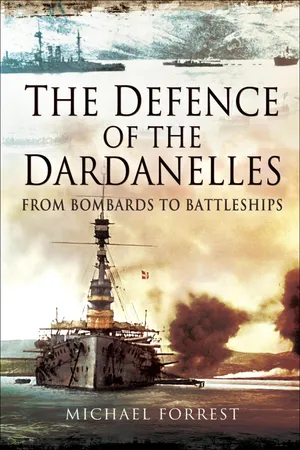
Table of contents

  1. Dedication
  2. Title Page
  3. Copyright Page
  4. Table of Contents
  5. Glossary of Terms
  6. Foreword and Acknowledgements
  7. Introduction
  8. CHAPTER 1 - A Brief History of the Dardanelles
  9. CHAPTER 2 - Germany and the Ottoman Empire
  10. CHAPTER 3 - The Fortification and other Defences
  11. CHAPTER 4 - Ships versus Forts
  12. CHAPTER 5 - The Reduction of the Fortifications – The Beginning
  13. CHAPTER 6 - The Reduction of the Fortifications – The Hammer and the Anvil
  14. CHAPTER 7 - ā€˜They are Gone’
  15. CHAPTER 8 - Submarines, Destroyers and More Guns
  16. CHAPTER 9 - The Chanak Crisis and After
  17. CHAPTER 10 - The Fortifications Today
  18. APPENDIX 1 - Krupp Coastal Defence Guns Purchased by Ottoman Turkey
  19. APPENDIX 2 - Krupp Coastal Defence Gun Locations on the Dardanelles
  20. APPENDIX 3 - Dardanelles Gun Batteries – 18 March 1915
  21. APPENDIX 4a - Dardanelles Minefield up to 18 March 1915
  22. APPENDIX 4b - Dardanelles Minefield and Anti-Submarine Nets from 28 March to December 1915
  23. APPENDIX 5 - Extracts from the Foreign Committee Paper (No. 93) March 1886
  24. APPENDIX 6 - British and French Battleships used in the Dardanelles Campaign up to 18 March 1915
  25. APPENDIX 7 - The Power of the Guns
  26. APPENDIX 8 - The Director Fire Control System
  27. APPENDIX 9 - Shells, Fillings, Fuses and Charges
  28. Bibliography
  29. Index

Trusted byĀ 375,005 students

Access to over 1.5 million titles for a fair monthly price.

Study more efficiently using our study tools.

Information

Year
2013
Topic
History
Print ISBN
9781781590522
eBook ISBN
9781783469420
Index
History

Frequently asked questions

Yes, you can cancel anytime from the Subscription tab in your account settings on the Perlego website. Your subscription will stay active until the end of your current billing period. Learn how to cancel your subscription
No, books cannot be downloaded as external files, such as PDFs, for use outside of Perlego. However, you can download books within the Perlego app for offline reading on mobile or tablet. Learn how to download books offline
Perlego offers two plans: Essential and Complete
  • Essential is ideal for learners and professionals who enjoy exploring a wide range of subjects. Access the Essential Library with 800,000+ trusted titles and best-sellers across business, personal growth, and the humanities. Includes unlimited reading time and Standard Read Aloud voice.
  • Complete: Perfect for advanced learners and researchers needing full, unrestricted access. Unlock 1.5M+ books across hundreds of subjects, including academic and specialized titles. The Complete Plan also includes advanced features like Premium Read Aloud and Research Assistant.
Both plans are available with monthly, semester, or annual billing cycles.
We are an online textbook subscription service, where you can get access to an entire online library for less than the price of a single book per month. With over 1.5 million books across 990+ topics, we’ve got you covered! Learn about our mission
Look out for the read-aloud symbol on your next book to see if you can listen to it. The read-aloud tool reads text aloud for you, highlighting the text as it is being read. You can pause it, speed it up and slow it down. Learn more about Read Aloud
Yes! You can use the Perlego app on both iOS and Android devices to read anytime, anywhere — even offline. Perfect for commutes or when you’re on the go.
Please note we cannot support devices running on iOS 13 and Android 7 or earlier. Learn more about using the app
Yes, you can access The Defence of the Dardanelles by Michael Forrest in PDF and/or ePUB format, as well as other popular books in History & Middle Eastern History. We have over 1.5 million books available in our catalogue for you to explore.