- 208 pages
- English
- ePUB (mobile friendly)
- Available on iOS & Android
eBook - ePub
About this book
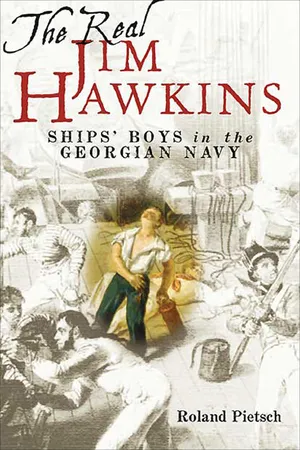
Generations of readers have enjoyed the adventures of Jim Hawkins, the young protagonist and narrator in Robert Louis Stevensons Treasure Island, but little is known of the real Jim Hawkins and the thousands of poor boys who went to sea in the eighteenth century to man the ships of the Royal Navy. This groundbreaking new work is a study of the origins, life and culture of the boys of the Georgian navy, not of the upper-class children training to become officers, but of the orphaned, delinquent or just plain adventurous youths whose prospects on land were bleak and miserable. Many had no adult at all taking care of them; others were failed apprentices; many were troublesome youths for whom communities could not provide so that the Navy represented a form of floating workhouse. Some, with restless and roving minds, like Defoes Robinson Crusoe, saw deep sea life as one of adventure, interspersed with raucous periods ashore drinking, singing and womanizing. The author explains how they were recruited; describes the distinctive subculture of the young sailor the dress, hair, tattoos and language and their life and training as servants of captains and officers.More than 5,000 boys were recruited during the Seven Years War alone and without them the Royal Navy could not have fought its wars. This is a fascinating tribute to a forgotten band of sailors.
Trusted by 375,005 students
Access to over 1.5 million titles for a fair monthly price.
Study more efficiently using our study tools.
Information
CHAPTER 1
Seafaring Boys in the Eighteenth Century: Fiction and Reality
THE Battle of Lagos, 1759: this year marked the turning point of the Seven Years War and the Royal Navy’s ascent to ruler of the oceans. On board one of the Navy vessels facing the French fleet, Olaudah Equiano, a fourteen-year-old ship’s boy originally from Africa, experienced his first naval battle as a ‘powder monkey’:
My station during the engagement was on the middle deck, where I was quartered with another boy, to bring powder to the aftermost gun; and here I was a witness of the dreadful fate of many of my companions, who, in the twinkling of an eye, were dashed in pieces, and launched into eternity. Happily I escaped unhurt, though the shot and splinters flew thick about me during the whole fight. … We were also, from our employment, very much exposed to the enemy’s shots; for we had to go through nearly the whole length of the ship to bring the powder. I expected, therefore, every minute to be my last, especially when I saw our men fall so thick about me; … at first I thought it would be safest not to go for the powder till the Frenchmen had fired their broadside; and then, while they were charging, I could go and come with my powder. But immediately afterwards I thought this caution was fruitless; and, cheering myself with the reflection that there was a time allotted for me to die as well as to be born, I instantly cast off all fear or thought whatever of death, and went through the whole of my duty with alacrity.1
Olaudah’s account is a rare voice, preserved from the thousands of boys who were brought up on board eighteenth-century British warships to become sea-bred sailors and the backbone of Britain’s maritime empire. These real-life versions of Jim Hawkins, from Robert L Stevenson’s novel Treasure Island, faced no lesser dangers than their famous fictional counterpart. Yet the story of these ships’ boys has, until now, remained untold. Who were they, why did they enlist in the Navy, and what were the dangers and rewards awaiting them at sea? Stevenson had placed his Treasure Island story in the middle of the eighteenth century, over a hundred years before his own time. Hence his ship’s boy Jim Hawkins would have gone to sea at exactly the same time as Olaudah Equiano. Ever since Treasure Island was first published in book form in 1883, generations of young readers have grown up with Jim Hawkins’ adventures – through the book itself, as well as through countless radio, stage, television and cinema adaptations in Britain and worldwide. The story of the boy at sea, travelling to exotic places and performing heroics in the adult world, hit a universal chord amongst readers.

Treasure Island (US, 1950), with Bobby Driscoll as Jim Hawkins.

Walt Disney’s Treasure Island as a Dell comic.
Numerous authors followed Stevenson’s theme of the ship’s boy in the sailing Navy. But Stevenson was not the first to tell stories of boys at sea; others before him had specialised in the genre.2 Earlier in the nineteenth century, Captain Frederick Marryat (1792-1848) found a wide audience for his stories of Peter Simple (1834), Mr Midshipman Easy (1836) and The Pirate (1836). What makes Marryat so fascinating for the historian is that he had experience of Nelson’s Navy at first hand, as he went to sea as a boy, and served as a midshipman with Lord Cochrane during the war against Napoleon. A few other officers of Marryat’s time also published stories about Nelson’s Navy, perhaps feeling that they were the last witnesses of the ‘great war’ and the golden days of the sailing Navy; none reached Marryat’s fame, though. Peter Simple was once the most widely read of his novels, yet today Marryat’s best-known, and frequently reprinted, story of a boyhood at sea is that of Mr Midshipman Easy.3
The adventures of midshipman Jack Easy, and the comical confrontations Jack experiences, as his youthful ideals regarding the equality of men clash with the reality of naval life, are a treasure for anyone curious to discover what it was like to come of age in Nelson’s Navy. Though Jack Easy’s adventures have to be taken with a pinch of salt, Marryat’s hero leads us much closer to the reality of a boyhood at sea than the fantastic story of Jim Hawkins’ treasure hunt. If all maritime fiction can indeed be divided into just two classes, the ‘Royal Navy yarn’ and the ‘desert island romance’, then Marryat is as soundly settled in the former, as Treasure Island is in the latter. Unlike Treasure Island, Midshipman Easy was also aimed at a more mature audience. However, the great regret for the purpose of our story is that Jack Easy is the privileged son of a gentleman: he enters the Navy with the prospect of becoming an officer rather than a common seaman, and once again we hear little about the numerous boys on the lower deck who were raised to become able seamen.
In the second half of the nineteenth century, amidst the boom of adventure stories published for boys, the ship’s boy established himself as a regular character in fiction. Just before Stevenson wrote Treasure Island, William H G Kingston (1814-1880) and Robert Michael Ballantyne (1825-1894) captured the imagination of young readers with their stories of seafaring boys. Like Marryat, Kingston’s books, such as From Powder Monkey to Admiral (1870) or The Three Midshipmen (1873), were ‘Royal Navy yarns’ and tried to stick closer to the reality of a boy’s life in the Navy. However, instead of Marryat’s mature irony, Kingston’s books were juvenile adventure stories. Because the days of the sailing Navy, the drifting sailor and unexplored exotic lands had disappeared with the arrival of steam-power, industrialisation, and uniform-wearing seamen in continuous service, there was now an outpouring of fictional and (pseudo-)autobiographical literature of the romantic sailing days. Robert Ballantyne’s The Coral Island (1857), telling the adventure of three shipwrecked boys who end up on an uninhabited Polynesian island, would fall into the category of ‘desert island romance’ and was allegedly one of the main influences for Stevenson’s Treasure Island. Stevenson mentions both Ballantyne and Kingston in his poem ‘To the Hesitating Purchaser’, which opens Treasure Island.
Stevenson also refers to a third, older author in the poem: James Fenimore Cooper (1789-1851). Cooper was serving in the US Navy as a midshipman around the same time that Frederick Marryat entered the Royal Navy. Although Cooper did not specialise in novels about boys at sea, he was one of the authors who established sea stories as a popular literary genre in the US. Midshipman turned author Cooper thus laid the foundation in the US readers’ market for the first cabin boy turned author: Herman Melville (1819-1891), author of the classic whaling adventure Moby Dick (1851), but also of Redburn (1849), a novel based on his own experiences as a cabin boy. Like Marryat’s Jack Easy, Melville’s young hero in Redburn first of all must overcome the culture shock of encountering the rough company to be found at sea. And some years later, so too does the cabin boy of Jack London’s (1876-1916) novel Sea-Wolf (1904) – all of them stories of boys and youths who come of age at sea.
In the twentieth and twenty-first centuries, the ship’s boy theme was continued by, amongst others, Leon Garfield’s Jack Holborn (1964),4 and also a string of novels, all sharing the same title Powder Monkey, by different authors of children’s and juvenile historical fiction: George Manville Fenn (1904), Maureen Rylance (1999), George J Galloway (2001), and the first book in Paul Dowswell’s series of the adventures of ship’s boy Sam Witchall (2005). Karen Hesse’s Stowaway (2000) contributed a fictional diary based on the real-life ship’s boy Nicholas Young, who sailed on James Cook’s Endeavour. Boys destined for an officer’s career were covered by C S Forester’s Mr Midshipman Hornblower (1950), the prequel to the Hornblower series, keeping Marryat’s title, and aimed at mature readers and naval enthusiasts. Comic strips and television cartoons produced further celebrated ships’ boys, such as the cabin boy Tom in Captain Pugwash’s adventures (first televised by the BBC in 1957), with the boy Tom seemingly being the only member of crew on board actually capable of sailing the ship.

Scene from The Death of Nelson, by Daniel Maclise (1859-64).

Detail of the powder boy from The Death of Nelson.
Whilst the ordinary ship’s boy has become a favourite character among authors of juvenile fiction, historians have so far neglected him. Boys destined to become midshipmen and officers have received some attention,5 yet those hailing from humbler backgrounds, and not aiming at an officer’s career, have until now remained totally anonymous. The paucity of studies can be partly excused by the lack of source material: eighteenth-century records telling us about boys aboard who were training to become ordinary sailors are scarce. Until the 1790s, the documents of the Royal Navy treated boys rather indifferently, the recorded information about the youngsters being often sketchy and time-consuming to collect and interpret. One thankful exception is the archive of the London Marine Society, a private charity which equipped thousands of boys for the Royal Navy, and later also for the merchant service. The Society’s historical records regarding ships’ boys give a unique insight into the nature of the real-life Jim Hawkins.
There have always been boys working on board ships. The seventeenth-century Spanish Navy had its pajes, the medieval German Hansa had its Jungen, and eighteenth-century British society was no different from many other societies in believing that a sailor had better start in his boyhood, otherwise he might never become a proper seaman. Marine Society founder and philanthropist Jonas Hanway (1712-1786) reckoned that it was ‘beyond all contradiction, that those who are bred to the sea from the earliest part of life, generally become the ablest mariners’, and that by ‘being inured to hardships, they are not only rendered the more active and intrepid, but they can also bear long voyages, winter cruizes, and change of climate.’6 Sailors were often described as an oddly distinct group with a separate culture, making it hard for outsiders to enter their community. Many landsmen failed to adapt to this foreign world when they embarked on a life at sea. In order to serve Britain’s global political and economic ambitions, which relied so heavily on her ships and sailors, it was vital to nurture this peculiar breed of sailors in sufficient numbers from a very young age. Throughout the history of great navies, the lack of skilled sailors in times of war had always been a much bigger headache than lack of ships – in this respect the eighteenth-century British Navy struggled as much as the Athenian, the sixteenth-century Spanish, or the seventeenth-century Dutch navies, in filling its boats.
There is an assumption that seafaring was largely a hereditary trade, with most boys going to sea simply because that was how their fathers earned their living. However, this assumption has never been proven by a comprehensive study, and we shall see later that in times of war a large number of boys and young men from all sorts of backgrounds, and with no maritime connections at all, found their way into the Navy. In the Royal Navy the ‘land-boys’ at times even outnumbered the sons of seafarers and boys from coastal communities. Furthermore, we shall also see how throughout the eighteenth century various public and private schemes were devised to encourage more boys from non-seafaring families to go to sea. Hence Jim Hawkins, who only knew the sea through the tales of the guests and drunkards in his parents’ inn, was not unusual for a ship’s boy in the Royal Navy.
The boys on board the Navy vessels were an essential component in securing the future supply of quality seamen, and within a few years the youths were turned into able seamen. However, there was no continuous service in the eighteenth-century Navy; sailors were hired when needed, and many of these newly-trained boys were likely to go on to work in the merchant service or related trades. Yet they were always available when war dramatically increased the Navy’s demand for manpower. The boys appeared in the Navy’s muster books as captain’s servant or officer’s servant, regardless of their social backgrounds, and whether they were aiming at an officer’s career or just at becoming able seamen. Although in their life and training the two groups differed greatly, official class differentiations were only introduced to the Navy’s muster books at the end of the century. The boys were not merely called servants, they were certainly also frequently called upon for personal servant duties by their officer (the term officer will include both captains and officers from now on). Yet despite the title, the boys’ main purpose was not to be someone’s domestic servant, but to be ‘trainee sailors’. The Admiralty wished them to be the Navy’s ‘nursery’ for seamen.7

Thomas Rowlandson, Cabin-Boy (1799).
Thirteen was the official minimum age for a servant, with an exception for officers’ sons, who were allowed to be as young as eleven – ‘Much too young,’ Horatio Nelson once muttered in a conversation, without going further into detail, but probably remembering the time when he had to bid farewell to family and home, entering a warship as a tender twelve-year-old.8 Older boys, aged eighteen to twenty, were usually allowed to omit the servant role and enter the Navy as paid landsmen. The Navy Regulations allowed each captain four servants for every hundred men of his ship’s complement. Lieutenants, masters, pursers, surgeons, cooks and chaplains were allowed one servant if the complement was at least sixty. Boatswains, gunners and carpenters were also allowed one servant for a complement of at least sixty, and a second servant when the ship’s complement reached a hundred. An admiral, depending on his rank, was entitled to ten to sixteen servants.
For each of his servants an officer received the net monthly pay of an ordinary seaman, whilst only having to spend about a fifth of this wage on the boy for clothing, other necessities or pocket money. However, to say that the officer pocketed the boy’s wage, as it is often phrased in the literature, is slightly misleading: the ordinary seaman’s wage had less to do with rewarding the boy’s work, than being primarily a means of encouraging officers to take boys on board. By thus providing a financial incentive to each individual officer to recruit and look after one or more boys, the Navy hoped to ensure that enough youngsters would make their way to sea. Yet in finding their boys the officers received very little help f...
Table of contents
- Cover
- Title Page
- Copyright
- Dedication
- Contents
- List of Illustrations
- Acknowledgements
- Introduction: ‘To the Hesitating Purchaser’
- Chapter 1: Seafaring Boys in the Eighteenth Century: Fiction and Reality
- Chapter 2: Jim’s Troublesome Youth on Land: ‘The Idle Apprentice Sent to Sea’
- Chapter 3: Poor Jim: Charity and the Marine Society
- Chapter 4: The Typical Jim Hawkins
- Chapter 5: Jim’s Motives: Sailors and Youth Culture
- Chapter 6: Jim’s Life on Board
- Chapter 7: Jim’s Coming of Age at Sea: Masculinity and the Horrors of War
- Chapter 8: Jim’s Return from the Sea
- Epilogue
- Notes on Sources and Literature
- Notes to the Text
- Bibliography
Frequently asked questions
Yes, you can cancel anytime from the Subscription tab in your account settings on the Perlego website. Your subscription will stay active until the end of your current billing period. Learn how to cancel your subscription
No, books cannot be downloaded as external files, such as PDFs, for use outside of Perlego. However, you can download books within the Perlego app for offline reading on mobile or tablet. Learn how to download books offline
Perlego offers two plans: Essential and Complete
- Essential is ideal for learners and professionals who enjoy exploring a wide range of subjects. Access the Essential Library with 800,000+ trusted titles and best-sellers across business, personal growth, and the humanities. Includes unlimited reading time and Standard Read Aloud voice.
- Complete: Perfect for advanced learners and researchers needing full, unrestricted access. Unlock 1.5M+ books across hundreds of subjects, including academic and specialized titles. The Complete Plan also includes advanced features like Premium Read Aloud and Research Assistant.
We are an online textbook subscription service, where you can get access to an entire online library for less than the price of a single book per month. With over 1.5 million books across 990+ topics, we’ve got you covered! Learn about our mission
Look out for the read-aloud symbol on your next book to see if you can listen to it. The read-aloud tool reads text aloud for you, highlighting the text as it is being read. You can pause it, speed it up and slow it down. Learn more about Read Aloud
Yes! You can use the Perlego app on both iOS and Android devices to read anytime, anywhere — even offline. Perfect for commutes or when you’re on the go.
Please note we cannot support devices running on iOS 13 and Android 7 or earlier. Learn more about using the app
Please note we cannot support devices running on iOS 13 and Android 7 or earlier. Learn more about using the app
Yes, you can access The Real Jim Hawkins by Roland Pietsch in PDF and/or ePUB format, as well as other popular books in History & Military & Maritime History. We have over 1.5 million books available in our catalogue for you to explore.