A military history of the British Army's 1st Airborne Division at Arnhem in the Netherlands during World War II.
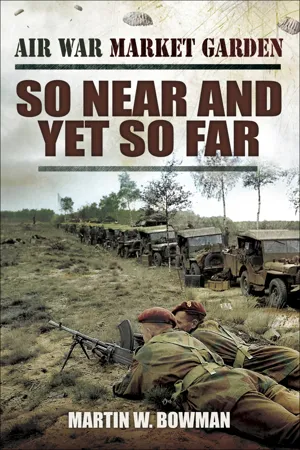
This is the second volume in a meticulously researched four-part series that provides a comprehensive insight into the aerial exploits at Operation 'Market Garden' in September 1944. In an interesting method of presenting the information, the author's arrangement of British, American, Dutch and German personal narrative interspersed with factual material offers a more personalised view of the war through the eyes of the hard-pressed Allied airborne troops who were actually there in the thick of the action.
They take you steadily through the bitter house-to-house fighting in Eindhoven, Nijmegen and Arnhem and the fanatical attempts to keep open the narrow road to permit XXX Corps to reach and relieve Colonel John Frost's men, outnumbered and out-gunned at Arnhem Bridge. They reveal the frustration and bitter disappointment in the battles of the drop zones, the bloody fight for the bridges across the Rhine and the almost suicidal second and third lifts to re-supply the troops holding on precariously, fighting desperately, tenaciously and bravely to prevent their positions being overrun in the face of overwhelming enemy superiority. Stories of individual heroism act to humanize this period of wartime history which is often reduced to mere facts.
Timelines detail the day-to-day events happening in all areas of the battle both on the ground and in the air and also add weight to the story in hand, whilst carefully selected archive images work to supplement the text perfectly.
- 256 pages
- English
- ePUB (mobile friendly)
- Available on iOS & Android
eBook - ePub
So Near and Yet So Far
About this book
Information
Print ISBN
9781781591178
Subtopic
Military & Maritime HistoryChapter 1
‘Screaming Eagles’ and the ‘All American’
‘During the morning of September 17th the front line had been quiet, but in the late hours of the morning, the enemy air activity suddenly increased considerably, particularly that of fighter bombers. From my command post at Vught I was able to observe numerous enemy planes and to hear the sounds of bombardments and the firing of aircraft, machine-guns and flak quite nearby... At about noon I was disturbed at my desk by a roaring in the air which increased in intensity so that finally I left my desk and went on to the balcony. Wherever I looked I could see aircraft, troop-transports and large aircraft towing gliders. They flew both in formation and singly. It was an immense stream which passed quite low over the house. I was greatly impressed by the spectacle and I must confess that during these minutes the danger of the situation never occurred to me. I merely recalled with some regret my own earlier airborne operations and when my Chief of Staff joined me on the balcony I could only remark, ‘Oh, how I wish that I had ever had such a powerful force at my disposal.’
Generalfeldmarschal Kurt Student.1 When he heard the roar of aircraft above his head on that Sunday morning he was, as he himself admits, ‘taken completely by surprise’. He had ‘never considered the possibility’ of an airborne attack in his area. ‘Actually, it was really obvious to use airborne troops in this situation in order to gain possession of bridges before their demolition. However, both the command and the troops, particularly my staff and I, were all so overtaxed and under such severe strain in the face of our difficult and many-sided mission that we thought only in terms of ground operations.’
As Bill Tucker looked down at the coast of Holland the first thing he saw was two twin guns firing up towards them. There were thousands of planes in the sky, including lots of fighter-bombers for protection. Skimming the ground, they led the way to the drop zones, attempting to clear everything ahead of the formations. Even though the intense bombing preceding the airborne assault had knocked out many 88 and 20 mm anti-aircraft batteries, camouflaged nettings suddenly swung back to reveal hidden enemy positions, some hidden in haystacks open to disclose nests of guns. It was not possible to silence all enemy opposition. Tucker saw an RAF Typhoon swoop down. It was good to see the flame of his rockets exploding on or near the gun positions. Strangely enough there was ack-ack, but no German fighters. Tucker kept yelling to the men that if they got hit, he would go through the door like at shot, so they had better get ready. Most were sitting on the edge of their seats with the static line in their hands. The new men were sitting down the ramp in the plane sweating out their first combat jump. Several new paratroop innovations - leg packs for machine guns, quick-release harness on some chutes and combat instead of jump boots-made him and many other men nervous. In particular, the troopers were concerned that their shroud lines might catch on the buckles of their new combat boots.
Their first sight of Holland below showed that the land was flooded. In some places the water seemed to be up to the middle of the first floor windows of each house. First Lieutenant James Coyle had prayed that there would be no flooded areas near the 550th PIR drop zone because some of the men in Normandy had landed in areas which the Germans had flooded and they drowned before they could get out of their chutes. For a long time since they crossed the coast all he could see was that the areas below were flooded, miles of fields covered with water with the cattle crowding on any high ground that was available to them. But as they flew nearer to Groesbeek he was relieved to see that there was no sign of water. ‘We were flying at only 1,000 feet and shortly before we came to our DZ we flew over an isolated Convent in the countryside. The nuns had all come out in the courtyard and were waving to us as we flew by. As I waved back, I wondered what they would think if they knew that we would be jumping not too many miles away and the war was about to catch up with them. They made such a peaceful picture as they waved their aprons until I could no longer see them.’
Gerard Thuring was living with his parents in the Breda area near the River Maas. Their home was located in the midst of the routes taken by the many C-47s and gliders to their drop and landing zones. Gerard and his family went to their cellar because of the anti-aircraft fire near the Keizersveer Maas Bridge. After the danger passed they left the cellar to see the aircraft leaving. They thought that they were civilian Douglas DC-3 aircraft, some with ropes behind pulling gliders. Later Gerard and his brother got on the roof of their house to see what was happening. They waved excitedly just like everybody else.
The 82nd Airborne pathfinders had landed near Overasselt and the troopers marked the area with coloured strips and smoke stoves. Within three minutes a yellow-panelled ‘0’ and violet smoke clearly outlined the area. The four C-47s carrying the 101st pathfinders to zones north of Eindhoven ran into heavy anti-aircraft fire. One planeload was shot down in flames. There were only four survivors. The other three planes flew on and the pathfinders dropped accurately on the 101st’s two zones. By 1254 dropping and landing zones were located and marked. Incredibly, the Germans still had not raised an alarm. Now, in tight formations, the great procession of C-47s carrying the 101st Airborne thundered across Belgium. Twenty-five miles beyond Brussels, the serials swung north heading for the Dutch border. XXX Corps could be seen spread out over every field, trail and road. Massed columns of tanks, half-tracks, armoured cars and personnel carriers and line after line of guns stood poised for the break-out. On tank antennas pennants fluttered in the wind and thousands of troops standing on vehicles and crowding the fields waved up to the men of the airborne. Orange smoke billowing into the air marked the British front line. Beyond was the enemy.
Just seven minutes away from their drop zones north of Eindhoven, the men of the 101st ran into intense flak. Pfc John Cipolla was dozing when he was suddenly awakened by ‘the sharp crack of anti-aircraft guns and shrapnel ripped through our plane.’ Like everyone else, Cipolla was so weighed down by equipment that he could hardly move. Besides his rifle, knapsack, raincoat and blanket, he had ammunition belts draping his shoulders, pockets full of hand grenades, rations and his main parachute plus reserve. In addition, in his plane, each man carried a land mine. ‘A C-47 on our left flank burst into flames and then another and I thought, ‘My God, we are next! How will I ever get out of this plane?’ His C-47 was shuddering and everyone seemed to be yelling at the same time, ‘Let’s get out! We’ve been hit!’ The jumpmaster gave the order to ‘Stand up and hook up.’ Then he calmly began an equipment check. Cipolla could hear the men as they called out ‘1-OK; 2-OK; 3-OK.’ It seemed hours before Cipolla, the last man of the stick, was able to shout, ‘21-OK.’ Then the green light went on and, in a rush, the men were out and falling, parachutes blossoming above them. Looking up to check his canopy, Cipolla saw that the C-47 he had just left was blazing. As he watched, the plane went down in flames.
Second Lieutenant Robert O’Connell remembers that his formation flew so tight, ‘I thought that our pilot was going to stick his wing into the ear of the pilot flying on our left.’ O’Connell’s plane was on fire. The red pre-jump warning light was on and ‘so much smoke was fogging the aisle that I could not see back to the end of my stick.’ Men were coughing and yelling to get out. O’Connell ‘braced himself against the door to keep them in.’ The pilots flew on steadily, without taking evasive action and O’Connell saw that the formation was gradually losing altitude and slowing down, preparatory to the jump. O’Connell hoped that ‘if the pilot thought the ship was going down, he would give us the green in time for the troops to get out.’ Calmly, the pilot held his flaming plane on course until he was right over the drop zone. Then the green light went on and O’Connell and his men jumped safely. O’Connell learned later that the plane crash-landed but the crew survived.
At about 1300 the first elements of the 101st Airborne from the 501st PIR began jumping in the sandy area between Veghel and Eerde, Holland. The remainder of the 501st jumped to the northwest at Drop Zone A-I near Heeswijk. Troop-carrier pilots flew their C-47s through the flak and over the drop zones. ‘Don’t worry about me,’ Second Lieutenant Herbert E. Shulman, the pilot of one burning C-47, radioed his flight commander. ‘I’m going to drop these troops right on the DZ.’ He did. Paratroopers left the plane safely. Moments later; it crashed in flames. Staff Sergeant Charles A. Mitchell watched in horror as the plane to his left streamed flame from its port engine. As the pilot held it steady on course, Mitchell saw the entire stick of paratroopers jump right through the fire. Pfc Paul Johnson was forward next to the pilot’s cabin when his plane was hit dead centre and both fuel tanks caught fire. Of the sixteen paratroopers, pilot and co-pilot, only Johnson and two other troopers got out. They had to climb over the dead in the plane to make their jumps. Each survivor was badly burned and Johnson’s hair was completely seared away. The three came down in a German tank bivouac area. For half an hour they fought off the enemy from a ditch. Then, all three injured, they were overwhelmed and taken prisoner.
Just as the green light went on in another plane, the lead paratrooper, standing in the door, was killed. He fell back on Corporal John Altomare. His body was quickly moved aside and the rest of the group jumped. And, as another stick of troopers floated to the ground, a C-47 out of control hit two of them, its propellers chopping them to pieces.
Just after Captain Cecil Lee stood to hook up, his plane was hit. Shrapnel ripped a hole through the seat he had just vacated. Nearby, a trooper shouted disgustedly, ‘Now they give us a latrine!’ In another plane, Second Lieutenant Anthony Borrelli was sure he was paralysed. The red light went on and everyone hooked up - except Borrelli, who couldn’t move. An officer for only two weeks and on his first combat mission, Borrelli, who was Number 1 in the stick, was conscious of all eyes on him. he had hooked his belt to the seat! Private Robert Boyce made the trip despite the good intentions of the division dentist who had marked him ‘LOB.’ (Left Out of Battle) because of his dental problems. With the intervention of his company commander, Boyce, a Normandy veteran, was permitted to go. As his C-47 flew low in its approach, Boyce saw Dutch civilians below holding up two fingers in the V for victory salute. ‘Hey, look,’ he called to the others, ‘they’re giving us two to one we don’t make it.’2 The odds against their ever reaching their drop zones seemed at least that high to many. Colonel Robert F. Sink, commander of the 506th Regiment, saw ‘a tremendous volume of flak coming up to greet us.’ As he was looking out of the door, the plane shuddered violently and Sink saw a part of the wing tear and dangle. He turned to the men in his stick and said, ‘Well, there goes the wing.’ To Sink’s relief, ‘nobody seemed to think much about it. They figured by this time we were practically in.’ In plane Number 2, Sink’s executive officer, Lieutenant Colonel Charles Chase, saw that their left wing was afire. Captain Thomas Mulvey remembers that Chase stared at it for a minute and then remarked mildly, ‘I guess they’re catching up on us. We’d better go.’ As the green light went on in both planes, the men jumped safely. The plane in which Chase was travelling burned on the ground. Sink’s plane, with its damaged wing, is thought to have made the journey back to England safely.
Similar intense flak engulfed the serials of the 502nd Regiment and planes of two groups almost collided. One serial, slightly off course, strayed into the path of a second group, causing the latter to climb for altitude and its troopers to make a higher jump than had been planned. In the lead plane of one of the serials was the division commander, General Maxwell D. Taylor and the 502nd’s First Battalion Commander, Lieutenant Colonel Patrick Cassidy. Standing in the doorway, Cassidy saw one of the planes in the group burst into flames. He counted only seven parachutes. Then fire broke out in another C-47 just off to the left. All the paratroopers jumped from it. Mesmerized by the blazing plane, Cassidy failed to notice that the green light was on. General Taylor, standing behind him, said quietly, ‘Cassidy, the light’s on.’ Automatically Cassidy answered, ‘Yes, sir. I know it,’ and jumped. Taylor was right behind him.
In the 82nd Airborne formation Captain Robert ‘Doc’ Franco saw that there were flak towers in many places along the way. ‘We could see people coming out of churches in the small towns. As we neared the Drop Zone there was enemy machine-gun fire from the ground.’
‘A large city came into view which I took to be Nijmegen’ continues James Coyle ‘and we turned in a broad circle to the south.’
In Nijmegen, eleven miles to the south of Arnhem, bombers had hit German anti-aircraft positions with such accuracy that only one was still firing. The great, towering PGEM power station, supplying electricity for the entire province of Gelderland, had received only superficial damage, but high-tension wires were severed, cutting off power throughout the area. A rayon factory near the PGEM station was badly damaged and ablaze. Houses in many parts of the city had received direct hits. Bombs had fallen on a girls’ school and a large Catholic social centre. Across the Waal in the village of Lent, a factory was destroyed and ammunition dumps exploded. In the city’s air-raid command post, the staff worked by candle-light. The air-raid workers were more and more puzzled by the stream of reports piling in. The principal approaches to the city were now blocked off. Most people sought shelter from the fighters continually strafing the streets. From a second-floor window of a block of flats south of the Waal bridge, Nurse Breman looked down at ‘wounded German soldiers helping each other along. Some were limping quite badly and I could see many with bandages. Their tunics were open and most had not even bothered to put their helmets on. On their heels came German infantrymen. As they headed towards the bridge, they fired into the windows whenever they saw Dutch peering out.’ When the Germans reached the bridge approaches, they began digging foxholes. ‘They dug everywhere,’ Miss Breman remembers, ‘next to the street leading up to the bridge, in grassy areas nearby and beneath trees. I was sure the invasion was coming and I remember thinking, ‘What a beautiful view of the battle we shall have from here.’ I had a feeling of expectancy.’ Nurse Breman’s expectations did not include her marriage some months later to Master Sergeant Charles Mason of the 82nd, who would land in Glider 13 near the Groesbeek Heights two miles southwest of her apartment.
When they arrived over the Drop Zone the area was black with smoke. ‘As we swung around to the north again’ continues James Coyle, ‘the red light came on and I gave the familiar commands to ‘Stand up’ and ‘Hook up’, etc. As I stood in the door I could see that we were flying over large open ploughed fields and thought that at least we should have a soft landing. Suddenly, there was a large orange and black burst of ack-ack between my plane and the plane flying right across from us in the formation. I could hear shrapnel whizz past the door over the noise of the engines. As far as I could tell our plane was not hit but there were two or three more bursts between the planes as we flew on. I could not understand how they could train large guns and follow us at an altitude of only 600 feet. About the time I was sure that the next burst would hit us, the green light came on and we jumped. As soon as my chute opened, I looked down and I saw a large tent beneath me which looked like one of our hospital tents I had been in in Sicily. I soon discovered that this was no hospital tent! Enemy soldiers came streaming out of the tent and started running towards 20mm ack-ack guns which were mounted on poles. My chute drifted away but one of the German soldiers was running right for the spot where I thought I would land. I drew my .45 pistol and tried to get a shot at him but my parachute was oscillating. I was aiming at the sky as often as I was aiming at the ground. I put my pistol back in the holster as I was sure I would drop it when I hit. When I did land I struggled to my knees and drew my pistol again. The German was no more than 15 feet away, running on a hard path that crossed the ploughed field. Just as I was about to shoot at him he threw away his rifle, then his helmet and I saw he was a kid of about seventeen or eighteen years old. I also realised that he had completely panicked. He just ran past me without looking at me, although I knew that he knew that I had landed almost on top of him. I didn’t have the heart to shoot him. Paratroopers were pretty helpless when they hit the ground and I realised that if he had kept his wits and kept his rifle, he could have killed me easily. It was a fair trade.
‘I laid my pistol on the ground beside me where it would be handy if any other Germans that I had seen run out of the tent came my way while I was getting out of my parachute harness, but none did. Apparently none of them had fired their ack-ack guns and when I looked up I realised why. The sky was full of parachutes. They must have thought that the entire American army had jumped right on top of them and part of it -‘E’ Company 505 - had.’
Pfc Carl Beck in Coyle’s Company who was looking for a soft landing after his Normandy experience parachuted in and landed in a big field that had just been ploughed. ‘It was the softest landing I ever made,’ he said later. Captain ‘Doc’ Franco’s jump was ‘smooth’ he recalls, ‘but we were receiving fire all the way down. A man near me, descending at the same speed, was hit. He screamed obscenities at his unknown assailant and promised to get him as soon as he reached the ground - he probably did.’ ‘Like all good jumpers I considered my chute sacred, but for the first time in my career, with that machine-gun fire whistling and snapping near my head, I stayed flat, got my knife and cut off my chute. By the time I was able to get on my hands and knees and then move, I saw that our guys had rounded up about forty prisoners or so. Speed was always a trait of the 505 and on that Sunday no time was wasted. The edge of the DZ was also the outskirts of Groesbeek. I quickly rounded up a few First Aid men, found an empty house and went to work. I remember a young officer who had the misfortune of being present when a mortar shell containing white phosphorus exploded. He was not badly hurt but particles of the phosphorus imbedded themselves throughout his lower torso and his genitalia. The particles burned and smouldered and the lad was in agony. Luck was with us in the form of a bathtub. The sufferer was submerged in water, which shut off the oxygen and the burning stopped. It was a bull-by-the-tail situation and there was no way of letting the victim out without the phosphorus igniting again. Eventually someone found some Vaseline gauze and we were able to blob the stuff on the wounds and evacuate him.’
After three hours in the air the glider Pfc Gordon Walberg was in had its 300 foot nylon rope cut loose and the nose of the glider shot straight up. ‘The pilot trimmed it back and we landed at a speed of 94 mph. The impact with the sugar beet field was rough and the pilot released the small drogue parachute on the tail to reduce our speed. We slid across the Landing Zone wrapping fence posts and smooth wire around both the chute and the tail plane. We came to a halt with our cargo intact and with caution we crawled out and looked for the enemy. Only a small amount of gunfire was being heard. My guess is that we landed in a field not far from St. Antoniusweg and the approach to Klooster Church. Our first casualty was Pfc Charles M. O’Leary when he was killed by gun fire as he left his glider. This would be the Battalion’s first casualty of many during our next 59 days. We got the nose of the glider unlatched and unloaded the anti-tank gun. Somebody went in search of our A-7 jeep. By this time the sky was filled with an amazing sight of C-47s, CG-4As and paratroopers floating to earth. As the jeep backed up to hook up our 57mm gun I signalled to Pfc Robert ‘Moose’ Hayden to search out the small farmhouse at the edge of the field. As we left the Landing Zone I remember looking back to see if all was still going alright and just thankful to be down safe and sound.’
By 1350 thirty-three of the fifty gliders had landed, with 209 officers and men, eight anti-tank guns and twenty-four jeeps, with trailers and radios. Within a half hour the headquarters’ radios were functioning in a wood 1,000 yards west of Groesbeek. As the lead C-47 crossed Holland at 1,000 feet Gavin’s aide Hugo Olsen described the flak as ‘sometimes darkening the sky’ but the general had his men get ready and he busied himself looking for landmarks. The first one he saw was the Grave Bridge. When the green light came on Gavin jumped. Buffeted by the prop blast he fell and then, with a painful wrenching jerk, the parachute opened. His landing was heavy and hurried and he felt something tear in his back. A painful electric jolt went down his spine. He assumed that he had torn muscles as he struck and rolled. It would be weeks before he saw a doctor and discovered he had two broken vertebrae.
‘...over the dunes of the Dutch coast’ wrote Martha Gellhorn ‘...the flak began and the endless flying wedge of transport planes and the gliders with men crowded in those canvas cockleshells without parachutes moved through the sky like an enormous procession of clay pigeons. It took thirty-five minutes for this fleet of planes to pass any given point on the ground-in short, thirty-five minutes for the flak batteries to get the proper range. If one has not made such a ride, one could not presume to imagine what any man felt or thought while doing it. There was fighter cover and luck and whatever else there was and the losses en route were slight. Above Grave and north and south of Groesbe...
Table of contents
- Other volumes in this series
- Title Page
- Copyright Page
- Table of Contents
- Acknowledgements
- Chapter 1 - ‘Screaming Eagles’ and the ‘All American’
- Chapter 9 - ‘Whoa Mohomet!’
- Chapter 3 - The Second Lift
- Chapter 4 - The Third Lift
- Chapter 5 - ‘A Real Cock-Up!
- Chapter 6 - So Near Yet So Far
- Chapter 7 - The Courage Of Private Moss
- Index
Trusted by 375,005 students
Access to over 1.5 million titles for a fair monthly price.
Study more efficiently using our study tools.
Frequently asked questions
Yes, you can cancel anytime from the Subscription tab in your account settings on the Perlego website. Your subscription will stay active until the end of your current billing period. Learn how to cancel your subscription
No, books cannot be downloaded as external files, such as PDFs, for use outside of Perlego. However, you can download books within the Perlego app for offline reading on mobile or tablet. Learn how to download books offline
Perlego offers two plans: Essential and Complete
- Essential is ideal for learners and professionals who enjoy exploring a wide range of subjects. Access the Essential Library with 800,000+ trusted titles and best-sellers across business, personal growth, and the humanities. Includes unlimited reading time and Standard Read Aloud voice.
- Complete: Perfect for advanced learners and researchers needing full, unrestricted access. Unlock 1.5M+ books across hundreds of subjects, including academic and specialized titles. The Complete Plan also includes advanced features like Premium Read Aloud and Research Assistant.
We are an online textbook subscription service, where you can get access to an entire online library for less than the price of a single book per month. With over 1.5 million books across 990+ topics, we’ve got you covered! Learn about our mission
Look out for the read-aloud symbol on your next book to see if you can listen to it. The read-aloud tool reads text aloud for you, highlighting the text as it is being read. You can pause it, speed it up and slow it down. Learn more about Read Aloud
Yes! You can use the Perlego app on both iOS and Android devices to read anytime, anywhere — even offline. Perfect for commutes or when you’re on the go.
Please note we cannot support devices running on iOS 13 and Android 7 or earlier. Learn more about using the app
Please note we cannot support devices running on iOS 13 and Android 7 or earlier. Learn more about using the app
Yes, you can access So Near and Yet So Far by Martin W. Bowman in PDF and/or ePUB format. We have over 1.5 million books available in our catalogue for you to explore.