"The first biography of Marcus Aurelius' adopted brother and co-emperor . . . a valuable read for anyone with an interest in Roman history."—
The NYMAS Review
Lucius Verus is one of the least regarded Roman emperors, despite the fact that he was co-ruler with his adoptive brother Marcus Aurelius for nine years until his untimely death. The later sources were strangely hostile to him and modern writers tend to dismiss him, but contemporary writings shine a more favorable light on his accomplishments. His handling of military affairs, particularly the conflict with Parthia after their invasions of Armenia and Syria, deserves a new consideration in the light of a careful reassessment of all the available source material. This volume looks at the upbringing of the boy who lost two fathers, acquired a brother, had his name changed twice, became a general overnight, and commanded the army that defeated one of Rome's greatest foes in the 2nd century AD. His rise to power is placed in the context of Rome's campaigns in the East and the part played by all—from the ordinary soldiers up to the aristocracy who commanded them—in making Lucius Verus's Parthian Wars a success.
"Bishop's background is in Roman military archaeology, and where the details of Roman warfare are concerned, he knows his subject matter backwards and forwards . . . For those who wish to understand how the Roman commanders fighting under Verus achieved success in the East, Bishop's book can be heartily recommended."—
Bryn Mawr Classical Review
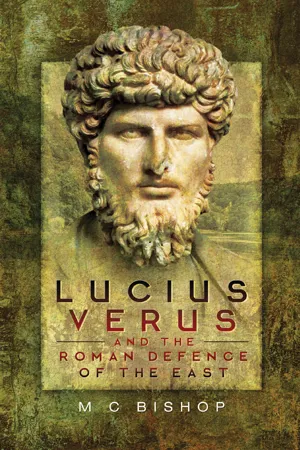
- 213 pages
- English
- ePUB (mobile friendly)
- Available on iOS & Android
eBook - ePub
Lucius Verus and the Roman Defence of the East
About this book
Trusted by 375,005 students
Access to over 1 million titles for a fair monthly price.
Study more efficiently using our study tools.
Information
Chapter 1
Introduction
Indeed, by the compact also, which has long subsisted between us, I think I am sufficiently qualified for receiving pardon. At all events, when in spite of repeated appeals from me you never wrote, I was sorry, by heaven, but, remembering our compact, not angry. (Lucius to Fronto, Ad Verum Imp. 2.2)
Defining the man
Lucius Verus was inevitably a product of his times and of the society in which he was brought up. For the modern reader, however, he is much more the product of the historians who have written about him, all the way from his near-contemporaries right up to modern, secondary sources. Rather confusingly, he even makes an appearance in the Hollywood blockbuster Gladiator, albeit as a small boy and son (rather than husband) of Lucilla, the daughter of Marcus – in reality this boy did not survive infancy. Indeed, most of the quotes on the internet purporting to be by Lucius are lines written for this fictional boy, rather than what the factual man said; in this volume, the words of the real Lucius Verus will be found, as will those of his family and friends. Defining what the real Lucius was actually like is a difficult task for the historian and one doomed to produce unsatisfactory answers. It is not completely without hope, however, and that is one of the reasons for the existence of this book: it is time to reassess Imperator Caesar Lucius Aurelius Verus Augustus and see if he really is ‘qualified for receiving pardon’.1
Lucius Ceionius Commodus was the son of another L. Ceionius Commodus who, at the time, was praetor in the city of Rome (Figure 1). Unfortunately, perhaps, and to the evident delight of the author of the Historia Augusta, Lucius shared his birthday with Nero, although to some at least of the Romans that was not necessarily quite as bad a turn of events as it might seem to us. The first five years of Nero’s reign – the so-called Quinquennium Neronis – was regarded as a near-perfect reign by many and something to be imitated by later rulers. The notion inevitably contains within it a ‘power corrupts’ message, since those first five Neronian years were constrained by his mentors, Seneca and Burrus – a philosopher and a soldier – and his mother, Agrippina, keeping him on the straight and narrow.2

Figure 1: Map of sites in Italy and the Balkans mentioned in the text (drawing M.C. Bishop).
Lucius is ultimately best known for, and perhaps even defined by, his Eastern wars against Parthia. That such a successful military venture against a perennially troublesome foe should be his ultimate achievement might be thought no bad thing, were it not for the fact that he has been so roundly dismissed as a lightweight. As will become apparent, sources ancient and modern have repeated the same old line about his dissolute, playboy nature and his lack of actual involvement in the fighting, while admiring his ascetic – almost extremist – adoptive brother Marcus who, in matters martial, has been if anything allowed to be more reluctant and less successful than Lucius with little by way of criticism. No such assumptions will be made in this work. Instead, the evidence will be carefully weighed for its validity, sifted for meaning, and finally analysed in order to attempt to approach as near as possible to the truth about Lucius Verus and his defence of the eastern provinces of the Roman Empire.
To understand how this son of a Roman senator came to be co-ruler of the Roman Empire, however, it is first necessary to examine something of the dynastic history of Rome under its first emperors after the disastrous civil wars that marked the end of the Roman Republic. Thanks to the fact that Augustus was able successfully to establish the fiction of his role as primus inter pares (the first amongst equals) within the senatorial class, his Julio-Claudian dynasty was to remain in power for more than ninety years. Although its collapse is often attributed to neglect by the last of that dynasty, Nero, an equally important consideration was the fact that he died childless. Having given no consideration to the succession, what happened next was in many ways inevitable. The brutal civil wars of AD 69/70 and its series of would-be emperors (or usurpers, depending upon your viewpoint) ultimately brought about a change in regime, with the Flavians (Vespasian, followed by his two sons, Titus and Domitian) ruling from 70 until 96. That dynasty ended when Domitian died childless, assassinated by the freedman Maximus, and the need for an emperor to replace him became so urgent that the Senate turned to one of their own number as a stopgap. This was arguably the beginning of the Antonine dynasty (and Marcus and Lucius certainly viewed it as such).
‘Great-great-grandfather’: Nerva (r. AD 96–8)
The distinguished if dull (and in Roman terms, at 65, rather elderly) M. Cocceius Nerva was persuaded to take the throne and, following a conspiracy in AD 97, attend to his own succession in the only way possible for him and adopt one of the leading generals of his day, M. Ulpius Traianus (Trajan). This was the beginning of a sequence of adoptions that was only ended by Marcus Aurelius’ successful production of an heir, the troubled (and troubling, if we are to believe the sources) Commodus (who was given the same praenomen, nomen, and cognomen as Lucius when born; more on that later). Nerva had effectively established a dynasty (and Marcus and Lucius were very pointedly referred to on inscriptions as his abnepotes or great-great-grandsons), albeit one shored up by adoptions (but not one which preferred the ‘best candidate’ over a blood successor).3
‘Great-grandfather’: Trajan (r. AD 98–117)
A career politician and accomplished military man, Trajan had commanded first legions and then provincial armies, when he was adopted by Nerva. In many ways, he was the ideal emperor, with both political and military experience. Once Nerva had died and Trajan succeeded him, he embarked on a series of successful campaigns, first in Dacia, then Arabia, and ultimately dying after seizing Mesopotamia from the Parthians and turning it into a province. It is easy to overlook the fact that, while many emperors had had military experience before they came to power, and some had even campaigned in the field while emperor, Trajan was the first emperor to lead protracted, aggressively acquisitive campaigns in person. As such, he was arguably the first of the soldier emperors, setting a new trend for what was to be expected of those who held the purple. However, he did not have children and did not make any provision for the succession (although Hadrian subsequently claimed he did: him). His influence on Lucius, his adoptive great grandson, cannot be overlooked. Although he had died some thirteen years before Lucius’ birth, his military record may nevertheless have been influential for the younger man in later life, particularly once he arrived in the East.4
One of the most important surviving testaments to Trajan’s martial accomplishments is the helical frieze that decorates the exterior of the shaft of his eponymous column. He is depicted in the reliefs of Trajan’s Column numerous times, addressing troops, supervising activities, and moving around; in fact, everything short of actually fighting. That particular activity is however depicted on the Great Trajanic Frieze, parts of which are incorporated within the Arch of Constantine next to the Colosseum in Rome, where he is shown riding down his foes on horseback. Two very different models of a military emperor are thus present in the iconographic tradition and they are not easily reconciled. Trajan’s Column depicts the manager, while the Great Trajanic Frieze celebrates the warrior. Subsequent emperors were going to have to choose which they wished to be seen as. The Column frieze was also a reminder of something else: the importance of the provincial armies. In a city dominated by the Praetorian Guard (any general might have a praetorian guard, but only the emperor had the Praetorian Guard), it acted as an aide-memoire of where an emperor’s real power base lay and one that would not be lost on the Antonine emperors.5
‘Grandfather’: Hadrian (r. AD 117–38)
When one former provincial army commander – Trajan – went on to adopt another – Hadrian – it is clear that a message was being sent. Both men had experienced the senatorial military career, rising through legionary tribune (tribunus laticlavius), legionary legate (legatus legionis Augusti), and ultimately all the way to commander of a provincial army (legatus Augusti pro praetore – more usually termed a provincial governor, but that is to underestimate the military component of the post). This inevitably meant that both men were thoroughly conversant with the provincial armies. Moreover, the fact that Hadrian, like Trajan, hailed from Spain only served to reinforce the fact that the Senate in Rome were no longer making the pace and that the provinces (and their armies) were now kingmakers. Despite his military background (or perhaps even because of it), Hadrian immediately showed himself upon accession to be a consolidator, not a conqueror. It is likely that his periods in military command will have contributed to his view of how the empire should be run and, in particular, how its limits should be determined. Perhaps as a result of having accompanied Trajan on campaign in the last years of his life, Hadrian opted for the role of manager – not just of a campaign, but of the entire empire, visiting as much of it as possible during his lifetime.6
His childless marriage to Sabina meant that he too had to give thought to the succession and for this he turned to a senator from a distinguished line, Lucius Ceionius Commodus, and adopted him as L. Aelius Caesar in AD 136. He was a man with no military experience (and so by definition a manager), but part of the attraction in choosing Ceionius Commodus may well have rested in his already having a small son, Lucius, to secure that succession for another generation. The freshly minted heir was packed off to the Danube frontier to pre-empt trouble brewing amongst the Quadi, providing him with precisely the military experience he was lacking. While there, a fragmentary inscription has led to the suggestion that he dedicated a temple to Antinous on the Pfaffenberg, above the legionary fortress at Carnuntum. Hadrian’s plan fell apart, however, when Aelius Caesar died of a haemorrhage on 2 January 138, soon after his return to Rome. We do not know if little Lucius had been with him on the frontier, but it was not unusual for senatorial officers and commanders to take their families with them. Aelius Caesar was only 36 at the time of his death and, given Lucius’ subsequent fate, the inevitable question presents itself of whether there might have been an inherited condition shared by father and son. Birley suggests that he may have suffered from tuberculosis, citing his coughing up blood. Hadrian was forced to find another candidate as successor, this time turning to a man with a distinguished senatorial pedigree, T. Aurelius Fulvus Boionius Arrius Antoninus. At the time of adopting Antoninus, however, Hadrian was careful to stipulate that he should in turn adopt the young M. Annius Verus (the future Marcus Aurelius) and Aelius Caesar’s son, L. Ceionius Verus (Lucius Verus). He had thus not only crafted his immediate successor, but (given that Antoninus had yet another childless marriage) ensured the succession beyond his first choice by providing an heir and a spare. The Antonine dynasty was therefore a masterful construct of Hadrian’s, reinforced as it was by his stabilization of the frontiers of the empire, and thus arguably his greatest legacy.7
‘Father’: Antoninus Pius (r. AD 138–61)
Hadrian died at Baiae safe in the knowledge that not only was his successor ready, but that the next generation after that were being prepared. Unlike Trajan and Hadrian, T. Aurelius Fulvus Boionius Arrius Antoninus had never held a legionary tribunate, commanded a legion, or headed an army in one of the military provinces. Antoninus Pius, as he became known, was no warrior, but he nevertheless gradually eased Hadrian’s prohibition on expansion. Under his reign, the Roman frontier in Britain was advanced from Hadrian’s Wall on the Tyne–Solway isthmus up to the Antonine Wall between Bo’ness in the east and Old Kirkpatrick in the west. Moreover, military occupation during the Antonine period extended to the north of the Antonine Wall, re-establishing many of the old Flavian military bases along the eastern coastal plain of what is now Scotland. For this, Antoninus relied on his generals, notably Q. Lollius Urbicus (c.138–c.144) and Cn. Iulius Verus (c.154–c.158), both legati Augusti pro praetore in Britain. Unlike Hadrian, however, he never even set foot in the province. Delegation – the Latin word legatus shares the root of that modern English term – had worked in the past and Antoninus Pius was clearly content to rely upon it again. With the right field commanders, the thinking seems to have run, victory could be achieved (and glory earned) without an emperor needing to show his face on a battlefield.8
In Germany, modifications were also made to the course of the Limes Germanicus. This was the sort of tweaking that required a detailed knowledge of the terrain and which once more lay with Antoninus Pius’ legati and not with him. Micromanagement of military matters did not interest him. This did not mean that he did not care about or was unaware of military affairs – only the most foolish of emperors, such as Nero, adopted that line – but rather that Rome administered her provinces by investing a huge amount of trust in her administrators and commanders, requiring only that broadly defined goals – the mandata of provincial commanders – be achieved in the most economical fashion.9
As emperor, the sources say, he also ignored Hadrian’s instructions with regard to his own succession and quite openly favoured Marcus over Lucius, appointing the former as consul...
Table of contents
- Cover
- Title
- Copyright
- Dedication
- Contents
- List of illustrations
- List of plates
- Preface
- Chapter 1: Introduction
- Chapter 2: Sources of All Ills
- Chapter 3: Early Life
- Chapter 4: Rome and the East
- Chapter 5: It’s Good to Share
- Chapter 6: A Giant’s Bones
- Chapter 7: Triumph
- Chapter 8: Crossing the River: Rome, the Danube, and Death
- Chapter 9: Conclusion: Golden boy or wastrel?
- Chapter 10: Epilogue: Marcus Aurelius in the field
- Appendix 1: Timeline
- Appendix 2: Redacting the Historia Augusta
- Appendix 3: Lucius’ letters to Fronto
- Endnotes
- Bibliography
- Plate section
Frequently asked questions
Yes, you can cancel anytime from the Subscription tab in your account settings on the Perlego website. Your subscription will stay active until the end of your current billing period. Learn how to cancel your subscription
No, books cannot be downloaded as external files, such as PDFs, for use outside of Perlego. However, you can download books within the Perlego app for offline reading on mobile or tablet. Learn how to download books offline
Perlego offers two plans: Essential and Complete
- Essential is ideal for learners and professionals who enjoy exploring a wide range of subjects. Access the Essential Library with 800,000+ trusted titles and best-sellers across business, personal growth, and the humanities. Includes unlimited reading time and Standard Read Aloud voice.
- Complete: Perfect for advanced learners and researchers needing full, unrestricted access. Unlock 1.4M+ books across hundreds of subjects, including academic and specialized titles. The Complete Plan also includes advanced features like Premium Read Aloud and Research Assistant.
We are an online textbook subscription service, where you can get access to an entire online library for less than the price of a single book per month. With over 1 million books across 990+ topics, we’ve got you covered! Learn about our mission
Look out for the read-aloud symbol on your next book to see if you can listen to it. The read-aloud tool reads text aloud for you, highlighting the text as it is being read. You can pause it, speed it up and slow it down. Learn more about Read Aloud
Yes! You can use the Perlego app on both iOS and Android devices to read anytime, anywhere — even offline. Perfect for commutes or when you’re on the go.
Please note we cannot support devices running on iOS 13 and Android 7 or earlier. Learn more about using the app
Please note we cannot support devices running on iOS 13 and Android 7 or earlier. Learn more about using the app
Yes, you can access Lucius Verus and the Roman Defence of the East by M.C. Bishop in PDF and/or ePUB format, as well as other popular books in History & Historical Biographies. We have over one million books available in our catalogue for you to explore.