- 304 pages
- English
- ePUB (mobile friendly)
- Available on iOS & Android
eBook - ePub
The Men Behind Monty
About this book
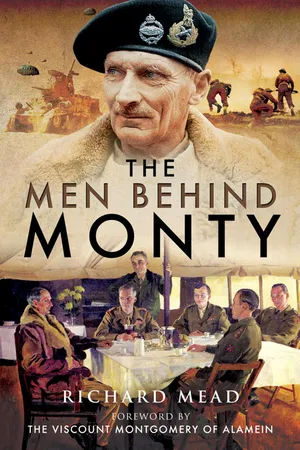
The Men Behind Monty examines the role played by the staff in the victorious campaigns of Field Marshal Viscount Montgomery, Britain's most successful field commander since the Duke of Wellington.When Monty took command of Eighth Army in August 1942, he inherited the staff of his predecessor. He retained all the key members and most of them stayed with him not only from El Alamein to Tunis, but also in Sicily and Italy. When he took command of 21st Army Group in January 1944, many accompanied him to take up the most prominent positions on the HQ staff and the majority remained until the German surrender in May 1945.This fascinating work focuses not only on the senior officers responsible for the various staff branches, and notably on Monty's outstanding Chief of Staff, Freddie de Guingand, but also on his personal staff, the ADCs and personal liaison officers.The book sheds light on the work of the staff generally, and on their direct contribution to Monty's decisions, his sometimes difficult and controversial relationships with his superiors and allies.
Tools to learn more effectively

Saving Books

Keyword Search

Annotating Text

Listen to it instead
Information
Chapter One
Prelude in the Desert
War came to the Western Desert of North Africa on 10 June 1940, when Benito Mussolini cast his hat into the ring alongside his fellow dictator in Germany. Mussolini was motivated by both greed and vainglory. He coveted the territory which he might now be able to obtain for Italy, notably British colonies or areas of influence in North and East Africa, and he was desperate to have a seat at the top table in the new European order.
The British, close to being driven from the continent of Europe and with their French allies looking increasing shaky, were understandably apprehensive about their position in Egypt, in which country they were far from popular and where there were signs of growing sympathy for the Axis. Egypt had been technically an independent state since 1922, but Great Britain remained responsible for its defence and security. Although the Anglo-Egyptian Treaty of 1936 handed over control of the Egyptian Army to local commanders, a sizeable body of British troops had remained in the country, critical as it was to Britain’s control of the short route to India through the Suez Canal.
The threat from the Italians was not new. In October 1935 Italy had invaded Ethiopia, causing a crisis in which the League of Nations finally revealed its ineffectiveness and which ended with the de facto Italian occupation of that country. The British were more concerned about the danger from Libya, an Italian colony since 1912, and they temporarily augmented their military establishment in Egypt until the crisis subsided. With the coming of war against Germany and with concerns growing about Mussolini’s plans for the expansion of his empire, steps were taken again to increase the British forces in the Middle East. By June 1940 there was a powerful fleet based at Alexandria, whilst British Troops in Egypt (‘BTE’), the organization responsible for ground forces, had grown significantly from its three peacetime brigades.
The longest established formation in Egypt was 7 Armoured Division, formerly the Mobile Division (Egypt), comprising two armoured brigades and a support group of artillery and infantry, together with divisional troops. In July 1940 the division had 175 light tanks, armed with machine guns, and 75 cruiser tanks with 2-pounder guns. New arrivals since the beginning of the war were 4 Indian Division, whose two Indian brigades had been augmented by a British brigade, and 6 Australian Division, whilst 2 New Zealand Division was due to disembark shortly. Churchill, who from the beginning regarded the defence of Egypt as of vital importance, despatched a convoy containing fifty Matilda infantry tanks, about half the number available in Britain, a bold decision for a premier expecting invasion at any moment. Well armoured, albeit slow moving, they were to prove their worth in the months to come.

Map 1.
Three days before the declaration of war by Italy, Lieutenant General Richard O’Connor was summoned from Palestine to take command of the new Western Desert Force, a corps-sized formation consisting of 7 Armoured Division and 4 Indian Division, with its HQ at Mersa Matruh. On the instructions of General Sir Archibald Wavell, C-in-C Middle East, O’Connor immediately went on the attack, capturing the frontier positions at Forts Capuzzo and Maddalena, but the Italians then advanced in force with the whole of their Tenth Army, moving ponderously into Egypt until they reached Sidi Barrani, where they stopped and constructed defensive positions. O’Connor, grateful for this pause, conserved his tanks and trained his men for a future offensive.
Both Wavell and O’Connor were thoroughly offensively minded and, in November 1940, plans were drawn up for a new attack. BTE, now under Lieutenant General Henry Maitland ‘Jumbo’ Wilson, still sat in between Middle East Command and Western Desert Force and this plethora of HQs might have introduced unnecessary duplication into the process, but by good fortune both the commanders and their chief staff officers were men of good sense. Wilson’s BGS, Sandy Galloway, was lent to O’Connor to work on the planning with the latter’s BGS, Rupert Hobday, and when Galloway fell ill he was replaced by John Harding, at the time a GSO1 at GHQ Middle East. As events progressed, it was found more effective for O’Connor to report directly to Wavell. For the remainder of the war, BTE remained in command of the static troops in the base area of Egypt, whilst responsibility for those doing the fighting was delegated by the C-in-C Middle East first to Western Desert Force and then to Eighth Army.
Operation COMPASS was originally conceived and planned as a five-day raid. A full-scale training exercise was carried out by way of preparation, and on 9 December, as the troops advanced on what had been billed as a second exercise, they were told that it was the real thing. The attack was totally successful, the Italian fortified positions south of Sidi Barrani being overrun, whilst a left hook around the town to the sea cut off large numbers of the enemy, the remainder of whom retreated in some confusion to the frontier. At just this point 4 Indian Division was withdrawn for service in East Africa, to be replaced by 6 Australian Division. O’Connor, with Harding replacing Hobday as his BGS, did not let this throw him off his stride, but instead immediately capitalized on the enemy’s confusion, bringing his new division into action as soon as it arrived. The Australians, together with 7 Armoured Division, went on to mount successful attacks on Bardia and Tobruk. By the end of January 1941, Western Desert Force had taken Derna on the coast road and Mechili, astride the main track across the desert south of the hilly Jebel Akhdar.
There then took place the outstanding action of the campaign, in which the Australians pressed forward from Derna to Benghazi, whilst mobile forces from 7 Armoured Division raced across the desert to cut the main road from Benghazi to Tripoli at Beda Fomm, trapping what remained of Tenth Army. It was a very complete victory, in which Western Desert Force, never much more than 30,000 strong, had taken 130,000 prisoners and captured or destroyed 400 tanks, 850 guns and large quantities of soft transport. Great Britain’s position in North Africa looked secure.
At this juncture Wavell would probably have been able to mount an advance from O’Connor’s forward position at El Agheila all the way to Tripoli, seizing the whole of Libya, bringing the lightning campaign to an ultimate conclusion and shortening the war in North Africa by two years. Instead, his attention was diverted to another theatre of war, Greece. The Greeks had themselves dealt the Italians a bloody nose over the winter, but they were now under serious threat from a drive into the Balkans by the Germans to protect their flank prior to launching Operation BARBAROSSA against the Soviet Union. Churchill was obsessed with bolstering Greece and he brought Wavell, initially sceptical, around to his viewpoint. W Force, commanded by Wilson and comprising 2 New Zealand Division, 6 Australian Division and 1 Armoured Brigade, was duly despatched, only to be soundly defeated when the Germans invaded.
The Australians were replaced in Western Desert Force by their countrymen in the keen but untested 9 Australian Division, from which some of the best trained units had been withdrawn for service in Greece and replaced by newly arrived and greener troops. Then 7 Armoured Division was withdrawn to Egypt to refit, relieved by the newly arrived and as yet untrained 2 Armoured Division, now shorn of 1 Armoured Brigade. Of the three regiments in its other armoured brigade, one was equipped with light tanks with no anti-tank capability, one had only half its proper establishment of cruiser tanks and the third was equipped entirely with Italian tanks captured at Beda Fomm. The support group was also short of its full establishment. In the meantime, O’Connor had also gone, stepping into Wilson’s job at BTE. He was replaced by Philip Neame, now styled Military Governor of Cyrenaica, which became a static district.
On the other side of the front line, a highly significant development now took place. Concerned by his ally’s failure to hold on to Cyrenaica, Hitler sent to Libya one of his most experienced generals, Erwin Rommel, who had proved his quality as a divisional commander during the blitzkrieg in France in May and June 1940. Using the newly arrived 5 German Light Division and two fresh Italian divisions, with two German panzer divisions under orders to follow as soon as they landed in Libya, Rommel went on to the offensive on 24 March, taking 2 Armoured Division by surprise, capturing El Agheila and sweeping forward along the very track that O’Connor had used to reach Beda Fomm. Wavell sent O’Connor back to the battlefield to act as an adviser to Neame, but in the confusion of retreat both men were captured, as was Michael Gambier-Parry, GOC of 2 Armoured Division, which soon ceased to exist as a coherent formation.
Together with 9 Australian Division, sundry British units, including some much needed artillery, withdrew in good order to Tobruk. The Australian commander, Leslie Morshead, was a vigorous and determined soldier and he and John Harding, who had stayed with Neame as BGS when O’Connor returned to Cairo but had avoided capture, resolved to stand fast there, swiftly siting strong defensive positions around the town. As the Axis troops swept past on their way to the Egyptian frontier, the Australians and British found themselves under siege.
By the end of April, Wavell was in trouble on several fronts. Rommel’s force had entered Egypt, W Force had been expelled from Greece and the same fate would shortly be in store for the British, Australian and New Zealand troops in Crete. There were also problems in Iraq, where a pro-Axis clique had taken power and threatened to cut off the air route to India. No sooner had this been satisfactorily resolved than Wavell was forced to undertake the invasion of Vichy French Syria to prevent the Germans establishing themselves there. A brief but unpleasant little campaign ensued which secured the Levant but distracted Wavell from his most important task, recovering the lost ground in the Western Desert.
On 15 May Wavell mounted Operation BREVITY, its objective being to take the Halfaya Pass and Sollum on the Egyptian side of the frontier and then exploit as far as possible towards Tobruk. The weakness of the force resulted in withdrawal two days later, with modest initial gains quickly lost. The more ambitious Operation BATTLEAXE was mounted by XIII Corps, Western Desert Force’s new name, with the objective not only of taking the Axis frontier positions but also of relieving Tobruk. On paper this reunited the original two divisions of the desert war, 7 Armoured and 4 Indian, the former refitted, the latter returned from East Africa. In practice, the Indian Division had only a single brigade and was given temporary command of 22 Guards Brigade. Although 7 Armoured Division had the benefit of new cruiser tanks which had arrived in a recent convoy from England, one of its brigades was still equipped entirely with Matildas, which had served well against the Italians but were obsolete in the face of German tanks and anti-tank guns. With the attack opening on 15 June, there was initial success on the escarpment, where 7 Armoured Division took Fort Capuzzo; but Rommel held the vital Halfaya Pass, where the British armour met the lethal German 88s for the first time. The commander of XIII Corps, Noel Beresford-Peirse, was inexperienced in the use of armour and his force found itself in serious trouble when faced with 15 Panzer Division. The commander of 4 Indian Division, Frank Messervy, ordered a retreat from Halfaya and Sollum, 7 Armoured Division was forced to conform and the operation was over three days after it began.
The failure of BATTLEAXE proved to be the last straw for Churchill, who had lost patience with Wavell. On 2 June it was announced that he had exchanged appointments with the C-in-C India, General Sir Claude Auchinleck.
Chapter Two
Eighth Army Enters the Field
Auchinleck came to the Middle East with his reputation standing high, in Churchill’s eyes at least. Whereas Wavell had been slow to respond to the crisis in Iraq and had seemed to the Prime Minister almost reluctant to commit troops there, Auchinleck had reacted vigorously, despatching a division from India and reinforcing by air the small garrison at Habbaniya sufficiently strongly to drive away the threatening Iraqis, even before Wavell’s relieving column arrived from Palestine.
Unusually for an officer of the Indian Army, ‘the Auk’, as he was popularly known, had held a corps command in the UK at the beginning of the war, taking part of his HQ to Norway in April 1940 in the closing stages of the short campaign there, which he had quickly recognized was a lost cause. He had organized the inevitable evacuation skilfully and was rewarded on his return with Southern Command, where he succeeded Brooke. There he attracted the favourable attention of the Prime Minister, but also the scorn of Montgomery, one of his corps commanders, with whom he completely failed to establish a good relationship. Both men were delighted when Auchinleck became C-in-C India, an appointment which the latter regarded at the time as both the pinnacle and the likely finale of his career. Now he found himself back where the action was the hottest.
The Prime Minister did not allow the new man time to settle in. On the contrary, he began where he had left off with Wavell, applying considerable pressure for a new offensive to be undertaken immediately. Like Wavell, Auchinleck was a consummate professional soldier and he resisted any attempt to make him attack before he was ready. First the Syrian campaign required to be finished. In Egypt new formations were arriving, but they all required time for acclimatization and training, whilst the tanks sent from the UK had to be modified for desert conditions. Auchinleck did, however, begin to plan a major operation and travelled to London in late July to present his preliminary plans to the Prime Minister and the CIGS, General Sir John Dill.
Auchinleck’s new offensive was to employ both the existing XIII Corps and a new XXX Corps. An Army would be required to control the whole battlefield, and this was to the first field formation of such a size to see action since the demise of the British Expeditionary Force in June 1940. The choice of its commander was the first of many matters over which Auchinleck and Churchill disagreed. The Prime Minister favoured ‘Jumbo’ Wilson, although he had never met him, whilst Auchinleck preferred Alan Cunningham. On the evidence, this was the right decision. Wilson had been resoundingly defeated in Greece and had made heavier weather than anticipated in Syria. He was also, although this might not have weighed heavily with the 66-year old Prime Minister, approaching his sixtieth birthday. Cunningham, on the other hand, had recently conducted a successful campaign against the Italians in Somaliland and Ethiopia and was familiar with desert conditions. Churchill accepted Auchinleck’s choice rather grumpily, but it was to come back to bite the C-in-C in due course. The Prime Minister was also forced to give in to Auchinleck’s insistence that he would be unable to mount the offensive until November.
It was on 10 September 1941 that HQ Western Army was formed at Pirbright Camp, Abbasia, and on 27 September that its designation was changed to HQ Eighth Army. Even to Auchinleck, who hardly knew Cunningham, the appointment of the Army Commander must have seemed something of a risk, so the choice of a first-class Brigadier General Staff was seen by many as an insurance policy. The man selected was Sandy Galloway. Galloway already had considerable experience as a general staff officer. He had served in Egypt in the 1930s as the Brigade Major of the Canal Brigade and had been on the Directing Staff at Camberley. Possibly as a result of the latter appointment, he was chosen to open the new Staff College at Haifa as its Commandant in February 1940. That August he became Wilson’s BGS at BTE, in which capacity he was involved in the planning for Operation COMPASS, before following Wilson to Greece, where he was instrumental in organizing the successful evacuation of the bulk of W Force from ports in the Peloponnese. With a reputation for both common sense and decisiveness, he was trusted by Arthur Smith, formerly Wavell’s and now Auchinleck’s Chief of Staff, and by other senior officers at GHQ Egypt and in the War Office.
Galloway began to assemble his side of the staff, selecting, where possible, officers he knew. The staff of Western Desert Force, with Harding still the BGS, had mostly continued with XIII Corps, so he had to look outside. One of the first men Galloway picked was David Belchem, a young officer from the Royal Tank Regiment who had been in the first intake at Haifa before progressing to Wavell’s Intelligence Staff in Cairo. Hoping to return to his regiment, Belchem had found himself posted instead as GSO2 (Ops) at W Force, where he worked for Galloway and acted as his right-hand man during the evacuation. Back in Cairo, with clear ideas as to how a campaign should not be fought, he once again applied to return to regimental duty, only to be picked by Galloway as GSO1 (Staff Duties), which at least meant promotion to acting lieutenant colonel.
‘Staff Duties’ is a misnomer for what is a key General Staff branch. Lieutenant General Sir Ronald Weeks, Deputy CIGS from 1942 to 1945, was to say later that the Director of Staff Duties at the War Office should have been called the Director of Organization, and the same applied further down the line. In an army HQ the GSO1 (SD) acted as the main link between the GSO1 (Ops) and the A & Q staff. The former translated the plans of the commander into action, whilst the latter provided the necessary manning (A) and the provisioning and movement (Q). The SD branch acted as co-ordinator between them, organizing the allocation and deployment, and sometimes even the creation, of formations and units to meet the requirements of the order of battle. Belchem excelled at the job: Charles Richardson, who joined the HQ in the following summer, described him as ‘sharp as a knife … clear, accurate and decisive in every emergency’.1
Galloway’s opposite number on the administrative side of the HQ was the Deputy Adjutant and Quartermaster General, Charles Miller, a cavalryman and an exact contemporary of Galloway’s at Camberley, who arrived from holding the same position at BTE. Miller’s Q branch was led by Brian Robertson, the Assistant Quartermaster General. The son of Field Marshal Sir William Robertson, the CIGS in ...
Table of contents
- Front Cover
- Title Page
- Copyright Page
- Contents
- List of Maps
- Foreword
- Introduction
- Chapter 1 Prelude in the Desert
- Chapter 2 Eighth Army Enters the Field
- Chapter 3 Auchinleck Takes Control
- Chapter 4 Freddie
- Chapter 5 The Making of Monty
- Chapter 6 Monty the General
- Chapter 7 The New Broom
- Chapter 8 Alam Halfa and After
- Chapter 9 Intelligence and Deception
- Chapter 10 Lightfoot and Supercharge
- Chapter 11 The Pursuit
- Chapter 12 The End in Africa
- Chapter 13 Husky
- Chapter 14 To the Sangro
- Chapter 15 Prelude to Overlord
- Chapter 16 The Monty Men Take Charge
- Chapter 17 G, Q & A
- Chapter 18 Preparing for D-Day
- Chapter 19 Tac Goes to War
- Chapter 20 The Hinge
- Chapter 21 The Phase Lines
- Chapter 22 The Great Leap Forward
- Chapter 23 Arnhem and Antwerp
- Chapter 24 The Bulge
- Chapter 25 The Rhine
- Chapter 26 Triumph and Tragedy
- Chapter 27 Post War
- Chapter 28 Reflections
- Appendix I Monty’s Address to the Officers of H.Q. Eighth Army on Taking over Command
- Appendix II 21st Army Group – Organisation of G Staff & Advisers
- Appendix III 21st Army Group – Organisation of Q Staff
- Appendix IV 21st Army Group – Organisation of A Staff
- Appendix V Officers of TAC HQ 21st Army Group
- Abbreviations
- Acknowledgements
- Sources and Bibliography
- Notes
Frequently asked questions
Yes, you can cancel anytime from the Subscription tab in your account settings on the Perlego website. Your subscription will stay active until the end of your current billing period. Learn how to cancel your subscription
No, books cannot be downloaded as external files, such as PDFs, for use outside of Perlego. However, you can download books within the Perlego app for offline reading on mobile or tablet. Learn how to download books offline
Perlego offers two plans: Essential and Complete
- Essential is ideal for learners and professionals who enjoy exploring a wide range of subjects. Access the Essential Library with 800,000+ trusted titles and best-sellers across business, personal growth, and the humanities. Includes unlimited reading time and Standard Read Aloud voice.
- Complete: Perfect for advanced learners and researchers needing full, unrestricted access. Unlock 1.4M+ books across hundreds of subjects, including academic and specialized titles. The Complete Plan also includes advanced features like Premium Read Aloud and Research Assistant.
We are an online textbook subscription service, where you can get access to an entire online library for less than the price of a single book per month. With over 1 million books across 990+ topics, we’ve got you covered! Learn about our mission
Look out for the read-aloud symbol on your next book to see if you can listen to it. The read-aloud tool reads text aloud for you, highlighting the text as it is being read. You can pause it, speed it up and slow it down. Learn more about Read Aloud
Yes! You can use the Perlego app on both iOS and Android devices to read anytime, anywhere — even offline. Perfect for commutes or when you’re on the go.
Please note we cannot support devices running on iOS 13 and Android 7 or earlier. Learn more about using the app
Please note we cannot support devices running on iOS 13 and Android 7 or earlier. Learn more about using the app
Yes, you can access The Men Behind Monty by Richard Mead in PDF and/or ePUB format, as well as other popular books in Storia & Biografie in ambito militare. We have over one million books available in our catalogue for you to explore.