A military history of the two campaigns British and Commonwealth forces fought against Communist terrorists in Malaya during the mid-twentieth century.
The struggle with Communist terrorists in Malaya known as The Emergency became a textbook example of how to fight a guerrilla war, based on political as much as military means. This book deals with both the campaign fought by British, Commonwealth, and other security forces in Malaya against Communist insurgents, between 1948 and 1960, and also the security action in North Borneo during the period of Confrontation with Indonesia from 1962 to 1966. Both campaigns provided invaluable experience in the development of anti-guerrilla tactics, and are relevant to the conduct of similar actions which have been fought against insurgent elements since then. The book written with the full co-operation of various departments of the UK Ministry of Defence contains material that until recently remained classified.
This is the first full study to cover the role of airpower in these conflicts. It will be of relevance to students at military colleges, and those studying military history, as well as having a more general appeal, particularly to those servicemen and women who were involved in both campaigns.
eBook - ePub
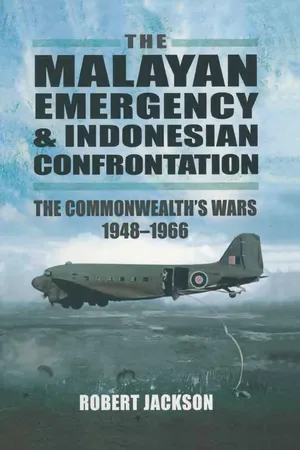
The Malayan Emergency & Indonesian Confrontation
The Commonwealth's Wars, 1948–1966
- 176 pages
- English
- ePUB (mobile friendly)
- Available on iOS & Android
eBook - ePub
About this book
Trusted by 375,005 students
Access to over 1.5 million titles for a fair monthly price.
Study more efficiently using our study tools.
Information
CONTENTS
Preface
1 MALAYA: THE LAND AND THE PEOPLE
2 THE COMMUNIST THREAT TO MALAYA
3 THE SECURITY FORCES
4 GROUND OPERATIONS: APRIL 1948 TO APRIL 1950
5 GROUND OPERATIONS PHASE TWO: APRIL 1950 TO DECEMBER 1951
6 GROUND OPERATIONS PHASE THREE: JANUARY 1952 TO MAY 1954
7 THE BEGINNING OF THE END
8 THE FINAL PHASE
9 OFFENSIVE AIR OPERATIONS
10 AIR TRANSPORT SUPPORT
11 HELICOPTER SUPPORT OPERATIONS
12 THE ROYAL MALAYAN AIR FORCE
13 PSYCHOLOGICAL WARFARE
14 THE MALAYAN EMERGENCY: CONCLUSIONS
15 CONFRONTATION
Appendix 1: Naval forces in the Emergency and Confrontation
Appendix 2: Commonwealth military and air units in the Malayan Emergency
Bibliography
Index
PREFACE
Between 1948 and 1966, British and Commonwealth forces fought two campaigns in South-East Asia, the first against Communist terrorists in Malaya, the second against Indonesian forces in Borneo. Both campaigns were concluded successfully, and had far-reaching consequences for the political stability of the Eastern Hemisphere.
The political background to both campaigns is complex and largely outside the scope of this work, which attempts to set out the military achievement in as concise a manner as possible, and to examine the lessons that were learned from it. A great many military units were involved in prosecuting both campaigns, and although some have been singled out for special mention it has been impossible to deal fairly with the achievements of them all, particularly in the context of the Malayan Emergency. A full list of military and air units involved will be found in the appendices to this book, together with a bibliography of recommended further reading.
RJ
1
MALAYA: THE LAND AND THE
PEOPLE
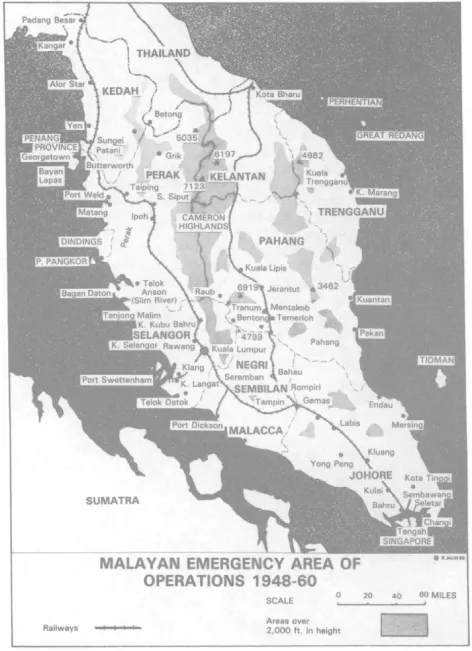
Malaya is one of the most beautiful, and at the same time one of the most primordial, countries on earth. In the north, the narrow Kra isthmus binds it to Thailand, its only land frontier; the peninsula itself is some 500 miles long, a little larger than England without Wales, ending at the Johore Strait which separates it from the island of Singapore. To the east, the South China Sea stretches away to the Philippines and the Pacific; to the west, beyond neighbouring Indonesia, lies the vast expanse of the Indian Ocean.
The hinterland of Malaya – more correctly known nowadays as Peninsular Malaysia – is largely inaccessible. The central mountain ranges, running like a spine along much of the country’s length, rise to 7,000 feet at their maximum elevation. On their western, steepest side, rivers plunge down the mountain slopes in waterfalls and fast-flowing streams until they reach the 50-mile-wide coastal plain which faces Sumatra across the Malaccan Strait; on the eastern flank the slopes are gentler and the rivers longer and lazier, flowing into the South China Sea over palm-fringed beaches.
Carpeting the mountain ranges is the dense jungle, one of the oldest rain forests in the world. One hundred million years old, it covers four-fifths of the peninsula, together with its associated mangrove swamps:
Harsh and elemental, implacable to all who dare to trifle with its suffocating heat or hissing rains, the jungle alone has remained untamed and unchanged …. Here the tall trees with their barks of a dozen hues, ranging from marble white to scaly greens and reds, thrust their way up to a hundred feet or even double that height, straight as symmetrical cathedral pillars, until they find the sun and burst into a green carpet far, far above; trees covered with tortuous vines and creepers, some hanging like the crazy rigging of a wrecked schooner, some born in the fork of a tree, branching out in great tufts of fat green leaves or flowers; others twisting and curling round the massive trunks, throwing out arms like clothes-lines from tree to tree. In places the jungle stretches for miles at sea level – and then it often degenerates into marsh, into thick mangrove swamp that can suck a man out of sight in a matter of minutes ….In an evergreen world of its own that will never know the stripped black branches of winter, elephants, tigers, bears and deer roam the thick undergrowth; flying foxes, monkeys and parrots chatter and screech in its high places; crocodiles lie motionless in the swamp; a hundred and thirty varieties of snake slither across the dead leaves on wet ground; the air is alive with the hum of mosquitoes ferocious enough to bite through most clothing; and on the saplings and ferns struggling to burst out of the undergrowth thousands of fat, black, bloodsucking leeches wait patiently for human beings to brush against them. Only on the jungle fringe is there colour and light and a beauty unmarred by fear. Here, when the sun comes out after a tropical shower, thousands of butterflies hang across the heat-hazed paths in iridescent curtains. Brightly coloured tropical birds dart like jewels between clumps of bamboo, giant ferns, ground orchids, flame of the forest trees, bougainvillaea, wild hibiscus, in a countryside heavy with the scent of waxen-like frangipani blossoms, where the occasional monkey watches suspiciously from the heights of a tulip tree with its clusters of poppy-red flowers.(Noel Barber, The War of the Running Dogs)
This description of the Malayan jungle, by a man with first-hand experience of it over many years, is one of the best there is. It summarizes the contrasts of the wild, natural landscape that dominates every aspect of Malayan life. In its depths live the aboriginal tribespeople, shy folk who hunt small game with their blowpipes and who live in communal houses built on piles driven into the edge of a river near the plots of land where they cultivate their simple crops of rice, vegetables and sugar cane. Here, in their kampongs on the jungle fringes, close to the sea or the rivers, live the Mohammedan Malays, the indigenous people of the land, an attractive, courteous and endearing race who live their lives at a leisurely pace; they grow rice, breadfruit and papayas in and around their villages, harvest ginger, cinnamon and figs from the countryside’s natural bounty, fish the abundant rivers and derive oil, roofing materials and coconuts from the palm groves.
The way of life of the Malays contrasts sharply with that of the Chinese. They are the town dwellers, and their lives revolve around commerce, although their influence has declined over the past forty years. In Singapore their influence is strong, but on the mainland, mainly because of the events described in this book, they have been ousted from posts of importance. Nevertheless, together with the Indian population of Malaysia, they continue to be a vibrant force in Malaysia’s economic climate.
The Malays are an old race, probably the oldest in South-East Asia, at least in terms of civilization. Their origins are not clear, but they probably reached the peninsula from southern India by way of Sumatra. Long before the Christian era, they were carrying on a thriving trade in ivory, camphor, sandalwood and tin with merchants from the Coromandel coast of India and from China; by AD 160 they were known to the western world, and sixty years later, when gold was found in the peninsula, prospectors and adventurers arrived from many points of the compass, including the Roman Empire. The lure of gold attracted Indians in great numbers, bringing the Hindu religion with them and marrying into local families. In the fifteenth century Islam became the primary religion of Malaya, although the Hindu religion retained a strong following, particularly in the rich state of Kedah.
In the sixteenth century Kedah’s main trade outlet was through the port of Malacca, which came under Dutch jurisdiction with the colonization of the East Indies a century later. The Dutch placed restrictions on all the ports within their sphere of influence, including Malacca, whereupon Kedah looked across the Bay of Bengal to Calcutta, where an English trading company had received its charter from Queen Elizabeth I on the last day of December 1599. Before long, the East India Company had set up a trading post at the mouth of the Kedah River, and England’s long association with Malaya had begun.
Between 1765 and 1800, a series of treaties between the British and the Sultan of Kedah guaranteed the latter an annual income of several thousand Spanish dollars in exchange for British occupation of Penang Island and a strip of land on the coast opposite. One of the original conditions was that Britain would provide military aid for the Sultan if Kedah should be invaded by her powerful neighbour, Siam, but when the long-feared invasion came in 1821, resulting in Kedah being overrun and the population massacred, the British did nothing except provide sanctuary for the fleeing Sultan and his family. The failure to intervene seriously weakened British influence in Malaya for many years, even though an agreement engineered by the British led to a Siamese withdrawal from Kedah and parts of Perak, which had also been attacked, in 1826.
Siamese influence in Kedah remained powerful throughout the nineteenth century, and it was only with the approval of the Siamese Government that a British consul was appointed in the state in 1894 on the request of the Sultan. With the signing of the Ang...
Table of contents
- Cover
- Half Title
- Full Title
- Copyright
- Contents
Frequently asked questions
Yes, you can cancel anytime from the Subscription tab in your account settings on the Perlego website. Your subscription will stay active until the end of your current billing period. Learn how to cancel your subscription
No, books cannot be downloaded as external files, such as PDFs, for use outside of Perlego. However, you can download books within the Perlego app for offline reading on mobile or tablet. Learn how to download books offline
Perlego offers two plans: Essential and Complete
- Essential is ideal for learners and professionals who enjoy exploring a wide range of subjects. Access the Essential Library with 800,000+ trusted titles and best-sellers across business, personal growth, and the humanities. Includes unlimited reading time and Standard Read Aloud voice.
- Complete: Perfect for advanced learners and researchers needing full, unrestricted access. Unlock 1.5M+ books across hundreds of subjects, including academic and specialized titles. The Complete Plan also includes advanced features like Premium Read Aloud and Research Assistant.
We are an online textbook subscription service, where you can get access to an entire online library for less than the price of a single book per month. With over 1.5 million books across 990+ topics, we’ve got you covered! Learn about our mission
Look out for the read-aloud symbol on your next book to see if you can listen to it. The read-aloud tool reads text aloud for you, highlighting the text as it is being read. You can pause it, speed it up and slow it down. Learn more about Read Aloud
Yes! You can use the Perlego app on both iOS and Android devices to read anytime, anywhere — even offline. Perfect for commutes or when you’re on the go.
Please note we cannot support devices running on iOS 13 and Android 7 or earlier. Learn more about using the app
Please note we cannot support devices running on iOS 13 and Android 7 or earlier. Learn more about using the app
Yes, you can access The Malayan Emergency & Indonesian Confrontation by Robert Jackson in PDF and/or ePUB format, as well as other popular books in History & Asian History. We have over 1.5 million books available in our catalogue for you to explore.