A highly decorated Royal Navy officer recounts his experiences at the command of a motor torpedo boat in the North Sea during WWII.
In 1942-43, Captain Peter Dickens commanded the 21st MTB Flotilla, mainly in the North Sea and the English Channel. In
Night Action, he vividly recounts his experiences performing daring missions amid storms of gunfire, usually under the cover of darkness. Dickens and his crew managed to closely engage enemy convoys and escorts in high-speed attacks and wreak havoc among the German supply lines.
Like the sailors who fought Nazi U-boats in the battle of the Atlantic, Dickens and his comrades were experiencing a new kind of warfare and had to develop techniques and tactics as they went along; their kind of action called for great courage, spilt-second timing and complete understanding between captain and crew.
For his bravery and heroism, Dickens was awarded The Distinguished Service Order, a Distinguished Service Cross, and The Most Excellent Order of the British Empire. In
Night Action, he offers a frank depiction of live aboard the 21st MTB Flotilla, combining comradery and humor with the true horror of war
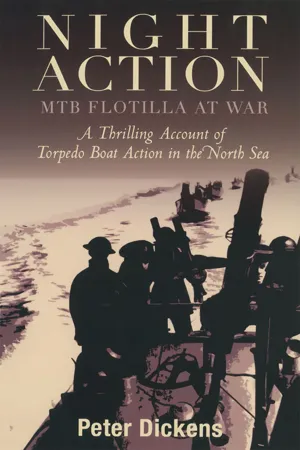
eBook - ePub
Night Action
MTB Flotilla at War: A Thrilling Account of Torpedo Boat Action in the North Sea
- 256 pages
- English
- ePUB (mobile friendly)
- Available on iOS & Android
eBook - ePub
Night Action
MTB Flotilla at War: A Thrilling Account of Torpedo Boat Action in the North Sea
About this book
Trusted by 375,005 students
Access to over 1.5 million titles for a fair monthly price.
Study more efficiently using our study tools.
Information
Contents
| Map | |
| Introduction | |
| Preface | |
| I | The Second Battle of Barfleur |
| II | Conditioning for War |
| III | Coastal Forces |
| IV | Getting the Hang of It |
| V | Hellrot |
| VI | Iron Ore |
| VII | Softly Catch Monkey |
| VIII | ‘Expect Unsuccessful Attack’ |
| IX | Back to Beehive |
| X | The Barrels and the Bullfight |
| XI | The Four Horsemen |
| XII | Hits and Near Misses |
| XIII | Sad Ending |
| Appendice | |
| I | British Ships and Craft |
| II | Operational Statistics |
| III | Enemy Ships and Craft |
| Bibliography | |
| Index |

Introduction
IN THIS BOOK Peter Dickens presents a remarkably vivid and engrossing account of Coastal Forces operations off the wartime East Coast of England and as far as enemy occupied shores. His story is told with humour and, in the author’s own words, with accuracy and ungilded truth. As such it presents a quite unrivalled insight into the courage and bravery of young men, largely untrained and tested in this method of warfare in the early part of the War, seeking and engaging the enemy with the minimum of protection in their lightly armed wooden craft. Accounts of engagements with the enemy are given in remarkable detail and show a clear insight into the need for those in command to make life and death decisions in the thick of war.
Although developed to a small extent in World War I with the use of Coastal Motor Boats, the disciplines of this area of warfare were much neglected in the interwar years. In 1939 the Motor Gunboats and Motor Torpedo Boats available for the tasks ahead of them were totally inadequate and were increased in number dramatically as ‘Their big ship oriented Lordships’, to quote the author, came to a realisation of the need for the protection of our coastal convoys and coastal waters from enemy attack. Much of the credit for the development of Coastal Forces can be given to those few specialist ship builders whose vision appeared to exceed that of the Admiralty. This was an area of warfare that was largely uncharted and, with innovation and the intelligent development of procedures, new disciplines of warfare were founded. Peter Dickens was part of this world and as a young Lieutenant, with only limited operational experience, he nevertheless brought to this scene a great sense of purpose and his ultimate contribution to Coastal Forces wartime operations was immense. He quickly saw the folly of racing into the enemy with all guns blazing, which was an approach which sat well with those then commanding Coastal Forces operations from ashore, but which did little but alert the enemy to the Royal Navy’s presence. He developed techniques of stealth, which in addition to bringing surprise to the enemy, gave the benefit of being able more carefully to assess the opposition and the potential targets. His torpedo attacks became increasingly successful and his ability and reputation as a wartime Coastal Forces leader developed in parallel. The conditions of this close action ship-to-ship warfare are brought out clearly but the attrition from adverse weather on open bridges, the constant high volume of noise from the engines and the ever straining of all senses as they tried to detect the enemy, must have produced human deterioration which is difficult to imagine. The small ships’ companies bonded and were totally dependent on each other’s professional skill. Peter Dickens writes of his respect and admiration for the legendary Robert Hichens, who commanded the Motor Gunboat Flotilla and with whom he worked to great effect, both at sea and in lobbying the Admiralty for improvements in weapons and sensors.
The author had numerous encounters with the enemy and fought fifteen significant actions firing fifty-five torpedoes and gaining at least a dozen hits leading to either a sinking or severe damage. He gained first his Distinguished Service Cross for attacks on enemy shipping in September and November 1942 and his Distinguished Service Order (DSO) for a particularly daring attack on enemy shipping off the Dutch Coast on 13 July 1943. These accompanied a Mention in Despatches in early 1943.
Any autobiography or personal account will inevitably tell the reader a lot about the personality and character of the author and this book is no exception. Joining Coastal Forces in 1942 put him, as a career Royal Naval officer, in a slightly unusual position. Although Coastal Forces, in the early war years, had been mainly manned by career officers with his background, these had largely given way to officers of the Royal Naval Volunteer Reserve. These were officers in the service for the duration of hostilities and from a wide and vastly different range of backgrounds from that of the Dartmouth trained career officer. This must have produced tensions, which although not always clear in the book, were known to exist. Nevertheless, both this book and other accounts confirm the mutual respect that quickly developed between the two factions of service officers. Ambition and eagerness for command are not surprising characteristics in a 25-year-old naval officer on the threshold of his career and Peter Dickens had these characteristics in abundance. Once he had achieved his command of the 21st MTB Flotilla he started to demonstrate qualities of leadership and the ability to assess people and situations with remarkable clarity, which undoubtedly helped him gain confidence in his role. Nevertheless, he is candid about the fears and self doubt which haunt all commanders who are faced with putting the lives of others in danger. He made mistakes but manages to put these into perspective with humour and self-depreciation. What is particularly revealing is his genuine concern and respect both for each member of his crew and also for others working with him within the flotilla.
This is a fascinating account that will undoubtedly lead readers to learn more about the Coastal Forces of World War II and the men it moulded. Most particularly, the book confirms the wisdom of giving young men responsibility early in life and making them responsible and accountable for their actions.
Captain Trevor Robotham RN
Director of the Coastal Forces Heritage Trust
Preface
IT IS PRESUMPTUOUS for someone as unimportant as I am to write about his own doings, and some attempt at an excuse is called for. To most people small, fast fighting craft were exciting and glamorous, but to the Royal Naval Establishment they were anathema and now we have none. There seems a case therefore for trying to pass on some of the thrill, the delights and disappointments, failures and successes, problems and their solutions, experienced by a very young man in the enviable and uncommon job of Senior Officer of a Motor Torpedo-Boat Flotilla.
Being quite unprepared and untrained for the task I was avid to learn from anyone’s experiences in World War I, but none had been recorded that I could find. It is just conceivable today that the Establishment will be proved mistaken, such miscalculations being not unknown, and that we shall again find ourselves having to resuscitate small craft to help dispute some narrow sea where nothing larger can be risked. Perhaps our off-shore oilfields may be a trigger, for we are told that they will soon become the foundation of our economy but not so far how we propose to protect them.
Should such a change of policy come about I must admit that to be 30 years behind the times in the 1970s means that our efforts will have little technical relevance to what might happen in the future. So primitive were our boats that we had neither radar nor voice radio which worked, if that can be imagined, and so it is no part of my present job to point tactical lessons. What I must do is tell the story as accurately as possible so that our successors may pick out any lessons there may be for themselves, and history can usually provide such lessons to those with the wit to distinguish the principle from the transient. I have therefore checked my memory against all relevant documents and the recollections of many of my brothers-in-arms; I have sincerely tried to write the ungilded truth, except for two very minor deliberate mistakes perpetrated for the sake of brevity and neatness. I hope the old and bold will concede that I have done so; but they must be ready for some shocks when they read the enemy’s story for the first time and learn that many cherished beliefs were so much wishful thinking. They can however be reassured that we did not fall into the trap of claiming more enemy ships that we actually hit over the whole period, it was just that we did not always select the right ones in the dark.
I am enormously indebted to many people who have gone out of their way to help me, and often entertained me generously as well. Of the old salts: David Felce, Henry Franklin, Basil Gerrard, Douglas Gill, Ken Hartley, Ken Harris, Alan Jensen, Tommy Kerr, Arthur Lee, Jim Macdonald, Peter Magnus, Tom Neill, Percy Odell, Val Ohlenschlager, John Perkins, Alun Phillips, Walter Salmon, Jim Saunders, Ted Smyth, Peter Standley, Ian Trelawny and Edwin White. Almost though not quite in the same category is Friedrich Paul who gave me his personal account of a hectic few minutes, which neither of us wish to repeat, when he commanded the German torpedo-boat T23. On the research side I owe much to the invariable kindness, patience and erudition of Mr J. D. Lawson and the staff of the Naval Historical Branch and Naval Library of the Ministry of Defence; also to that eminent German naval historian Vice-Admiral Friedrich Ruge, to Christopher Dreyer, Mr W. G. P. Fraser, and the staff of the Rolls Room at the Public Record Office.
Many of the above have lent me photographs, and I am also extremely fortunate to have had access to the magnificent collections of Geoffrey Hudson and Grahame Nicholls, and to those of the Bibliothek für Zeitgeschichte through Dr Jurgen Rohwer, Vosper Thorneycroft through John Brooks, and the Director General Ships (M.O.D.) through Miss M. E. Joll. In other ways I have been greatly helped by Kapitän zur See Hans Dehnert, Douglas Hunt, Kapitän zur See Herbert Friedrichs, Michael Benson, Bremer Horne, Guy Sells (who translated many German documents, mostly in difficult nautical jargon), ex-Chief Wren Mrs Maud Parrett, ex-Wren Mrs Joan Davey, my wife, and my family who have helped me write the story of what Dad did and did not do in the Great War in a way that may have some chance of appealing to their generation. The arduous task of reading the typescript critically has been undertaken by Alan Jensen, John Perkins, Jim Saunders and Ian Trelawny; while the book has been immeasurably improved by the masterly editing and insight of Derek Priestley (of Peter Davies). My gratitude to everyone is very deep and sincere.
I
The Second ...
Table of contents
- Cover
- Full Title
- Copyright Page
- Contents
Frequently asked questions
Yes, you can cancel anytime from the Subscription tab in your account settings on the Perlego website. Your subscription will stay active until the end of your current billing period. Learn how to cancel your subscription
No, books cannot be downloaded as external files, such as PDFs, for use outside of Perlego. However, you can download books within the Perlego app for offline reading on mobile or tablet. Learn how to download books offline
Perlego offers two plans: Essential and Complete
- Essential is ideal for learners and professionals who enjoy exploring a wide range of subjects. Access the Essential Library with 800,000+ trusted titles and best-sellers across business, personal growth, and the humanities. Includes unlimited reading time and Standard Read Aloud voice.
- Complete: Perfect for advanced learners and researchers needing full, unrestricted access. Unlock 1.5M+ books across hundreds of subjects, including academic and specialized titles. The Complete Plan also includes advanced features like Premium Read Aloud and Research Assistant.
We are an online textbook subscription service, where you can get access to an entire online library for less than the price of a single book per month. With over 1.5 million books across 990+ topics, we’ve got you covered! Learn about our mission
Look out for the read-aloud symbol on your next book to see if you can listen to it. The read-aloud tool reads text aloud for you, highlighting the text as it is being read. You can pause it, speed it up and slow it down. Learn more about Read Aloud
Yes! You can use the Perlego app on both iOS and Android devices to read anytime, anywhere — even offline. Perfect for commutes or when you’re on the go.
Please note we cannot support devices running on iOS 13 and Android 7 or earlier. Learn more about using the app
Please note we cannot support devices running on iOS 13 and Android 7 or earlier. Learn more about using the app
Yes, you can access Night Action by Peter Dickens in PDF and/or ePUB format, as well as other popular books in History & Military Biographies. We have over 1.5 million books available in our catalogue for you to explore.