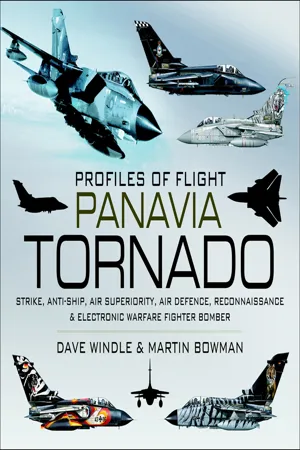
eBook - ePub
Panavia Tornado
Strike, Anti-Ship, Air Superiority, Air Defence, Reconnaissance & Electronic Warfare Fighter Bomber
- 80 pages
- English
- ePUB (mobile friendly)
- Available on iOS & Android
eBook - ePub
Panavia Tornado
Strike, Anti-Ship, Air Superiority, Air Defence, Reconnaissance & Electronic Warfare Fighter Bomber
About this book
The Tornado has been the backbone of the RAF within its many different theaters of operation. The aircraft started as a European venture between Germany, Italy and the UK, based on the original swing-wing technology invented by Barnes-Wallis. It has also been successfully exported to several Middle-Eastern air forces. It is likely to remain in service for several years to come.This book contains the world famous color profiles created by Dave Windle of the type in different operational modes, configurations and color schemes. Martin Bowman has written detailed descriptions and photographs to create the perfect enthusiasts reference.
Trusted by 375,005 students
Access to over 1.5 million titles for a fair monthly price.
Study more efficiently using our study tools.
Information
PANAVIA TORNADO
In 1965 British Aircraft Corporation (BAC) and Dassault agreed to collaborate on an AFVG (Anglo-French Variable Geometry) proposal, and a Memorandum of Understanding was signed on 17 May 1965. The AFVG was to be a multi-role aircraft for use by the air forces and naval air arms of both Britain and France. A full-scale mock-up was assembled at BAC Warton, but on 29 June 1967 France withdrew from the project and the UK government sought out other likely European partners for a collaborative aircraft project designated MRA-75 (Multi-Role Aircraft for 1975). Germany and Italy joined the Tornado programme after a meeting on 19 October 1967 at Fürstenfeldbruck, near Munich, when the Chiefs of Staff of the Belgian, Dutch, West German and Italian air forces met to discuss a possible replacement for their Lockheed F-104 Starfighters. In Britain the main purpose of the Interdictor Strike (IDS) version was to provide a replacement for the Vulcan and Buccaneer and Canberra in the overland strike, maritime strike and reconnaissance roles respectively. An air-defence variant would replace the Phantoms and Lightnings in both the UK and Germany.
In July 1970 the British and West German governments went ahead with a Multi-Role Combat Aircraft (MRCA), and they were joined two months later by Italy. On 26 March 1969 a new multinational company, Panavia GmbH, had been formed in Munich to oversee the activities of Aeritalia of Turin in Italy, BAC at Warton and Messerschmitt-Bölkow-Blohm (MBB) at Augsburg in West Germany, who would jointly build the new aircraft. BAC and MBB each took a 42.5% share in the new company. In Italy Fiat took a 15% share (in June the Netherlands pulled out of the programme).
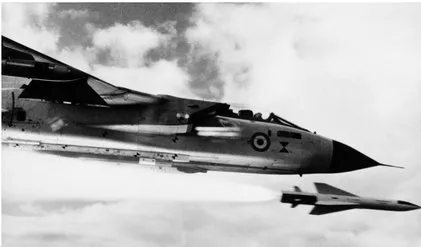
P.04 D-9542, the fourth Tornado prototype, which first flew on 2 September 1975, firing a Kormoran anti-ship missile. P.01, the first prototype (D-9591) flew on 14 August 1974. D-9542 was destroyed in a flying accident in April 1980, killing both crew. (MBB)
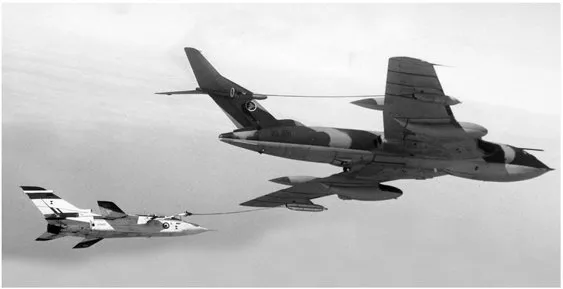
P.02 XX946, the second Tornado prototype, which first flew on 30 October 1974, with a Handley Page Victor K2 tanker during early trials. (BAe)
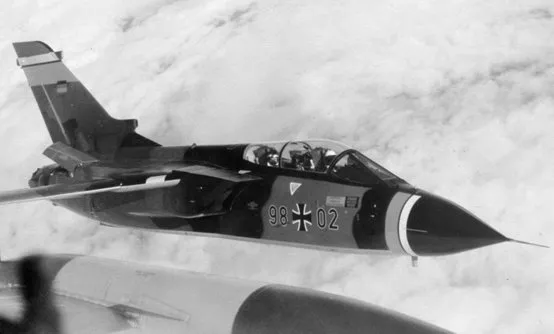
P.13 (98+02), the fifth German aircraft, and one of the six pre-series Tornado aircraft (P.11-P.16), which first flew on 10 January 1978. (MBB)
In September 1969 Turbo-Union, a consortium of Rolls-Royce (40%), MTU (40%) and Fiat (20%), was formed to build and develop the Rolls-Royce RB-199-34R three-spool turbofan to power the MRCA. Aircraft in the initial production batches were powered by the Mk 101 variant, which developed 9,000 lb of thrust in ‘cold’ power and was boosted to 16,000 lb of thrust with reheat, which meant that the aircraft was underpowered in dry thrust, especially at altitude, and it required the use of afterburner to give it reasonable performance. Later Tornadoes were fitted with the more powerful Mk 103 version of the RB-199-34R engine. Front and rear fuselage manufacture was the responsibility of BAC (later British Aerospace) at Warton, the wings being built by Aeritalia, while responsibility for the manufacture of the centre fuselage section was undertaken by MBB (later Deutsche Aerospace SA). Final assembly of the aircraft was undertaken at the national aircraft manufacturing plants relevant to the air forces for which the aircraft were destined.
Britain, Germany and Italy signed a Memorandum of Understanding on MRCA in 1970, and placed contracts for ten prototype MRCA aircraft. In April 1973 the construction of six pre-series aircraft was agreed. The first aircraft (MRCA 01) was assembled in Germany and flew for the first time on 14 August 1974 at Manching. The first flight of the second prototype took place from Warton on 30 October 1974. By the end of March 1976 the seventh prototype was flying. That same month the Panavia 200 Multi-Role Combat Aircraft was named ‘Tornado’. On 29 July Britain, Germany and Italy agreed to purchase 809 Tornadoes (385 for the RAF, including 165 of the ADV air-defence version; 202 for the Luftwaffe, replacing the F-104G and G.91R; 122 for the Marineflieger, replacing the F-104G; and 100 for the Regia Aeronautica, replacing the F-104G and G.91Y) in all roles. The first public flight of the Tornado was at the SBAC show at Farnborough in September 1976, where Tornado 06 was demonstrated. The first delivery of Tornadoes was to begin in 1979 to the Tri-National Operational Conversion Unit at RAF Cottesmore. The first production aircraft for use by the‘Triple T-E’ was delivered on 1 July 1980. Initial deliveries to the air arms of West Germany, Italy and the UK were made in the period 1982/3. The first German unit to receive the Tornado was the joint Air Force & Navy Weapons Conversion Unit in 1982. Later that same year the first operational Tornadoes for the German Navy were based with Marineflieger Geschwader 1 at Jagel. The first Tornadoes operational with the Luftwaffe were assigned to Jagdbombergeschwader 31 late in 1983. In August 1982 the first Tornadoes entered service with the Italian Air Force when 154° Gruppo received eighteen aircraft. By 1986 German contracts for the Tornado stood at 324, of which 228 were assigned to the Luftwaffe. After the original production requirements were formalised, new orders included nine more Tornadoes for the RAF, thirty-five of an ECR (Electronic Combat and Reconnaissance) version beginning in 1991 to replace the RF-4E in the Luftwaffe, seventy-two for the Royal Saudi Air Force and eight for the Sultan of Oman’s air force.
In Britain the Tornado GR1 strike wing became reality on 1 May 1983 when 27 Squadron, the third and final UK-based Tornado interdictor-strike squadron, arrived at Marham. Officially, the date of the squadron’s formation was 12 August, by which time a full complement of thirteen Tornadoes had been delivered. In September three 617 Squadron Tornadoes visited Canada, flying the 3,500-mile journey to the Toronto International Airport with the aid of Victor and Vulcan tankers. On 28 October Tornado ZA558/F of 617 Squadron was lost when it crashed into the sea ten miles north-west of Cromer, Norfolk. The navigator ejected and was uninjured, but the pilot was killed. Between 28 January and 8 February 1984 four of 27 Squadron’s Tornadoes were flown to Thumrait airfield in the Gulf Sultanate of Oman for a goodwill visit. The ‘Flying Elephants’ participated in and won a bombing competition with the Sultan of Oman’s Air Force Hunters and Jaguars, and the Tornadoes also visited Abu Dhabi and Saudi Arabia. During a 27 Squadron deployment to Goose Bay in July for Exercise Western Vortex, Tornado GR1 ZA494 crashed after a flap problem. The crew ejected safely. In November the squadron lost a second Tornado when the crew ejected safely from ZA603 during a training sortie in Germany. On 8 November 1984 Tornado ZA604 of 27 Squadron was involved in a collision with a USAFE A-10A close support aircraft. The crew ejected without injury. The A-10A was landed safely.
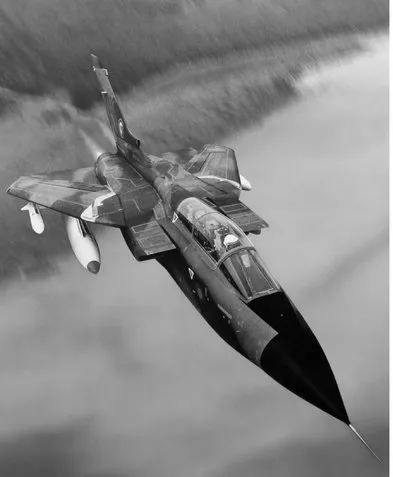
Tornado prototype aircraft carrying two underwing 330-gallon drop-tanks and two Sky Shadow dummies. (BAe)
In October 1984 617 Squadron took part in the annual US Strategic Air Command Bombing Competition at Ellsworth Air Force Base, South Dakota. The Dam Busters’ six Tornadoes needed tanker support provided by 55 Squadron’s Victors to compete in Exercise Prairie Vortex against B-52s of Strategic Air Command and F-111s of the Tactical Air Command. F-111Cs of the Royal Australian Air Force also took part. In total forty-two crews were competing for three trophies. The competition involved two phases of bombing sorties over the low-level ranges in Montana, Nevada, South Dakota and Wyoming, and extended over eight weeks. The first six weeks of the detachment were spent as a work-up period to allow everyone to acclimatise, settle in and sort out the aircraft before the competition proper began. The first phase comprised a single 5¼-hour daylight hi-lo-hi bombing mission, in which terrain following and electronic countermeasures (ECM) were employed to avoid detection and attacks by interceptors and simulated SAMs; live practice bombs were dropped on invisible targets using offset blind-bombing techniques. A low-level dash and high-level cruise return completed the mission. Phase 2 involved a six-hour mission and was flown over two separate courses, one in daylight and the other at night. Multiple targets were attacked at high and low level using tone bombs while evading multiple threats from interceptors and missiles. Throughout the missions timing was recorded to within one-second accuracy, as was navigation and bombing. It must be remembered that the Tornado was the only aircraft in the competition that demanded in-flight refuelling, by Victor K2 tankers of 55 Squadron, requiring split-second timing to avoid acquiring penalty points. The Tornadoes required at least two AAR brackets per sortie, and in total 111 day and night join-ups were successfully made. The LeMay and Meyer trophies had never been out of the USA before, but 617 Squadron won both of these trophies, and the Mathis was missed only because the radar failed in one of the Tornadoes at a crucial point in the competition. The Curtis E. LeMay Trophy, awarded to the crew with the highest number of points scored in high- and low-level bombing and time control, was won when two 617 Squadron crews gained first and second places. The John C. Meyer Trophy awarded for‘the best low-level damage expectancy’ was won by Squadron Leader Dunlop and Flight Lieutenant Middleton with 90.4%, beating an F-111F of the 48th Tactical Fighter Wing by almost four percentage points. Another Tornado was placed third. In the Mathis Trophy awarded to the team with the highest points for both high- and low-level bombing, Tornado crews were placed second and sixth. In thirty timed bomb releases 617 Squadron achieved an average timing error of less than one second. In bombing accuracy during the high-speed, low-level attacks of both phases, the average mean point of impact was less than twenty yards from the target: during the high-level bombing of Phase 2 the average mean point of impact was twenty-one yards from the target. Richard DeLauer, Under-Secretary of Defence for Research and Engineering in the DoD, had said that the Tornado was ‘vulnerable, heavy and expensive. I just don’t think it’s a good plane’!
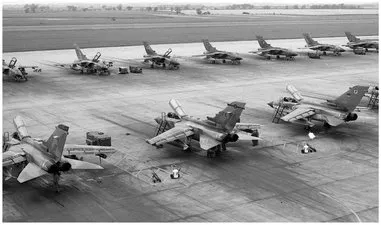
Tornadoes of the Tri-National Tornado Training Establishment (TTTE) at RAF Cottesmore. (GMS)
In October 1985 six Tornadoes of 27 Squadron, together with Victor tankers of 57 Squadron, competed in that year’s Bombing Competition at Ellsworth. The early sorties were designed to be mini-replicas of the competition missions, with both Victors and Tornadoes flying for about 2½ hours in preparation for the 6½-hour competition routes. The whole RAF detachment was supporting two teams in the competition, with two Tornado crews and two Victor crews in each team. Each crew flew three competition sorties spread over three weeks, with no allowance given for mistakes or if aircraft failed to take off on time. The first two Tornado...
Table of contents
- Title Page
- Copyright Page
- Table of Contents
- ACKNOWLEDGEMENTS
- PANAVIA TORNADO
- PROFILES OF FLIGHT - PANAVIA TORNADO GR1, GR1P, GR4, GR4A, IDS, ECR, F3
Frequently asked questions
Yes, you can cancel anytime from the Subscription tab in your account settings on the Perlego website. Your subscription will stay active until the end of your current billing period. Learn how to cancel your subscription
No, books cannot be downloaded as external files, such as PDFs, for use outside of Perlego. However, you can download books within the Perlego app for offline reading on mobile or tablet. Learn how to download books offline
Perlego offers two plans: Essential and Complete
- Essential is ideal for learners and professionals who enjoy exploring a wide range of subjects. Access the Essential Library with 800,000+ trusted titles and best-sellers across business, personal growth, and the humanities. Includes unlimited reading time and Standard Read Aloud voice.
- Complete: Perfect for advanced learners and researchers needing full, unrestricted access. Unlock 1.5M+ books across hundreds of subjects, including academic and specialized titles. The Complete Plan also includes advanced features like Premium Read Aloud and Research Assistant.
We are an online textbook subscription service, where you can get access to an entire online library for less than the price of a single book per month. With over 1.5 million books across 990+ topics, we’ve got you covered! Learn about our mission
Look out for the read-aloud symbol on your next book to see if you can listen to it. The read-aloud tool reads text aloud for you, highlighting the text as it is being read. You can pause it, speed it up and slow it down. Learn more about Read Aloud
Yes! You can use the Perlego app on both iOS and Android devices to read anytime, anywhere — even offline. Perfect for commutes or when you’re on the go.
Please note we cannot support devices running on iOS 13 and Android 7 or earlier. Learn more about using the app
Please note we cannot support devices running on iOS 13 and Android 7 or earlier. Learn more about using the app
Yes, you can access Panavia Tornado by Dave Windle,Martin W. Bowman in PDF and/or ePUB format, as well as other popular books in History & Military & Maritime History. We have over 1.5 million books available in our catalogue for you to explore.