A rare look inside the Department of Miscellaneous Weapon Development, "a fascinating report on the trials—and some tribulations—of a clandestine world" (
Kirkus Reviews).
Previously published under the title
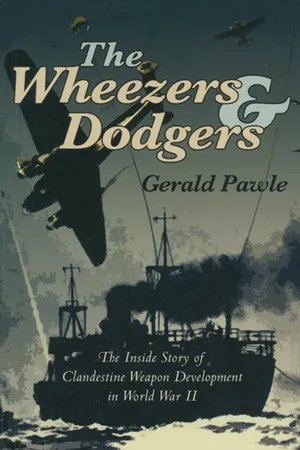
The Secret War 1939-1945, this is a firsthand account of the Admiralty's Department of Miscellaneous Weapon Development, the so-called "Wheezers and Dodgers," and the many ingenious weapons and devices it invented, improved or perfected.
Gerald Pawle was one of a group of officers with engineering or scientific backgrounds who were charged with the task of winning the struggle for scientific mastery between the Allies and the Germans in what Churchill enthusiastically called "the wizard war." Their work ranged from early stop-gap weapons like the steam-powered Holman projector, via great success stories like the Hedgehog anti-submarine mortar, to futuristic experiments with rockets, a minefield that could be sown in the sky, and the spectacularly dangerous Great Panjandrum, a giant explosive Catherine-wheel intended to storm enemy beaches.
The development of these and many other extraordinary inventions, their triumphs and disasters, is told with panache and humor by Pawle, and a diverse group of highly imaginative and eccentric figures emerge from the pages.
eBook - ePub
The Wheezers & Dodgers
The Inside Story of Clandestine Weapon Development in World War II
- 304 pages
- English
- ePUB (mobile friendly)
- Available on iOS & Android
eBook - ePub
The Wheezers & Dodgers
The Inside Story of Clandestine Weapon Development in World War II
About this book
Trusted by 375,005 students
Access to over 1.5 million titles for a fair monthly price.
Study more efficiently using our study tools.
Information
CONTENTS
| PART I: The Enemy in the Sky | |
| CHAPTER | |
| 1. | THE CANOE LAKE |
| 2. | A JOURNEY TO DOVER |
| 3. | THE ROOM IN ADMIRALTY ARCH |
| 4. | FLAME ON THE WATERS |
| 5. | ARMOUR FOR THE BATTLE |
| 6. | THE GUN FROM SWITZERLAND |
| 7. | COUNTERBLAST! THE ROCKET WAR |
| 8. | CABLES IN THE SKY |
| 9. | THE POTATO-THROWER |
| 10. | THE WIRE BARRAGE |
| PART II: The Enemy under the Waters | |
| 11. | HIGHLY EXPLOSIVE! |
| 12. | THE BIRTH OF THE HEDGEHOG |
| 13. | HIS MAJESTY’S PIER |
| 14. | HARRYING THE U-BOATS |
| 15. | THE MANTLE OF ELIJAH |
| 16. | THE TOYSHOP |
| PART III: Keys to the Fortress | |
| 17. | INVASION AHEAD |
| 18. | THE MAN IN THE GROSVENOR HOTEL |
| 19. | SWISS ROLL AND THE LILY ISLANDS |
| 20. | THE GREAT PANJANDRUM |
| 21. | THE GRASSHOPPER AND THE ALLIGATOR TAKE TO THE WATER |
| 22. | BUBBLES IN THE CHANNEL |
| 23. | THE FLOATING WALL |
| 24. | PREPARING FOR NEPTUNE |
| 25. | THE MIRACULOUS PORT |
BIBLIOGRAPHY | |
INDEX | |
PART I: THE ENEMY IN THE SKY
1
THE CANOE LAKE
THIS is the story of a group of naval scientists, the story of a department in the Admiralty which had no exact counterpart in the whole complex Allied machine which waged the Second World War against Germany and her confederates—the story of the Wheezers and Dodgers.
The Wizard War, as Sir Winston Churchill has termed the ceaseless struggle for mastery between the Allied and enemy scientists, involved moves and counter-moves often ‘unintelligible to ordinary folk.’ And for long after the war was over a detailed description of some of those moves, which would have made them intelligible to the layman, was inadvisable on security grounds.
To-day, however, most of what was attempted and achieved by the Royal Navy’s Directorate of Miscellaneous Weapon Development—to give the Wheezers and Dodgers their official title—is no longer on the secret list. It has remained untold only, one presumes, because D.M.W.D. was essentially a clandestine organization, its triumphs and failures unknown to all but a relatively small circle of Servicemen and civilian scientists.
The Wheezers and Dodgers were a research and development team. They were formed in the shadow of defeat in Europe, and their activities reached flood tide with the Allied landings on the coast of Normandy four years later. In those four years they were destined to tackle some of the strangest tasks in the history of warfare.
ON the last Sunday in May 1940 there was intense activity in the Admiralty. The British Expeditionary Force, with four of its divisions in imminent danger of encirclement outside Lille, was fighting its way back to the French coast, and Operation Dynamo was on.
The first significant move in this naval plan for the evacuation from France had wisely been made a full week earlier. When the German Army broke through at Sedan an immediate request went from the Admiralty to the Ministry of Shipping for all available coasting vessels to proceed to the Downs, but as late as May 24 it was still not certain that a major evacuation would be feasible. Since then the situation had deteriorated alarmingly, and no one on the naval staff expected more than 45,000 men to be brought away from the beaches. But now the die was cast. The operation named Dynamo was to be attempted.
A severe ordeal faced the array of little ships massing in the Downs. The Germans had already reached the coast near Calais, and were shelling any vessels which tried to approach Dunkirk direct. H.M.S. Wolfhound carrying the imperturbable Captain William Tennant and his staff to Dunkirk, where he was to act as the Navy’s Master of Ceremonies at the evacuation, had to make a sixty-mile détour to avoid a minefield, and was dive-bombed all the way, a final stick of bombs straddling her as she reached the inner harbour.
For the individual protection of the hundreds of coasting vessels now awaiting the orders of Vice-Admiral, Dover, there was little that the Admiralty could provide against the mounting air attack. The threat of enemy mines was another matter, however, and as the unceasing stream of trawlers and colliers, yachts and drifters, barges and paddle steamers, neared the assembly area they were diverted to one of three South Coast ports and shepherded through a strange ritual.
As ship after ship made fast, working parties of sailors swarmed on board. Heaving-lines were thrown to them by men in boats alongside, and then, sweating and straining, they began to haul a huge cable of copper wire slowly up the ship’s side. A whistle shrilled, and for a few seconds the cable clung to the hull. Then it slid slowly back to rest under the water, A brief pause for mysterious calculations, and the ship was cleared for sea, another heading in immediately to take her place.
Hour after hour, through daylight and the confusion of darkness, this selfsame performance was repeated. In four days four hundred ships destined for Dunkirk underwent this baptism by electricity surging from enormous submarine storage batteries ashore. To the older men in the crews of the trawlers and small coasters ordered forward for these strange attentions—men whose lives had been bound up with the simpler science of wind, tides, and stars—the whole business must have savoured of black magic.
They knew about the magnetic mine. The Germans had been sowing them by parachute in the shallow waters of the shipping channels and harbours, where they lay inert and invisible till some poor devil took his ship over them. They had seen escorting destroyers and the bigger merchantmen, their hulls festooned with coil upon coil of cable—some sort of protection against these magnetic mines thought up by the scientific chaps. That might be all right for ships with enough power to keep the coils charged; for the rest—and that meant the greater part of the civilian fleet waiting to head for Dunkirk—there was nothing to hope for in that line. Nothing, at least, till now, though what good could come of wiping a wire against the hull and taking it away after less than half a minute was difficult to understand. There seemed little sense in it.
To the team of naval scientists from H.M.S. Vernon, the Torpedo and Mining establishment at Portsmouth, who had been roped in en bloc to supervise this urgent operation, and toiled with little rest for four days and nights, this ‘wiping’ technique had, however, developed well beyond the realm of experiment. They were now applying a proved and brilliantly simple answer to the problem first studied in the Vernon six months earlier, after Lieutenant-Commanders Ouvry and Lewis had retrieved from a mud-bank in the Thames the first magnetic mine to fall into British hands intact.
When that first mine was dissected it was found that if a ship’s natural magnetic field could be reduced by some artificial means to a certain point the steel hull would no longer set the mechanism of the mine in motion.
Two initial tasks, therefore, faced the men in Vernon’s Mine Design Department. They had to find a practical way of demagnetizing or ‘degaussing’ ships so that the lurking mines remained inert on the sea-bed when approached. And they had to discover how these mines could be swept.
It was a race against time, and the team of scientists anxiously pursuing their own lines of research in Vernon were called upon to investigate the wildest schemes put up to the Admiralty by well-meaning individuals who had thought up their own dramatic counter-measures. Typical of these was the following plan, forwarded officially to the Admiralty by an influential member of one of the Navy’s most famous shore establishments.
It has been suggested [said the writer] that a means of causing magnetic mines to explode harmlessly may be found by attaching small but strong permanent magnets to flat fish, and distributing these fish over the sea bottom. The fish, moving in search of food, would, at short range, bring mines under the influence of a magnetic field and consequently cause explosion. The questions are (1) Whether the influence of a magnet which could be carried by a fish would be effective; and (2) Whether the scheme is possible from the ‘fish’ point of view.
The writer plainly had doubts about “the ‘fish’ point of view,” but he had, he confided, been encouraged by an optimistic opinion expressed to him by a marine biologist. The latter favoured catching skates and rays, “which are large, hardy, and will survive much handling.” The biologist had, it appeared, offered any help necessary to put “this excellent idea to immediate use,” and the author of the plan added: “Mr —— has lately been employed on research into the habits of skates, so his knowledge of that aspect of the question is recent and first-hand.” He ended his memorandum to the Lords Commissioners of the Admiralty on an encouraging note: “It would appear that if a suitable small magnet will do its work, then the skate can be induced to do the rest.”
Rear-Admiral Wake-Walker had been appointed by the First Lord of the Admiralty, then Mr Churchill, to supervise all technical measures for defeating the magnetic mine, and to him this memorandum was passed. The cares of office had not robbed the Admiral of his sense of humour, and in due course the author of this imaginative scheme received the following formal reply:
1. The suggestion contained in your 191/D 478 is considered of great value.2. As a first step in the development of this idea it is proposed to establish a School for Flat Fish at the R.N. College, Dartmouth. Candidates for this course should be entered in the first place as Probationary Flat Fish, and these poor fish would be confirmed in their rank on showing their proficiency by exploding a mine.3. A very suitable source of candidates to tap would be the Angel Fish of Bermuda, which, though flat, swim in a vertical plane.4. With the success of this scheme it may be necessary to control fried-fish shops.5. It is requested that you will forward, through the usual channels, proposals as to the necessary accommodation, and a suggested syllabus of the Course.
The sponsor of this novel plan reluctantly concluded that the Admiralty were unable to recognize a good idea when they saw one, and the skates and rays never contributed to the war effort after all!
Within a month, and despite such well-intentioned distractions, the team at Vernon had established the principle of degaussing vessels by passing current through cables permanently fixed to their hull. Devising a practical technique for sweeping the mines presented much greater difficulties. Professor B. P. Haigh, Professor of Mechanical Engineering at the Royal Naval College, Greenwich, was the first to hit on the idea of two minesweepers towing floating parallel cables through which violent pulses of electricity could be discharged to detonate the mines, but his scheme involved the use of so many thousand horse-power of electricity that special power plants would have been needed.
At this point of stalemate a young lieutenant-commander R.N.V.R. who had been serving for some weeks in Vernon as Staff Technical Adviser to Captain Denis Boyd,1 the establishment’s commanding officer, and had been following the progress reports, made a significant discovery.
Charles Frederick Goodeve was a Canadian, now in his middle thirties. He had come to England twelve years earlier on an Empire scholarship, and when war broke out he was Reader in Physical Chemistry at University College, London. He had also made rapid progress as a private consultant in chemical and electrical engineering. If science absorbed Charles Goodeve’s working hours the Navy was his dominant interest outside them. One of five children, he had been brought up in Winnipeg, on the Red River, which flows north to 300-mile-long Lake Winnipeg, with its fascinating, picturesque islands and beaches. His father was a Church of England parson, and his parents, always hard up, solved the holiday problem by building a cottage on the lake. There the children spent months every year, eating the lake fish they caught and the abundant fruit. Charles, an unsociable boy older than his years, would disappear for weeks on end, covering hundreds of miles in boats or canoes with his Husky dog as his only companion.
As soon as he could he joined the Canadian Navy’s Volunteer Reserve. In those early days he had no interest in the technical side. For him the Navy spelt excitement and adventure, and every year he spent three golden summer months afloat, either in the Patrician, an ancient destroyer, or in a minesweeper, where he soon found himself, to his intense pride, second in command. At that time two old destroyers, discarded by the Royal Navy after the First World War, and four minesweepers comprised the entire Canadian Fleet, but its youngest commissioned officer was given a thorough grounding in navigation and seamanship.
In spite of these halcyon days as a naval reservist, life was far from easy for young Charles Goodeve. His father’s health broke down, and, with the family hard put to it to make ends meet, he left school early and apprenticed himself to a firm of Chartered Accountants in...
Table of contents
- Cover
- Full Title
- Copyright Page
- Foreword
- Preface
- Contents
Frequently asked questions
Yes, you can cancel anytime from the Subscription tab in your account settings on the Perlego website. Your subscription will stay active until the end of your current billing period. Learn how to cancel your subscription
No, books cannot be downloaded as external files, such as PDFs, for use outside of Perlego. However, you can download books within the Perlego app for offline reading on mobile or tablet. Learn how to download books offline
Perlego offers two plans: Essential and Complete
- Essential is ideal for learners and professionals who enjoy exploring a wide range of subjects. Access the Essential Library with 800,000+ trusted titles and best-sellers across business, personal growth, and the humanities. Includes unlimited reading time and Standard Read Aloud voice.
- Complete: Perfect for advanced learners and researchers needing full, unrestricted access. Unlock 1.5M+ books across hundreds of subjects, including academic and specialized titles. The Complete Plan also includes advanced features like Premium Read Aloud and Research Assistant.
We are an online textbook subscription service, where you can get access to an entire online library for less than the price of a single book per month. With over 1.5 million books across 990+ topics, we’ve got you covered! Learn about our mission
Look out for the read-aloud symbol on your next book to see if you can listen to it. The read-aloud tool reads text aloud for you, highlighting the text as it is being read. You can pause it, speed it up and slow it down. Learn more about Read Aloud
Yes! You can use the Perlego app on both iOS and Android devices to read anytime, anywhere — even offline. Perfect for commutes or when you’re on the go.
Please note we cannot support devices running on iOS 13 and Android 7 or earlier. Learn more about using the app
Please note we cannot support devices running on iOS 13 and Android 7 or earlier. Learn more about using the app
Yes, you can access The Wheezers & Dodgers by Gerald Pawle in PDF and/or ePUB format, as well as other popular books in History & Social Science Biographies. We have over 1.5 million books available in our catalogue for you to explore.