- 224 pages
- English
- ePUB (mobile friendly)
- Available on iOS & Android
eBook - ePub
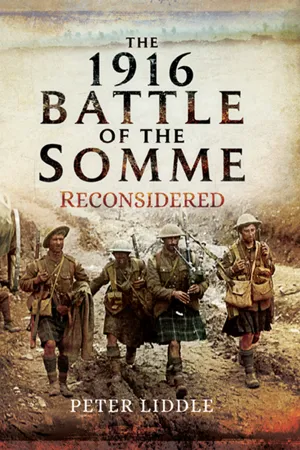
The 1916 Battle of the Somme Reconsidered
About this book
Twenty-four years after the publication of his classic study of the Somme, Peter Liddle reconsiders the battle in the light of recent scholarship. The battle still gives rise to fierce debate and, with Passchendaele, it is often seen as the epitome of the tragic folly of the First World War. But is this a reasoned judgement? Peter Liddle, in this authoritative study, re-examines the concept and planning of the operation and follows the course of the action through the entire four and a half months of the fighting. His narrative is based on the graphic testimony of the men engaged in the struggle, not just concentrating on the front-line infantryman but also the gunner, sapper, medical man, airman and yes, the nurse, playing her crucial role behind the line of battle. The reader is privileged in getting a direct insight into how those who were there coped with the extraordinary, often prolonged, stress of the experience and maintained to a remarkable degree a level of morale adequate for what had to be endured.
Tools to learn more effectively

Saving Books

Keyword Search

Annotating Text

Listen to it instead
Information
Chapter 1
The Battle of the Somme: Concept, Planning and Preparation

In almost all respects the position of the Allies at the end of 1915 was disappointing. Outright failure at the Dardanelles was matched by defeats on the Eastern Front and for the Serbian army in the Balkans. Costly endeavours in France had met with little success. A dangerous situation was developing in Mesopotamia. In Egypt a need had arisen for a Western Desert Force as well as to secure the Suez Canal against the Turkish threat. An attempted British landing on the coast of Tanganyika had been a fiasco and the military consequences further disadvantaged the forces engaged in the difficult East African campaign. Over-optimistic views of what might be achieved from Macedonia had led to an expeditionary force being sent there, but to date it had not rescued the Serbs from their defeat and it was now somewhat shamefacedly hedged-in defensively by its own barbed wire. The new ally, Italy, was heavily engaged in battle with Austria but a dividend from this did not seem to be held by Italian, or indeed by Russian, hands. Finally in setting this depressing scene for Allied strategic consideration, the Royal Navy had not exercised the sort of demonstrable command of the seas which would have given heart to politicians and generals only too aware that Russia was hard-pressed, and there seemed small reason for confidence that the Germans could be expelled from the defensive positions they had taken up securing their gains in economically valuable and cherished acres of France and Belgium. In a general picture of gloom, the approaching readiness of Britain to play a fuller military part on the Western Front shone some rays of sunshine as the Allies considered their options for a co-ordinated offensive in the New Year.
From June 1915, co-ordinated effort had been under consideration and from November with an increased sense of urgency through meetings, conferences and the circulation of memoranda. That no fanciful ideas were being entertained of the achievement of a swift, cheap victory was clearly attested on 27 March 1916 by General Joffre, the French Commander-in-Chief, at a conference where the British and the French Prime Ministers were present: ‘We have to destroy the morale of the German Army and nation.’1 This was in fact precisely what the German Army was endeavouring to achieve against the French at Verdun with their offensive on that sector now nearly five weeks in operation. The German blow here and an Austro-Hungarian attack on their Italian Front imposed serious constraint upon the Allied plans. In the event, the main burden of carrying out co-terminous offensives fell upon Britain and Russia. The idea, as conceived by Joffre and presented at the end of December 1915 to Sir Douglas Haig, the new British Commander-in-Chief, had been for a huge, 60-mile-frontage, Franco-British offensive on either side of the Somme. Aspects of a developing plan had been discussed and solutions reached when the Germans struck at Verdun in late February, destroying in a blow the scale of the Allied intention. The compromise reached may be categorised as the retention of the French idea but in larger measure to be fulfilled by the British.
Clearly there was a need for Britain to play an increased role in operations on the Western Front. In Britain’s New Armies there was an uncommitted resource and France, where manpower resources were fully stretched already, was now being subjected to a massive new onslaught. By no statistical comparison had Britain’s military effort in Flanders and France been on a scale to earn equality of voice in Anglo-French military deliberations. France now expected the evident imbalance of commitment to be redressed. This, and anxiety over Verdun, drew all French thinking concerning the appropriate location for the belated British contribution, aouth to the Somme. Here the British Expeditionary Force would be harnessed into a responsibility which could not be shrugged off – a reality, as made clear by Terraine, which this particular military coalition demanded from Britain in 1916.2
Sir John French, Commander-in-Chief of the BEF when the French offensive in Artois was planned in 1915, had been reluctant to accept the Gallic choice for a related British offensive at Loos that September. Haig had more than shared his reservations and there had been little, if any, profit from that battle. Now, in the early months of the following year, Haig would have chosen attack from Flanders rather than Picardy to free the Belgian coastal ports from U-Boat use, but again the British were unavoidably required to dance to the French tune.
Tim Travers has argued that the hierarchical structure of the British army, the limitations of intellect and the socio-educational experience of the senior officers, the very way in which the Army went about its business – appointments, promotions, dismissals and Haig’s own deviousness in this respect – precluded the possibility of fresh thinking in tackling problems of the nature of the Western Front in 1916. In his book The Killing Ground, he set out to prove that, for the Somme, Haig’s predominant concern was how to apply ‘traditional principles to what was seen as a new and puzzling form of warfare’ – he was, in other words, considers Travers, out of his depth.3
Travers lays out his case with conviction but it remains unproven in at least two linked respects – the way in which the war might have been more efficiently prosecuted is not tackled (perhaps this is the unattainable evidence which the prosecutor needs for conviction) and in Travers’s book there is no examination of Haig’s undeniable achievement in 1918 which is now lauded on all sides and is seen by many as one solidly grounded in the great battle on the Somme two years earlier.
Was it then the imperative of coalition warfare which led Haig first to accept his responsibility in Picardy and then to plan according to principles the carrying-out of which would inexorably drain the German ability to wage the war in the West, or was it something else? Was it Haig’s inflexible cast of mind, his incapacity to break out of received patterns of problemsolving into imaginative thinking, which led to the way the Somme was fought? It seems to this author that the balance of the case rests with Haig’s professional assessment of the nature of the war and the soundness of his acceptance that this dictated the only means by which it could be waged on land. However, there is a matter which will require further discussion and that is the issue of Haig’s retention of some hope of a breakthrough – proof either of a properly-held provision for the achievement of a highly-desirable situation, as is argued by Gary Sheffield, or confirmation of a one-track mind as held by Haig’s detractors. Just occasionally the case for the latter is declaimed with such baleful venom, as in Denis Winter’s Haig’s Command,4 that, paradoxically, the uncommitted probably fly to the other camp.
The lack of a strategically-significant objective behind the German battlefront on the Somme is in stark contrast to that behind Nieuport and Messines. Haig had indeed encouraged the development of offensive planning early in 1916 for Flanders but it was Verdun which was to neutralise all such thought. On 14 February, a week before the Germans struck at Verdun, Haig formally accepted that he would launch the required major offensive on the Somme. An Army, the Fourth, newly formed on 1 March, would take over a 20-mile front which stretched from the River Somme itself northwards as far as Fonquevillers. On the shoulders of this Army would rest the main responsibility for the battle.
The front selected for the assault had the German salient at Gommecourt as its northern extremity, then to the south the villages of Serre and Beaumont Hamel just behind the German first line. As the opposing trench systems south of Beaumont Hamel inclined more to the east, they were severed by the course of the River Ancre. To the south of this river the village strongpoints in or behind the German forward positions were Thiepval, Ovillers, La Boisselle and Fricourt, before, quite strikingly, the front took up an eastward alignment in front of Mametz and Montauban to the north. Here the Fourth Army boundary met that of the French Sixth Army which held the line up to the River Somme.
There was a clearly perceptible ridge behind the German positions on both sides of the Ancre, which had an obvious tactical significance. If it were not to be captured, the same operational disadvantage which had occurred on three fronts at the Dardanelles, the enemy continuing to hold the higher ground, would obtain in the new huge undertaking. This link with the events of the previous year can quite reasonably be made even allowing for the dramatically different configuration of the ridges in Picardy and those behind Anzac Cove, or far less strikingly behind the village of Krithia on the Gallipoli Peninsula.
Adjacent to the villages between the meadow and marsh-bordered Ancre and Somme rivers or breaking the open landscape of gently sloping fields scoured by the occasional valley, were woods which were named but had not yet the evil renown with which they would soon be associated – High Wood, Delville Wood, Trones Wood, Bazentin-le-Petit Wood and Bernafay Wood. Transversely across the battlefront from south-west to north-east, the road from Albert, which was about one-and-a-half miles behind the British front line, cut a straight course to Bapaume, nine miles behind the German front line.
At no point were the opposing front lines widely separated and in addition to fortified localities behind their line at Montauban, Mametz Wood, Contalmaison, Pozières and Serre, the Germans had a completed second-line position on their commanding ridge and a third line in preparation. A key feature, known to some extent by British High Command but the significance of which was not fully appreciated, was that the German positions had been deeply dug as a concrete warren of security against Allied artillery bombardment.
The developing tactical appraisal made by Fourth Army Headquarters had to have a resolution of interrelated problems. Was the Fourth Army to attack along the whole extent of its positions and would success be achieved more completely by prolonged bombardment or by surprise? General Sir Henry Rawlinson, in command of the Fourth Army, concluded that a prolonged bombardment would in several respects make things easier for the assault troops. The Commander-in-Chief considered Rawlinson’s proposals lacked the element of surprise and that he had set tactical objectives which were too modest in width and depth. As debate was joined on these differing approaches, Haig was counselled by his artillery adviser, Major-General Birch, that the plan was asking too much of the artillery resources. The divergence between Haig and Rawlinson in aim and method was tactical but also philosophical. At this stage Haig had faith in a breakthrough such as had not yet been achieved on the Western Front; Rawlinson considered that adequate artillery preparation and an assault in set stages would secure limited but valuable gains of the higher ground which overlooked the British positions.
Travers has maintained that: ‘Haig’s hope for the breakthrough was so strong that he had not clearly thought through alternatives in case of failure.’5 He had reserves of cavalry in place to exploit such a breakthrough but as the plans developed and Rawlinson’s reservations were seen to be as significant as was his loyalty in following his Chief’s directives, Travers judgement was that Haig became confused over the nature of the battle being prepared, thus a twofold indictment can be put forward. First, there should have been no confusion in Haig’s mind when he was about to commit human and material resources on an unprecedented scale, and second, it was hypocritical of Haig subsequently to claim that the battle had been to serve the French and Allied cause by so hammering the German Army in a prolonged offensive, une bataille d’usure, that it would be permanently damaged.
William Philpott, in Bloody Victory, and Gary Sheffield, in The Chief, interpret matters quite differently. Broadly they follow Terraine who maintained that the conclusion drawn by Haig from the overall Allied picture, and more crucially the scene in France in mid-March, was that the British effort must be made ‘with maximum strength, aiming at the maximum result – the defeat of the German Army in the field’.6 Hence the German Army was to be beaten, by initial breakthrough or breakthrough at some stage if possible, or, if it had to be, by being worn down to a shred. Planning for either embraced the other.
On the specific issue of breakthrough, Sheffield considers that ‘the evidence strongly suggests Haig’s plans to seize the German Second Position on the first day of the battle was achievable, at least on the southern sector’.7 Sheffield maintains his balanced case by stating that there are mistakes made in planning and preparation but the charge of confusion of aim in Haig’s mind cannot be sustained. In this chapter we shall be looking at the issue of blameworthiness on the part of the Commander-in-Chief in regard to any mistakes in planning and preparation and what also must be addressed is the issue of Rawlinson’s differing view from that of his Chief in what was achievable from the Big Push.
Until quite recently it has been received wisdom that, all along the line of the attack on 1 July, the infantry assault was made by measured advance of uniform, linear, intervalled waves of heavily-burdened troops in extended order, this being based both on an appraisal of the anticipated effectiveness of an unprecedentedly prolonged heavy preliminary bombardment, and then on the perceived limited capacity of New Army troops to advance by anything other than such procedure – there is official documentation to that effect in a GHQ memorandum of 8 May. It stated: ‘Officers and men generally do not now possess that military knowledge arising from a long and high state of training, which enable them to act promptly on sound lines in unexpected situations. They have become accustomed to deliberate action based on precise and detailed orders.’8 Certainly, in training, this method of advance would give an impression of the required irresistible forward movement. However, Trevor Wilson and Robin Prior, no friends of High Command, and then William Philpott, have shown that there were different approaches taken by local command in some sectors, and a more flexible procedure must be conceded in the endeavour to maintain the momentum of the attack in a deep battle. Philpott makes the point that: ‘It is overly simplistic to judge that the British army was too rigid or conservative in its tactics and command. It was keen to learn, engaging with its task thoughtfully and professionally: but to date its commanders, officers and men had relatively little experience of large-scale offensive operations.’9
A related point is made by the same historian with regard to the readiness of the New Army infantry battalions for their battle initiation: yes, they were under-prepared for what they would face – not undertrained in terms of fitness or morale, but without the weapons training in assault to turn confidence into competence – but there were variations in the degree of readiness because some New Army units had received appropriate training. It was not just French artillery support that accounts for some striking British infantry success at the southern end of the line but the performance of the well-trained troops in that sector.
Beneath the overwhelming determinants of ill-fortune on 1 July, that is British artillery failing to neutralise defence from the opposing positions and then the remarkable resilience of the German troops occupying the shelled trenches and strongpoints, more than the degree of readiness of the assaulting troops would be influential factors on the day. The issue of communication control or rather absence of control of the battle once joined was of material importance. Signallers laying telephone lines were as vulnerable to shelling as the means of communications they laid. Runners might or might not get through, their reports might or might not then be out of date, carrier pigeons and message-carrying dogs might indeed get to their destination, flares might be correctly interpreted, but any possibility of effective adjustment of original orders as a result of receipt of intelligence by these means was virtually out of the question.
Concerning the issue of definite knowledge of the concreted depth of defence of the German positions and that these positions had not been neutralised by the preliminary bombardment, it is simply not established that there was sufficient intelligence conclusively to that effect – yet another hoary myth of condemnatory hindsight. However, the reality of the strength of the German po...
Table of contents
- Cover
- Title Page
- Copyright
- Contents
- List of Plates
- Maps
- Acknowledgements
- Foreword
- Introduction: The Somme, Our Heritage
- Chapter 1: The Battle of the Somme: Concept, Planning and Preparation
- Chapter 2: The First of July
- Chapter 3: After the First Day: July to Early September
- Chapter 4: The Fifteenth of September: A New Major Effort and a New Weapon
- Chapter 5: Through October into November and a ‘Slough Of Despond’
- Chapter 6: A Verdict
- Notes
- Bibliography
- Personal Experience Documentation
- Official Nomenclature for the Battle of the Somme and its Subsidiary Actions
- Army, Corps and Divisional Unit Involvement in the Battle of the Somme, 1 July–18 November 1916
- Order of Battle, 1 July 1916
Frequently asked questions
Yes, you can cancel anytime from the Subscription tab in your account settings on the Perlego website. Your subscription will stay active until the end of your current billing period. Learn how to cancel your subscription
No, books cannot be downloaded as external files, such as PDFs, for use outside of Perlego. However, you can download books within the Perlego app for offline reading on mobile or tablet. Learn how to download books offline
Perlego offers two plans: Essential and Complete
- Essential is ideal for learners and professionals who enjoy exploring a wide range of subjects. Access the Essential Library with 800,000+ trusted titles and best-sellers across business, personal growth, and the humanities. Includes unlimited reading time and Standard Read Aloud voice.
- Complete: Perfect for advanced learners and researchers needing full, unrestricted access. Unlock 1.4M+ books across hundreds of subjects, including academic and specialized titles. The Complete Plan also includes advanced features like Premium Read Aloud and Research Assistant.
We are an online textbook subscription service, where you can get access to an entire online library for less than the price of a single book per month. With over 1 million books across 990+ topics, we’ve got you covered! Learn about our mission
Look out for the read-aloud symbol on your next book to see if you can listen to it. The read-aloud tool reads text aloud for you, highlighting the text as it is being read. You can pause it, speed it up and slow it down. Learn more about Read Aloud
Yes! You can use the Perlego app on both iOS and Android devices to read anytime, anywhere — even offline. Perfect for commutes or when you’re on the go.
Please note we cannot support devices running on iOS 13 and Android 7 or earlier. Learn more about using the app
Please note we cannot support devices running on iOS 13 and Android 7 or earlier. Learn more about using the app
Yes, you can access The 1916 Battle of the Somme Reconsidered by Peter Liddle in PDF and/or ePUB format, as well as other popular books in History & German History. We have over one million books available in our catalogue for you to explore.