eBook - ePub
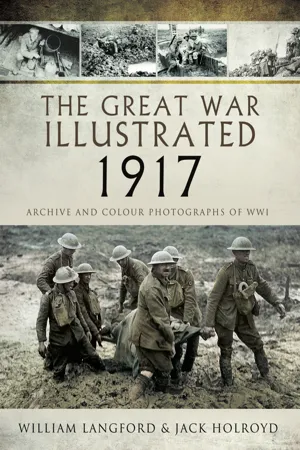
The Great War Illustrated - 1917
Archive and Colour Photographs of WWI
- 480 pages
- English
- ePUB (mobile friendly)
- Available on iOS & Android
eBook - ePub
About this book
The fourth volume of this pictorial WWI history captures the harrowing events of 1917—from the Battle of Arras to the Capture of Jerusalem.
The Great War Illustrated series presents a vivid chronicle of the First World War in photographs, with a separate volume dedicated to each year of the conflict. Richly furnished with archival images, many of which have rarely been seen before, each installment brings readers into the drama and devastation of combat. The photographs are all numbered, captioned, and supported by informative text.
The Great War Illustrated–1917 contains 1,000 images, with a middle section in full color. It covers the battles at Arras, Passchendaele, and Cambrai, as well as the use of aviation, submarines, and the role of the tanks.
The Great War Illustrated series presents a vivid chronicle of the First World War in photographs, with a separate volume dedicated to each year of the conflict. Richly furnished with archival images, many of which have rarely been seen before, each installment brings readers into the drama and devastation of combat. The photographs are all numbered, captioned, and supported by informative text.
The Great War Illustrated–1917 contains 1,000 images, with a middle section in full color. It covers the battles at Arras, Passchendaele, and Cambrai, as well as the use of aviation, submarines, and the role of the tanks.
Tools to learn more effectively

Saving Books

Keyword Search

Annotating Text

Listen to it instead
Information
Chapter One: The German Retreat – Der Betrieb ‘Alberich’
-plgo-compressed.webp)
17GW002 German troops withdrawing through the streets of Péronne during the fall back to the prepared postions of the Hindenburg Line.
-plgo-compressed.webp)
17GW001 British and French troops in reserve lines at Le Verguier, France, during the German Retreat to the Hindenburg Line, April 1917.
-plgo-compressed.webp)
-plgo-compressed.webp)
17GW002 German troops withdrawing through the streets of Péronne during the fall back to the prepared postions the Germans called the Siegfried Line and the Allies the Hindenburg Line.
-plgo-compressed.webp)
17GW008 Erich Friedrich Wilhelm Ludendorff commented:
‘The shortening of our front made it stronger and safer. The enemy’s plans were countered. The lines of attack they had chosen were no longer suitable and the ground we had abandoned left them no resources. If they wanted to use it they had to repair everything and very heavy work was necessary in order to prepare an attack. We could, accordingly, thin out the troops and withdraw divisions. The result that had been sought by Operation Alberich and the occupation of the Siegfried position was fully obtained.’
At the outset of 1917 the Allies, overestimating German losses of the Somme and Verdun fighting, believed that just one more major offensive would be enough to break through the German lines and drive them out of France and Belgium. At the request of the American President Wilson, the Germans informally made clear their peace terms in January 1917, which were rejected by the allies. The French General Nivelle was determined to launch another major offensive at Champagne in the spring of 1917, but the German withdrawal to the Hindenburg Line disrupted these plans.
-plgo-compressed.webp)
17GW013 The Butte de Warlencourt, which marked the limit of the British advance during the Battle of the Somme and from where the German withdrawal began on 24 February 1917. The Albert-Bapaume road runs from bottom to top; the British front line can be seen at the bottom right of the picture in front of the mound (Butte). As the Germans pulled back towards Bapaume their rear guard was engaged by elements of the 2nd Australian Division and fighting took place at Le Barque and elsewhere on this sector. After three weeks’ fighting the withdrawal carried on from Bapaume to the prepared positions of the Hindenburg Line.
-plgo-compressed.webp)
17GW014 The Butte de Warlencourt was an ancient burial mound off the Albert–Bapaume road, northeast of Le Sars in the Somme département of northern France. Some of the fiercest fighting took place on and around the Butte which was riddled with tunnels and dugouts and heavily defended by mortars, machine guns and belts of barbed wire the Butte commanded the road to Bapaume and although the British managed to get onto the Butte, they were always removed by counter attacks. On the German withdrawal, February 1917, the British ...
Table of contents
- Cover
- Title
- Dedication
- Copyright
- Contents
- Foreword by Nigel Cave
- Introduction
- Chapter One The German Retreat – Der Betrieb ‘Alberich’
- Chapter Two Arras – Vimy Ridge
- Chapter Three Bloody April – The Red Baron – Air War, Fighters
- Chapter Four The Nivelle Failure – French Army Revolt
- Chapter Five Unrestricted Submarine Warfare
- Chapter Six America Joins the Fray – Russia Leaves
- Chapter Seven Capture of The Wytschaete–Messines Ridge
- Chapter Eight Third Battle of Ypres – Passchendaele
- Chapter Nine The Battle of Cambrai
- Chapter Ten Highlight of 1917 – the Capture of Jerusalem
- The Great War Illustrated in Colour
Frequently asked questions
Yes, you can cancel anytime from the Subscription tab in your account settings on the Perlego website. Your subscription will stay active until the end of your current billing period. Learn how to cancel your subscription
No, books cannot be downloaded as external files, such as PDFs, for use outside of Perlego. However, you can download books within the Perlego app for offline reading on mobile or tablet. Learn how to download books offline
Perlego offers two plans: Essential and Complete
- Essential is ideal for learners and professionals who enjoy exploring a wide range of subjects. Access the Essential Library with 800,000+ trusted titles and best-sellers across business, personal growth, and the humanities. Includes unlimited reading time and Standard Read Aloud voice.
- Complete: Perfect for advanced learners and researchers needing full, unrestricted access. Unlock 1.4M+ books across hundreds of subjects, including academic and specialized titles. The Complete Plan also includes advanced features like Premium Read Aloud and Research Assistant.
We are an online textbook subscription service, where you can get access to an entire online library for less than the price of a single book per month. With over 1 million books across 990+ topics, we’ve got you covered! Learn about our mission
Look out for the read-aloud symbol on your next book to see if you can listen to it. The read-aloud tool reads text aloud for you, highlighting the text as it is being read. You can pause it, speed it up and slow it down. Learn more about Read Aloud
Yes! You can use the Perlego app on both iOS and Android devices to read anytime, anywhere — even offline. Perfect for commutes or when you’re on the go.
Please note we cannot support devices running on iOS 13 and Android 7 or earlier. Learn more about using the app
Please note we cannot support devices running on iOS 13 and Android 7 or earlier. Learn more about using the app
Yes, you can access The Great War Illustrated - 1917 by William Langford,Jack Holroyd in PDF and/or ePUB format, as well as other popular books in History & Military & Maritime History. We have over one million books available in our catalogue for you to explore.