
- 256 pages
- English
- ePUB (mobile friendly)
- Available on iOS & Android
eBook - ePub
About this book
This illustrated study of the German Imperial Navy presents a ship-by-ship history from the dreadnaught era through WWI.
The battleships of the Third Reich have been written about exhaustively, but there is little in English devoted to their predecessors of the Second Reich. In The Kaiser's Battlefleet, Aidan Dodson fills this significant gap in German naval history by covering these capital ships and studying the full span of battleship development during this period.
Kaiser's Battlefleet presents a chronological narrative that features technical details, construction schedules and the ultimate fates of each ship tabulated throughout. With a broad synthesis of German archival research, Dodson provides fresh data and corrects significant errors found in standard English-language texts. Heavily illustrated with line work and photographs drawn from German sources, this study will appeal to historians of WWI German as well as battleship modelmakers.
The battleships of the Third Reich have been written about exhaustively, but there is little in English devoted to their predecessors of the Second Reich. In The Kaiser's Battlefleet, Aidan Dodson fills this significant gap in German naval history by covering these capital ships and studying the full span of battleship development during this period.
Kaiser's Battlefleet presents a chronological narrative that features technical details, construction schedules and the ultimate fates of each ship tabulated throughout. With a broad synthesis of German archival research, Dodson provides fresh data and corrects significant errors found in standard English-language texts. Heavily illustrated with line work and photographs drawn from German sources, this study will appeal to historians of WWI German as well as battleship modelmakers.
Tools to learn more effectively

Saving Books

Keyword Search

Annotating Text

Listen to it instead
Information
PART I: RISE AND FALL OF THE BATTLEFLEET

Moltke during her visit to the United States in 1912. (Harris & Ewing, via Library of Congress)
1 | BEFORE THE EMPIRE |
UNTIL THE NINETEENTH CENTURY, ‘Germany’ was simply a large number of separate political entities, whose status and combinations changed over time, and ranged from city-states through to a number of fully-fledged kingdoms. Until 1805, most had belonged to the increasingly-nominal Holy Roman Empire, which had been replaced during 1815 the Congress of Vienna by a loose German Confederation (Deutsches Bund) of thirty-nine states, to which six more were subsequently added. A progressive customs union (Zollverin) gradually brought the states closer together, and the short-lived Frankfurt National Assembly that had been established in the wake of the 1848 revolutions attempted to make this into a formal empire. The failure of this initiative, and the ephemeral Erfurt Union, which foundered through Austrian opposition, led the loose Confederation to continue to exist until 1866.
That year, the Austro-Prussian War led in 1867 to the winning Prussian-led alliance forming the North German Confederation (Norddeutscher Bund), excluding Austria, Bavaria, Württemberg, Baden and their allies. In 1870, the Franco-Prussian War led to Bavaria, Württemberg and Baden joining the grouping, which was proclaimed the German Reich at Versailles on 18 January 1871, comprising twenty-seven constituent territories, with the imperial dignity vested in the kings of Prussia.
Of the German states, only Prussia had made intermittent attempts at maintaining a navy.1 These were consolidated after the end of the Napoleonic Wars in 1815, while 1848 and 1852 there existed a Reichsflotte, created under the auspices of the Frankfurt National Assembly, which was, however, dissolved in April 1852; although most ships were sold into merchant service, two frigates (one steam, one sail) passed to the Prussian Navy. The latter force was then developed by Prince Adalbert of Prussia (1811–73), Commander-in-Chief from 1854 to 1870, including the establishment of the naval bases of Kiel in 1865 and Wilhelmshaven (in an enclave within the Grand Duchy of Oldenburg) in 1869, and the steady purchase of frigates and smaller vessels. It was as the sole naval force within the new North German Confederation that the Prussian Navy transitioned to being the new (albeit Prussian-led) Federal Navy on 1 October 1867, the navy henceforth remaining a ‘German’ institution, in contrast to the armies at the disposal of the Confereration and later Empire, which remained in the ownership of the individual states.
The ‘new’ fleet was accompanied by a new Fleet Plan, a modification of plans put forward by the Prussian Navy in 1862 and 1865 (and rejected by the Prussian Landtag [State Parliament]). The 1867 Plan, however, was approved by the new Reichstag [Reich Parliament], and envisaged a fleet of sixteen armoured ships, twenty unarmoured corvettes and eight avisos, plus twenty-six gunboats and auxiliaries, by 1877, to provide both a home and a foreign force. As compared with the 1865 iteration of the Plan, there were four less armoured ships and six more corvettes, a change opposed by Prince Adalbert, and reflecting what would be an ongoing debate regarding the balance to be struck between building and maintaining a home battlefleet and doing the same for a cruising force capable of world-wide deployment.
Arminius
A number of other lesser naval powers acquired armoured vessels in the wake of the adoption of the type by the French and British navies, and the proof of the concept of armoured warships during the American Civil War.2 Like her particular rival at the time, Denmark (against whom wars were fought over the ownership of Schleswig-Holstein during 1848-51 and again in 1864), Prussia bought a small twin-turreted ironclad from a British shipyard, in this case Samuda Bros. of Poplar, on the Thames; the very similar Danish Rolf Krake3 came from Napier, on the Clyde.
The Prussian vessel, named Arminius, had been laid down in 1863 on speculation by the shipyard (perhaps with an eye to the Confederate States of America [CSA], which was attempting to acquire ships in Europe at the time),4 her purchase by Prussia being partly financed by popular contributions. Her design was by Captain Cowper Phipps Coles, RN (1819–70), and mounted two examples of his pattern of turret, apparently intended to be equipped with a pair of Armstrong 68pdr/8in [20.3cm] MLRs. However, she was actually armed with Krupp BLRs, possibly first with 21cm/12.25s before finally receiving 21cm/19s. The protection of her iron hull was mounted on a 229mm teak backing, and comprised wrought iron 114mm thick, tapering to 76mm fore and aft. The turrets varied from 114mm to 119mm in thickness, while the conning tower carried 114mm plate. Arminius had four transverse trunk boilers, with a 2-cylinder horizontal engine, rated at 1200ihp, giving a speed of around 10kts. Although it had been hoped that she would be ready by September 1864, Arminius was not delivered in time owing to the Second Schleswig War with Denmark. On 3 October 1866, the ship undertook a comparative trial with the visiting US monitor Miantonomoh in Kiel, Arminius proving the faster by two knots.

Arminius as completed, with her bulwarks raised. (BA 134-B0164)
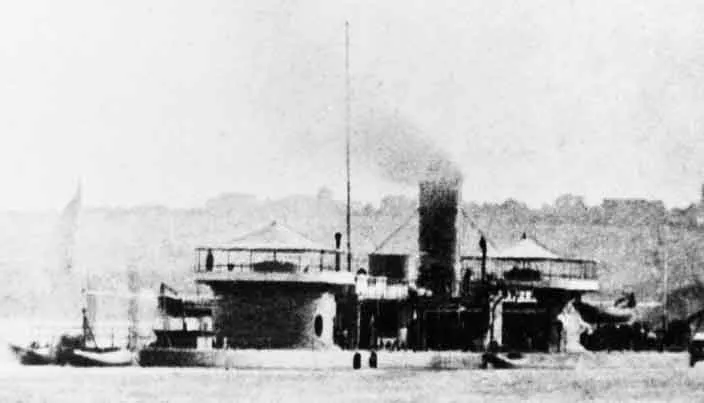
The monitor USS Miantonomoh at Kiel at the time of her trial run against Arminius. (NHHC NH 46259)
The ship was given a topsail schooner rig, with masts at the extremities of the hull, they and their shrouds obstructing the firing arcs of the turrets. However, it proved impossible to steer the ship under sail, and the rig was removed at her first refit.
Prinz Adalbert
The year after Arminius had been ordered, the opportunity arose to buy another ironclad when the French shipbuilder Lucien Arman was ordered by Emperor Napoleon III to put up for sale two ships allegedly being built for Egypt – but really ordered by the CSA, and under an embargo since February. Initial negotiations for their disposal had actually begun in December 1863, when the Danes were approached by the French.5 Denmark initially intended to buy both ships,6 but in the event sufficient funds were available for only one, ‘Sphinx’, a contract being agreed on 31 March 1864. Two months later, on 25 May, the Prussians purchased ‘Cheops’, ships belonging to each of the combatants in the Second Schleswig War (February–August 1864) thus being built alongside each other at Bordeaux.

The Confederate ram that Prussia did not buy: ‘Sphinx’, which briefly flew the Danish flag as Stærkodder, before being transferred to her original owners, taken over by the United States at the end of the Civil War (and laid up at Washington, where she is seen here) and finally sold to Japan as Kötetsu, later Azuma. (NHHC NH 43994)
The Danish half-sister, now named Stærkodder, was subject to various contractual terms that the builders found difficult to fulfil, and negotiations continued even after the ship had sailed from the shipyard in October, arriving at Copenhagen on 10 November. Although some trials were carried out, the ongoing negotiations broke down, possibly influenced by the technical assessment of the ship by the Danes, not to mention the end of the war with Prussia, and in January she was handed over to the CSA in Danish waters, becoming CSS Stonewall.7
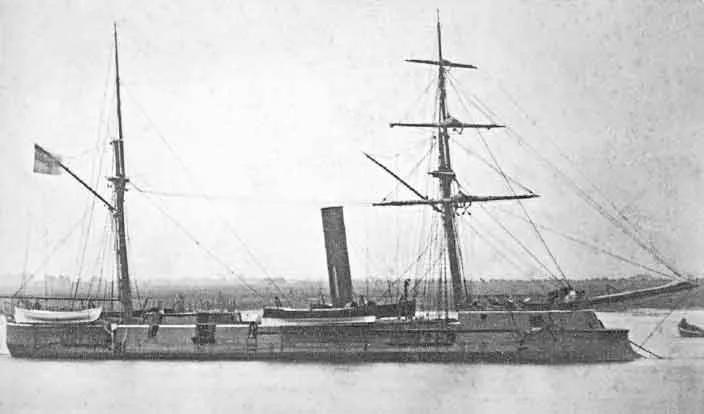
Prinz Adalbert in 1870. (BA 134-C0066)
The Prussian purchase was at one point cancelled, but reinstated in January 1865, and delivered as Prinz Adalbert in October. She was very different from Armenius, being wooden-hulled, with tumblehome sides and a huge ram. In contrast to the revolving turrets of the British-built vessel, there were fixed box-batteries at the bow and on the after deck, with guns (one in the forward battery, two in the mid-ships one) on mountings that allowed them to fire through a chosen port. On the other hand, there were twin shafts and rudders to ensure good manoeuvrability.
When the ship arrived in Prussia, she was immediately rearmed with Krupp guns. She also proved to be in poor material condition, with significant leakage, her defects requiring a reconstruction at Geestemünde during 1868/69, including re-fitting the armour. Other changes carried out in Prussia included moving the mainmast further aft (the ship was in any case useless under sail). However, unsound timber severely truncated her service life, being outlived by Arminius by a quarter-century.
Friedrich Carl and Kronprinz
Both Arminius and Prinz Adalbert were primarily suitable only for coastal waters. In contrast, the next ironclads acquired by the Prussian Navy were fully seagoing vessels, which in the context of the 1860s meant rigged vessels armed on the broadside, the type that comprised the bulk of new construction by Great Britain and France.
It has been recognised that the defence of Prussian interests required more vessels to be added to the navy, capable of countering potential enemies, in particular the Danes, opposing any landings and breaking a blockade. As noted above, a fleet plan had been put to the Prussian Landtag in 1865, but rejected; it was therefore necessary to issue a royal decree on 4 July to set a Navy budget that included funds for two armoured frigates, one to be built in Great Britain and one in France, each vessel being some four times larger than Arminius and Prinz Adalbert.
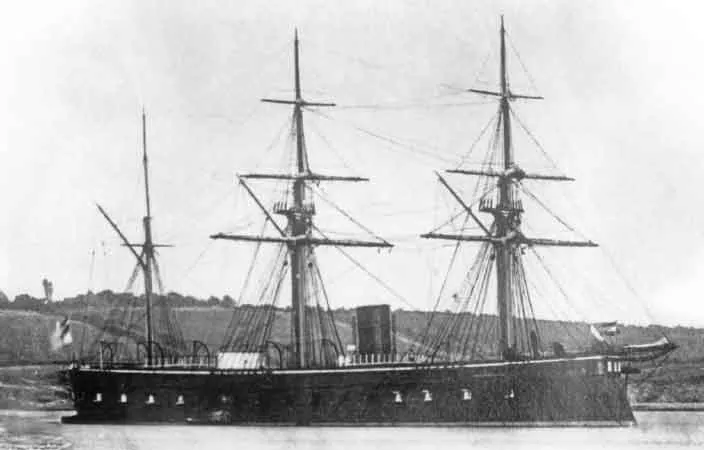
Friedrich Carl in 1867. (Author’s collection)
The first order was placed for the French-built Friedrich Carl, on 9 January 1866, followed four days later with that for Kronprinz, from Arminius’ builder and designed by the British Royal Navy’s Chief Constructor, (Sir) Edward Reed. Both ships were of similar size, protection and capability, although as designed Kronprinz had a slightly heavier armament (thirty-two, as against twenty-six, 72pdrs) and was significantly faster; on the other hand, Friedrich Carl spread more canvas. In practice, both came into service armed identically with Krupp breech-loading guns, albeit after a significant period laid up without armament, owing to a breech failure during a series of trials held in 1867/68. This led to the rejection of guns fitted with the then-standard Kreiner breech and a delay until new weapons with a new breech of Krupp design were available.

Kronprinz as complet...
Table of contents
- Cover
- Title Page
- Copyright
- Contents
- Preface
- Introduction
- The Naming of German Warships
- Conventions and Abbreviations
- Part I: Rise and Fall of the Battlefleet
- Part II: Technical and Career Data
- Appendices
- Bibliography
Frequently asked questions
Yes, you can cancel anytime from the Subscription tab in your account settings on the Perlego website. Your subscription will stay active until the end of your current billing period. Learn how to cancel your subscription
No, books cannot be downloaded as external files, such as PDFs, for use outside of Perlego. However, you can download books within the Perlego app for offline reading on mobile or tablet. Learn how to download books offline
Perlego offers two plans: Essential and Complete
- Essential is ideal for learners and professionals who enjoy exploring a wide range of subjects. Access the Essential Library with 800,000+ trusted titles and best-sellers across business, personal growth, and the humanities. Includes unlimited reading time and Standard Read Aloud voice.
- Complete: Perfect for advanced learners and researchers needing full, unrestricted access. Unlock 1.4M+ books across hundreds of subjects, including academic and specialized titles. The Complete Plan also includes advanced features like Premium Read Aloud and Research Assistant.
We are an online textbook subscription service, where you can get access to an entire online library for less than the price of a single book per month. With over 1 million books across 990+ topics, we’ve got you covered! Learn about our mission
Look out for the read-aloud symbol on your next book to see if you can listen to it. The read-aloud tool reads text aloud for you, highlighting the text as it is being read. You can pause it, speed it up and slow it down. Learn more about Read Aloud
Yes! You can use the Perlego app on both iOS and Android devices to read anytime, anywhere — even offline. Perfect for commutes or when you’re on the go.
Please note we cannot support devices running on iOS 13 and Android 7 or earlier. Learn more about using the app
Please note we cannot support devices running on iOS 13 and Android 7 or earlier. Learn more about using the app
Yes, you can access The Kaiser's Battlefleet by Aidan Dodson in PDF and/or ePUB format, as well as other popular books in History & Military & Maritime History. We have over one million books available in our catalogue for you to explore.