A compelling account of the fierce ten-day battle that led to the end of Mussolini's rule, with maps and photos.
In September 1943, in the first weeks of the Allied campaign to liberate Italy, an Anglo-American invasion force of over 80,000 men was nearly beaten back into the sea by the German defenders in a ferocious ten-day battle at Salerno, south of Naples. This is the story of the tense, bitter struggle around the Salerno beachhead which decided the issue and changed the course of the campaign. For those ten critical days, the fate of Italy hung in the balance.
Using documentary records, memoirs, and eyewitness accounts from all sides, Angus Konstam re-creates every stage of the battle at every level as it happened, day by day, hour by hour. His painstakingly researched account offers a fresh perspective on a decisive battle that has been neglected by British and American historians in recent years, and it gives a fascinating insight into the realities of warfare in Europe eighty years ago.
Praise for Angus Konstam's previous books
"Wonderful details." —
Publishers Weekly
"Riveting." —
History of War
"Interesting and exciting . . . thoroughly enjoyable." —
Booklist
Trusted by 375,005 students
Access to over 1.5 million titles for a fair monthly price.
On 17 August 1943 the battle for Sicily was over, as the last of the island’s German garrison escaped across the 2-mile wide Straits of Messina. Following their gruelling five-week battle the Allied commanders gathered on the Sicilian shore and decided what to do next. For the best part of four years the British Eighth Army had fought the Italians, and then the Germans, in the sandy wastes of North Africa. For the past year they had been joined by an inexperienced but eager American army, whose strength and competence had grown steadily. Sicily had served as a necessary stepping stone between Africa and Europe. The same two armies now began preparing for the next stage of the war – the invasion of Hitler’s ‘Fortress Europe’.
In fact, the Allies had been developing plans for an invasion of Italy for some time, and an amphibious landing on the Italian peninsula seemed the next logical step. If Italy could be knocked out of the war the Germans might be forced to retreat north into the Alps, while their army fighting in Russia would be stripped of one of its most reliable allies. The capture of Italy would also provide the Allies with much-needed bases and resources, which could be used in the next stage of the war – the invasion of Northern Europe and the drive on Germany.
On 3 September 1943 the British Eighth Army crossed the narrow Straits of Messina and established a foothold on the ‘toe’ of Italy. General Montgomery’s troops then began a pursuit of the retreating Germans up the ‘toe’, their progress slowed by the enemy’s ‘scorched earth’ policy of destroying bridges and sowing mines as they fell back. Then, on 9 September, the British 1st Airborne Division seized the Italian port of Taranto without a shot being fired. The lack of Italian resistance was hardly surprising. On the same day as Montgomery’s troops landed on the Italian mainland the Allies entered into secret negotiations with the Italian government, which agreed to surrender to the Allies at midnight on 8/9 September.
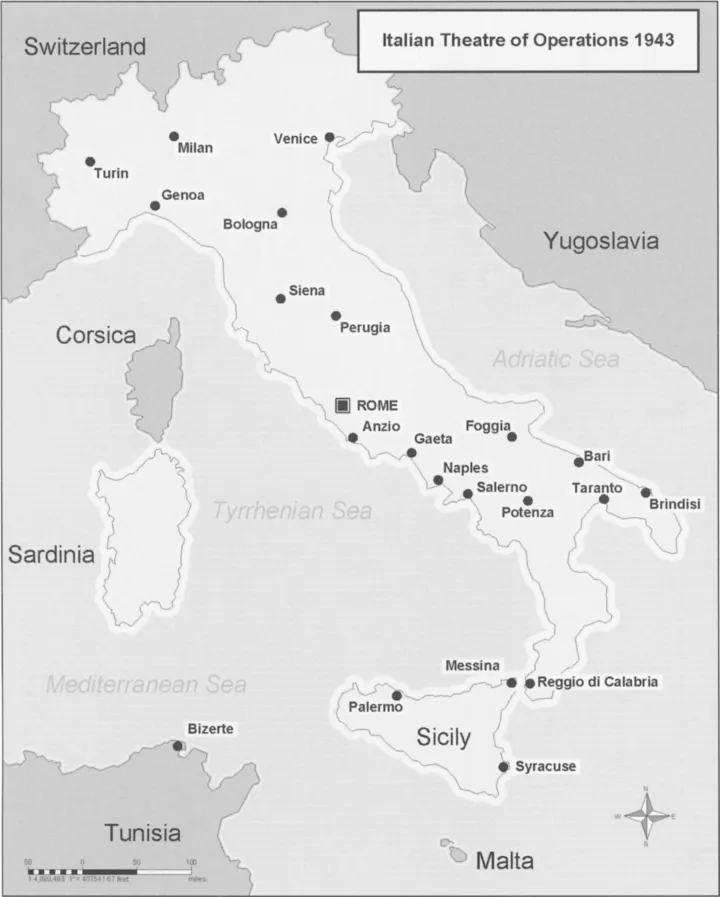
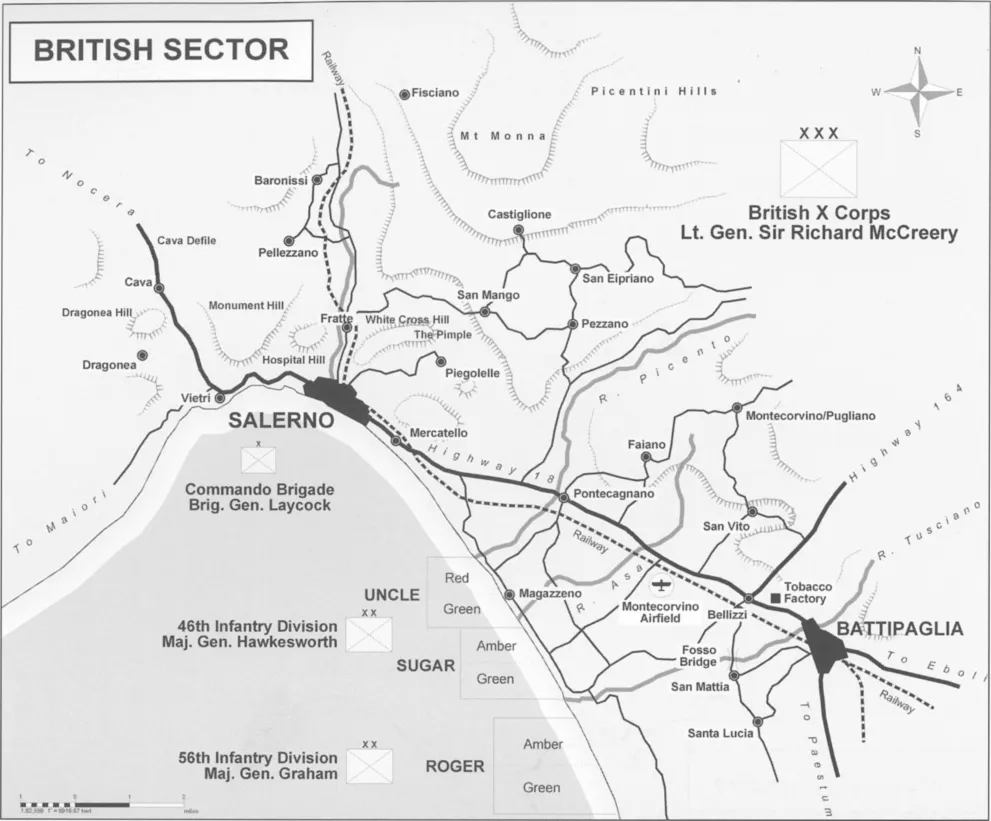
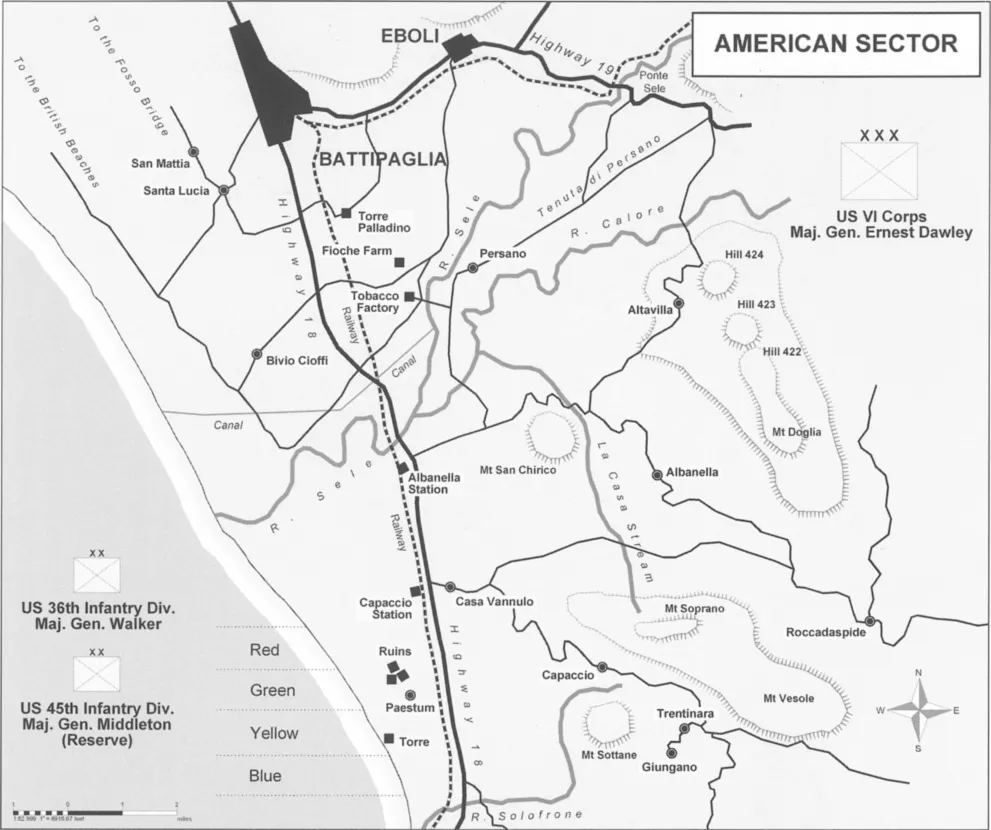
While the Germans hurriedly disarmed Italian Army units stationed within reach of their troops, the Allies were preparing to launch their assault on the Italian mainland. On the morning of 9 September units of the Allied Fifth Army began landing near Salerno, south of Naples. If the Allies thought the Italian surrender meant they could simply walk ashore, their hopes were cruelly dashed. The Germans opposed the landing, and so began a gruelling ten days of hard fighting. At one stage it even seemed likely the Allies would be thrown back into the sea. Only the arrival of reinforcements, the deployment of naval and air forces, and the grim determination of the men in the front line saved the Fifth Army from disaster. This is the story of those ten days, and of the bloody battle fought on the Salerno plain.
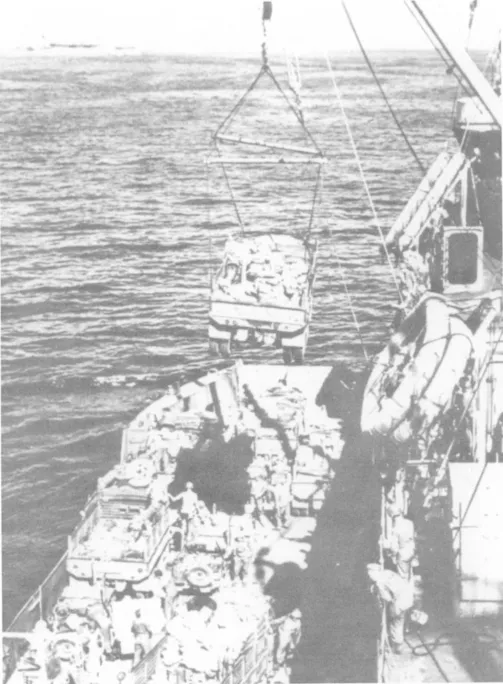
US Army trucks being offloaded onto an LCT off Paestum on D-Day (Library of Congress).
Strategic Options
The decision to land an Anglo-American army on the beaches below Salerno was not an obvious one for the Allied planners. At the Casablanca Conference in January 1943 Prime Minister Churchill and President Roosevelt decided to invade Sicily after clearing the Germans from North Africa, rather than transfer the bulk of their armies to Britain in preparation for an assault against North West Europe. As Supreme Allied Commander in the Mediterranean Theatre of Operations, General Eisenhower had reservations about the invasion of Sicily, which was code-named Operation Husky. It seemed like an open-ended commitment to a war in Italy, which could divert resources from a landing in France. However, after Roosevelt and Eisenhower extracted an agreement to limit the Allied involvement in the Mediterranean theatre, the invasion went ahead as planned.
Operation Husky proved a resounding success. The Allies landed on the southern and south-eastern coasts of Sicily on 10 July 1943 and within a month the Germans and their lacklustre Italian allies had been driven back to Messina, in the north-eastern tip of the island. The Germans then evacuated the island, pulling over 80,000 troops to safety. Finally on 17 August Messina was captured, and the campaign brought to an end. However, the fighting didn’t stop there. In May Churchill had persuaded Roosevelt that Eisenhower should try to knock Italy out of the war, as a continuation of Husky. Inevitably this meant an invasion of the Italian mainland. While the fighting was raging in Sicily, Eisenhower’s staff was busy drawing up plans for this next stage of the conflict.
During the next few weeks several schemes were developed, all involving landings either around Naples and Rome, or else on the southern coast of Italy. The more northerly invasion sites offered the most substantial strategic rewards if the landings succeeded, but conversely they also involved the greatest risk. By contrast, a landing on the southern coast was virtually risk-free, but the strategic advantages were minor. While a landing around Rome was discounted early on because the beaches lay beyond the reach of Allied air cover, other invasion plans were developed that gave Eisenhower a range of options. Operations Barracuda, Gangway and Mustang all involved landings in the Bay of Naples. However, these were eventually considered to be too risky, as the Germans would be able to reinforce the battlefield far more rapidly than the Allies could, while the beaches lay too far from the airfields in Sicily to permit all but the most minimal air cover for the operation.
A far safer option was Operation Slapstick, which involved the landing of General Clark’s Fifth Army at Taranto, supported by a drop by the US 82nd Airborne Division. This too was discarded, as the whole operation was considered too cautious. For the same reason Operation Goblet, a landing by General Montgomery’s Eighth Army at Crotone in Calabria was also abandoned, as was Operation Buttress, the landing of Fifth Army’s X Corps in the same area. Next came the drafting of plans for an independent parachute drop by the 82nd, either around Naples (Operation Giant I), or around Rome (Operation Giant II). Both were designed to block the flow of German reinforcements to the main landing area to the south, but both operations were rightly considered too perilous. In the end these plans were adapted by the Airborne commander when General Clark asked the 82nd to carry out a drop in support of the Salerno landings.
By the end of August it was clear that although the Germans still held southern Italy, their troops were in poor shape, and the Wehrmacht needed time to replenish the men and equipment lost during the Sicilian campaign. The normally cautious Montgomery urged an immediate landing in Calabria to take advantage of this – to establish a foothold on the Italian ‘toe’ before the enemy could recover. His aggressiveness was encouraged by the favourable political situation in Italy. After a string of military disasters the Italian leadership was anxious to make peace with the Allies. On the night of 24/25 July the Fascist Grand Council voted Mussolini from office, and the following day King Victor Emmanuel III ordered the arrest of the Italian dictator. A new government was formed under the leadership of Marshal Badoglio, who promptly entered secret negotiations with the Allies.
Meanwhile Eisenhower and General Alexander, commanding the Fifth Army Group, decided to launch a two-pronged invasion. The first elemen...
Table of contents
Cover
Half Title
Full Title
Copyright Page
Contents
Frequently asked questions
Yes, you can cancel anytime from the Subscription tab in your account settings on the Perlego website. Your subscription will stay active until the end of your current billing period. Learn how to cancel your subscription
No, books cannot be downloaded as external files, such as PDFs, for use outside of Perlego. However, you can download books within the Perlego app for offline reading on mobile or tablet. Learn how to download books offline
Perlego offers two plans: Essential and Complete
Essential is ideal for learners and professionals who enjoy exploring a wide range of subjects. Access the Essential Library with 800,000+ trusted titles and best-sellers across business, personal growth, and the humanities. Includes unlimited reading time and Standard Read Aloud voice.
Complete: Perfect for advanced learners and researchers needing full, unrestricted access. Unlock 1.5M+ books across hundreds of subjects, including academic and specialized titles. The Complete Plan also includes advanced features like Premium Read Aloud and Research Assistant.
Both plans are available with monthly, semester, or annual billing cycles.
We are an online textbook subscription service, where you can get access to an entire online library for less than the price of a single book per month. With over 1.5 million books across 990+ topics, we’ve got you covered! Learn about our mission
Look out for the read-aloud symbol on your next book to see if you can listen to it. The read-aloud tool reads text aloud for you, highlighting the text as it is being read. You can pause it, speed it up and slow it down. Learn more about Read Aloud
Yes! You can use the Perlego app on both iOS and Android devices to read anytime, anywhere — even offline. Perfect for commutes or when you’re on the go. Please note we cannot support devices running on iOS 13 and Android 7 or earlier. Learn more about using the app
Yes, you can access Salerno 1943 by Angus Konstam in PDF and/or ePUB format. We have over 1.5 million books available in our catalogue for you to explore.