- 224 pages
- English
- ePUB (mobile friendly)
- Available on iOS & Android
eBook - ePub
The Royal Armoured Corps in the Cold War, 1946–1990
About this book
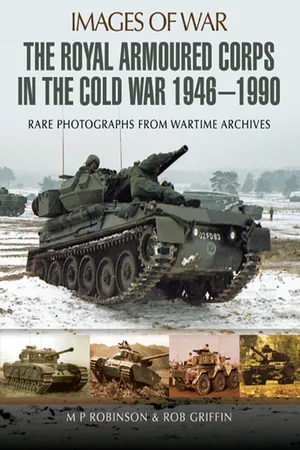
The Royal Armoured Corps composition may have changed dramatically during the four and a half decades of The Cold War but its role in the nations defence has been predominant. This highly informative book focuses on the deployment of the British Armys armoured regiments from the end of the Second World War, their vehicles and equipment, the creation of the British Army of the Rhine, NATO commitments and other peripheral missions. The characteristics and variants of the Centurion, the powerful but short lived Conqueror, the Chieftain and Challenger are covered in expert text and by numerous images. The RAC in the Cold War is a tribute to the men who served in these famous regiment and their stories make fascinating reading.
Trusted by 375,005 students
Access to over 1.5 million titles for a fair monthly price.
Study more efficiently using our study tools.
Information
Chapter One
The Early Post-War Period
The Royal Armoured Corps (or RAC) was formed on the eve of war in 1939 from the battalions of the Royal Tank Corps and the mechanised regiments of cavalry. Six bloody years later the Axis lay defeated and Britain stood exhausted from campaigns fought around the globe. The army faced occupation duties in Europe, and the unpredictable burdens of keeping the peace in a far-flung empire. In August 1945 the British Army of the Rhine (BAOR) was reformed from the British occupation forces in northwest Germany. BAOR was to remain a constant factor for the RAC for most of the next fifty years. outside of Europe, North Africa, India, Palestine, and Malaya had RAC units present in their army garrisons as well. The RAC’s composition was unique in that it included the army’s oldest cavalry regiments and the battalions of the Royal Tank Regiment, which dated only from the First World War. old cavalry regiments with officers traditionally connected to the British establishment had throughout the Second World War been brigaded with the very junior units of the Royal Tank Regiment. The Royal Armoured Corps had some of Britain’s best military minds in its officer corps, veteran commanders to lead the corps united through the turbulent peace. Many career officers in the Royal Armoured Corps had found themselves in the few years after the war’s end with stark choices. Wartime regimental commanders often accepted lower rank to stay in the shrinking army, or left the service. A rapid turn-over of officers and NCos came as wartime regiments disbanded and as the Python leave system took effect. In the next two years the number of available junior officers dwindled sharply in the entire army, creating a shortage of troop leaders in the RAC which was eventually resolved by conscription.1

The 1st Royal Tank Regiment on parade in Germany after the end of the war in Europe. The wartime RTR was a huge organization with twelve regular regiments and many other units raised for the duration. Some of these quickly disbanded RTR regiments returned as Territorial regiments in 1947. (MP Robinson Collection)

In 1947 the 13th/18th Hussars had some M24 Chaffee tanks on strength as well as armoured cars. During the winter of 1947, food and fuel shortages were the cause of some unrest in the local population. The tanks were eventually handed over to the 14th/20th Hussars, and the 13th/18th Hussars spent the remaining months of their occupation duty equipped with armoured cars. (John Jollivet)
Attlee’s government wanted to reduce the army and the size of the empire quickly. In late 1945 the army disbanded the Royal Reconnaissance Corps, the wartime RAC regiments raised from converted infantry regiments, and the territorial RTR regiments. Most of these units had finished the war overseas – mainly in Italy, the Middle East, India or northern Europe. The rapid disbandment of these units led to some administrative difficulties and to the assignment of occupation duties throughout Europe to the remaining RAC regiments on the continent. In the last months of 1945 and for much of 1946 there was a whirlwind of personnel changes in the individual regiments, and many unit movements. The armoured units in the 8th Army and the 21st Army Group became widely dispersed across Western Europe in the course of occupation duties.

Two Humber scout cars of the 13th/18th Hussars parked at the barracks at Wolfenbuttel in 1946 or 1947. Also pictured in the background are a Daimler Armoured Car and one of the Chaffees. The 13th/18th Hussars finished the war with the 8th Armoured Brigade on Shermans, but within a year they were under orders of the 5th Infantry Division on armoured cars, with only enough men to form two squadrons. (John Jollivet)
Occupation was very different from wartime armoured or reconnaissance operations. Regiments detached into squadrons in order to control large areas. Many regiments exchanged some (or all) of their tanks for armoured cars. Individual troops patrolled, hunting for caches of weapons and rounding up persons of interest. Temporary camps were set up – often in former enemy barracks. Wartime soldiers departed in a steady stream, and numbers were made up from disbanded regiments as an expedient. Even this didn’t provide enough men for long, and many units manned only two of their sabre squadrons by the middle months of 1946. In the regiments themselves, time not spent on showing the flag or assisting displaced people was spent on honing peacetime skills or in sports. Bases were moved repeatedly, and it became hard to track changes in assignment as larger formations disappeared and areas returned to civil administration.2

A Comet of the 2nd Queen’s Bays about to test its ditch crossing ability in Italy in 1946. The Bays were then part of the 2nd Armoured Brigade, 1st Armoured Division (along with the 4th RTR, 6th RTR and 9th Lancers). The 2nd Armoured Brigade’s role in the area was to dissuade Tito’s forces from attempting to advance into Trieste. The potential for violence was real; the British commander of the Pola district was assassinated by an Italian fascist in protest to the handover of Istria to the Yugoslavs in 1947. The Bays left Italy for Egypt in June 1947. (Brian Simpson)
The RAC in time of peace was controlled by the Director, Royal Armoured Corps (DRAC), and by the War office, and they both needed to balance the needs of the army with those of the peacetime budget. The first post-war RAC Conference was held in late 1945. The RAC’s senior officers and the War office both made a concerted effort to determine the best ways to implement the structural lessons of the war while reducing the corps to a manageable size. The RAC’s peacetime strength was set at twenty cavalry regiments and eight RTR regiments. Not everyone saw a rapid force reduction as a sensible move for British interests. At the 1946 Royal Armoured Corps conference Field-Marshal Montgomery himself argued that Britain’s future security required a large post-war professional regular army backed by a large citizen reserve army. He proposed that Britain kept a regular army of two armoured divisions and four infantry divisions, with three additional independent armoured brigades. He envisioned a requirement for four RAC reconnaissance regiments for the regular infantry divisions, and four armoured car regiments as army troops. This force was to be manned by conscripts and by a smaller core of regulars. Monty’s ideal regular army was backed up by a Territorial Army of two armoured divisions, three armoured brigades, seven RAC reconnaissance regiments (for seven infantry divisions) and four armoured car regiments. It would have been an army almost on a wartime scale.3

A Comet in course of a gearbox change during the Queen’s Bays service in Palmanova, Italy in 1946. The Comet was generally a quick, reliable and maneuverable vehicle. In Libya drivers occasionally raced them for fun – a strictly unofficial pastime! (Brian Simpson)
If combined with new equipment, Montgomery’s proposal would have provided a strong force for intervention in Europe. He saw that the United States and Great Britain needed to keep large standing armies to discourage Soviet expansion westwards. Monty’s vision ran against both the current of political thought and the economic realities of setting up a welfare state, but he could have had a crystal ball for the accuracy of his estimation of the army’s needs… and of what was to come. The west had much to mistrust in the USSR’s post-war policies. The reality was that the RAC needed to simultaneously shrink and modernise, in order to protect British interests at an acceptable cost. Shrink it did – at a rapid pace. By late 1946 the British Army in Europe had dwindled to three under-strength corps. By the end of the year the 7th Armoured Division was all that remained of the wartime armoured divisions, as the 11th had disbanded during the year. BAOR was reduced to a peacekeeping force for the next two years as Great Britain cast her eyes at her shrinking empire.
By 1947 only three nominal divisions remained in the areas under British control in Europe. Some regiments returning to Britain after years abroad were immediately redeployed as conflicts flared in Palestine and India. The regiments in the Middle East were stationed in Palestine, Egypt and Libya – in tanks and armoured cars. The Suez Canal, the main strategic concern in the area, was guarded on both the eastern and western sides by RAC units. There was a real risk of war with Jewish and Egyptian forces while Israel was established. As a result of misidentification Egyptian forces on several occasions opened fire on British armoured units on exercises in the eastern Sinai in 1946. The important areas where armoured forces were still deployed were all outside Europe – and all were associated to the strategic needs of the empire. Five regiments were still in India, and eight were serving in the Middle East (half of whom were equipped with armoured cars). Smaller detachments were located in Hong kong and Japan. The 4th RTR was sent to Palestine in 1948 equipped with Comet tanks to protect the final British withdrawal from Israeli attacks. In Malaya, where communist agitation had been a threat since 1945, the 3rd RTR had a small presence (with the bulk of the regiment stationed in Hong...
Table of contents
- Cover
- Title Page
- Copyright
- Contents
- Acknowledgement
- Dedication
- Introduction
- Chapter 1: The Early Post-War Period
- Chapter 2: Joining the Royal Armoured Corps
- Chapter 3: The Regiment
- Chapter 4: Korea
- Chapter 5: The 1950s
- Chapter 6: 1959–1969: The RAC Focused on BAOR
- Chapter 7: The Armoured Regiments in the Early Cold War Period
- Chapter 8: Armoured Reconnaissance
- Chapter 9: Chieftain
- Chapter 10: The 1970s
- Chapter 11: The 1980s and the End of the Cold War
- Conclusion
- Notes
- Appendix I: Territorial RAC Regiments 1947–1990
- Appendix II: RAC Battle Tanks 1945–1990
- Appendix III: RAC Middle East
- Appendix IV: RAC Asian Deployments
Frequently asked questions
Yes, you can cancel anytime from the Subscription tab in your account settings on the Perlego website. Your subscription will stay active until the end of your current billing period. Learn how to cancel your subscription
No, books cannot be downloaded as external files, such as PDFs, for use outside of Perlego. However, you can download books within the Perlego app for offline reading on mobile or tablet. Learn how to download books offline
Perlego offers two plans: Essential and Complete
- Essential is ideal for learners and professionals who enjoy exploring a wide range of subjects. Access the Essential Library with 800,000+ trusted titles and best-sellers across business, personal growth, and the humanities. Includes unlimited reading time and Standard Read Aloud voice.
- Complete: Perfect for advanced learners and researchers needing full, unrestricted access. Unlock 1.5M+ books across hundreds of subjects, including academic and specialized titles. The Complete Plan also includes advanced features like Premium Read Aloud and Research Assistant.
We are an online textbook subscription service, where you can get access to an entire online library for less than the price of a single book per month. With over 1.5 million books across 990+ topics, we’ve got you covered! Learn about our mission
Look out for the read-aloud symbol on your next book to see if you can listen to it. The read-aloud tool reads text aloud for you, highlighting the text as it is being read. You can pause it, speed it up and slow it down. Learn more about Read Aloud
Yes! You can use the Perlego app on both iOS and Android devices to read anytime, anywhere — even offline. Perfect for commutes or when you’re on the go.
Please note we cannot support devices running on iOS 13 and Android 7 or earlier. Learn more about using the app
Please note we cannot support devices running on iOS 13 and Android 7 or earlier. Learn more about using the app
Yes, you can access The Royal Armoured Corps in the Cold War, 1946–1990 by M.P. Robinson,Robert Griffin in PDF and/or ePUB format, as well as other popular books in History & Military & Maritime History. We have over 1.5 million books available in our catalogue for you to explore.