"A top-of-the-line examination of operations in north European waters during the first eight months of [WWII] . . . by far the best work on that subject."—Stone & Stone
The term "the phony war" is often applied to the first months of the Second World War, a term suggesting inaction or passivity. That may have been the perception of the war on land, but at sea it was very different. This new book is a superb survey of the fierce naval struggles, from 1939 up to the invasion of Norway in April 1940.
The author begins the book with the sinking of the German fleet at Scapa Flow in 1919 and then covers the rebuilding of the Kriegsmarine and parallel developments in the Royal Navy and summarizes relevant advances in European navies. The main part of the book then describes the actions at sea starting with the fall of Poland. There is a complex, intertwined narrative that follows. The sinking of
Courageous, the German mining of the British East Coast, the Northern Patrol, the sinking of
Rawalpindi, small ship operations in the North Sea and German Bight, the Altmark incident are all covered. Further afield the author deals with the German surface raiders and looks at the early stages of the submarine war in the Atlantic.
As with his previous books, Geirr Haarr has researched extensively in German, British, and other archives, and the work is intended to paint a balanced and detailed picture of this significant period of the war when the opposing naval forces were adapting to a form of naval warfare quite different to that experienced in WWI.
eBook - ePub
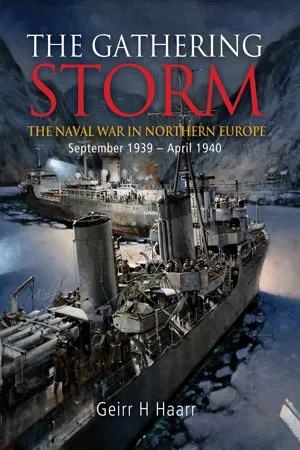
The Gathering Storm
The Naval War in Northern Europe September 1939 - April 1940
- 550 pages
- English
- ePUB (mobile friendly)
- Available on iOS & Android
eBook - ePub
About this book
Trusted by 375,005 students
Access to over 1 million titles for a fair monthly price.
Study more efficiently using our study tools.
Information
Topic
StoriaSubtopic
Storia militare e marittima— 1 —
Introduction
THERE WAS NO ‘PHONEY war’ at sea at the start of WWII. The hostilities commenced literally within the hour of war being declared. This book describes those early events at sea as they are remembered through the accounts of those that were actually there.
The accounts of the men who went to war is challenging material. Inevitably written sometime after the events, hours, days or years, room is made for the individual or his superiors to add, interpret or omit events. Many of the documents contain corrections or comments that could have been made by the author, his superiors, staff members or readers, not always obviously distinguishable from the first-hand accounts.
Most individuals saw little beyond their own decks and had limited knowledge of what was actually happening. Quite often, accounts from different persons present at the same event describe quite different experiences, giving contradictory information, resulting in more questions than answers. The confusion of combat and lost sense of time often resulted in accounts from otherwise level-headed individuals that, when compared to others also at the scene, gives an interesting insight into the nature of war itself. There are also direct errors in some of the reports, typically in names of persons, places or ships, but also in relative position and results of their own fire. In a few cases, there are also what appear to be deliberate over-statements or manipulations, probably intended to increase the apparent importance of the effort of the author or his comrades.
Nevertheless, I have found scores of individual stories from which, together with the formal reports and memoirs, paints a picture of the war at sea in the first seven months of the war. There is lots of tedium, routines and boredom, but also heroism, self-sacrifice and fear. Both sides faced ‘the cruel sea’. The winter of 1939–40 was appalling and, often, the ocean was a worse enemy than the men from the other side.
The research material has come in many languages: English, German, Norwegian, Swedish, Danish, Polish and French. All translations into English are my own responsibility and, where necessary, I have striven to maintain the significance of what was said or written rather than give a word-for-word translation. For documents written in English, the quotations have been kept as much as possible as the original, except for a few minor changes to improve the readability. The account is mainly based on primary sources, where possible combining official and private material to achieve the best insight. In some cases, secondary sources have been used after a thorough assessment of their credibility.
In compiling the manuscript, I have attempted to make a balanced account from each side, each theatre of war and each type of ship involved. The amount of detail available makes it impossible to cover everything, and faults, mistakes or misinterpretations are inevitable. Hence, anyone who has corrections, comments or alternative information that might lead to modifications or improvement of the account is encouraged to contact me, either directly or through the publisher.
— 2 —
The Allied Navies
Scant Resources
IN 1919 THE ROYAL Navy could muster 438,000 men, 58 capital ships, 12 aircraft carriers, 103 cruisers, 456 destroyers and 122 submarines. Great Britain was the unchallenged master of the seas. Economic and social reforms were necessary, though, and reduced military spending was inevitable. Arguments that sustaining an armaments industry would help maintain employment and stimulate new industries were dismissed. The British politicians had no choice but to follow a course that would lead to a dramatic development for the armed forces. The army was cut to little more than an imperial police force. The Royal Navy and the newly established Royal Air Force fared relatively better but still faced dramatic cutbacks. The Royal Navy would fall to almost insignificance within ten years. One by one, the shipbuilding and ordnance companies collapsed or merged to preserve a minimum of employment and competence. First Sea Lord Admiral Beatty was shocked and stubbornly continued to plan for a renewal of the fleet, including battleships and carriers, arguing that the strategic needs of the empire could only be met by naval superiority.1 This was not to be.
The Washington Naval Treaty signed on 1 February 1922 allowed the Royal Navy to retain twenty-two capital ships, most of them of the 25,750-ton, 15-inch gun Queen Elizabeth-class, with the notable exception of Hood, which floated a substantial 41,200 tons. In the ‘Special Programme of Naval Construction’ of 1923 that gave the priorities for the remainder of the decade, some of the retained capital ships were listed for upgrading while four were scrapped, allowing for the building of two new ones – Nelson and Rodney. To remain below 35,000 tons while keeping their 16-inch guns, all three triple turrets were positioned forward, with the after hull trimmed short. The day of the capital ship was nearly over, though, and within two decades, the aircraft carrier would replace the capital ships as the ultimate naval weapon, supported by simpler, less expensive warships and submarines.
By the early 1930s, the Royal Navy had shrunk to two main fleets, the Home Fleet and the Mediterranean Fleet. Cruiser squadrons were maintained at the West Indies, North America, Cape, East Indies and China stations. Later still, economic constraints led to some of these being replaced by sloops and other smaller ships performing ‘cruiser tasks’. In 1939, the Home Fleet was still a significant force but of mixed vintage and inadequately balanced for full tactical efficiency. In addition to the battleships Rodney, Nelson, Ramillies, Royal Oak and Royal Sovereign, the battlecruisers Hood, Renown and Repulse were under command, as were the aircraft carriers Ark Royal and Furious, twelve cruisers, seventeen destroyers and sixteen submarines in addition to minesweepers and support ships. An additional two cruisers and nine destroyers were stationed in the Humber. The battleships Revenge and Resolution with the carriers Hermes and Courageous, three A/A cruisers and nine destroyers were deployed at Portland, in addition to destroyers and light forces in Harwich, Dover, Portsmouth, Plymouth and Milford Haven.2

Battlecruiser Renown was originally commissioned in September 1916. By 1939, she had effectively been reconstructed. Among the improvements were high-pressure boilers and Parson-geared turbines, upgraded 15-inch gun turrets and completely new 4.5-inch dualpurpose secondary gun armament. She could do just over 30 knots but became very wet forward if she did. (Wright and Logan – W&L)
Ramillies, Royal Sovereign, Royal Oak and Repulse lacked modernisation and, although they would be dangerous to most opponents in terms of guns, they were so slow that for all practical purposes they were useless. Only Hood and the modernised Renown were fast enough to catch the German ‘pocket’ battleships, and both would be a match for Scharnhorst and Gneisenau in an equal fight.3 Hood, the pride of the fleet, was ageing and due for extensive upgrades and modernisation in September 1939 – which she would never have. Nelson and Rodney were still relatively modern with powerful main guns and armour, but very slow. The lack of speed in the British capital ships meant that to catch the German battleships they would have to rely on surprise or damage by torpedoes from submarines, destroyers or aircraft – even more difficult as the German capital ships had efficient radars installed.
At the end of WWI, the Royal Navy had some forty modern cruisers in commission and a further nine under construction. Most of these were small, with 6-inch guns, suitable for the North Sea and the Mediterranean. For the protection of Atlantic and Asian trade routes, larger ships were needed. The Washington Treaty allowed for 10,000 tons and 8-inch guns, so eleven County-class cruisers were ordered in 1924–26.4 These were seaworthy ships and could maintain speed in rough seas, being stable gun platforms with a good rate of fire and a superior director system. To stay within the limitations, a top speed of 32 knots had to be accepted, and the ships were vulnerable to bombing throughout their careers, due to reduced armour. Several of them would play important roles in the early years of WWII.
Shortage of funds forced simplifications and in 1928 York was launched, followed by the modified Exeter a year later. These were some 8,000 tons, carrying three twin 8-inch gun turrets. Further reductions were needed, and 6-inch guns became the hallmark of British cruiser design in the 1930s. Although it was half the weight of an 8-inch shell, it was argued that the rapid rate of fire of the 6-inch guns would give a superior weight of broadside if it could shorten the range fast enough to avoid lethal damage from longrange heavier guns.
Five Leander-class,5 three Arethusa-class6 and eight Southampton-class7 cruisers were launched between 1931 and 1937. The Leanders were some 7,200 tons with eight 6-inch guns, while the Arethusas carried six 6-inch guns at 5,250 tons. The Southamptons carried a formidable twelve 6-inch guns in four three-gun turrets, but this required a displacement of over 9,000 tons. In 1938 the even larger Belfast and Edinburgh were launched but these would not be operational until after the outbreak of war. At the start of the war, the Royal Navy had fifty-seven cruisers in commission, of which thirty-seven were modern designs.8

Cruiser Norfolk, 24 May 1939, at Devonport. The County-class cruisers were 10,000-ton ships with eight 8-inch guns in twin mounts. (Keystone)

Destroyer Firedrake showing off in high seas. She was one of the 1,400-ton F-class destroyers, built in 1934 and commissioned in May 1935. Armament consisted of four 4.7-inch Mk IX guns in single mounts and eight 0.5-inch Vickers machine guns in quad mounts in addition to eight torpedo tubes (in quad mounts) and one rack for twenty depth-charges. Maximum speed exceeded 35 knots. (Crown Copyright)
Three single-reduction steam turbines provided 42,000 horsepower to two shafts. Endurance was 3,400 miles at 15 knots, or 5,340 miles at 12.5 knots. The early ships carried 4-inch guns while the later versions were upgraded with 4.7-inch guns. The elevated forecastle and bridge well aft gave the nimble ships good sea-keeping abilities. Efficient fire control was ensured by a 10-foot base rangefinder and the new ‘Destroyer Director Control Tower’ (DCT). Anti-aircraft (A/A) defences were insufficient, though: initally only two quadruple 0.5-inch machine guns abreast the bridge and some 0.303 Lewis guns. Two quadruple torpedo mountings for 21...
Table of contents
- Front Cover
- Title Page
- Copyright Page
- Contents
- Acknowledgements
- 1 Introduction
- 2 The Allied Navies
- 3 The German Navy
- 4 Baltic Eagles
- 5 What Now?
- 6 German Home Waters
- 7 Sinking the Athenia
- 8 Contact Obtained
- 9 Learning the Hard Way
- 10 No Margin for Error
- 11 A/S Striking Forces
- 12 The Grey Wolves
- 13 The Bull of Scapa Flow
- 14 Pale Death
- 15 The Thin Grey Line
- 16 Airwar at Sea
- 17 Commerce Raiders
- 18 Mine Warfare
- 19 Night Stalkers
- 20 The Northern Patrol
- 21 Winter War
- 22 No Friends
- 23 The Altmark Incident
- 24 Crossroads
- 25 Storm Warning
- 26 Conclusions
- Appendices
- Abbreviations
- Notes
- References
Frequently asked questions
Yes, you can cancel anytime from the Subscription tab in your account settings on the Perlego website. Your subscription will stay active until the end of your current billing period. Learn how to cancel your subscription
No, books cannot be downloaded as external files, such as PDFs, for use outside of Perlego. However, you can download books within the Perlego app for offline reading on mobile or tablet. Learn how to download books offline
Perlego offers two plans: Essential and Complete
- Essential is ideal for learners and professionals who enjoy exploring a wide range of subjects. Access the Essential Library with 800,000+ trusted titles and best-sellers across business, personal growth, and the humanities. Includes unlimited reading time and Standard Read Aloud voice.
- Complete: Perfect for advanced learners and researchers needing full, unrestricted access. Unlock 1.4M+ books across hundreds of subjects, including academic and specialized titles. The Complete Plan also includes advanced features like Premium Read Aloud and Research Assistant.
We are an online textbook subscription service, where you can get access to an entire online library for less than the price of a single book per month. With over 1 million books across 990+ topics, we’ve got you covered! Learn about our mission
Look out for the read-aloud symbol on your next book to see if you can listen to it. The read-aloud tool reads text aloud for you, highlighting the text as it is being read. You can pause it, speed it up and slow it down. Learn more about Read Aloud
Yes! You can use the Perlego app on both iOS and Android devices to read anytime, anywhere — even offline. Perfect for commutes or when you’re on the go.
Please note we cannot support devices running on iOS 13 and Android 7 or earlier. Learn more about using the app
Please note we cannot support devices running on iOS 13 and Android 7 or earlier. Learn more about using the app
Yes, you can access The Gathering Storm by Geirr H Haarr in PDF and/or ePUB format, as well as other popular books in Storia & Storia militare e marittima. We have over one million books available in our catalogue for you to explore.