- 128 pages
- English
- ePUB (mobile friendly)
- Available on iOS & Android
eBook - ePub
About this book
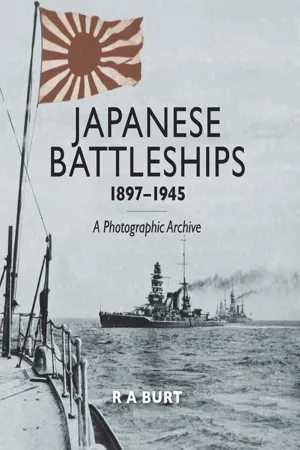
Rare images of the Imperial Japanese Navy's fleet before it was almost completely destroyed in World War II.
This photographic archive contains some 125 stunning images of the battleships of the Imperial Japanese Navy, many unfamiliar, some very rare. They constitute an archive that is pretty much without equal in publications in the West. The period covered is from the launch of Japan's first real contemporary battleship, Yashima, built by Armstrong's on the Tyne, up to the final destruction of her fleet in the Pacific in 1945.
During that time Japan built up the third largest navy in the world and, before the First World War, it was Britain that armed her at sea. All her dreadnoughts saw action in the Second World War, and of all these numerous ships only Nagato survived the conflict. She was to become a target in the Bikini A-bomb tests in 1946.
Just as the ships were lost, so were the majority of photographic records, and relatively few images have come down to us. This selection from R.A. Burt's archive represents therefore a remarkable portrayal of these ships. Extended captions and ship specifications enhance its reference value, making it an essential volume for enthusiasts, modelers, and anyone with an interest in the Second World War.
This photographic archive contains some 125 stunning images of the battleships of the Imperial Japanese Navy, many unfamiliar, some very rare. They constitute an archive that is pretty much without equal in publications in the West. The period covered is from the launch of Japan's first real contemporary battleship, Yashima, built by Armstrong's on the Tyne, up to the final destruction of her fleet in the Pacific in 1945.
During that time Japan built up the third largest navy in the world and, before the First World War, it was Britain that armed her at sea. All her dreadnoughts saw action in the Second World War, and of all these numerous ships only Nagato survived the conflict. She was to become a target in the Bikini A-bomb tests in 1946.
Just as the ships were lost, so were the majority of photographic records, and relatively few images have come down to us. This selection from R.A. Burt's archive represents therefore a remarkable portrayal of these ships. Extended captions and ship specifications enhance its reference value, making it an essential volume for enthusiasts, modelers, and anyone with an interest in the Second World War.
Trusted by 375,005 students
Access to over 1 million titles for a fair monthly price.
Study more efficiently using our study tools.
Information
KONGO CLASS
Displacement: 26,330 tons normal load (average for class)
Dimensions: Length: 704ft oa; Beam: 92ft; Draught: 27ft 6in mean
Armament: 8 x 14in 45cal; 16 x 6in; 16 x 14pdr; 4 x 12pdr; 7 x MG; TT: 8 x 21in
Armour: Main belt: 8in (Krupp); Bulkheads: 9in–8in; Barbettes: 10in; Turrets: 9in (faces); Armoured deck: 2in; Conning tower: 10in
Machinery: Four Parsons turbines (Haruna Brown Curtis) driving four screws, thirty-six Yarrow large-tube boilers (Miyabara in Japanese-built ships)
Designed SHP: 64,000 for 27.5 knots
Fuel: 1,000 tons oil and 4,200 tons coal max
Complement: 1,121 (average)
KONGO
Laid down: 17 January 1911, Vickers, Barrow-in-Furness
Launched: 18 May 1912
Completed: August 1913
Fate: Sunk by torpedo from USS Sealion II, 21 November 1944
HIEI
Laid down: 4 November 1911, Yokosuka, Kosho
Launched: 2 November 1912
Completed: August 1914
Fate: Sunk by gunfire, torpedoes and air attack at Savo Island, 13 November 1942
HARUNA
Laid down: 16 March 1912, Kawasaki, Kobe
Launched: 14 December 1914
Completed: April 1915
Fate: Sunk by US aircraft in shallow water at Kure, 28 July 1945
KIRISHIMA
Laid down: 17 March 1912, Mitsubishi, Nagasaki
Launched: 1 December 1912
Completed: April 1915
Fate: Sunk by gunfire from USS Washington, 15 November 1942

Kongo on trials 8 May 1913
With a close eye on dreadnought construction in Germany and Great Britain, Japan knew that if she was going to keep her fleet to full strength it was necessary to have more of the all big-gunned type of vessels. Japan’s warship construction had improved immensely, but was still inadequate to meet new dreadnought requirements. Vickers of Barrow, an old friend of the Imperial fleet, was asked for a new design which was prepared by the firm’s Chief Constructor, Sir George Thurston, who had the battlecruiser HMS Princess Royal in the yard at that time. Obviously that ship’s design would be reflected in the Japanese unit. Having a free hand, however, there were many improvements made over the British ship, but in the end there was little difference in the offensive and defensive qualities of the two ships.
With a close eye on dreadnought construction in Germany and Great Britain, Japan knew that if she was going to keep her fleet to full strength it was necessary to have more of the all big-gunned type of vessels. Japan’s warship construction had improved immensely, but was still inadequate to meet new dreadnought requirements. Vickers of Barrow, an old friend of the Imperial fleet, was asked for a new design which was prepared by the firm’s Chief Constructor, Sir George Thurston, who had the battlecruiser HMS Princess Royal in the yard at that time. Obviously that ship’s design would be reflected in the Japanese unit. Having a free hand, however, there were many improvements made over the British ship, but in the end there was little difference in the offensive and defensive qualities of the two ships.

Kongo forward turrets 1913
A close-up of Kongo on the starboard side showing ‘A’ and ‘B’ 14in guns, turrets, bridge and forward funnel. There is plenty of activity onboard with Japanese crew as well as her British construction workers from Vickers of Barrow-in-Furness. She is preparing to leave the yard for a series of steam trials (May 1913) followed by gunnery testing of approximately ten rounds from the 14in guns. It was stated in the contract for Kongo that she should be able to float with fifty feet of her side blown away, should not heel more than eleven degrees and automatically regain her vertical in a specified length of time, though at an increased draught. This was some demand from the Japanese Navy and one that could not, in all practical purposes, be met. No doubt many promises were made at the time of laying down the keel in 1911.
A close-up of Kongo on the starboard side showing ‘A’ and ‘B’ 14in guns, turrets, bridge and forward funnel. There is plenty of activity onboard with Japanese crew as well as her British construction workers from Vickers of Barrow-in-Furness. She is preparing to leave the yard for a series of steam trials (May 1913) followed by gunnery testing of approximately ten rounds from the 14in guns. It was stated in the contract for Kongo that she should be able to float with fifty feet of her side blown away, should not heel more than eleven degrees and automatically regain her vertical in a specified length of time, though at an increased draught. This was some demand from the Japanese Navy and one that could not, in all practical purposes, be met. No doubt many promises were made at the time of laying down the keel in 1911.

Kongo starboard broadside 1914
Having completed many arduous tasks on completion to prove her capabilities, Kongo is seen here as part of the Japanese battle fleet with her three sister-ships under construction at a rapid pace. A beautifully balanced design and one that was often compared with British designs within the Royal Navy – especially HMS Tiger that was in the process of fitting out at the John Brown Shipyard on the Clyde. It is often stated that HMS Tiger was influenced by the Kongo design, but there is no evidence whatsoever in any official document (the ship’s cover or Admiralty documents). Compared with HMS Tiger, however, there is little difference in the salient features of the design. Note the black funnel tops that were a familiar feature of Japanese ships once in service.
Having completed many arduous tasks on completion to prove her capabilities, Kongo is seen here as part of the Japanese battle fleet with her three sister-ships under construction at a rapid pace. A beautifully balanced design and one that was often compared with British designs within the Royal Navy – especially HMS Tiger that was in the process of fitting out at the John Brown Shipyard on the Clyde. It is often stated that HMS Tiger was influenced by the Kongo design, but there is no evidence whatsoever in any official document (the ship’s cover or Admiralty documents). Compared with HMS Tiger, however, there is little difference in the salient features of the design. Note the black funnel tops that were a familiar feature of Japanese ships once in service.

Kongo August 1928
Note the impressive bridgework, large cap to the fore funnel and strange, bulbous top to the second funnel. During the late 1920s it was decided that vast improvements could be made to the class and they were suitably reconstructed: Kongo from September 1929–March 1931; Haruna from March 1924–July 1928; and Kirishima from March 1927–March 1930. Increased armour protection was worked in, they were re-boilered, antitorpedo bulges were fitted and improvements to the gunnery installations were introduced. Displacement rose to 31,700 tons in the normal load.
Note the impressive bridgework, large cap to the fore funnel and strange, bulbous top to the second funnel. During the late 1920s it was decided that vast improvements could be made to the class and they were suitably reconstructed: Kongo from September 1929–March 1931; Haruna from March 1924–July 1928; and Kirishima from March 1927–March 1930. Increased armour protection was worked in, they were re-boilered, antitorpedo bulges were fitted and improvements to the gunnery installations were introduced. Displacement rose to 31,700 tons in the normal load.

Kongo close-up August 1928
This is the appearance of Kongo just before being taken into the dockyard for her first major reconstruction (December 1929–March 1931). Armour increases over decks, aircraft capabilities, new boilers and machinery and a funnel reduction to two, were all done in this refit. Compare this view with the close-up of her as completed. The tripod is now hidden from view by the additional platforms. Note the pagoda-style superstructure taking shape and the strange funnel cap/large hood fitting on the middle funnel. What slightly spoils her appearance in this view are the long lines of washing; obviously it was laundry day.
This is the appearance of Kongo just before being taken into the dockyard for her first major reconstruction (December 1929–March 1931). Armour increases over decks, aircraft capabilities, new boilers and machinery and a funnel reduction to two, were all done in this refit. Compare this view with the close-up of her as completed. The tripod is now hidden from view by the additional platforms. Note the pagoda-style superstructure taking shape and the strange funnel cap/large hood fitting on the middle funnel. What slightly spoils her appearance in this view are the long lines of washing; obviously it was laundry day.

Kongo port side August 1928
This image was taken at the same time as the previous one and shows her overall appearance at this date.
This image was taken at the same time as the previous one and shows her overall appearance at this date.

Kongo from the air 1928
A superb aerial photograph showing the balanced layout of Kongo and a view which modelmakers will appreciate. It shows many of the deck fixtures and fittings not visible in broads...
A superb aerial photograph showing the balanced layout of Kongo and a view which modelmakers will appreciate. It shows many of the deck fixtures and fittings not visible in broads...
Table of contents
- Cover
- Title Page
- Copyright
- Contents
- Introduction
- Fuji Class
- Asama Class
- Shikishima Class
- Idzumo Class
- Asahi
- Azuma
- Yakumo
- Mikasa
- Kasuga Class
- Tsukuba Class
- Tango
- Suwo Class
- Hizen (ex-Retvizan)
- Iwami (ex-Orel)
- Iki (ex-Imperator Nikolai)
- Katori Class
- Satsuma Class
- Kurama Class
- Settsu Class
- Kongo Class
- Drawings
- Fuso Class
- Ise Class
- Nagato Class
- Yamato Class
Frequently asked questions
Yes, you can cancel anytime from the Subscription tab in your account settings on the Perlego website. Your subscription will stay active until the end of your current billing period. Learn how to cancel your subscription
No, books cannot be downloaded as external files, such as PDFs, for use outside of Perlego. However, you can download books within the Perlego app for offline reading on mobile or tablet. Learn how to download books offline
Perlego offers two plans: Essential and Complete
- Essential is ideal for learners and professionals who enjoy exploring a wide range of subjects. Access the Essential Library with 800,000+ trusted titles and best-sellers across business, personal growth, and the humanities. Includes unlimited reading time and Standard Read Aloud voice.
- Complete: Perfect for advanced learners and researchers needing full, unrestricted access. Unlock 1.4M+ books across hundreds of subjects, including academic and specialized titles. The Complete Plan also includes advanced features like Premium Read Aloud and Research Assistant.
We are an online textbook subscription service, where you can get access to an entire online library for less than the price of a single book per month. With over 1 million books across 990+ topics, we’ve got you covered! Learn about our mission
Look out for the read-aloud symbol on your next book to see if you can listen to it. The read-aloud tool reads text aloud for you, highlighting the text as it is being read. You can pause it, speed it up and slow it down. Learn more about Read Aloud
Yes! You can use the Perlego app on both iOS and Android devices to read anytime, anywhere — even offline. Perfect for commutes or when you’re on the go.
Please note we cannot support devices running on iOS 13 and Android 7 or earlier. Learn more about using the app
Please note we cannot support devices running on iOS 13 and Android 7 or earlier. Learn more about using the app
Yes, you can access Japanese Battleships, 1897-1945 by R.A. Burt in PDF and/or ePUB format, as well as other popular books in History & Japanese History. We have over one million books available in our catalogue for you to explore.