- 240 pages
- English
- ePUB (mobile friendly)
- Available on iOS & Android
eBook - ePub
About this book
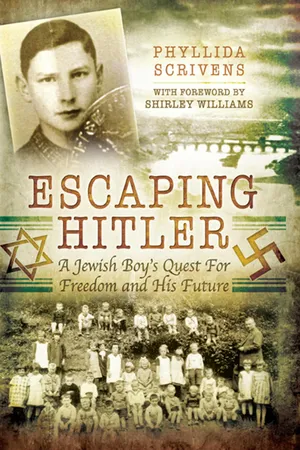
Escaping Hitler is the true story, covering ninety years, of a fourteen-year-old boy Gnter Stern who, when Adolf Hitler threatened his family, education and future, resolved to escape from his rural village of Nickenich in the German Rhineland. In July 1939 Gnter boarded a bus to the border with Luxembourg, illegally crossed the river and walked alone for seven days through Belgium into Holland, intent on catching a ferry to England and freedom. The outcome was not exactly as he had planned. The author gathered her information through interviews with Gnter, now known as Joe Stirling, and with those closest to him. During an emotional foot-stepping journey in September 2013 the author visited Gnters birthplace, met with a school friend, discovered the apartment in Koblenz where he fled following Kristallnacht in 1938, drove the route of Gnters walk through Europe and retraced the final steps of his parents prior to their deportation to a Nazi death camp in Poland during 1942.
Trusted by 375,005 students
Access to over 1.5 million titles for a fair monthly price.
Study more efficiently using our study tools.
Information
Chapter 1
Child, 1924–1939
Innocence
‘I was very keen to learn to read and we had lots of books. Shock-haired Peter was one of my favourites. In a way these stories are very frightening. I used to enjoy learning to read them.’
The powerful smell of tanned leather, sweetly scented woodland flowers, a suitcase full of banknotes and Der Struwwelpeter; the profound, personal blend of memories defining Günter’s early childhood. Aged three or four, he sat on his bedroom floor hiding amongst hundreds of scraps of paper, each stamped many times over with an ever-increasing value. A little older, on days when the sun warmed the air, he met with other youngsters in the fields and woodlands around the near-by volcanic lake, Laacher See, to shape posies of blueweed, ox-eye daisies, yellow archangels and phlox. These they proffered for sale to wealthy tourists who drove through the countryside in their Opel Laubfrosch convertibles and shiny Stuttgart limousines, looking for the nearby medieval abbey of Maria Laach.
Young Günter’s formative summers in the Rhineland village of Nickenich were spent running errands or playing his mother’s 78s, mainly Johann Strauss, on the wind-up gramophone. Günter loved to play football on the Hintergasse outside his home, the boys using a tin can for want of a ball. From a very young age, encouraged by his parents, Günter learned to read and in his quieter moments enjoyed discovering new worlds inside the covers of books. Along with timeless fairy stories of the Brothers Grimm, his favourite was Der Struwwelpeter, a fuzzy-haired character created in 1845 by storyteller Heinrich Hoffman. This collection of morality tales includes striking illustrations of Shock-Headed Peter, the naughty, unpopular boy who refuses to wash or comb his hair.
After his father, Peter was Günter’s earliest hero.
Nickenich
‘Lots of people were small farmers, who all lived in the tightly packed community, working narrow fields scattered all around the village. Each morning they would set off in their carts, drawn by a horse or more likely one or two oxen, to which of their strips required attention. The objective was to produce enough potatoes, rye, wheat, hay, oats and maize to feed their animals, and sufficient eggs, chickens, pigs and calves to feed themselves.’
Alfred Stern married his sweetheart Ida in her home village of Kettig on 5 August 1922. The couple had met whilst Alfred, a Viehhändler (cattle dealer), conducted business with her father, a supervisor at the main cattle market in Koblenz-Lützel, less than 10 miles from Kettig. The newly-weds chose to settle in Nickenich, a relatively large community of around 2,000 people, in the mountainous Eifel region, bordered by the Mosel River in the south and the Rhine Valley to the east. Two other cattle dealers were already serving the local farmers. However, Alfred knew that they were both nearing retirement. The farmers lived in the village; a close-knit community, each owning a cow or two, providing milk for the families, wives proficient at making cheese. This tradition, along with the close proximity of the cattle market in Koblenz, should ensure Alfred a decent living.
But at that time mere survival was a serious challenge. In the summer of 1923, whilst Günter was still the longed-for issue of a young bride, Germany suffered from a severe case of hyperinflation. Following defeat in the Great War in 1918, the terms of the Treaty of Versailles had crippling economic ramifications. The German standard of living fell to about half of what it had been before the conflict. Over the next five years the situation escalated into an unprecedented catastrophe. At the peak of the crisis the German currency included a note valued at 50 million marks. By November 1923 the mark was dead, all existing banknotes declared invalid, resulting in mountains of lower value notes burnt in place of logs or given to children as playthings. Years later Alfred would regale his son with stories from those desperate days. Once, having sold a cow, he gave his wife all the proceeds. Within hours she spent every pfennig on a much-needed new apron.
Having established his reputation, his list of clients growing, Alfred spent busy days transporting cattle, poultry and horses to market on hired trucks. He bought and sold the animals, having first washed and groomed them, skilfully trimming overgrown hoofs to make the valuable livestock more appealing. Meanwhile, Ida kept house in a rented one-bedroomed flat at the foot of the Hintergasse, a steep cobbled lane. The narrow houses formed a patchwork of black basalt volcanic stones from the region, the large smooth pebbles underfoot creating a sombre feel to the unlit streets. Most homes had a cellar for storing root vegetables, a large backyard, stabling for horses, cows, pigs, chickens and of course, a steaming pile of manure to enrich the fields and vegetable plots. The families sold any excess produce to help pay for basic necessities. On Saturday, 18 October 1924, Ida gave birth to a boy. It was a difficult labour. There would be no further babies.
A short time later, in need of more space, the Stern family moved up the lane to Number 183 Nickenich. At that time dwellings in villages and small towns were simply given a number, often without any apparent logic. It was not until some years later that their home became known as Hintergasse 10. It was common for the modest houses and flats to have outside toilets and no running water or heating. Günter’s new home was a two-bedroomed flat above the workshop of Herr Doll, a saddler living in a nearby hamlet. He cycled every day to Nickenich to craft saddles, harnesses and collars using simple hand tools. Significantly for his tenants, the workshop boasted a boiler. The Sterns now benefitted from access to hot water, a real luxury, carried up the stairs in buckets to fill the metal tub for bathing in front of the fire.
Winter arrived in November, invariably holding on until mid-March. Günter and his village friends looked forward to waking up to a magical fall of snow, arrived silently overnight. Before the grown-ups could sweep it away with their shovels and brooms, the youngsters found their wooden sledges and tin trays, slithering fearlessly head first down the incline of the Hintergasse, before serious snowball fights broke out amongst the boys. An open log fire on the first floor of the flat provided warmth for Günter and his parents until they retired for the night. There was no heating in the bedrooms. But cotton bedcovers resembling large envelopes filled with real chicken feathers kept them snug.
When a little older, Günter enjoyed spending more time with his father, occasionally accompanying him on business trips to the cattle market in Koblenz, exploring the fenced-off animal pens, strolling hand in hand with his maternal grandfather, beloved Opa, from whom Günter learnt chess, cards, Nine Men’s Morris and the importance of caring for others. At home Alfred acted as unofficial village vet. Günter watched fascinated, as his father felt the bellies of cows to confirm they were in calf. The boy marvelled as Alfred calmed nervous horses, a technique developed during his time in the Army. Occasionally the pair would walk together to a neighbouring village. Alfred would buy a cow and allow Günter to lead the creature, a string around its neck, along the road to the next community where he might sell it on at a modest profit.
Along the route Alfred impressed his son with tales of the Great War.
War Veteran
‘My father told no end of stories of the horror of the war with all the battlefield names that became familiar like Ypres and the Somme.’
Alfred enlisted in the Imperial German Army in 1913, seeing active service only a year later. Initially he joined a Foot Artillery regiment, driving heavy horse-drawn guns, later transferring to the cavalry as a mounted messenger. Telephone wires laid under the ground were frequently broken and disconnected by constant shelling, necessitating the transfer of intelligence between command posts and front-line troops by a soldier on horseback. Pigeon post had to be abandoned when the birds, disoriented by shooting and explosions, ended up flying the wrong way.
Alfred was wounded four times. He spent the rest of his life with a piece of shrapnel in his neck, too near the spinal cord to be removed safely. This would later provide opportunities to tease his young son with weather predictions courtesy of ‘shrapnel twinges’. He was rewarded with an Iron Cross for courage in the face of enemy fire. For many years Alfred continued to have nightmares, later relating horrific tales of combat, including having two horses shot dead from under him. A favourite tale was of the strange British troops who, despite at times wearing ‘skirts like women’, were fearless fighters. In the German trenches the men anxiously listened as strange wailing sounds signalled a British attack. Some soldiers were so terrified of this weird ‘music’ that they tried to desert, frequently resulting in execution by their own officers. The conflict over, Alfred returned to cattle dealing.
At nearly thirty it was time to settle down.
Lessons
‘It was an all-age school. We learnt mainly reading, writing, nature study and arithmetic. And history. Remember it was in the early years of Hitler so it was history as Hitler wanted it taught. It was totally politically censored. You only learnt German history and the great things that Germans had done, which was fair enough, but also how awful nearly all of the rest of the world had been towards us.’
Just before his seventh birthday Günter joined the local school, a two-minute walk up the hill, turn left at the top opposite the catholic church dedicated to Saint Arnulf and into the school yard. On that first morning, the schoolmaster Herr Weinand welcomed his new class of attentive faces. There was a message chalked onto the blackboard: ‘Aller Angfang ist schwer.’ (Every beginning is difficult.) Günter had no notion of how many times in life he would have cause to recall that piece of wisdom. Addressing his young charges the teacher said, ‘Stand up if you can read that’. Günter, grateful to his mother for patiently teaching him his letters, stood up along with about five others. Consistently attentive and quick to learn, the young schoolboy particularly enjoyed nature rambles and outdoor lessons under the trees when the days were still and mellow.
Some afternoons, instead of going straight home, he would visit a house just three doors down. By day this neighbour worked as a painter and decorator but in the evenings he played his violin in the local pub and was quite a celebrity in the village. Alfred could not afford to send his son for professional music lessons; instead Günter learnt the basics on a child-sized violin. Günter’s enthusiasm for learning did not stop at music. A conscientious student at most subjects, it wasn’t long before he could recite his tables. In class tests, some children endeavoured to copy his work, confident that Günter Stern would know the answers. Ida and Alfred dreamed of their son attending the Gymnasium, maybe going to university and becoming a doctor or a lawyer. But to be a student at the Grammar School in nearby Andernach required rather more than being top of the class. Your parents had to be able to afford the fees. But these were adult concerns. Günter simply enjoyed his books and being with his special friends, Rudi Pauken, Toni Fuchs, Alwin Bous and Heinz Becker. Heinz was the son of Hermann Becker, the village cobbler whose family lived in Kirchstrasse, at the top of the Hintergasse and opposite St Arnulf’s Church. The only difference between them was that his friends went to church on a Sunday and Günter went to synagogue on a Saturday.
Günter was the only Jewish child in the school.
Observance
‘Every Spring on the Jewish holiday of Passover we would take gifts of matzah to the houses of our friends in Nickenich. These disks of flat “bread” were very brittle and quite tasteless, a bit like water biscuits. Our best friends got six rounds and quite a few others got two. Friends coming to play would ask if they could have a piece of “that funny stuff, like you bring round at Easter time”. But if the request came “out of season” I had to disappoint them.’
Alfred Stern was born on 9 December 1889 in Meudt, a small community in the Westerwald, a region of low mountains on the right bank of the Rhine, renowned for its relatively high proportion of Jewish families. Before 1810 the Jews used Patronymic names, derived from the given name of a father or male ancestor. Many generations of the Stern family can be traced back to one couple, Jakob, Son of Moyses and his wife Sara, both born around 1736. During the period 1810 to 1840 the dukedoms that would become Germany, forced the Jews to take family names. Names were chosen for a variety of reasons, many reflecting a profession or place of birth. Consequently, there are five different family names emanating from the descendants of Jakob and Sara, including Heilberg, Lahrheim, Löewenstein, Cahn and Stern, all originating from the village of Meudt.
Shortly before the Great War, Alfred’s devoutly orthodox father, Heimann Stern, relocated his tailoring business, along with wife Dina and five children, Johanna, Alex, Rega, Alfred and Meta, to the nearby shoemaking community of Montabaur. It wasn’t long before Alfred joined the Army, possibly in an effort to escape the restrictive religious rules ardently enforced by his father. During the conflict he was given special dispensation by the Army Rabbis and advised that God would forgive him for deviating from the observance of dietary laws. No Jew expected to be given Saturdays off or to receive any special food. These dispensations meant that Alfred would find it difficult to return to any form of orthodoxy in his civilian life.
After his son was born, once or twice a year and possibly out of duty, Alfred took Günter to visit his paternal grandfather, widowed since 1917, 40 kilometres to the east of Nickenich. As he grew older, Günter continued to be transfixed by the sight of the elderly man, in his white shawl and black brimmed hat, sitting at the rear of the family shop, Hebrew Bible on his lap, rocking back and forth, back and forth, quietly chanting, deep in prayer. Unbeknown to the boy, living in Montabaur was his father’s namesake, Alfred Stern, known as Freddy, third cousin to Günter, one year younger and also an only child. The two boys shared a great-great grandfather in Alexander Leser, born in 1765. Freddy’s branch of the Stern family had set up home at 24, Bahnhofstrasse, living over the shoemaking workshop. Like Günter, Alfred enjoyed a happy childhood. However, Montabaur was a much larger community than Nickenich. As the Nazi threat increased during 1938, Freddy felt compelled to carry a truncheon to school to ward off bullies from the Hitler Youth.
In Nickenich, Ida was intent on raising her son to respect the rites and customs of his ancestors. Her husband didn’t make it easy. Despite her disapproval, Alfred consistently disregarded the strict rules of his Jewish heritage, cycling with his son on the Sabbath to the nearby village of Kruft to attend prayers, despite the command against using transport of any kind on holy days. Father and son hid their bikes behind a hedge so that the other worshippers would be unaware of them violating one of the laws of Moses. Ida baked kosher honey cake and flatbread buttons for Günter and his friends, who regularly dropped by on the off chance of an oven-fresh treat. She loved to sing, favouring songs from popular Strauss operettas such as Die Fledermau (The Bat) or Franz Lehar’s Die Lustige Witwe (The Merry Widow). Günter loved breaking from his studies to savour his mother’s fine singing voice.
Her husband, less interested in music, preferred to spend some evenings in the village pub, playing hands of ‘Skat’, the German national card game, with his Catholic friend Peter Saftig. Peter was a farmer living in near-by Wiesenstrasse with wife Margarete, son Franz and daughters Maria and Elisabeth. Once in a while, the two men worked together. On one occasion Alfred heard of a farmer in the village of Niederzissen, some 20 kilometres away fr...
Table of contents
- Cover
- Title Page
- Copyright
- Contents
- List of Plates
- Dedication
- Acknowledgements
- Illustration Credits
- Foreword
- Author’s Introduction
- Family Trees
- Prologue: Visitors
- Chapter 1: Child, 1924–1939
- Chapter 2: Schoolboy and Soldier, 1939–1945
- Chapter 3: Parent and Politician, 1945–1955
- Chapter 4: Businessman and Lion, 1955–1970
- Photo Gallery
- Chapter 5: Tour Guide and Sheriff, 1970–1980
- Chapter 6: Employer and Grandfather, 1980–2000
- Chapter 7: Retirement
- Epilogue
- Bibliography
Frequently asked questions
Yes, you can cancel anytime from the Subscription tab in your account settings on the Perlego website. Your subscription will stay active until the end of your current billing period. Learn how to cancel your subscription
No, books cannot be downloaded as external files, such as PDFs, for use outside of Perlego. However, you can download books within the Perlego app for offline reading on mobile or tablet. Learn how to download books offline
Perlego offers two plans: Essential and Complete
- Essential is ideal for learners and professionals who enjoy exploring a wide range of subjects. Access the Essential Library with 800,000+ trusted titles and best-sellers across business, personal growth, and the humanities. Includes unlimited reading time and Standard Read Aloud voice.
- Complete: Perfect for advanced learners and researchers needing full, unrestricted access. Unlock 1.5M+ books across hundreds of subjects, including academic and specialized titles. The Complete Plan also includes advanced features like Premium Read Aloud and Research Assistant.
We are an online textbook subscription service, where you can get access to an entire online library for less than the price of a single book per month. With over 1.5 million books across 990+ topics, we’ve got you covered! Learn about our mission
Look out for the read-aloud symbol on your next book to see if you can listen to it. The read-aloud tool reads text aloud for you, highlighting the text as it is being read. You can pause it, speed it up and slow it down. Learn more about Read Aloud
Yes! You can use the Perlego app on both iOS and Android devices to read anytime, anywhere — even offline. Perfect for commutes or when you’re on the go.
Please note we cannot support devices running on iOS 13 and Android 7 or earlier. Learn more about using the app
Please note we cannot support devices running on iOS 13 and Android 7 or earlier. Learn more about using the app
Yes, you can access Escaping Hitler by Phyllida Scrivens in PDF and/or ePUB format, as well as other popular books in History & Military Biographies. We have over 1.5 million books available in our catalogue for you to explore.