This WWII history presents a vivid chronicle of the British Army's 9th Parachute Battalion and their operations in Normandy based on survivor interviews.
The first hours and days following the Allied invasion of Normandy were perhaps the most crucial moment of the Second World War. The Day The Devils Dropped In examines the pivotal role played by the 9th Battalion of the Parachute Regiment in the first week of the landings. These brave British soldiers were tasked with neutralizing the mighty Merville Battery, and capturing Le Plein and the Chateau St. Côme on the Breville Ridge. Failure by to achieve any of these objectives could have meant disaster for Operation Overlord—and catastrophe for the Allied war effort.
In his quest to uncover what transpired in the early days of the landings, historian Neil Barber tracked down and interviewed surviving participants in the operation. In
The Day the Devils Dropped In, he presents the full story, largely in the very words of those who lived through the experience. Enhanced by wartime photographs throughout, this revealing chronicle is a fine tribute to those whose contribution must never be forgotten.
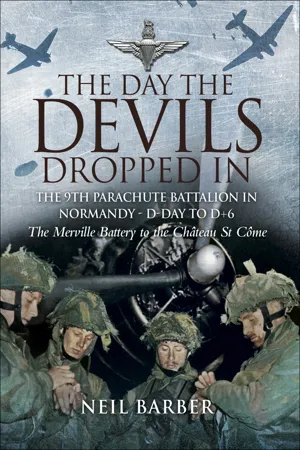
eBook - ePub
The Day the Devils Dropped In
The 9th Parachute Battalion in Normandy - D-Day to D+6: The Merville Battery to the Château St Côme
- 224 pages
- English
- ePUB (mobile friendly)
- Available on iOS & Android
eBook - ePub
The Day the Devils Dropped In
The 9th Parachute Battalion in Normandy - D-Day to D+6: The Merville Battery to the Château St Côme
About this book
Trusted by 375,005 students
Access to over 1.5 million titles for a fair monthly price.
Study more efficiently using our study tools.
Information
Topic
StoriaSubtopic
Storia militare e marittimaCHAPTER ONE
‘An Elite Club of Volunteers’
On 5 November 1942, the War Office authorized the formation of a brigade to strengthen the existing British Airborne Forces, namely the 1st Airborne Division. As part of this expansion, the 10th Holding Battalion, The Essex Regiment was chosen to be converted into a parachute unit. Major-General Frederick ‘Boy’ Browning, the ‘father’ of the Airborne Forces, subsequently visited the battalion and gave a talk about the objectives of a parachute force, and from a strength of 644 all ranks, 567 volunteered. However, before acceptance, the men were required to pass stringent mental and physical criteria. This began with a two-week selection course at Hardwick Hall near Chesterfield, which involved a strict medical, rigorous physical training and various tests. The survivors then went on a further two-week course for parachute training at Ringway in Manchester.1 The first week was devoted to learning and practising the drill and culminated in two jumps from a balloon at 700 to 800 feet. During the second week the trainees had to make five jumps from aircraft. Around 150 successfully completed the course, and were duly presented with the coveted wings. One of them was Company Sergeant-Major Jack Harries:
Certainly the issue of Para wings, the Airborne shoulder flash and the red beret seemed to transform men almost overnight, and suddenly you were part of an elite club of volunteers.
Most of this successful group were experienced pre-war regulars, 1940 conscripts or members of the Territorial Army, and these formed the backbone of the 9th (Eastern and Home Counties) Battalion, the Parachute Regiment.2
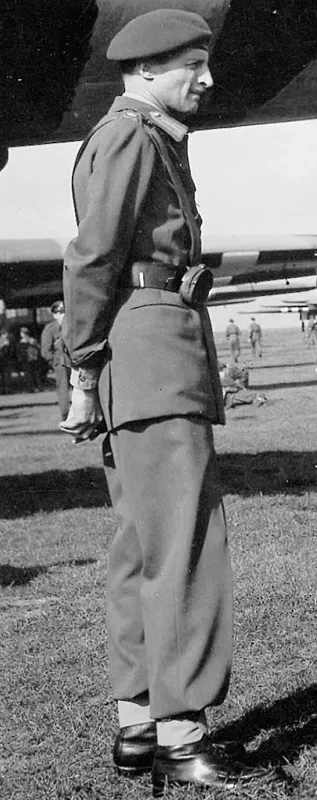
Major General Frederick Browning. Taylor Library
The new brigade was designated as 3 Parachute Brigade and was completed by the 7th and 8th Battalions.
The structure of a Parachute Battalion basically consisted of a HQ Company, three Rifle Companies, ‘A’, ‘B’ and ‘C’, and the Reserve Company. HQ Company dealt with the administration of the Battalion and included the signals and intelligence sections plus an MG platoon of four Vickers heavy machine guns and a mortar platoon of six three-inch mortars. Each Rifle Company comprised of five officers and 120 men organised into Company HQ and three platoons of thirty-six men each.
‘Home’ for the 9th Battalion was Kiwi Barracks in Bulford Camp near Andover in Wiltshire, and Lieutenant-Colonel Tom Hearn, the greatly respected Commanding Officer of the 10th Essex, briefly continued in this role, but had to relinquish command as he was too old to jump. Colonel Stanley James Ledger Hill was appointed.
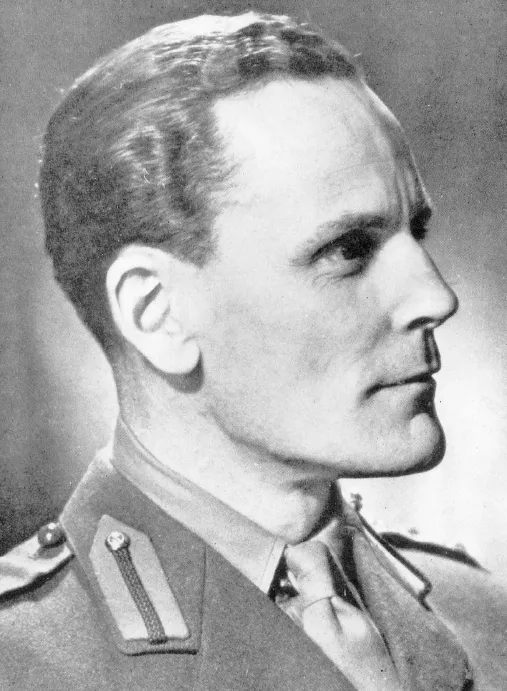
James Hill.
James Hill’s path to the Battalion had been eventful to say the least. While commanding the 1st Parachute Battalion in North Africa, he had been shot three times when leading a raid behind enemy lines. One bullet went straight through his chest, while the other two hit him in the neck and shoulder. He was placed in the sidecar of an Italian motorcycle with his badly wounded adjutant and rapidly driven back to Beja where he was operated upon by a forward parachute surgical team. Here, his life was saved and after three weeks in a casualty clearing station, was evacuated to a hospital in Algiers. To regain fitness, as soon as he was able, at night he started slipping out of the French windows of his room for illicit walks in the hospital gardens. Seven weeks later, considering himself fit enough, he just walked out of the hospital and set off to report to his superior, Brigadier Edward Flavell. The front had by then moved on into Tunisia, a journey of 400 miles. He hitchhiked the whole distance. Unfortunately, Flavell could not return command of the Battalion to him so he put Hill on a plane back to England, whereupon he was immediately sent to hospital in Tidworth.3 Whilst here he received the offer of the 9th Battalion, but his first problem was getting passed fit to command again. He was friendly with the hospital’s commanding officer, Major Salmon, and so one afternoon, while she was at dinner, he left a note saying that he apologised for missing her, but that General Browning required him back immediately. He also asked that a medical certificate be forwarded to him.4, 5
Hill duly assumed command of the Battalion and his impact was immediate. The officer commanding ‘A’ Company was Major Allen Parry:
The Colonel invariably picked on a different officer each day and said ‘Come along and walk to the office with me.’ The walk was a breathtaking experience. James Hill invariably carried a thumb stick, which increased the length of his stride. His speed of movement often left the unfortunate officer trotting a couple of paces behind his master, trying to answer his questions but with insufficient breath to do so. The Colonel quickly earned the name ‘Speedy’ from the soldiers.
Sergeant Doug Woodcraft, ‘A’ Company:
When Colonel Hill took over the Battalion, he took us all on a forced march. At the end he addressed us, saying ‘Gentlemen, you are not fit, but don’t let this worry you because from now on we are going to work a six and a half day week. You can have Saturday afternoons off!’
And he meant it! Even Sunday Services at the Garrison Church provided only a brief respite. Company Sergeant Major Harries:
We were required to attend in full battle order with weapons and leave them outside on the lawns, and at the end of the Service Brigadier {sic} Hill would arrive and suggest we all went on ‘a nice stroll’ before lunch. No one could refuse of course but the stroll usually consisted of anything up to ten miles which usually developed into more of a run than a march, such was the pace of Brigadier Hill at the front.
Hill placed great emphasis on both physical and mental endurance. Everything was done ‘at speed’, and all movement during working hours was carried out at the double. This was necessary because when the men initially went into battle, they would be carrying all of the Battalion’s equipment and ammunition with them, and would also be facing numerically superior and more heavily armed opponents.
*
On 23 April 1943, the War Office issued orders for the formation of the 6th Airborne Division, which was to comprise of 3 Parachute Brigade, transferred from the 1st Airborne Division, and two new brigades, 5 Parachute Brigade and 6 Airlanding glider-borne Brigade.6
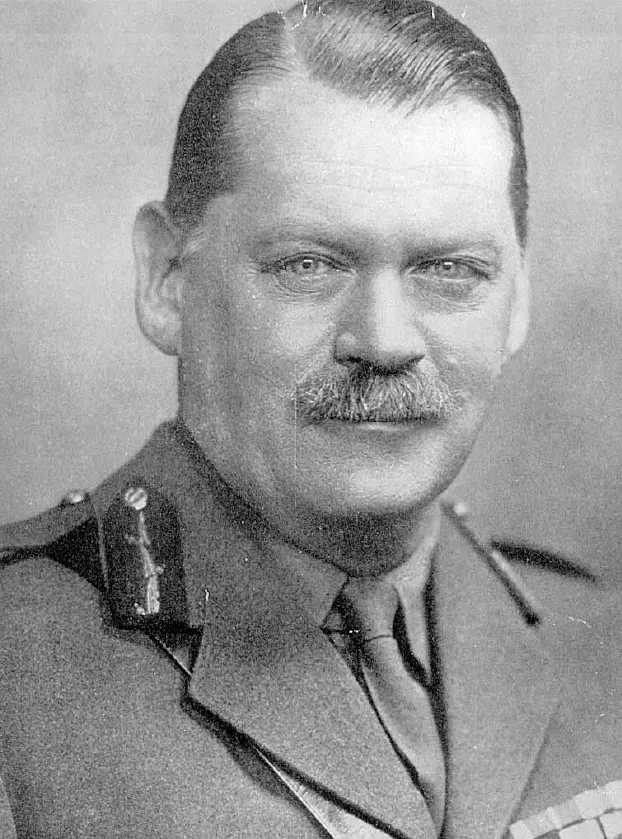
Major-General Richard Gale. Taylor Library
The Divisional Commander was Major-General Richard ‘Windy’ Gale, a veteran of the First World War and a straight talking ‘soldier’s soldier’ who set the tone for the character of the Division when he introduced the motto, ‘Go To It!’:

9th Battalion officers.
This motto will be adopted by 6th Airborne Division and as such should be remembered by all ranks in action against the enemy, in training and during day to day routine duties.7
James Hill was duly promoted to Brigadier and given command of 3 Parachute Brigade.8 Colonel Martin Lindsay, another experienced parachutist, became the new CO of the 9th Battalion. Training continued with the same intensity, under the watchful eye of his second-in-command, Major Terence Otway.
*
To bring the Battalion up to its fighting complement of a...
Table of contents
- Front Cover
- Title Page
- Copyright Page
- Contents
- Foreword
- Preface
- Acknowledgements
- List of maps
- List of abbreviations
- Chapter 1. ‘An Elite Club of Volunteers’
- Chapter 2. Ready to ‘Go To It!’
- Chapter 3. ‘Gentlemen, The Operation is On!’ – Monday 5 June
- Chapter 4. The Drop – Tuesday 6 June
- Chapter 5. The Attack
- Chapter 6. Onward
- Chapter 7. Consolidation – Wednesday 7 June
- Chapter 8. The Château St Côme; Opening Skirmishes – Thursday 8 June
- Chapter 9. Pressure Mounts – Friday 9 June
- Chapter 10. Onslaught – Saturday 10 June
- Chapter 11. Tragedy – Sunday 11 June
- Chapter 12. Day of Decision – Monday 12 June
- Chapter 13. Relief – Tuesday 13 June
- Aftermath
- Today
- The Fates of those mentioned in the text
- Sources
- Notes
Frequently asked questions
Yes, you can cancel anytime from the Subscription tab in your account settings on the Perlego website. Your subscription will stay active until the end of your current billing period. Learn how to cancel your subscription
No, books cannot be downloaded as external files, such as PDFs, for use outside of Perlego. However, you can download books within the Perlego app for offline reading on mobile or tablet. Learn how to download books offline
Perlego offers two plans: Essential and Complete
- Essential is ideal for learners and professionals who enjoy exploring a wide range of subjects. Access the Essential Library with 800,000+ trusted titles and best-sellers across business, personal growth, and the humanities. Includes unlimited reading time and Standard Read Aloud voice.
- Complete: Perfect for advanced learners and researchers needing full, unrestricted access. Unlock 1.5M+ books across hundreds of subjects, including academic and specialized titles. The Complete Plan also includes advanced features like Premium Read Aloud and Research Assistant.
We are an online textbook subscription service, where you can get access to an entire online library for less than the price of a single book per month. With over 1.5 million books across 990+ topics, we’ve got you covered! Learn about our mission
Look out for the read-aloud symbol on your next book to see if you can listen to it. The read-aloud tool reads text aloud for you, highlighting the text as it is being read. You can pause it, speed it up and slow it down. Learn more about Read Aloud
Yes! You can use the Perlego app on both iOS and Android devices to read anytime, anywhere — even offline. Perfect for commutes or when you’re on the go.
Please note we cannot support devices running on iOS 13 and Android 7 or earlier. Learn more about using the app
Please note we cannot support devices running on iOS 13 and Android 7 or earlier. Learn more about using the app
Yes, you can access The Day the Devils Dropped In by Neil Barber in PDF and/or ePUB format, as well as other popular books in Storia & Storia militare e marittima. We have over 1.5 million books available in our catalogue for you to explore.