eBook - ePub
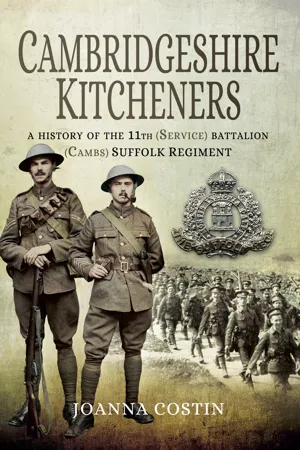
Cambridgeshire Kitcheners
A History of 11th (Service) Battalion (Cambs) Suffolk Regiment
- 328 pages
- English
- ePUB (mobile friendly)
- Available on iOS & Android
eBook - ePub
Cambridgeshire Kitcheners
A History of 11th (Service) Battalion (Cambs) Suffolk Regiment
About this book
In the opening months of the First World War, 1,500 men from Cambridgeshire came forward to serve their country as a battalion in Kitchener's New Army. They came from the city and they came from the fields. Many had never left the county before, let alone their country, and all too many would never return. Whether farm laborers, shop assistants, bricklayers, chauffeurs, university scholars or college porters, men from all walks of life united and became the Cambridgeshire Kitcheners. Sent to the Western Front in January 1916, they took part in some of the bloodiest battles of the war, including the Battle of the Somme. One hundred and eighty-seven men lost their lives on 1 July 1916, most within a few minutes of each other, as they marched over the top into no man's land and shell and machine-gun fire. This was not the end of their story. In early April, the battalion saw fierce fighting during the Battle of Arras and in a doomed assault on a heavily fortified position near Roux at the end of the month.In 1918 they resisted the German Spring Offensive, never falling back without orders, despite parts of the battalion becoming cut off and nearly surrounded during the fighting.Mixing personal accounts with official documents, this is the story of the Cambridgeshire Kitchener's war. Their momentous efforts are explained throughout this book, which is a timely reminder of this heroic battalion's dedication, skill and bravery.
Trusted by 375,005 students
Access to over 1.5 million titles for a fair monthly price.
Study more efficiently using our study tools.
Information
Chapter 1
Recruitment
The Cambridgeshire Kitcheners were formed less from a sense of local pride, which inspired the formation of many of the other Pals battalions, nor from a social class (as in the Public Schools Brigade or the Sportsmen’s battalions), than because of an overflow of recruits for general service. In September, the Bury St Edmunds depot of the Suffolk Regiment – the nearest Regular unit and the one to which most Cambridge men who attested for general service were being sent – was full to overflowing. They requested that no more men be sent, so the men who joined up were gathered into the Corn Exchange in Cambridge and began taking over various local schools for barracks, as well as erecting tents. Preliminary training began to be conducted on Parker’s Piece, and it was decided to apply to the War Office for permission to keep these men all together and to form a ‘Pals’ or ‘Chums’ or ‘Kitchener’ battalion (the local papers never quite appear to have agreed on what the battalion should be called, but the most common references are to the ‘Kitcheners’ and the ‘Cambs Suffolks’).
That said, once the Cambridgeshire Kitcheners were formed, the local newspapers were keen to emphasise what an honour it was to the county to have been given this task. The Cambridge Daily News exhorted readers:
‘It was from East Anglia that Cromwell drew his Ironsides, those famous soldiers by whose aid he banished from England the doctrine of the divine right of kings. Let the successors of the Ironsides come forward in increasing numbers and help our modern Cromwell to smash the equally blasphemous pretensions of the homicidal maniac who is ravaging Europe.’
This comparison with Cromwell’s Ironsides was frequently made, and the intention was that the battalion would be (according to the Cambridge Weekly News) ‘the envy of the neighbourhood, and if it had the chance to fight it would be the terror of their opponents.’
It was very much a county, not a Cambridge, battalion, as emphasised by the Wisbech Standard’s editor in response to a letter from ‘Citizen’ who suggested towards the end of October 1914 that the Isle and county was behind in recruiting and patriotic fervour. With a Cambridge Regular battalion in the offing, ‘why not an Ely Battalion of the Suffolk Regiment or Wisbech Battalion of the Suffolk Regiment? Let not the Isle allow this Borough Battalion to be raised alone.’ The editor, unsurprisingly upset at seeing his area disparaged in this way, replied:
‘Our correspondent appears to be under quite a wrong impression. The new Battalion of the Suffolk Regiment is not associated exclusively with Cambridge; it represents the whole of the county, including the Isle of Ely, and as the requisite number of recruits has not been obtained to complete the strength of the County Battalion, we cannot expect to have other battalions formed until that has been accomplished. The Isle has contributed largely to the Forces --ED.’

Market Place, Wisbech. Postcard sent in 1910. At least 27 members of the battalion came from this town. Wisbech had its own recruiting station, and so many members of the battalion who joined from nearby villages would have enlisted there rather than at Cambridge. (Author’s collection)
Unlike in most other areas of the country where municipal authorities or local worthies took charge of raising a Pals battalion, in Cambridgeshire the task fell to the Cambridgeshire and Isle of Ely Territorial Force Association. This body was also responsible for the Cambridgeshire Regiment – a Territorial Regiment which sent one battalion overseas in February 1915 and raised a reserve battalion for home service into which those men who were unable or unwilling to volunteer for service abroad were combined with new recruits to form a second line battalion. By the end of the war, the Cambridgeshire Regiment had expanded to include the front line battalion overseas and three home battalions. The head of the Territorial Force Association was Charles Robert Whorwood Adeane, whose seat was at Babraham Hall. He was much involved with agricultural improvement, both during and after the war and at one stage visited France to suggest to local farmers how they might rebuild and make good war damage.
In 1915, Charles Adeane was selected as the Lord Lieutenant of Cambridgeshire, when the previous Lord Lieutenant, Viscount Clifden, resigned his post. He was well liked and respected by most in the county, though not by all. In February 1916, the Chairman of the County Council, Sir George Fordham, got rather uppity about the fact that Charles Adeane had sent a letter to the King George V wishing him a speedy recovery after an accident in France. He had signed it on his own behalf and of the people of Cambridgeshire. A rather nasty letter, with little actual sense behind it, was sent to Charles Adeane from Sir George, and when he didn’t reply, Sir George sent it to the press.
The Cambridge Chronicle, a conservative leaning paper anyway, took severe umbrage at both the letter and the fact that Sir George intended to put it before the County Council for them to censure Charles Adeane. The editor commented that ‘Sir George’s action would be regrettable at any time, but it is particularly so now when national interests claim sole attention. Petty distinctions are not vital just now, and unless Sir George thinks fit to ask leave to withdraw the report it would be a charity to him if some member moved to proceed with the next business.’
That weekend, the letter was duly brought to the County Council, who were less impressed with Sir George’s sense of self-importance and rather more inclined to accept that Charles Adeane had acted in the right:
‘Sir George started badly and finished worse, and the round of applause that met his ears, when Mr Redfern’s motion “that the letter be not entered on the minutes” was carried, must have been extremely mortifying to him. It was to all intents a vote of thanks to the Lord Lieutenant, who has acted throughout with great dignity and has declined to be drawn into a controversy which never ought to have been begun.’
The Territorial Force Association in Cambridgeshire took on a huge variety of tasks in raising and training not only their own Territorial Force battalions, both for overseas service and home service, but a number of additional bodies of troops. After the Military Service Act introduced conscription in 1916, they organised the Volunteers (the battalions into which men who had temporary exemptions were put, to prepare them for service overseas once they were called up). They raised the Cambridgeshire Kitcheners (11th Suffolks), a Reserve battalion for the Suffolks (13th Suffolks), an engineering company (203rd Company Royal Engineers), a Sanitary Section, additional troops for guarding vulnerable points in England (a sort of precursor to the Home Guard) and they maintained responsibility for the First Great Eastern Hospital and its staff throughout the war. This hospital was erected on a temporary basis on the site where the University Library now sits, progressing from being a tented encampment (originally in a court of Trinity College), through to hutments.
This was a truly spectacular amount of work, in which they were greatly assisted by the Ladies’ Recruiting Committee. These prominent women did a great deal to encourage enlistment and, later in the war, to provide comforts for the troops and relief for prisoners of war. Pressure from women and on behalf of women was seen in some of the posters of the Parliamentary Recruiting Committee. ‘Women of Britain Say Go’, or ‘To the women of Britain. Some of your men folk are holding back on your account. Won’t you prove your love for your Country by persuading them to go?’

First Eastern General Hospital. (Author’s collection)

A ward in the First Eastern General Hospital. (Author’s collection)

Wounded soldiers relaxing outside the First Eastern General Hospital. (Author’s collection)

Partial picture of 203 Company Royal Engineers in 1915 – the whole panoramic photograph can be seen in the Cambridgeshire Collection, Cambridge Central Library. (T.G.K15 54189)

National Reservists leaving Cambridge in 1914. These were men recalled to the Colours on the outbreak of hostilities. Cambridgeshire Collection, Cambridge Central Library. (T.G.K14 2360)

Market Square Cambridge during mobilisation. Cambridgeshire Collection, Cambridge Central Library. (S.1914 53050)
Social pressure did not come from women alone. According to the Newmarket Journal, the Newmarket Board of Guardians met and agreed that ‘each Guardian should do his utmost to induce every young man in his parish who is eligible for service to enlist. Such an effort on the part of gentlemen who have great local influence, and who are, most of them, large employers of labour, should at the present time, when harvest operations are rapidly approaching their conclusion, prove invaluable.’
Charles Adeane was himself a prominent local landowner, and the journal of postmaster William Brand suggests that the attitude of the local gentry could have a big impact. He notes with indignation the difference between Adeane’s treatment of his villagers who had joined the Army with that of his own local gentry. He said that Private Day came home on leave and met Mr Adeane who enquired how he was doing and gave him half a sovereign, with two more for two other Abington men in the same regiment who were not on leave. That same day, William Brand’s son Jack, who was also on leave, took a telegram up to Pampisford Hall. Mr Binney, the local worthy, was seen ...
Table of contents
- Cover
- Title
- Copyright
- Contents
- Introduction
- Chapter 1 Recruitment
- Chapter 2 The Ladies’ Recruiting Committee
- Chapter 3 Training in Cambridge
- Chapter 4 The 34th Division
- Chapter 5 To France, At Last!
- Chapter 6 Preparing for the ‘Big Push’
- Chapter 7 The First Day of the Somme
- Chapter 8 Those Who Fell
- Chapter 9 Reporting the Somme
- Chapter 10 After the First Day
- Chapter 11 The Somme Continued
- Chapter 12 A New Year Begins
- Chapter 13 The Battle of Arras Begins
- Chapter 14 Analysing the Battle and Continuing the Attack 191
- Chapter 15 May–August 1917
- Chapter 16 The End of 1917
- Chapter 17 Early 1918
- Chapter 18 The German Spring Offensive (1)
- Chapter 19 The German Spring Offensive (2)
- Chapter 20 Leaving the 34th Division
- Chapter 21 Victory
- Chapter Notes
- Suggested Further Reading
- Appendix: List of All Men Mentioned in Book, with Service Numbers
Frequently asked questions
Yes, you can cancel anytime from the Subscription tab in your account settings on the Perlego website. Your subscription will stay active until the end of your current billing period. Learn how to cancel your subscription
No, books cannot be downloaded as external files, such as PDFs, for use outside of Perlego. However, you can download books within the Perlego app for offline reading on mobile or tablet. Learn how to download books offline
Perlego offers two plans: Essential and Complete
- Essential is ideal for learners and professionals who enjoy exploring a wide range of subjects. Access the Essential Library with 800,000+ trusted titles and best-sellers across business, personal growth, and the humanities. Includes unlimited reading time and Standard Read Aloud voice.
- Complete: Perfect for advanced learners and researchers needing full, unrestricted access. Unlock 1.5M+ books across hundreds of subjects, including academic and specialized titles. The Complete Plan also includes advanced features like Premium Read Aloud and Research Assistant.
We are an online textbook subscription service, where you can get access to an entire online library for less than the price of a single book per month. With over 1.5 million books across 990+ topics, we’ve got you covered! Learn about our mission
Look out for the read-aloud symbol on your next book to see if you can listen to it. The read-aloud tool reads text aloud for you, highlighting the text as it is being read. You can pause it, speed it up and slow it down. Learn more about Read Aloud
Yes! You can use the Perlego app on both iOS and Android devices to read anytime, anywhere — even offline. Perfect for commutes or when you’re on the go.
Please note we cannot support devices running on iOS 13 and Android 7 or earlier. Learn more about using the app
Please note we cannot support devices running on iOS 13 and Android 7 or earlier. Learn more about using the app
Yes, you can access Cambridgeshire Kitcheners by Joanna Costin in PDF and/or ePUB format, as well as other popular books in History & British History. We have over 1.5 million books available in our catalogue for you to explore.