- 144 pages
- English
- ePUB (mobile friendly)
- Available on iOS & Android
eBook - ePub
American Eagles: US Fighter Pilots in the RAF 1939–1945
About this book
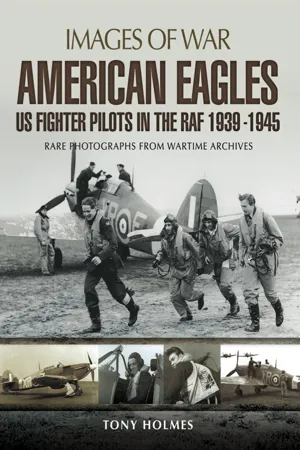
American Eagles provides a photographic snapshot of the lives of the American fighter pilots who volunteered their services during World War II, as well as the Spitfires and Hurricanes they flew. Keen to help Britain stem the spread of Fascism, or perhaps seeking adventure in a foreign land, a number of American citizens defied the wishes of their government by crossing the border into Canada and subsequently sailing to Britain to join the Royal Air Force. Some were prewar civilian pilots, others were rich playboys and a few were already serving in the RAF when war was declared. Men such as Don Blakeslee, Billy Fiske, 'Gus' Daymond and Jim Dunn, as well as many other notable pilots are featured in this volume, in photographs that have been carefully sourced from official and private archives across the globe. Each image has a detailed caption, chronicling the wartime exploits of the elite 'band of brothers' known as the American Eagles.
Tools to learn more effectively

Saving Books

Keyword Search

Annotating Text

Listen to it instead
Information
Chapter One
Pre-war Pilots

Two of the four American pilots serving with the RAF before the war were members of the Royal Auxiliary Air Force. Willard Whitney Straight (who had become a British citizen in 1936) and Carl Raymond Davis (of American parentage, although he was born in South Africa) were both part of 601 ‘County of London’ Squadron. This unit was dubbed ‘The ‘Millionaires’ Mob’ as it was staffed by ‘well-to-do’ gentlemen from the capital and the surrounding Home Counties. Both Straight and Davis reinforced this image, with the former being a millionaire racing car driver, aircraft designer and accomplished private pilot, and Davis a public school graduate and qualified mining engineer. The latter had been a part of 601 Squadron since August 1936, with Straight joining the following year. One of the first five units to be established with the formation of the Royal Auxiliary Air Force in 1925, 601 Squadron had flown a succession of two-seat biplane fighters from its RAF Hendon home. The unit was equipped with Hawker Harts when Pilot Officer Davis joined up, six 601 Squadron machines being seen here in a textbook Aircraft Close Vic formation cruising over Middlesex in the autumn of 1936. Note 601 Squadron’s distinctive red winged sword emblem stencilled onto the fins of each aeroplane. In 1937 the Harts made way for the closely related Demon, which boasted a Frazer-Nash hydraulic turret for the gunner sitting behind the pilot.

There were also two Americans serving with RAF Fighter Command before the war, namely James William Elias Davies and Cyril Dampier ‘Pussy’ Palmer. Born in Bernardsville, New Jersey, Davies had travelled to the UK with his British parents during the interwar period and joined the RAF in early 1936. Upon gaining his ‘wings’ in March 1937, Davies was posted to the newly reformed 79 Squadron at RAF Biggin Hill, in Kent. The unit was equipped with twelve Gloster Gauntlet II fighters, all of which are seen here ‘on the wing’ for a photographic session with The Aeroplane on 25 May 1938. Pilot Officer J.W.E. Davies is almost certainly at the controls of one of these machines, being a founder member of the unit’s ‘B’ Flight.

The last of the quartet of American fighter pilots to join the RAF before the war was Cyril ‘Pussy’ Palmer, who was born in Cleveland, Ohio, in March 1918. Barely 20 when he received his ‘wings’, Palmer was posted to 1 Squadron at RAF Tangmere during the summer of 1938. One of the most famous units in Fighter Command, it had been based in West Sussex since 1927 and equipped with the sleek Hawker Fury for more than six years by the time Pilot Officer Palmer arrived. No. 1 Squadron had hastily camouflaged its fighters in the wake of the Sudetenland crisis in September 1938, and the unit commenced its re-equipment with Hawker Hurricane Is the following month. The squadron was still in the process of conversion when Flight paid a visit to Tangmere in late 1938, so it could not participate in the aerial photography session seen here. However, its Fury IIs were identically camouflaged to these aircraft of 43 Squadron.

In early October 1938 this marvellous First World War-inspired squadron line-up photograph was taken at Tangmere to mark the end of 1 Squadron’s long association with the Fury – this shot was featured on the unit’s Christmas card for 1938. One of the pilots seen in the foreground is American Pilot Officer C.D. ‘Pussy’ Palmer, clothed in his standard issue white flying overall (dubbed a ‘prestige suit’ at the time) and wearing a flying helmet and goggles.

Merlins throbbing and groundcrew standing to attention, a trio of Hurricane Is from 79 Squadron’s ‘B’ Flight have their engines run up on the hardstanding in front of the North Camp triple-bay Belfast hangar at Biggin Hill in 1939. These early production examples of Hawker’s monoplane fighter were fitted with two-bladed, fixed-pitch wooden airscrews, fabric-covered wings and no windscreen or seat armour. The aircraft closest to the camera is L1718/AL-T, which was amongst seventeen Hurricane Is delivered to 79 Squadron from Hawker’s Brooklands factory in November 1938. Passed on to 111 Squadron in late 1939, this aircraft was reportedly lost in France during the Blitzkrieg of May 1940, although the exact details of its final demise remain unrecorded.

‘No. 79 Squadron, Scramble!’ Although staged for the benefit of the attendant press corps, this photograph taken at Biggin Hill on Tuesday, 8 August 1939 nevertheless captures the mood of the final peacetime RAF Air Defence Exercise held in south-east England. Exactly twelve months later fighter pilots would be repeating the selfsame routine several times a day, although they were now intercepting real Luftwaffe aircraft in their hundreds rather than a handful of Blenheim Is hastily repainted with white crosses.

Once in the air, 79 Squadron formed up into Aircraft Close Line Abreast formation and proceeded to fly over the North Downs at medium altitude again for the benefit of the press photographers, who were aloft in an RAF Anson. This particular shot, again taken on 8 August, was captured by the Kent Messenger photographer. The aircraft closest to the camera, L1697/AL-A, was the personal mount of 79 Squadron’s CO, Squadron Leader C.C. McMullen, who led the unit from January 1939 until February 1940. The Hurricane fifth from bottom, L1716/AL-D, was regularly flown by Pilot Officer James Davies. Delivered new to 79 Squadron in December 1938, it remained in RAF service until struck off charge in July 1944.

Hooked up to an Albion AM463 triple-hose bowser, a Hurricane I of 1 Squadron is refuelled on the flightline at Tangmere in early 1939. Note how the engine cowling fasteners have already become chipped and the paintwork aft of the exhaust stubs blackened within weeks of the Hurricane’s arrival in the frontline from the Hawker factory. These telltale signs of heavy use indicate just how hard 1 Squadron pushed itself to achieve operational readiness with the new fighter during the winter of 1938–39.

Pilot Officer ‘Pussy’ Palmer (centre) is seen here in a casual pose with other 1 Squadron pilots outside the unit’s Watch Office at Tangmere during the summer of 1939. Behind the American are Flying Officers S.W. Baldie and C.G.H. ‘Leak’ Crusoe, whilst the individual scratching his head is Flight Lieutenant P.R. ‘Johnny’ Walker, the squadron’s senior flight commander. A member of 1 Squadron’s legendary 1937 Hendon Air Pageant team, Walker enjoyed great success during the Phoney War and the Battle of France, claiming a number of victories. Awarded a DFC in June 1940, followed by a DSO in August 1942, Walker survived the conflict with a final tally of three and two shared destroyed, two unconfirmed destroyed and one damaged.

This worm’s-eye view of Hurricane I NA-G was taken at HMS Peregrine, better known as Royal Naval Air Station Ford, in mid-1939. Situ...
Table of contents
- Cover
- Title Page
- Copyright
- Contents
- Acknowledgements
- Introduction
- Chapter 1: Pre-war Pilots
- Chapter 2: Early Action
- Chapter 3: ‘Eagle’ Squadrons
- Chapter 4: Fighter Command
- Chapter 5: Yanks Abroad
- Chapter 6: Nightfighters
Frequently asked questions
Yes, you can cancel anytime from the Subscription tab in your account settings on the Perlego website. Your subscription will stay active until the end of your current billing period. Learn how to cancel your subscription
No, books cannot be downloaded as external files, such as PDFs, for use outside of Perlego. However, you can download books within the Perlego app for offline reading on mobile or tablet. Learn how to download books offline
Perlego offers two plans: Essential and Complete
- Essential is ideal for learners and professionals who enjoy exploring a wide range of subjects. Access the Essential Library with 800,000+ trusted titles and best-sellers across business, personal growth, and the humanities. Includes unlimited reading time and Standard Read Aloud voice.
- Complete: Perfect for advanced learners and researchers needing full, unrestricted access. Unlock 1.4M+ books across hundreds of subjects, including academic and specialized titles. The Complete Plan also includes advanced features like Premium Read Aloud and Research Assistant.
We are an online textbook subscription service, where you can get access to an entire online library for less than the price of a single book per month. With over 1 million books across 990+ topics, we’ve got you covered! Learn about our mission
Look out for the read-aloud symbol on your next book to see if you can listen to it. The read-aloud tool reads text aloud for you, highlighting the text as it is being read. You can pause it, speed it up and slow it down. Learn more about Read Aloud
Yes! You can use the Perlego app on both iOS and Android devices to read anytime, anywhere — even offline. Perfect for commutes or when you’re on the go.
Please note we cannot support devices running on iOS 13 and Android 7 or earlier. Learn more about using the app
Please note we cannot support devices running on iOS 13 and Android 7 or earlier. Learn more about using the app
Yes, you can access American Eagles: US Fighter Pilots in the RAF 1939–1945 by Tony Holmes in PDF and/or ePUB format, as well as other popular books in History & Military & Maritime History. We have over one million books available in our catalogue for you to explore.