- 184 pages
- English
- ePUB (mobile friendly)
- Available on iOS & Android
eBook - ePub
High Wood
About this book
Bois de Fourcaux, a luxuriant woodland covering 75 acres, set in the area of the battlefields of the Somme, dominates the surrounding landscape today, as it did in the summer of the year 1916. Known to the British Army as High Wood, the invading Germans had occupied the wood as it proved to be a natural field fortification and a menace that had to be neutralized if the British were to find a way forward in their attempts to breach the trench systems of the German Army and break out into the Green Fields Beyond.This insightful publication will take the battlefield visitor, and also those who are unable to visit the site, on a journey through the history of the battles for High Wood and its environs. It covers the most significant dates in the British Armys struggle to eject the invader and the Germans determination to hold that which they considered to be their new National Frontier. This is the story of the largely amateur British Army of 1916. Lessons were learned in the roaring furnace of the Somme that would transform the fighting ability of the British irrevocably: High Wood was at the epicentre of that learning process.The book contains detailed maps from the time of the High Wood battles using the excellent British Trench maps and, importantly, an explanation on the use of the numbered grid system, which enables the visitor to locate, to within 5 yards, the site of an action that took place 100 years ago. Photographs are also included to enhance the visitor experience. Join us for the journey
Tools to learn more effectively

Saving Books

Keyword Search

Annotating Text

Listen to it instead
Information
Chapter 1
The Dawn Attack: ‘They dared, they have managed.’
Friday 14 July, 70°F. Overcast.
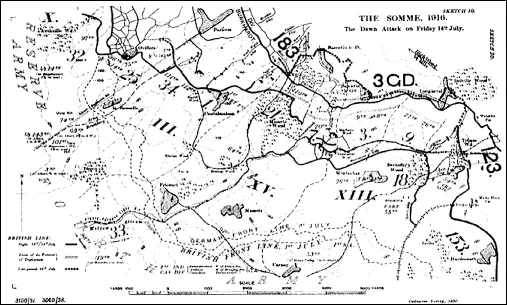
The map, reproduced from the British Official History, depicts Fourth Army’s gains on 14 July 1916. Interestingly, High Wood is not shown but referred to by an arrow pointing north-west from Delville Wood.
List of British Army formations involved in, or acting as ‘flank guards’ during the dawn attack:
Army: Fourth Army (General Sir H.S. Rawlinson)
Corps: III Corps (Lieutenant General W.P. Pulteney), XIII Corps (Lieutenant General W.N. Congreve VC), XV Corps (Lieutenant General H.S. Horne)

High Wood and its environs, 1916 – note the contour lines, they are very important in the understanding of the battles for High Wood.
Divisions: 1st, 3rd, 7th, 9th (Scottish), 18th (Eastern), 21st, 33rd, 34th, 35th (Bantam)
The visitor to High Wood would be entitled to ask the question, why here? What was so important about this particular wood, it is after all only one of many to be found on the former battlefield? The answer lies in the name applied to the wood by the British. High Wood dominates the landscape in all directions and in 1916 possession of the wood allowed the British observation over the enemy’s third battle line and much of the country east of it, including the elusive first day objective of Bapaume. Artillery was ‘queen of the battlefield’ during the First World War and direct observation was paramount, without which the ever-growing power of the Royal Artillery could not be brought to bear. To be successful in the application of their art, the gunners needed to be sure of two fixed points (a) where the shell begins its journey and (b) where it actually lands as opposed to the intended destination. Aerial observation would also play an increasingly important role for the gunners as communication techniques improved to the point that German troops came to dread the appearance of a British ‘spotter’ aircraft, as they knew full well that a hurricane of flying steel would soon be on its way to them. But ‘eyes on’ observation, which also included the use of captive balloons, would remain of the highest importance to both sides throughout the First World War.
The two months of fighting for possession of High Wood was punctuated by cavalry and mining attacks, massive artillery duels, the use of the new tank and, of mammoth importance, large loss of life for attacking and defending infantry.
Just under two weeks had passed since the disastrous British attack of 1 July, yet Fourth Army was re-equipped, had new formations and, with a much shorter front, had a higher concentration of field artillery and howitzers per mile than on that day. Fourth Army was going to attack the enemy’s Second Line, on a 6,000 yard front located upon the Bazentin Ridge, in the early hours of 14 July with two corps, fielding five divisions and employing 22,000 troops. The French had serious misgivings regarding a night attack by troops who, in their professional opinion, were not fully trained for the work and thus only disaster could ensue. In reality the French had a point, the BEF, for all its expanding numbers and growing abundance in equipment, had very little experience of conducting massive operations and, worryingly, still suffered from defective artillery ammunition and partly-trained gunners.
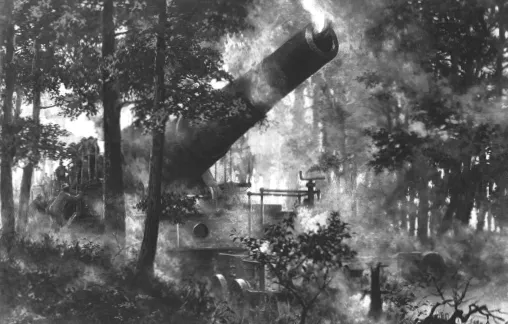
A new version of the forest giant: Mammoth French howitzer articulates the will of France.
The local French corps commander, General Balfourier, expressed his concerns via his liaison officer to Major General A.A. Montgomery, Rawlinson’s chief of staff, Fourth Army on 13 July. Montgomery replied:
Tell General Balfourier, with my compliments, that if we are not on the Longueval Ridge at eight tomorrow morning I will eat my hat.
The power of artillery cannot be underestimated; it was no idle boast by King Louis XIV of France (the ‘Sun King’, 1638-1715) that artillery was Ultima Ratio Regum, which has been translated as ‘the final argument of kings’. These expensive and highly destructive machines dictated the outcome of many wars and the First World War was no exception. On this day Fourth Army was supported by some 1,000 guns, including 311 howitzers and heavy pieces, a firepower concentration five times greater than that available for the 1 July assault. In effect, one heavy howitzer was deployed for every 19 yards of front and one 18-pdr field gun every 6 yards.
Extra protection for the attacking infantry came in the form of a creeping barrage and the use of time fuses as opposed to the widely used ‘No. 100 graze’ fuse, which could cause the shell to detonate by brushing a tree branch or telephone wire. It was feared that troops who were ‘leaning on’ the creeping barrage could be killed or wounded by friendly fire. In contrast to graze fuses, which were more liable to premature bursting, the time delay type would detonate one-tenth of a second after contact with the target.
In order for the attack planned for 14 July (the Battle of Bazentin Ridge) to succeed, the left and right flanks of the attacking formations had to be secured. This entailed taking Mametz Wood on the left flank and Trônes Wood on the right. Mametz Wood was secured by 12 July following heroic efforts by the 38th (Welsh) Division (Major General G.C. Blackader) and 21st Division (Major General D.G.M. Campbell. Trônes Wood on the right flank did not actually fall to the 18th Division (Major General F.I. Maxse) until 9.30am on 14 July.
By 2.30am on that day, the attacking troops of XIII and XV Corps, comprising eighteen separate infantry brigades, were assembled in their jumping-off positions, with advanced troops having left their trenches and taken up positions in complete silence within 300-500 yards of the enemy. At 3.20am the Royal Artillery opened a ‘hurricane’ bombardment of the German positions with French artillery lending support on the right flank. Writing in the Official History, Brigadier General Sir J.E. Edmonds described the bombardment:
The whole sky behind the waiting infantry of the four attacking divisions seemed to open with a great roar. For five minutes the ground in front was alive with bursting shell, whilst the machine guns, firing on lines laid before dark on the previous evening, pumped streams of bullets to clear the way.
The effect of this concentrated firepower upon the German defenders can be summarised by the recollections of a German officer, quoted by Christopher Duffy in Through German Eyes:
We heard a snarling and hissing in the air, and in a matter of seconds the whole landscape to front and rear as well as our own positions were enveloped in smoke, dust, and fumes. It was a furious and mighty fire which made the terrors of Notre Dame de Lorette seem almost like child’s play.
This illustrates the rapid evolution of the tactics of the Royal Artillery; just a fortnight previously the gunners had been unable to destroy the enemy’s barbed wire. The wide frontage of the 1 July attack and the multiplicity of tasks assigned to the guns, plus the 30 per cent of shells which had failed to explode, had seriously thinned out the effects of the bombardment. The gunners’ tasks had included: destruction of the enemy’s wire and trenches; suppression of his field and heavy gun batteries; disruption of all his known transport routes; destruction of all known enemy assembly points, ammunition and supply dumps and destruction of his command system. It was just too heavy a workload for the men and the guns to fulfil successfully and it robbed the infantry of the protection that should have been afforded them on 1 July.
Jack Sheldon in The German Army on the Somme quotes Reserve Leutnant Borelli of the German 77th Reserve Regiment’s 106th Machine Gun Company who, on 14 July, discovered that they were full in the path of the attack launched by the British 21st Division:
The enemy assaulted in about six waves, these were not dressed lines of infantry; rather they were concentrated groups of soldiers. My machine gun crews suffered heavy casualties because the British, who were sheltering in the craters directly to our front, could not be brought under fire and so were able to throw grenades with impunity in to the area of the machine guns.
By 1pm Fourth Army had achieved a remarkable surprise victory with most objectives on the Bazentin Ridge attained, largely with the least experienced troops of Kitchener’s ‘New Army’. High Wood was in plain sight from the Bazentin-le-Petit to Longueval road and all seemed quiet in no man’s land.
Two exceptions to Fourth Army’s success comprised the northern corner of Bazentin-le-Petit Wood and the fortified village of Longueval. In the case of Longueval, a series of conflicting reports concerning the whole, partial, or non-occupation of the village effectively blinded the higher staffs. Without the fully assured clearance of the two locations mentioned above, Fourth Army commanders deemed that any moves against High Wood would be caught in open ground by enfilade fire as in the jaws of a trap, a case of ‘fog of war’ which blinds commanders and gives rise to inertia. The ‘fog’ evolves from the breakdown of communications and intelligence that quickly becomes out of date following first contact with the enemy and is a constant throughout military history. Due to re-occurring breakages in the field telephone lines, reports had to be sent back to senior commanders by the use of runners. These very brave men often took hours to reach their assigned destination, by which time the intelligence they had risked their lives to deliver could be out of date or, if the runner was unfortunate enough to be killed or wounded during his journey, then the message would not get through at all. The same could happen in reverse, a commander could ‘peer into the fog’ and make a decision based on the intelligence available to him. Providing his runner survived the journey to the front lines and the recipient had not been killed, wounded, or gone to ground in a maze of trenches and shell holes, the message could get through and possibly influence the outcome of the battle.
The fog of war was not a product of the First World War, the great Chinese military thinker Sun Tzu, writing in the fourth century BC, expounded on the need for reliable intelligence. In the nineteenth century, the author of On War, Carl von Clausewitz wrote that ‘friction’ (fog) bedevils all military actions. As recently as 2001, the American military author Edwin Luttwak defined military operations thus:
The race for intelligence (reliable and up to date), the race to manoeuvre, the race to chaos; the protagonist who re-sets the race at the point of chaos before his opponent can react is more likely to be victorious.

Battle of Bazentin Ridge, 14 July 1916 – High Wood lay empty)
Incredibly, High Wood had been abandoned by the enemy early on 14 July and as proof at least three senior British officers walked across no man’s land to High Wood and returned safely without a shot b...
Table of contents
- Cover
- Title
- Copyright
- Contents
- Acknowledgements
- Introduction
- Timeline
- Chapter 1 The Dawn Attack: ‘They dared, they have managed.’: The action of Fourth Army on Friday, 14 July 1916
- Chapter 2 High Wood: the Accidental Hell: The action of Saturday 15 July – Sunday, 30 July 1916
- Chapter 3 Summer at High Wood: Tuesday 1 August – Friday, 25 August 1916
- Chapter 4 September: The End Game and the Debut of the Tank: Sunday 3 September – Friday, 15 September 1916
- Chapter 5 ‘There Will Be Voices Whispering Down These Ways’: The aftermath, searching for the missing and the years that followed
- Visiting the Battlefield: Car tours – walking tours – where to stay
- Selective Bibliography
Frequently asked questions
Yes, you can cancel anytime from the Subscription tab in your account settings on the Perlego website. Your subscription will stay active until the end of your current billing period. Learn how to cancel your subscription
No, books cannot be downloaded as external files, such as PDFs, for use outside of Perlego. However, you can download books within the Perlego app for offline reading on mobile or tablet. Learn how to download books offline
Perlego offers two plans: Essential and Complete
- Essential is ideal for learners and professionals who enjoy exploring a wide range of subjects. Access the Essential Library with 800,000+ trusted titles and best-sellers across business, personal growth, and the humanities. Includes unlimited reading time and Standard Read Aloud voice.
- Complete: Perfect for advanced learners and researchers needing full, unrestricted access. Unlock 1.4M+ books across hundreds of subjects, including academic and specialized titles. The Complete Plan also includes advanced features like Premium Read Aloud and Research Assistant.
We are an online textbook subscription service, where you can get access to an entire online library for less than the price of a single book per month. With over 1 million books across 990+ topics, we’ve got you covered! Learn about our mission
Look out for the read-aloud symbol on your next book to see if you can listen to it. The read-aloud tool reads text aloud for you, highlighting the text as it is being read. You can pause it, speed it up and slow it down. Learn more about Read Aloud
Yes! You can use the Perlego app on both iOS and Android devices to read anytime, anywhere — even offline. Perfect for commutes or when you’re on the go.
Please note we cannot support devices running on iOS 13 and Android 7 or earlier. Learn more about using the app
Please note we cannot support devices running on iOS 13 and Android 7 or earlier. Learn more about using the app
Yes, you can access High Wood by Michael Harrison in PDF and/or ePUB format, as well as other popular books in History & European History. We have over one million books available in our catalogue for you to explore.