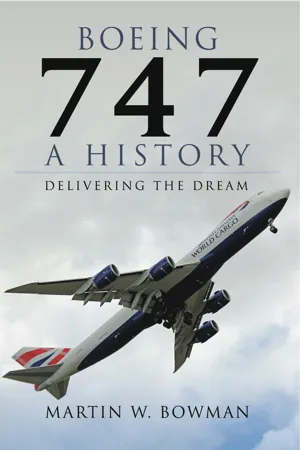
- 256 pages
- English
- ePUB (mobile friendly)
- Available on iOS & Android
eBook - ePub
About this book
A comprehensive history of the aircraft that transformed commercial aviation. Includes photos.
A presence in our skies for over half a century, the iconic Boeing 747 has transported hundreds of thousands of passengers across the world. From its introduction with Pan American Airlines in 1970, it has persevered as one of the forerunners of commercial flight. Often labeled the "Queen of the Skies," this is an aircraft revered by passengers and aircrew alike.
The first wide-body airliner ever produced, it has set new standards in air travel and opened up the air routes of the world to vast numbers of people who might otherwise have been unable to afford international air travel. This book focuses not only on the 747, but also its many variants, including the YAL-1A, which Boeing developed for the US Air Force, and the Evergreen 747 Supertanker, a 747-200, modified as an aerial application for fire-fighting. Across its types, the 747 carries around half the world's air freight. Accordingly, freight variants feature here too, including the 747-8.The sheer size of the workload carried out by this craft is astounding.
From the glamorous 1970s, an era of rapid expansion that saw an unprecedented boom in the tourist trade, to the various environmental and economical imperatives that impact upon modern flight, this work shows how the Boeing 747 has been developed in accordance with the changing demands of the ages.
Trusted by 375,005 students
Access to over 1.5 million titles for a fair monthly price.
Study more efficiently using our study tools.
Information
Subtopic
Industrie des transportsChapter 1
The Start Of it All
The 747 or something like it has to happen.
Joe Sutter, Boeing Chief of Technology.
Throughout aviation history some of those designs which failed to enter full-scale production, or which lost out to rival models, have been successfully reinvented to emerge as the format for a completely new type of aircraft. So it was with the 747, whose origins can be traced back to the early sixties when the US Air Force Military Air Transport Service sought an all-new high-capacity airlifter to increase significantly its airlift capacity in south-east Asia and throughout the world. In 1962 Project Forecast was established to gather data from academia and aerospace companies on the possibilities of giant airlifters and engine technologies to power them. At the same time the air travel industry was growing at a staggering 15 per cent per year and it was obvious to carriers such as Pan Am and to aircraft companies such as Boeing and Douglas that the 707 and DC-8 would have to be enlarged or even replaced by much larger commercial types.

The 707 was a success, as can be seen here by the flightline at Renton. Boeing managed to stay ahead of its rivals Douglas and Convair with the 707, but the 747 would be a massive leap forward.

Before Sutter’s appointment to head the 747 project it seemed that the new airliner would have a double-decker fuselage with six-abreast seating. However, this layout would have affected emergency evacuation procedures - it would have been extremely difficult to get passengers out, given the height of the upper deck from the ground. A mid-wing design meant that the main spar would run through the middle of the passenger cabin with all the attendant problems it caused, while the low-wing concept made the cabin look ungainly and top-heavy. Another model revealed three engines instead of four, mounted in the empennage topped by a high T-tail while yet another had the flight deck situated under the passenger cabin. Sutter completely disregarded the ‘turkeys’ as he called them.


The Pratt & Whitney JT9D engine (seen here on RA001 City of Everett) was characterized by the enormous front fan measuring 8 feet in diameter.
Restricted by limitations imposed by their model’s shorter and stockier landing gear, Boeing struggled to make the figures work. At first they designed the 707-820 concept by ‘stretching’ the 707-320B by 40 feet and using a bigger wing, which would produce a higher gross weight of up to 400,000lb, seating for 230 passengers and a range of 5,000 miles. On a smaller scale, the 707-620 concept, seating about 200 passengers, was studied. The -620 concept was a nonstarter, but the -820 concept could work if a suitable turbofan could be found to power it. Rolls-Royce, with its 17,500lb-thrust Conway Mk.508, was the first engine manufacturer to produce a conventional commercial turbofan. Pratt & Whitney followed with their 18,000lb-thrust JT3D-3, while General Electric weighed in with the CJ-805, which in its initial form powered the Convair CV-880 four-engined airliner. The CJ-805-21 derivative, which was based on the J79 engine used to power the Convair B-58 Hustler supersonic bomber and which produced more thrust when an ‘aft fan’ was introduced, was developed for the Convair CV-990.
While these turbofans produced enough thrust to power the DC-8-60 and Vickers VC-10 long-range airliners, they were not powerful enough for Boeing’s stretched 707 concept airliners and nowhere near powerful enough for the CX-HLS (later the C-5A Galaxy). (For this project, General Electric abandoned development on the CJ-805 and proceeded with the 41,000lb-thrust TF-39-1 two-shaft turbofan, which ultimately proved successful.) A 22,500lb-thrust commercial version of the Pratt & Whitney JT3D-15 turbofan, developed for the Lockheed C-141 Starlifter, at last provided Boeing with new options. It would permit Boeing to stretch the 707-320B by 46 feet and so create the 707-820/505 and it allowed them to consider an even bigger version, the 820/506, which incredibly was 56 feet longer than the -320B and could carry up to 279 passengers. However, if these designs were to proceed successfully, then the bigger wing and longer fuselage would, in turn, mean a complete redesign of the main landing gear and wing carry-through structure, while the tail would have to be extended upward as the ventral fin had to be deleted to avoid the danger of tail strikes. (By comparison, the more easily derived DC-8-61, with its simple stretch fuselage, could carry 251 economy class passengers, while the DC-8-62 and -62F, with nothing more dramatic than a shorter fuselage, 3 feet wing-tip extensions, new engine pylons and redesigned long-duct engine pods, could carry up to 189 passengers.) Not surprisingly, therefore, Boeing ultimately conceded that their stretched 707 concepts were unrealistic, even though they would have offered seat-mile costs (what it costs to carry a filled seat one mile) 26 per cent lower than those enjoyed by the -320B.

General Electric were so committed to perfecting their 41,000lb-thrust TF-39 engine to meet the performance requirements of the C-5A that they were unable to compete with Pratt & Whitney to provide the winning engine for the 747. However, from the start of the 747 project Boeing had wanted to use the GE engine and the CF6-50 was finally adopted for the 747-200B in 1972. (General Electric)

South African Airways maintenance on a RB211-524G. On 27 June 1975 British Airways ordered 747s powered by Rolls-Royce RB211-524 engines rated at 50,100lb; the third 747 engine-type option. The improvements to the 747-400 included more powerful engines with up to 58,000lb-thrust, with a choice of three power plants in four versions: the Pratt & Whitney PW4056, which utilizes single crystal turbine blades; the 58,000lb-thrust General Electric CF6-80C2B1F; or the 58,000lb-thrust Rolls-Royce RB211-524G/ 60,000lb-thrust -524H. (Rolls-Royce)
With the prospect of ever more powerful turbofan engines brightening the horizon, the giants of the commercial aircraft industry could continue their studies of huge air-lifters and airliners with a degree of confidence, at least as far as jet propulsion was concerned. This confidence did not, however, extend to all parts of the CX-HLS project, which was consuming millions of dollars in development costs as design teams wrestled with the myriad problems associated with such a new and radical design. At stake was a $250 million development contract, but aerodynamic and structural problems had first to be overcome, while fatigue and structure weight considerations had to be confronted. The original requirement specified by MATS (Military Air Transport Service, later Military Airlift Command; MAC) was for the huge airlifter to haul 125,000lb for 8,000 miles and it had to be capable of operating at maximum weight from unpaved surfaces. A ‘high flotation’ landing gear with twenty-eight wheels solved the latter requirement but the original specification was never met. As it turned out, in some respects CX-HLS was to prove a role model for the Boeing 747, but in others its growth had to be carefully monitored and its growing pains avoided if price escalation was to be contained to acceptable limits.
By August 1965 Boeing, McDonnell Douglas and Lockheed were able to submit their final designs for the CX-HLS project. Although Boeing had estimated that the cost of developing and then building 115 C-5As (production models) would cost around $2,800 million, their bid was for $2,300 million, $500 million lower. McDonnell Douglas submitted a bid of $2,000 million and Lockheed undercut both of them to win the contract with a bid of $1,900 million, $300 million below the Pentagon estimate. In October the Georgia Company was selected prime contractor - but events were to make it almost a pyrrhic victory. Problems associated with the aircraft design, coupled with the attendant cost overrun and inflation, conspired against the aircraft and eventually production had to be reduced from one hundred and fifteen to eighty-one examples, equipping just four Wings. Furthermore, operational service resulted in wing fatigue which ultimately required a complete rebuild of the wing and inner sections at a cost approaching $1,000 million. What benefits could Boeing derive from the failure to win the CX-HLS contract? Obviously they could make excellent use of the development potential gained during the abortive airlifter project and if the company avoided the high cost overruns, there was no reason why an equally large airliner could not be successful.

KLM-Royal Dutch Airlines 747-200B crossing the Solent and passing the Isle of Wight en route from Amsterdam-Schiphol to the USA in April 1994. General Electric were so committed to perfecting their 41,000lb-thrust TF-39 engine to meet the performance requirements of the C-5A that they were unable to compete with Pratt & Whitney to provide the winning engine for the 747. However, from the start of the 747 project Boeing had wanted to use the GE engine and the CF6-50 was finally adopted for the 747-200B in 1972. The first 747 - re-engined with the 51,000lb-thrust CF6-50D - flew on 26 June 1973. KLM was the first airline to use GE CF6-50 engines (the 52500lb-thrust -50E) on its 747-200s and ordered its first 747B powered by CF6-50E engines on 5 July 1974. The military F103-GE-100 version of the -50E also powered the USAF E-4s. (Author)

At the Renton plant on 4 January 1966 Boeing showed Pan Am representatives their designs for the seven 747 configurations. It was here that the airline executives saw the mock-up of the 747 double-decker for the first time. The outcome of the single- versus double-decker configuration was still in the balance but it was finally resolved in March 1966 when Juan Trippe flew to Renton to view the mock-up of the double-decker and the recently completed nose section of the single-decker. Much to the satisfaction of all concerned, Sutter included, the singledecker configuration won the day. (Boeing)
Joe Sutter, then Boeing chief engineer, who had worked on the 737, was recalled from vacation by Bill Allen to head the studies on the 747. Sutter reported to the vice-president...
Table of contents
- Front Cover
- Dedication
- Title Page
- Copyright Page
- Contents
- Acknowledgements
- Bibliography
- 747 Programme Chronology
- Introduction
- Chapter 1 The Start of It All
- Chapter 2 The Dream Becomes Reality
- Chapter 3 The Spacious Age
- Chapter 4 Pilot Error
- Chapter 5 Continuing The Classic Line
- Chapter 6 Off Course To Disaster
- Chapter 7 Baby Boeings
- Chapter 8 Pan Am Flight 103
- Chapter 9 Long Haul
- Chapter 10 Freighters
- Chapter 11 Military And Multifunctional
- Chapter 12 ‘Megatop’ - the 747-400 Series
- Chapter 13 A Day in Schiphol
- Chapter 14 ‘Cathay 403, Will You Accept A Visual?’ Captain Mike Rigg
- Chapter 15 Wings Across The Prairie: From the Flight Deck
- Chapter 16 Towards the Eight
- Appendix I 747-100 Characteristics
- Notes
Frequently asked questions
Yes, you can cancel anytime from the Subscription tab in your account settings on the Perlego website. Your subscription will stay active until the end of your current billing period. Learn how to cancel your subscription
No, books cannot be downloaded as external files, such as PDFs, for use outside of Perlego. However, you can download books within the Perlego app for offline reading on mobile or tablet. Learn how to download books offline
Perlego offers two plans: Essential and Complete
- Essential is ideal for learners and professionals who enjoy exploring a wide range of subjects. Access the Essential Library with 800,000+ trusted titles and best-sellers across business, personal growth, and the humanities. Includes unlimited reading time and Standard Read Aloud voice.
- Complete: Perfect for advanced learners and researchers needing full, unrestricted access. Unlock 1.5M+ books across hundreds of subjects, including academic and specialized titles. The Complete Plan also includes advanced features like Premium Read Aloud and Research Assistant.
We are an online textbook subscription service, where you can get access to an entire online library for less than the price of a single book per month. With over 1.5 million books across 990+ topics, we’ve got you covered! Learn about our mission
Look out for the read-aloud symbol on your next book to see if you can listen to it. The read-aloud tool reads text aloud for you, highlighting the text as it is being read. You can pause it, speed it up and slow it down. Learn more about Read Aloud
Yes! You can use the Perlego app on both iOS and Android devices to read anytime, anywhere — even offline. Perfect for commutes or when you’re on the go.
Please note we cannot support devices running on iOS 13 and Android 7 or earlier. Learn more about using the app
Please note we cannot support devices running on iOS 13 and Android 7 or earlier. Learn more about using the app
Yes, you can access Boeing 747: A History by Martin W. Bowman in PDF and/or ePUB format, as well as other popular books in Technologie et ingénierie & Industrie des transports. We have over 1.5 million books available in our catalogue for you to explore.