- 224 pages
- English
- ePUB (mobile friendly)
- Available on iOS & Android
eBook - ePub
Murderous Tommies
About this book
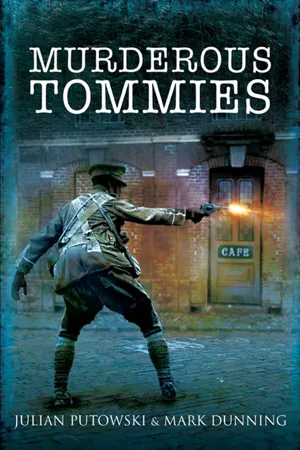
Much has been written about the soldiers executed during WW1 for military offenses, all of whom were conditionally pardoned in 2006. However, until now very little attention has been paid to the cases of men who were tried under the Army Act and executed for murder. The British Army has always been reticent about publicizing courts martial and eighty years elapsed before the government was compelled to prematurely declassify the written proceedings of First World War capital courts martial. Even then, public attention tended to concentrate on cases involving soldiers who had been shot at dawn for offenses other than homicide, and virtually nobody was inclined to seek a posthumous pardon or judicial review for the murderous Tommies. This meant neither the victims nor the convicted mens families were able to discover details about the murder cases. Though readily identifiable online via much-visited war cemetery websites, until now there has been no readily accessible, historically reliable and balanced narrative about the activities and courts-martial of all the murderous Tommies of the Western Front. This book provides for a full account of the cases involving the fourteen soldiers and one officer whose homicidal misdeeds were committed in France and Flanders while hostilities were in progress.Drawing on contemporary records, this carefully researched work chronicles the circumstances in which each of these men either slaughtered one of their comrades or an unarmed civilian. It examines the murderers motives and presents a balanced analysis of each case, including a detailed assessment of the extent to which each condemned man was granted a fair hearing by officers who sat in uneasy judgment as well as those involved in confirming the death sentences.
Trusted by 375,005 students
Access to over 1 million titles for a fair monthly price.
Study more efficiently using our study tools.
Information
CHAPTER 1
Double Indemnity
Company Sergeant Major Hughie Hayes, 2nd Battalion Welsh Regiment was shot on 20 January 1915 and succumbed to his injuries the following day. The Bethune Town Cemetery register attributes his death to ‘accidental wounds’. However, two of his fellow soldiers were subsequently tried and found guilty of having murdered the NCO.1 The written proceedings of their trial have not survived but understanding how Hayes came to be killed is, in some respects, quite straightforward.
The rank and file have always had to hand the means to kill oppressive NCOs or officers but the survival of military martinets owed much to their victims’ stoicism, deference to authority and the threat of draconian punishments. Even so, when harassment was potentially life threatening, some British soldiers secured summary relief by killing their tormentors.
If murderers were careless about avoiding detection or indifferent about the consequences their fate was sealed by court martial, though a contemporary narrative of the offence and trial rarely emerged. Formal announcements of the verdict and sentence via Army routine orders never involved disclosure of more than the barest details about the offence and nothing whatsoever about the condemned men’s motives.
In this case the written proceedings of a court martial are unavailable so it is quite difficult to establish a wholly reliable account of what happened. However, non-judicial sources, including personal correspondence and anecdotal evidence from memoirs, provide insights and perspectives about events that are wholly ignored, marginalized or erased from official records.
An account of the killing of Company Sergeant Hughie Hayes was originally written down on 23 May 1915 in the personal diary of Robert Graves, and reproduced in his celebrated war memoir, Goodbye to All That. About the killers, whom he understood to be ‘two young miners, in another company’, Graves wrote:
Their sergeant … had a down on them and gave them all the most dirty and dangerous jobs. When they were in billets he crimed them for things they hadn’t done; so they decided to kill him. Later they reported at Battalion Orderly Room and asked to see the Adjutant. This was irregular, because a private is not allowed to speak to an officer without an NCO of his own company to act as go-between. The Adjutant happened to see them and said: ‘Well, what is it you want?’ Smartly slapping the small-of-the-butt of their sloped rifles, they said: ‘We’ve come to report, sir, that we are very sorry but we’ve shot our company sergeant-major.’
The Adjutant said: ‘Good heavens, how did that happen?’
‘It was an accident, Sir.’
‘What do you mean you damn fools? Did you mistake him for a spy?’
‘No, Sir, we mistook him for our platoon sergeant.’2
The anecdote briefly chronicled an event that had occurred several weeks before Graves was temporarily attached to the battalion, and it retains a whiff of the kind of post-prandial yarn that would typically have enlivened a convivial supper in the officers’ mess.3 However, the pretext for the tragic killing was quite accurate and Hayes was certainly not the murderers’ intended victim.
The homicide to which Graves referred was committed during the evening of 20 January by 41-year-old Private William Price, a collier from Pontypridd, Glamorganshire, whose enlistment and service with the 2nd Battalion, Welsh Regiment had commenced in January 1891.4 Very little is known about his military career but Price’s disciplinary record was decidedly patchy, though he never committed an offence serious enough to have him dismissed from the Army.
During July 1892 he was punished with a spell of twenty-eight days’ detention for ‘Breaking out of barracks’ and on 22 August 1892, for ‘Striking a superior officer’ he was imprisoned for 167 days’ service. On the expiry of his sentence in early March 1893, Price was shipped out to India with the battalion.
His behaviour improved for a while but on 5 May 1899 he forfeited his good conduct pay and was tried by District Court Martial for using ‘Insubordinate language’ and jailed for forty-two days. While stationed at Dagshai Subathu in the Simla Hills, Price was again tried by District Court Martial on 8 July 1902 and imprisoned for fifty-six days for ‘Drunkenness’. After completing his sentence, Price was repatriated to the United Kingdom and discharged after having completed twelve years’ service. He returned to Pontypridd and may have resumed his job as a coal miner but there is some evidence that by 1911 Price was eking out a living as a rag collector.5
The second soldier involved in the murder was Private Richard Morgan from Mountain Ash, Glamorganshire, who declared that he was seventeen years old when he enlisted at Pontypridd with the Militia (3rd Battalion, Welsh Regiment) in May 1898. Two years later, the entire battalion, including Morgan, volunteered to go on active service overseas and fight the Boers in South Africa, where it remained until March 1902 before returning to Wales. Morgan went back to Mountain Ash, resumed work in a local colliery, got married and became a father.6
When war broke out, Morgan and Price rejoined the Army, though whether as Kitchener volunteers or for other reasons remains unclear. They were sent to Flanders as reinforcements on 30 November 1914 and joined the 2nd Battalion, Welsh Regiment, in Outtersteene, where it was recuperating after having suffered very heavy casualties.7 Three weeks later, the battalion was marched to Merville and went into action at Festubert, taking part in an abortive attempt to regain lost trenches that ended with the battalion suffering further heavy losses. On Christmas Day, instead of joining in the truce that was being generally celebrated elsewhere, the battalion mounted a raid across no-man’s-land that was officially recorded as, ‘A gallant effort for which the officers, C.S.M. Hayes and No. 10954 Pte. Hogan received special praise.’8

Conditions in the freezing trenches were appalling, as Captain Hubert Rees noted:
The weather was atrocious, and the condition of the actual trenches worse than anything I have seen. On one occasion it took me two hours to go along 150 yards of trench and return. In many places the mud and water were nearly waist deep and the men perched on mud islands.9
After being relieved on 8 January the battalion enjoyed four days’ rest, thawing out in Bethune before again being thrown into the front line at Givenchy, where the battalion continued to be threatened by hypothermia and frostbite as well as bombardment by enemy minenwerfers. Although they had only experienced five weeks at the front, under such circumstances Privates Price and Morgan and probably a good many of their comrades may be excused for seeking solace in alcohol.
The NCO whom Price intended to kill remains unknown but was most likely to have been a platoon sergeant and Private Morgan denied responsibility for mortally wounding Hayes. A few hours after the shooting, Morgan wrote a letter home in which he explained what had happened:
Dear Wife,
I now take the pleasure of writing these few lines hoping to find you in good health as it leaves me at present. I hope you will not take this too much to heart and that you will try and cheer up and bear it as I am going to hve [sic] to prove that shot. My mate shot a Sergeant Major and the sergeant that had it in for me swore that I encouraged him to do it and we are to be held over for a general court martiall [sic]. I am afraid that it will mean a couple of years but I am going to hve [sic] to prove that I am innocent and I hope that you will not think I am guilty as I am not I swear before God that I am innocent, don’t tell the children nor the neighbours anything about it but go and draw your money the same as usual until it will be stopped. since I began writing this I had a letter from our Sarah Anne wishing me all good luck, but it seems to me to be all bad luck now, but tell her that I am going to try to keep up heart to bear it, you can also tell mother, I won’t write to her now until I do know my sentence so no more this time only love to you and the children.
xxxxxxxxx
PS Goodbye may God bless you and keep you till we meet again
xxxxxxxx10
On 28 January the report of a court of enquiry was forwarded to 1st Corps Headquarters and a general court martial assembled to hear the case in Lillers at 10.00 am on Saturday 6 February.11 The President was Brigadier General Henry Cecil Lowther and the rest of the court was provided by 1st Division; Captain Archer Lyttleton, Welsh Regiment, conducted the prosecution but the identity of the Prisoner’s Friend, if one was assigned to assist the two accused soldiers, eludes detection.12
The condemned men were executed simultaneously on 15 February. In memoirs that drew heavily on correspondence with his wife, Rev Harry Blackburne, the chaplain attached to 3rd Brigade recorded his own role in providing spiritual comfort to Morgan and Price:
I have been with them frequently before the sentence was passed; now I must go and be with them to the end. Thank God, it is all over! We read together the story of the Prodigal Son and prayed, and then the sentence was carried out.13
Robert Graves’ second-hand account of the double execution was more melodramatic:
They were both shot by a firing squad of their own company against the wall of a convent in Bethune. Their last words were the battalion rallying-cry: ‘Stick it, the Welsh!’ The French military governor was present at the execution and made a little speech saying how gloriously British soldiers can die.14
Before 1917 the Army candidly notified the next of kin about the reason why a soldier had been executed but Richard Morgan’s widow seems to have followed her husband’s entreaty and did not broadcast details about her husband’s death. However, Richard’s parents responded to news of their son’s death by directing awkward questions at soldiers who were serving with the battalion.15
At the end of April they received an unsolicited letter from Private Thomas Day. Though he may have been privy to a more harrowing version of events, Day’s communication balanced candour with compassion:
Having been talking to Oswald Jones, he told me you had been inquiring about your son Dick’s death and that he did not know how to explain it to you, so I am taking the liberty of doing so myself, being that your son was a friend of mine there is no doubt that it all happened in drink and he happened to be in rather bad company at the time, we had the cour...
Table of contents
- Front Cover
- Title Page
- Copyright Page
- Contents
- List of Illustrations
- Acknowledgements
- List of Abbreviations
- Introduction: Fearful Symmetry
- Chapter 1: Double Indemnity
- Chapter 2: Alec Has Done It
- Chapter 3: Seeing Shadows
- Chapter 4: The Wrong Man
- Chapter 5: Accidentally Inflicted
- Chapter 6: The Missing Kilt
- Chapter 7: A Rum Affair
- Chapter 8: Is Anyone Dead?
- Chapter 9: Murder in the Rue Racine
- Chapter 10: Accused Was Drunk
- Chapter 11: A Good Turn
- Chapter 12: Something Unexplained
- Conclusion Worthy is the Lamb that was Slain
- Notes
- Appendices
- Bibliography
Frequently asked questions
Yes, you can cancel anytime from the Subscription tab in your account settings on the Perlego website. Your subscription will stay active until the end of your current billing period. Learn how to cancel your subscription
No, books cannot be downloaded as external files, such as PDFs, for use outside of Perlego. However, you can download books within the Perlego app for offline reading on mobile or tablet. Learn how to download books offline
Perlego offers two plans: Essential and Complete
- Essential is ideal for learners and professionals who enjoy exploring a wide range of subjects. Access the Essential Library with 800,000+ trusted titles and best-sellers across business, personal growth, and the humanities. Includes unlimited reading time and Standard Read Aloud voice.
- Complete: Perfect for advanced learners and researchers needing full, unrestricted access. Unlock 1.4M+ books across hundreds of subjects, including academic and specialized titles. The Complete Plan also includes advanced features like Premium Read Aloud and Research Assistant.
We are an online textbook subscription service, where you can get access to an entire online library for less than the price of a single book per month. With over 1 million books across 990+ topics, we’ve got you covered! Learn about our mission
Look out for the read-aloud symbol on your next book to see if you can listen to it. The read-aloud tool reads text aloud for you, highlighting the text as it is being read. You can pause it, speed it up and slow it down. Learn more about Read Aloud
Yes! You can use the Perlego app on both iOS and Android devices to read anytime, anywhere — even offline. Perfect for commutes or when you’re on the go.
Please note we cannot support devices running on iOS 13 and Android 7 or earlier. Learn more about using the app
Please note we cannot support devices running on iOS 13 and Android 7 or earlier. Learn more about using the app
Yes, you can access Murderous Tommies by Julian Putkowski,Mark Dunning in PDF and/or ePUB format, as well as other popular books in History & Women in History. We have over one million books available in our catalogue for you to explore.