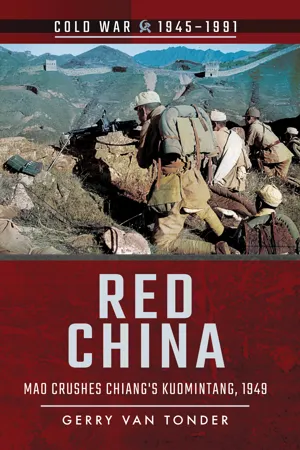
- 128 pages
- English
- ePUB (mobile friendly)
- Available on iOS & Android
eBook - ePub
About this book
When the world held its breath It is more than 25 years since the end of the Cold War. It began over 75 years ago, in 1944 long before the last shots of the Second World War had echoed across the wastelands of Eastern Europe with the brutal Greek Civil War. The battle lines are no longer drawn, but they linger on, unwittingly or not, in conflict zones such as Syria, Somalia and Ukraine. In an era of mass-produced AK-47s and ICBMs, one such flashpoint was China in 1949 China. 1949: two vast armies prepare for a final showdown that will decide Asias future. One is led by Mao Tse-tung and his military strategists Zhou Enlai and Zhu De. Hardened by years of guerrilla warfare, armed and trained by the Soviets, and determined to emerge victorious, the Peoples Liberation Army is poised to strike from its Manchurian stronghold. Opposing them are the teetering divisions of the Kuomintang, the KMT. For two decades Chiang Kai-sheks regime had sought to fashion China into a modern state. But years spent battling warlords, and enduring Japans brutal conquest of their homeland, has left the KMT weak, corrupt, and divided.Millions of Chinese perished during the crucible of the Sino-Japanese War and the long, grueling years of the Second World War. But the Soviet victory against the Japanese Kwantung Army in 1945 allowed Maos Communists to re-arm and prepare for the coming civil war. Within a few short years, the KMT were on the defensive while the Communists possessed the most formidable army in East Asia. The stage was set for Chinas rebirth as a communist dictatorship ruled by a megalomaniac who would become the biggest mass-murderer in history.
Tools to learn more effectively

Saving Books

Keyword Search

Annotating Text

Listen to it instead
Information
1. THE REVOLUTION
The Chinese Communist Party (CCP) was born at a clandestine meeting overseen by a foreign agent. For years prior, lone provocateurs of the Communist International, or Comintern, stalked China’s cities and sought out local ideologues. Liberal ideas had spread across the mainland since before the turn of the century. Sun Yat-sen’s successful revolt in 1911 was supposed to be the shattering climax of this process, being the singular force that caused the weakening Qing Dynasty downfall. Sun and his allies expected to usher a new era of modernity that would launch China onto the world stage. Or so it was hoped. Sun’s ambitions were quickly thwarted by Yuan Shikai, a veteran Qing commander who turned on the empire and assumed the role of dictator. Sun went into bitter exile as a result and southern China was torn apart by warlords for several years. Unable to impose a semblance of national unity, the ageing Yuan died in 1916 and left the Republic of China in tatters.
In this ferment far greater, destructive Western ideas took hold. With the nation gripped by a convoluted civil war from 1912 until 1920, the social bonds it frayed led to a newfound nationalism, seething with outrage that viewed China as a powerless hostage to foreign aggression. In 1919, the short-lived May Fourth Movement, with its widespread protests against Japanese violations of Chinese sovereignty, breathed life into the wildest dreams of intellectual dilettantes.
While the Christian faith had established a firm foothold in China, thanks to the tireless efforts of missionaries and teachers, the same zeal and devotion compelled local firebrands to proselytize the virtues of socialism and anarchism wherever these ideas found converts. Socialism already appealed to China’s millions of downtrodden peasants, who eked out a meagre living from estates controlled by landlords. The violence of anarchism, with its attractive belligerence toward authority in a culture obsessed with deference toward one’s betters, nurtured its own misfits, and it was far more likely to find anarchist gangs plotting in China’s larger cities than local cadres of Bolsheviks.
Indeed, for the young Mao Zedong—born in a village idyll in 1893—the siren call of revolution came to him gradually. Although he had enlisted as a teenage soldier in a warlord’s army during the initial disturbances following the 1911 revolt, which was launched in southern China and then spread north, he had little to show for the experience. Unlike the tough commanders who became his indispensable surrogates later in life, soldiering did not consume his life—literature and poetry did.
The Chinese Rebellion
New York, Saturday—The “New York American” states that Sun-Yat-Sen, who is living at Denver, Colorado, has left that city, and is now en route for New York.
Foreign Ships at Hankow
There is no change in the situation here. Four British, two German, two American, and two Japanese warships are protecting the foreign concessions, and two Chinese cruisers, two gunboats, and four torpedo boats are lying below the concessions out of range of Revolutionists’ guns.
Enlistment among the rebels is going on apace, and their present strength is estimated to be about 25,000 men.
Celebrations in United States
San Francisco, Saturday—Dr. Sun Yat Sen, the Chinese revolutionary leader, has, through the agency of the Young China Association, directed that mass meetings and parades shall be held to-morrow throughout the United States, to celebrate the successes of the Chinese Revolutionaries. The American press is unable to ascertain the whereabouts of Dr. Sun Yat Sen. The Revolutionists say a sum of £40,000 has been collected for the Revolutionist cause among Chinese in the United States.
A Remarkable Insurrection
If we are not dulled by the suggestion of remoteness which always belongs in the mind of ordinary Western readers to Chinese names, and if we bring a little imagination to bear upon the matter we shall see that this movement in energy, scale, and dramatic character is one of the most notable things that the modern world has known, writes the “Observer.” The present insurrection differs from the Taiping in the deliberate judgement and organised method with which it has so far been conducted. The lives and property of foreigners have been carefully protected. Missionaries have been treated with especial respect: so far not the shadow of an excuse has been given for foreign interference. This is remarkable enough as suggesting that the movement is not only the result of pre-preparation, but is under strong control.
Larne Times, Saturday, 21 October 1911
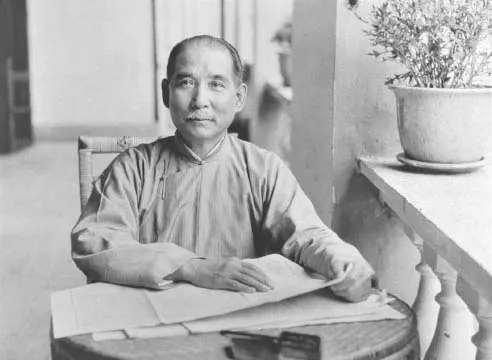
Dr Sun Yat-sen in Canton, 1924.
Always an avid reader, Mao’s erudition and natural curiosity made him receptive to liberal ideas passed down from translated books and essays. By the time he was in his twenties, he had absorbed the Chinese intellectual’s disdain for the country’s backwardness, poverty and traditional customs. Venting his progressive ideas on paper, Mao flourished as an occasional contributor to the magazine New Youth run by two radicals, Li Dazhao and Chen Duxiu, and soon turned to publishing himself. In 1919, he was credited as the founder, editor and sole writer of the short-lived Xiang River Review, which was a personal project to collect his musings on current events.
There were other events in Mao’s life that preoccupied him more than idle thoughts of becoming a rebel thinker. Brief interludes as a teacher, university assistant, occasional poet, and newlywed husband had little bearing on the turning point that awaited him in 1920 when a close friend, Cai Hesen, convinced him to turn communist.
The following year, Mao travelled to Shanghai for a rare summit. In attendance were the editors of New Youth and numerous radicals. Joining them was the Dutchman Henricus Sneevliet, whose earlier achievements included fomenting communist subversion in Java. It was rumoured that no less than Lenin had sanctioned his travel to China.
On 12 July 1921 the CCP was formed. It had the bare outline of an organization and a mandate to spread its influence far and wide. Its operating principle was to set the conditions for a communist takeover and impose a new regime over China, just like the one being established over what was formerly Czarist Russia. Mao did have a role to play in this unfolding drama, but it was a small one, and would remain so for a while.
While the 1920s are often remembered as a moment’s relief in an otherwise turbulent half-century, China had it the worst among the world’s great nations, for it had ceased to be one. It was reduced, catastrophically and geographically, to a rump state. Whereas the Qing Dynasty, assembled by Manchu conquerors between 1620 and 1644 from the wreckage of the earlier Ming Dynasty, grew into the last great Asian empire, encompassing the Korean peninsula, the Sinkiang deserts and the Tibetan plateau, not much was left of republican China.
Its most prosperous cities had to accommodate foreign cantonments. Since 1895, industrialized Japan with its modern army had annexed Formosa and Korea, and were creeping over the northern Manchurian provinces. The Mongols, Tibetans and the Turkmen enjoyed nominal independence along the frontiers. What remained truly Chinese were its central and southern provinces, which had no single regime to govern them as a whole country.
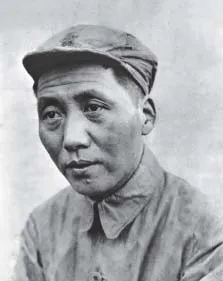
Mao Zedong, 1935.
This dismayed Sun Yat-sen, now ailing from old age. The Nationalist party he established, alternately known as the Guomindang or Kuomintang, was a pariah on the world stage, and couldn’t even field a proper army. For lack of trustworthy allies and a viable civil society to enhance its power, the KMT welcomed the newly minted communists, whose membership was ballooning. A year after their founding in Shanghai, the CCP arranged a partnership with the beleaguered KMT in what it dubbed the ‘United Front’. The growing clout of the Chinese Communists was further enhanced by aid from the Soviet Union, the only country to lend the KMT unconditional support. This informal alliance blossomed in 1924 when Soviet advisers helped establish the Whampoa Military Academy, an institution whose sole aim was organizing modern Chinese armed forces trained to Western standards. At the opening of the academy, Sun Yat-sen said to the students: “My only hope in establishing this academy is to create a revolutionary army to save China from her crisis. From now on, decide not to cherish the idea of becoming high officials or making big fortunes, but devote yourselves to the enterprise that saves the nation and her people, and become bold revolutionary soldiers.”
From its classrooms emerged the National Revolutionary Army, officered by young commanders who had earned their stripes in the previous decade’s civil war. Many were avowed communists. For example, Zhou Enlai and Zhu De would rise to prominence in the CCP so many years later, and even do battle against their fellow Whampoa alumni.
Sun passed away in 1925 with little to show for his efforts at shepherding China toward a national rejuvenation. With the KMT on the brink of collapse as a result of losing their founder, the NRA hoisted Whampoa’s superintendent, Chiang Kai-shek, to the party leadership in Canton, their de facto capital. But, like Sun and Yuan before him, the lack of a clear mandate left Chiang no choice but to impose his leadership by force. Far from a democrat with deeply held liberal beliefs, Chiang grew up in the waning years of the Qing era, and had trained in a Japanese military academy. He fully understood his country’s weakness and thought himself foremost a strongman, a necessary arch-warlord who would use nationalism and social reform to cement his grip on power. But first, his enemies needed to be crushed.
By the end of 1925, Chiang had assembled an army 85,000 strong, equipped with modern arms. This force was divided into three: the First Army Corps, the Second Army Corps, and the Seventh Army Corps, led by experienced warlord generals. A year of preparation was needed to bolster the different corps with professional junior officers and stockpile supplies.
Troubled China
Russians to be Driven Out
Peking, Thursday: Official telegrams state that General Chang Kai Shek [sic], assisted by Mr C. C. Wu and other prominent Chinese, has effected a coup d’état in Canton, imprisoning Chinese and Russian Communists. Several Russians are reported to have been killed.—Reuter.
Red Generals Break Away
Shanghai, Thursday: Foreign despatches from Canton report a split in the Communist party there. A conflict occurred on Monday last between the party of the Generalissimo, Chiang Kaishek [sic], and the Chinese and Russian Communists, who, it is stated, have been striving to secure Chiang’s election.
Chiang has now arrested some of the strike leaders and several Russians at the Whampao Cadet School, and is said to have decided to drive out all Russians and Communists from Canton.
Note—Mr C. C. Wu, who, in an earlier message from Peking, was stated to be assisting General Chiang, is the principal of the Whampao Cadet School.
The Retreating “National” Armies
Peking, Thursday: General Lu Chung-iin and Ming-chung now hold the dual command of the defeated Kuominchun (National) Army, which has been driven from Tientsin by the “Allied” General Li Chung-lin.
General Li Chung-lin is a rugged uncompromising fighter, and seems inclined to make the strong rearguard positions, held by the Kuominchun troops around Peking, into the scene of a decisive battle, although his colleagues are opposed to such a plan.
Meanwhile the Kuominchun authorities are striving desperately to find money to pay the great bodies of troops concentrated near the capital.—Reuter.
Hull Daily Mail, Thursday, 25 March 1926
On 7 July 1926, a new chapter began for China as the NRA undertook the historic Northern Expedition. Its goal was nothing less than to bring the provinces beyond the Yangtze valley under the KMT’s control.

Northern Expedition, the military campaign launched by the Kuomintang in 1926. (Image Sy)
It was unclear if the Northern Expedition could achieve a satisfactory outcome, but its gains against the warlord armies were overshadowed by a political crisis within the KMT’s ranks. With Chiang preoccupied with orchestrating the campaign, a revolt was brewing among the NRA’s more seditious members.
The communists resented Chiang’s rise to power as it echoed the tyranny of the late Yuan Shikai. Even worse for the communists, before launching the Northern Expedition, Chiang had assumed the role of commander-in-chief of the armed forces, including the miniscule navy and air corps. This allowed him to rule by decree on all matters related to his unification campaign. Such inordinate amount of executive leeway almost left the KMT’s ruling Central Committee based in Canton helpless by comparison. If Chiang managed to subdue the northern provinces and seize the Qing’s imperial capital Peiping, would he still bother establishing a true republican government?
Chiang did turn on the communists—eventually. By 1927, the lacklustre efforts by Soviet advisers in the Northern Expedition, coupled with rumours of communist plots to overthrow him, led to a purge within the KMT. Most damning was evidence found within the Soviet embassy in Peiping by a warlord’s henchmen. Pamphlets, telegrams and arms were collected linking the embassy’s staff to Comintern operatives and their local cells. Barely six years since their founding, the CCP and its thousands of members knew its days were numbered.
China’s communists retaliated by orchestrating revolts in every major city controlled by the KMT. This doomed the Northern Expedition into a punitive exercise as Chiang and his generals scrambled to restore order. But the CCP’s greatest coup didn’t occur until August. On the first of the month, NRA regiments, led by communist sympathizers, mutinied and set about to establish a Soviet—a self-governing enclave—in the southern provinces of Jiangxi, Zhejiang and Fujian. At the forefront of the rebellion were Whampoa alumni who had combat experience in the civil war years, and, under their direction, the mutineers marched on the city of Nanchang and held fast.
So disastrou...
Table of contents
- Cover
- Title
- Dedication
- Copyright
- CONTENTS
- Timeline
- Introduction
- 1. The Revolution
- 2. Shadow of the Rising Sun
- 3. Washington and Moscow
- 4. For the People by the People
- 5. Red Victorious
- 6. The Big Three
- 7. Eastern Superpower
- About the Author
- Plate section
Frequently asked questions
Yes, you can cancel anytime from the Subscription tab in your account settings on the Perlego website. Your subscription will stay active until the end of your current billing period. Learn how to cancel your subscription
No, books cannot be downloaded as external files, such as PDFs, for use outside of Perlego. However, you can download books within the Perlego app for offline reading on mobile or tablet. Learn how to download books offline
Perlego offers two plans: Essential and Complete
- Essential is ideal for learners and professionals who enjoy exploring a wide range of subjects. Access the Essential Library with 800,000+ trusted titles and best-sellers across business, personal growth, and the humanities. Includes unlimited reading time and Standard Read Aloud voice.
- Complete: Perfect for advanced learners and researchers needing full, unrestricted access. Unlock 1.4M+ books across hundreds of subjects, including academic and specialized titles. The Complete Plan also includes advanced features like Premium Read Aloud and Research Assistant.
We are an online textbook subscription service, where you can get access to an entire online library for less than the price of a single book per month. With over 1 million books across 990+ topics, we’ve got you covered! Learn about our mission
Look out for the read-aloud symbol on your next book to see if you can listen to it. The read-aloud tool reads text aloud for you, highlighting the text as it is being read. You can pause it, speed it up and slow it down. Learn more about Read Aloud
Yes! You can use the Perlego app on both iOS and Android devices to read anytime, anywhere — even offline. Perfect for commutes or when you’re on the go.
Please note we cannot support devices running on iOS 13 and Android 7 or earlier. Learn more about using the app
Please note we cannot support devices running on iOS 13 and Android 7 or earlier. Learn more about using the app
Yes, you can access Red China by Gerry van Tonder in PDF and/or ePUB format, as well as other popular books in Política y relaciones internacionales & Historia asiática. We have over one million books available in our catalogue for you to explore.