- 160 pages
- English
- ePUB (mobile friendly)
- Available on iOS & Android
eBook - ePub
Wartime Standard Ships
About this book
In both World Wars there arose a pressing need for merchant tonnage both to supplement existing ships but, more importantly, to replace ships that had been sunk by enemy action, and the key to the Allied strategy in both wars was a massive programme of merchant shipbuilding. This need gave rise to a series of standard designs with increasing emphasis on prefabrication and a progression towards welded hulls.This new book tells the remarkable story of the design and construction of the many types that not only contributed to their countrys war efforts, but were also responsible for a cultural change in world shipbuilding that would lay the foundations for the post-war industry. The story begins in the First World War with the National type cargo ships which were the first examples of prefabricated construction. The best known of all types of wartime standard ships, of course, were the Liberty ships and their successor, the better equipped Victory ships, both built in the United States. Some 2,700 Liberty ships were built and this incredible achievement undoubtedly saved the Allies from losing the War. In Canada, the Ocean and Park ships made a further major contribution. Germany and Japan also introduced standard merchant shipbuilding programmes during the Second World War and these are covered in detail. The many different types and designs are all reviewed and their roles explained, while the design criteria, innovative building techniques and the human element of their successful operation is covered.Some of the story has been told piecemeal in a range of diverse books and articles, a few with extensive fleet lists. However, the complete history of the twentieth century wartime-built standard merchant ship has not previously been written, so this new volume recording that history within its appropriate technical, political and military background will be hugely welcomed.
Tools to learn more effectively

Saving Books

Keyword Search

Annotating Text

Listen to it instead
Information
1 THE CONCEPT: AUSTERE, FUNCTIONAL AND LOTS OF THEM
Anation that is losing its merchant ships at a greater rate than it can replace them will inevitably lose the war. Britain found itself in this position in both the Great War and the Second World War, and Japan also realised the parlous state of its logistics in the Second World War. As island nations, both were solely dependent on sea transport to victual their people at home and both too were reliant on sea transport to take stores and munitions to their forces that were fighting away from home. So successful was the Allied destruction of German merchant ships in the Second World War that Germany also had a developing logistics problem in the Mediterranean and Black Sea by 1941 and later also in the Baltic and Atlantic.
In each case, the response to the attrition of merchant shipping was an emergency programme of building to standardised ship designs. The idea of standardisation was not new, but had previously been applied to ships of a particular trade, such as the Doxford Turret ships which were designed to minimise dues for transiting the Suez Canal. The standard engines-aft, bridge-amidships bulk tanker that emerged in the 1890s and evolved through to the 1960s was another example, with many standard types repeated over and over again to an identical design. Even in the fifteenth and sixteenth centuries, the standardisation technique was well advanced, as Filipe Castro reports:
… in England, as in Venice, predesigned frames were placed at regular intervals along the entire axis of the hull, while in Portugal and Spain the predesigned frames were clustered in the central portion of the ship’s hull … Italian merchant cities such as Naples, Genoa, and Venice were home to highly developed shipbuilding industries, having highly organized shipyards where craftsmen were divided into specialized groups: woodcutters, sawyers, carpenters, and caulkers working within the enclosed shipyard complex. Organized shipyards with specialized sets of labor were able to construct the ships quickly in a reliable and repetitive fashion.
Savings were made in standardised construction as the design work had already been done. The shipyard workers worked efficiently, as they were familiar with the assembly procedure. Parts and, in due course, even engines could be ordered cost-effectively in bulk to arrive at the shipyard on set dates, ready to be installed in the new ship. In addition, the parts were interchangeable between ships and were generally available ‘off the shelf’. Furthermore, crew that had worked on one standard-type ship could readily transfer to another of the same type without difficulty.
The wartime standard ships were built to straightforward designs, even to the extent that bent ribs were kept to a minimum. Some types of ships, indeed many of the Liberty ships, had no camber to the main deck to make construction even simpler. The ships were such that they could be assembled by semi-skilled workers, were utilitarian in that they were fit for purpose but no more, and optimised deadweight capacity for the size of ship. They ranged from concrete lighters and tugs to the most famous of them all, the Liberty ship. There were even wooden-hulled ships built in the Great War in response to the shortage of available steel. Wood was used whenever steel was in desperately short supply, and savings on steel were made with lightweight lattice derricks, absence of topmasts and other means. Not only were there fast cargo liners and troop transports, there were the tramp ship designs such as the American-built Oceans and the Canadian-built Forts and Parks, as well as the Liberty ships. The Oceans, Forts and Liberty ships were all based on a tried and tested design from work carried out in the late 1930s at Sunderland.
The ships were cut back to the bone: no frills, no luxuries. The Liberty ships of the Second World War were built to serve the Allied war effort with little prospect of commercial activity post-war. ‘Built by the yard and cut off by the mile’, the ships were built on rows of adjacent slipways, some in dry docks. Large sections were prefabricated, and widespread use was made of electric welding which brought construction times down to a record four days and fifteen hours from keel-laying to launching. The key to the speed was the supply chain, with parts arriving at the shipyard and held in stock until needed. In a report to Congress in 1941, the Liberty ship was described as having a five-year tenure:
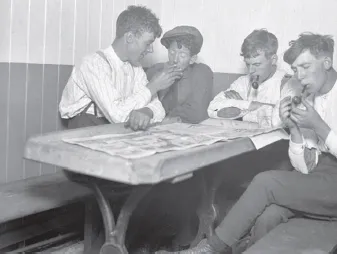
The austere surroundings of the crew’s mess room aboard a British-built A- or B-type standard ship built in the Great War. The lack of creature comforts and basic lifesaving equipment was a feature of these vessels that seamen were only too well aware of. (AUTHOR COLLECTION)
It is slow and seaworthy and has the longevity of a modern steel ship, but for the demands of normal commerce in foreign trade it could not compete in speed, equipment and general serviceability with up-to-date cargo vessels. The design is the best that can be devised for an emergency product to be quickly, cheaply and simply built. They will be constructed for the emergency and whether they have any utility afterward will have to be determined then. The coastal trade may offer some possibilities in that direction.
As it was, the Liberty ship was to be the world’s stock in trade well into the 1960s. It did have its problems: cracks developing in welded hulls, exacerbated, for example, by service in sub-zero temperatures in the Russian convoys, and propellers were prone to falling off the shaft. The latter was a corrosion problem between the two different metals caused by poorly fitting propeller bosses, a reflection of the speed at which the ships were put together.
The successor to the Liberty ship was the Victory ship, with its numerous improvements, including more expensive steam turbine engines. These ships were intended both to serve the war effort and to get commerce back up on its feet after the war had been won. Although the ships were basic and lacked much of the innovation in ship design that had evolved by the late 1930s, they were functional and very much fit for purpose. Like all the other Allied standard ships they were built to classification so that they could carry war insurance. It also meant that the surviving ships could take up commercial work after the war. This was not the case with the Japanese emergency shipbuilding programme, in which several ship types were built out of class, none of which could be insured during the war, and most had to be rebuilt after the war to the satisfaction of the classification societies.
In both world wars, British yards were working to capacity to satisfy military and merchant demands. The shipyards were inevitably understaffed due to the migration of men into the armed forces. Consequently, Britain had to look overseas for help and turned principally to America and Canada.
The loss statistics for the Great War underline the need for an emergency shipbuilding programme. By December 1915 Britain had lost 1.6 million gross tons of merchant shipping, and it was obvious that a great effort would be needed to replace these ships in order to maintain the country’s needs. Orders were, therefore, placed with British and later American and Canadian yards, and some even in China and Japan. The ships all had names prefixed by War. They comprised the A- to H-type tramp steamers and cargo liners and the N-type National prefabricated tramps, as well as coasters and tankers.
Orders were placed by Britain, through non-government agencies, with yards in neutral America for several hundred ships. The ships ranged in deadweight from the larger 12,500-ton ships built on the east coast to the small 3,000 tons deadweight (dwt) cargo capacity steamers built at yards on the Great Lakes. All were dry-cargo vessels. However, only a few were actually delivered to Britain, as the majority were requisitioned by America on its own engagement at war in 1917. This was the start of the ‘bridge of ships’, originally conceived to take American soldiers to war in Europe. Latterly, the building programme was intended to promote the United States Merchant Marine to a point where 50 per cent of that nation’s trade could be carried in its own ships, and the United States Shipping Board continued to sanction new building until 1921. Some 1,307 steel ships were built for the Emergency Fleet Corporation on behalf of the Shipping Board and a further 389 were requisitioned.

Repetitive, but skilled, single-task workers bored easily of their work and diversions were tempting. This information board posted at the entrance to one of the larger west-coast United States shipyards in the Second World War appeals to the latent patriots in the workforce. (AUTHOR COLLECTION)
The Canadians built for a variety of nationalities and delivered some valuable tonnage, not least ships built at yards on the Great Lakes. As with the American yards on the Lakes, ships were limited in size by the canal locks connecting to the St Lawrence River. Canada, too, continued to build after the war, with government sponsorship for strengthening the Canadian Merchant Marine. Companies such as the MANZ Line were an outcome of this programme.
Only fourteen British-built ships with War names were lost in the Great War. The remainder looked for a commercial role when the government’s interest in the ships ceased following the Armistice. The ships were sold at fixed prices, both to British shipowners and foreign-flag owners, the latter paying a premium price for their new tonnage. Post-war sell-off of low-priced surplus American ships and increasing regulatory control under United States registration encouraged owners to reflag in Panama, so creating the ‘flag of convenience’. Between the wars, the ships fulfilled an important role, not only as tramp ships, but many were also adapted for a variety of liner trades. Most of the ships survived the Depression and traded throughout the 1930s. However, they suffered heavy losses in the Second World War.
By 1941 Britain was losing ships three times faster than the combined efforts of British and Commonwealth shipyards to replace them. The need for different ship types in the Second World War and optimisation of existing successful ship designs as a basis for standard ship construction led to a number of different designs. These, in turn, were followed by the highly successful Liberty ships that were constructed in great numbers in America. The British emergency shipbuilding programme essentially replaced the ordinary ad hoc scheme of commercial ship construction.
The ships with Empire names were those built in Britain. The Empire ships were principally tramp ships and tankers. Most of the standard ship designs evolved from successful vessels built before the war. However, they also included 15-knot cargo liners and refrigerated vessels, and there were also coastal cargo ships and coastal tankers, as well as a range of harbour craft and tugs. Other specific types were the Bel-type heavy-lift ships; the Empire Malta class, small, dry-cargo tramp ships; the general-purpose dry-cargo Scandinavian type; the Ocean ‘Three Twelves’ standard-type tanker (12,000dwt cargo capacity, 12 knots and an oil fuel consumption of 12 tons per day); the Norwegian-type tanker; and the Standard Fast-type tanker. Smaller tankers comprised the Empire Pym type and the Intermediate type as well as a range of coastal tankers, some designed for service in the Far East. Dry-cargo coasters comprised mainly the Tudor Queen type and the Empire F type. The programme placed increasing emphasis on tanker construction as the war progressed.
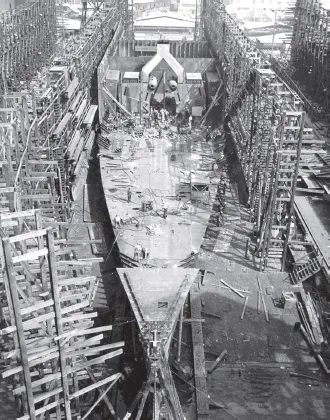
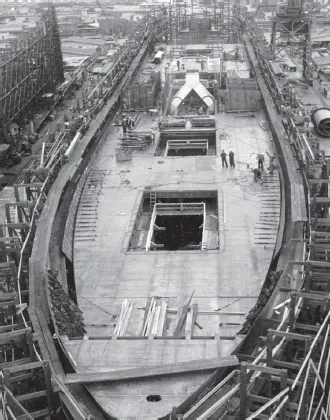
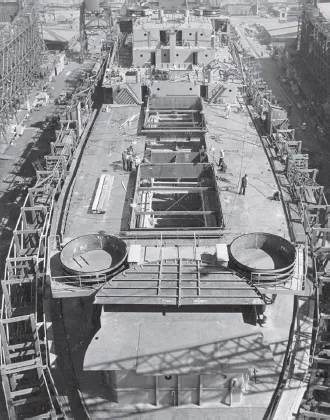
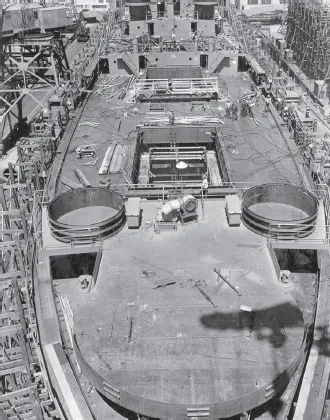
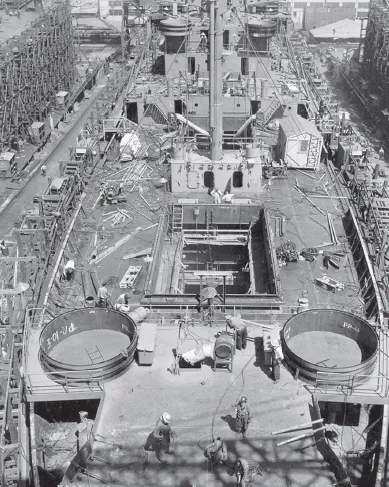
The construction sequence of the Liberty ship at Richmond, California, from a set of postcards issued by the Permanente Metals Corporation: (i) Fourth day on the slipway following keel-laying. (ii) Eighth day on the slipway. (iii) Twelfth day on the slipway. (iv) Sixteenth day on the slipway. (v) Twentieth day on the slipway prior to launching four days later.
There were several reasons why Britain could not develop a single standard-type ship, as was the case with the American emergency shipbuilding programme. Peter Elphick explains in the introduction to his seminal book Liberty: the ships that won the war:
The general pattern [in America] was for these standard ships, as they were called, to be built on a one yard, one design basis, usually a design that the yard was used to building. But there was never a hard and fast rule and from time to time a yard could be ordered to switch to another type of ship. The overall guidelines were speed of construction and the cargo carrying capacity of the ship. There were several reasons why this tendency towards shipbuilding conformity was never carried through to its logical conclusion in Britain, ie that of getting all yards to build to only two or three basic designs, which as the Americans were to show, would have brought about the many benefits that accrue to near-complete standardisation. The reasons why this course was not pursued in Britain include the historical layout of yards, the varying sizes of slipway, and the valuable and not to be lightly discarded local shipyard expertise that had been built up over many years.
It needs also to be remembered that most British shipyards that were not involved with Admiralty work had been unable to retool during the Depression. They were consequently illequipped for significant changes in construction methods. Nor could the British yards easily pursue a course of prefabrication, as both craneage and space were at a premium; there was insufficient factory area to construct large units, and inadequate lifting capacity when these units were taken to the ship that was being assembled. The rivet squads comprised skilled men and there was little experience of electric welding, so any move towards this instead of riveting was not an easy one to achieve, either. Peter Elphick again:
Perhaps the worst handicap of all to the industry in Britain, however, was the blackout, for to have worked the yards after dark under floodlights, especially during the long winter nights, would have been to invite the ministrations of the Luftwaffe, and German air attacks were quite bad enough without soliciting more.
Shipbuilding in America was in a very weak state in the 1930s. The American Merchant Marine was an ageing fleet, mostly built in and immediately after the Great War. America’s shipbuilding capacity, therefore, was limited at the start of the Second World War. It had begun to rebuild its cargo ship fleet in the late 1930s, with the intention of building fifty powerful and fast C (cargo)-type ships and, in due course, T (tanker)-type ships per year. The first keel laid down in the new programme of rebuilding sponsored by the United States Maritime Commission took place in August 1938, but it was neither a C-nor a T-type ship. It was the transatlantic liner America, completed in 1940 for the United States Lines Company and converted for war use in 1941 as the troop ship West Point.
In order to satisfy wartime demand, the United States Maritime Commission was obliged to scale down the programme of building fast and well-constructed C1-, C2- and C3-type cargo ships (the suffix reflecting the length of the ship) and T2 tankers. It largely switched to simpler designs, the Liberty and, later, the Victory ships; it was also necessary to construct several new emergency shipyards and extend existing ones. Unskilled labour was recruited to work alongside existing skilled labour. Available skilled labour was also divided between the existing and new shipyards. One consequence was racial tension between the white workers imported to the Alabama shipyard and the black unskilled men who been recruited locally.
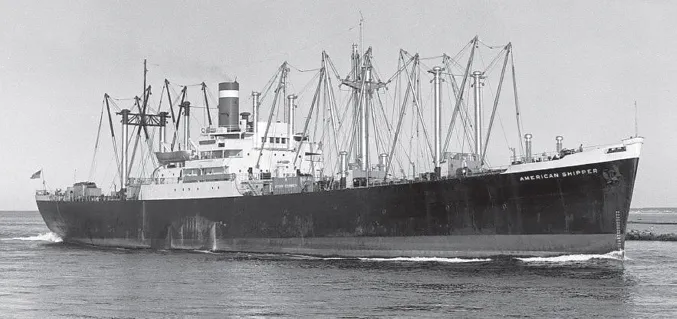
The United States Lines Company’s American Shipper (1946) was one of the last C2-type ships built under the auspices of the United States Maritime Commission. This later class of ship had a more streamlined profile than those built during the war. With a speed of 15½ knots an...
Table of contents
- Cover
- Title
- Copyright
- CONTENTS
- Preface
- Foreword by Ian Ramsay
- 1 The Concept: Austere, Functional and Lots of Them
- 2 Fit For Purpose: The Design Criteria
- 3 Ships Built in Britain During the Great War
- 4 The American and Canadian Great War ‘Bridge of Ships’
- 5 The Commercial Role of the Standard Ships of the Great War
- 6 At War Again – Rebuilding, Lessons Learnt and Lend-Lease
- 7 United States Maritime Commission – C, T and N Classes
- 8 The Empire Ships Built in Britain
- 9 The Liberty Shipbuilding Programme: ‘Built by the Mile and Cut Off by the Yard’
- 10 Canadian Shipbuilding and Shipowning, and Australia’s Rivers
- 11 Liberty’s Successor, the Victory Ships
- 12 German Standard Ships Built in the Second World War
- 13 Japanese Standard Ships
- 14 The Big Sell-Off and Post-War Commercial Success of the Standard Ships
- 15 The Influence of Standard Ship Design on the Evolution of Naval Architecture
- 16 Successes and Failures – An Unparalleled Achievement
- References
Frequently asked questions
Yes, you can cancel anytime from the Subscription tab in your account settings on the Perlego website. Your subscription will stay active until the end of your current billing period. Learn how to cancel your subscription
No, books cannot be downloaded as external files, such as PDFs, for use outside of Perlego. However, you can download books within the Perlego app for offline reading on mobile or tablet. Learn how to download books offline
Perlego offers two plans: Essential and Complete
- Essential is ideal for learners and professionals who enjoy exploring a wide range of subjects. Access the Essential Library with 800,000+ trusted titles and best-sellers across business, personal growth, and the humanities. Includes unlimited reading time and Standard Read Aloud voice.
- Complete: Perfect for advanced learners and researchers needing full, unrestricted access. Unlock 1.4M+ books across hundreds of subjects, including academic and specialized titles. The Complete Plan also includes advanced features like Premium Read Aloud and Research Assistant.
We are an online textbook subscription service, where you can get access to an entire online library for less than the price of a single book per month. With over 1 million books across 990+ topics, we’ve got you covered! Learn about our mission
Look out for the read-aloud symbol on your next book to see if you can listen to it. The read-aloud tool reads text aloud for you, highlighting the text as it is being read. You can pause it, speed it up and slow it down. Learn more about Read Aloud
Yes! You can use the Perlego app on both iOS and Android devices to read anytime, anywhere — even offline. Perfect for commutes or when you’re on the go.
Please note we cannot support devices running on iOS 13 and Android 7 or earlier. Learn more about using the app
Please note we cannot support devices running on iOS 13 and Android 7 or earlier. Learn more about using the app
Yes, you can access Wartime Standard Ships by Nick Robins in PDF and/or ePUB format, as well as other popular books in History & Military & Maritime History. We have over one million books available in our catalogue for you to explore.