"A delight . . . fulfills a long-felt need to do justice to the smaller ships of war that did such sterling service for the sailing Royal Navy."—
Ships in Scale
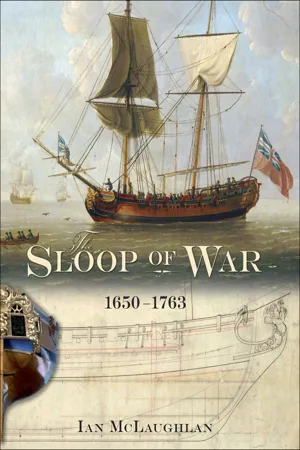
This is the first study in depth of the Royal Navy's vital, but largely ignored small craft. In the age of sail, they were built in huge numbers and in far greater variety than the more regulated major warships, so they present a particular challenge to any historian attempting a coherent design history. However, for the first time this book charts the development of the ancillary types, variously described in the 17th century as sloops, ketches, brigantines, advice boats and even yachts, as they coalesce into the single 18th-century category of Sloop of War. In this era, they were generally two-masted, although they set a bewildering variety of sail plans from them. The author traces their origins to open boats, like those carried by Basque whalers, shows how developments in Europe influenced English craft, and homes in on the relationship between rigs, hull-form and the duties they were designed to undertake.
Visual documentation is scanty, but this book draws together a unique collection of rare and unseen images, coupled with the author's own reconstructions in line drawings and watercolor sketches to provide the most convincing depictions of the appearance of these vessels. By tackling some of the most obscure questions about the early history of small-boat rigs, the book adds a dimension that will be of interest to historians of coastal sail and practical yachtsmen, as well as warship enthusiasts.
"Fascinating . . . It combines a truly scholarly delivery with a lovely presentation. History brought to life."—tomcunliffe.com
- 288 pages
- English
- ePUB (mobile friendly)
- Available on iOS & Android
eBook - ePub
The Sloop of War, 1650–1763
About this book
Trusted by 375,005 students
Access to over 1.5 million titles for a fair monthly price.
Study more efficiently using our study tools.
Information
Chapter 1

THE RIGGING OF SLOOPS
INTRODUCTION
The purpose of this chapter is to provide an introduction to the different types of rig fitted to sloops over the period 1650 to 1763. The chapter falls into three parts. The first deals with the different types of sail (by no means exclusive to sloops) that went to make up the various rigs, and the nomenclature involved with their rigging. The second attempts to show how these sails were combined to produce the desired rigs. Those readers familiar with the general arrangement of sails and their control can skip to the second part of this chapter. The third discusses the management of sloops under these rigs and deals with the questions of both directional and vertical stability.
The subjects of rigging and the arrangement of sails are normally left to the last when a large ship is being described but, because rig can be a defining issue when it comes to a discussion on sloops, it is sensible to describe the rigging of these small warships at the beginning of the story. A rig is relatively easy to describe in outline, but the methods of setting up the standing and running rigging of a vessel are complex and changed over the centuries to a degree that makes it impossible to incorporate the high level of detail this subject engenders within the compass of an outline history of sloops in general. Indeed, such is the variety of rigs that were used by sloops that a complete book could be written on this topic alone. The problem is compounded, particularly in the case of the early sloops, by the habit of making customised changes to rig and to the dimensions of spars and masts within the lifetime of many of these small ships. It follows that this chapter can only be an overview of the subject and will therefore confine itself to a consideration of the basic arrangements for masts and spars and the types of sails deployed on them. Examples of the dimensions of mast and spars will be found in Appendix 2. Those readers who wish to plunge into greater detail are referred to some excellent authorities and publications in the Bibliography.
Because the sloop was an unrated vessel, there was a degree of anarchy in the matters of rigging and of hull design. Thomas Riley Blanckley in his work of 1732 entitled A Naval Expositor wrote:
Sloops – Are Sail’d & Masted as Mens fancys leads them sometimes wth One Mast, wth Two and wth Three, wth Burmudoes, Shoulder of Mutton, Square Lug & Smack Sails, they are in Figure either Square or Round Stern’d.1
Possibly the main confusion arises from the modern understanding that a sloop is, and indeed was, a vessel with a single mast rigged fore-and-aft, broadly similar to the present day sailing yacht.2 However, this book is concerned with the word ‘sloop’ as applied to a great fleet of small warships with differing rigs, hull shapes and operational tasks. Unlike the rated classes above them, which were normally ship-rigged with three masts, sloops carried a variety of sail plans, usually set on two masts, occasionally on three, and very seldom on a single mast.
TYPES OF SAIL AND THEIR CONTROL LINES
There are two terms applying to rig that will be referred to repeatedly throughout the book: ‘fore-and-aft’ and ‘square’. A fore-and-aft sail is one that is attached in some way to a mast or a stay by its forward edge and lies, at rest, along the centreline of the vessel. Such sails can be used, when hauled in tight, to cleave the wind. They can be eased and allowed to lie across the ship, when the wind is from behind. Square sails lie across the ship but can be canted and trained round so that they can also cleave the wind, though they will not allow the ship to point as high (as near to the wind direction) as the fore- and-aft-rigged version.
Under ideal circumstances, both types of sail will assume an aerofoil shape, with the forward-most curve of the aerofoil directly in line with the incoming airflow. It is necessary at this point to distinguish between the ‘true’ wind (ie the direction in which the wind is blowing over the sea surface) and the ‘apparent’ wind, which is the direction of the wind as perceived from the ship. When the ship is head to wind or sailing downwind, these directions coincide; in every other situation, when the ship is travelling forwards at an angle to the true wind direction, the apparent wind direction will be closer to the direction of travel than the true wind. The triangle of velocities in Fig 1-1 illustrates the effect.
It is easy to see that as the boat speed increases relative to the true wind speed, the apparent wind moves more and more ahead. If the sails were already set to their optimum angle, then it will be necessary to bear away even further from the true wind direction. Any attempt to avoid this by sheeting the sail in beyond the optimum will increase the sideways forces (and hence leeway), again moving the vessel away from the true wind direction.

Fig 1-1. True and apparent wind close-hauled and running
1.Direction of apparent wind
2.Direction of true wind
3.Following wind where true and apparent are the same
4.Fore and aft head sails will not draw properly
5.Square rig
6.Fore-and-aft rig
Obviously, the exact performance of a vessel depends on many factors, both inherent (hull shape and resistance, sail orientation, etc) and external (eg wind direction and boat speed), but as a rule of thumb a square-rigged ship could rarely get closer than 75 degrees to the true wind. A typical fore-and-aft rig, by contrast, could usually achieve about 50 degrees off the true wind. Such a difference is critical; with the additional influence of leeway, a square-rigger could often tack backwards and forwards repeatedly without making any ground to windward, while the fore-and-aft rig could usually progress. This distinction is vital to understanding the evolution of sloop rigs.
The importance of windward ability cannot be over-emphasised, particularly for ships such as sloops working close to a coast on surveillance, reconnaissance and communications. The need to round headlands and beat out of bays was their lot. In the wide ocean it is of less importance, unless there is a need to close with or run from an enemy. In single-ship engagements the ship with the best windward ability would have a clear advantage.
Square sails are ideally suited to a following wind as they present a large well-controlled area to the wind. Fore-and-aft sails can be inefficient downwind, particularly if they have no boom along their foot. If the sail can be held out by a boom then it can be made to present a satisfactory face to the wind but few fore-and-aft sails are suitably rigged to accept a boom along their foot, in which case they will stall and cease to pull the vessel through the water. Many of the examples shown below carry sails of both varieties within their sail plan and can use both, simultaneously or separately, to achieve the optimum arrangement for any particular direction of wind.
In rigging their ships, the nations facing the Atlantic, the North Sea or English Channel initially favoured square rig alone, although well before the time of our interest a fore-and-aft sail, the lateen or settee sail, originating in the Eastern Mediterranean, was in use on the mizzen mast of ships with three masts and on ketches with two masts. Therefore it is logical to start with square sails and leave the lateen sail to the fore-and-aft section later.
Standing rigging is relatively simple to describe. Masts could be a one-part or ‘pole’ mast or a mast built up of two or more sections (Fig 1-2). In the latter’s case, each section except the uppermost would have at its head a construction capable of receiving and securing the lower part of the mast above into a housing comprising a cap, crosstrees and trestletrees. Masts were secured against lateral forces using shrouds, against fore-and-aft forces using stays, and against quartering forces using backstays, which could be supplemented in extremis by additional backstays set up on a temporary basis. All these items of standing rigging could be adjusted using deadeyes and lanyards or blocks and tackles.
The lowest square sails just above the deck were the main and fore courses. They were set from a spar or yard lying at right angles to their masts and across the centreline of the vessel (Fig 1-3). The yard on the mainmast would be just over twice the ship’s beam and the sail a little less. The sail could be trimmed using bridles on its luff (the windward edge of the sail) leading to bowlines, which led through some firm point forward of the sail, thus permitting the crew to set the l...
Table of contents
- Front Cover
- Title Page
- Copyright Page
- Contents
- Preface
- Abbreviations
- Introduction and Definition
- Chapter 1 The Rigging of Sloops
- Chapter 2 The Fishing Boat Legacy
- Chapter 3 The Sea-Wars Between England, Holland, France and Spain 1651–1678
- Chapter 4 The Small Warships of the Commonwealth and the Restoration Navies 1651–1688
- Chapter 5 The Wars Against France 1688–1714
- Chapter 6 Ketches, Brigantines, Advice Boats and Sloops, 1689–1702
- Chapter 7 Early Small Sixth Rates and the Development of Fore-and-Aft Rig and Oared Propulsion
- Chapter 8 The Bomb Vessel and Fireship 1683–1712
- Chapter 9 The First Sloops of War 1704–1719
- Chapter 10 The Barque Longue and Early Corvette 1671–1714
- Chapter 11 The Hanoverian Succession and the Wars for Trade and Empire 1714–1763
- Chapter 12 The ‘Peacetime’ Sloops 1714–1728
- Chapter 13 Towards a Specification 1728–1740
- Chapter 14 A Multi-Role Class 1728–1749
- Chapter 15 French Corvette and Privateer Construction 1734–1763
- Chapter 16 The Last of the Snow- and Ketch-Rigged Cruising and Bomb Sloops 1749–1761
- Chapter 17 Ship Rig and Long Quarterdeck 1741–1763
- Chapter 18 Conclusion
- Notes
- Appendix 1 Alphabetical List of Purpose-Built and Prize Sloops by Name, Dates, Designer and Rig
- Appendix 2 A Selection of Mast and Spar Dimensions
- Appendix 3 A Selection of Sloop Plans and How to Make a Rudimentary Interpretation of Them
- Appendix 4 Performance Under Sail and Sailing Quality Reports
- Appendix 5 The Designers and Builders
- Appendix 6 Arming the Sloop of War
- Bibliography
Frequently asked questions
Yes, you can cancel anytime from the Subscription tab in your account settings on the Perlego website. Your subscription will stay active until the end of your current billing period. Learn how to cancel your subscription
No, books cannot be downloaded as external files, such as PDFs, for use outside of Perlego. However, you can download books within the Perlego app for offline reading on mobile or tablet. Learn how to download books offline
Perlego offers two plans: Essential and Complete
- Essential is ideal for learners and professionals who enjoy exploring a wide range of subjects. Access the Essential Library with 800,000+ trusted titles and best-sellers across business, personal growth, and the humanities. Includes unlimited reading time and Standard Read Aloud voice.
- Complete: Perfect for advanced learners and researchers needing full, unrestricted access. Unlock 1.5M+ books across hundreds of subjects, including academic and specialized titles. The Complete Plan also includes advanced features like Premium Read Aloud and Research Assistant.
We are an online textbook subscription service, where you can get access to an entire online library for less than the price of a single book per month. With over 1.5 million books across 990+ topics, we’ve got you covered! Learn about our mission
Look out for the read-aloud symbol on your next book to see if you can listen to it. The read-aloud tool reads text aloud for you, highlighting the text as it is being read. You can pause it, speed it up and slow it down. Learn more about Read Aloud
Yes! You can use the Perlego app on both iOS and Android devices to read anytime, anywhere — even offline. Perfect for commutes or when you’re on the go.
Please note we cannot support devices running on iOS 13 and Android 7 or earlier. Learn more about using the app
Please note we cannot support devices running on iOS 13 and Android 7 or earlier. Learn more about using the app
Yes, you can access The Sloop of War, 1650–1763 by Ian McLaughlan in PDF and/or ePUB format, as well as other popular books in History & British History. We have over 1.5 million books available in our catalogue for you to explore.