- 240 pages
- English
- ePUB (mobile friendly)
- Available on iOS & Android
eBook - ePub
The War in the South Pacific
About this book
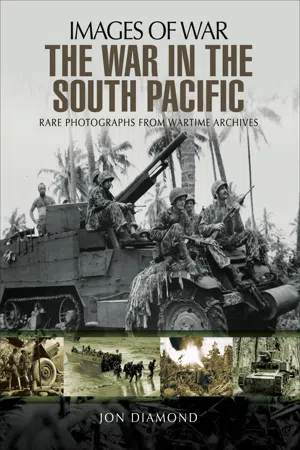
The Japanese invaded the Solomon Islands in May 1942 with the aim of building an airfield at Guadalcanal. After an epic six month struggle they were repulsed and the island became a staging base for US Admiral Halsey and his South PacificForce. Comprising powerful naval, marine and army assets as well as land and carrier-based aircraft, Halseys Forces mission was to neutralise the Japanese presence in the South Pacific before moving on to Japan itself. As explained and depicted in this fascinating book, the campaign was eventually successful but only after some of the bitterest fighting of the Second World War. The fanatical opposition called for extreme measures from US, British and Australian land, seas and air forces. With detailed narrative and captions, the many archival photographs in The War in the South Pacific make for a superb record of this legendary conflict.
Trusted by 375,005 students
Access to over 1.5 million titles for a fair monthly price.
Study more efficiently using our study tools.
Information
Chapter One
Overview of the South Pacific Campaign
Key Allied victories in the Pacific have been singled out as seminal turning points against the Japanese. The American Navy’s sinking of four enemy carriers at Midway crippled future Imperial Japanese Navy (IJN) initiatives on the scale mounted during the war’s initial six months. The six-month gruelling defence and ultimate conquest of Guadalcanal by American land, sea and air forces, after the initial Marine amphibious invasion of that Southern Solomon Island on 7 August 1942, halted the Japanese south-eastward strategic advance to sever the sea lanes to the Antipodes. What has become ignored, however, is the back-breaking series of defeats that the Japanese suffered in their attempts to defend the New Georgia group of islands and Bougainville in the Central and Northern Solomon Islands respectively. The toll in Imperial Japanese Army (IJA) units, naval ships, aircraft and crews could never be replaced by the Japanese after the defeats suffered on these hellacious jungle islands, especially given the requisite presence of Imperial forces on other fronts, including the Central Pacific, New Guinea and the Asian mainland.
By the first week of February 1943, the Guadalcanal campaign was won by the US Marines, Army and Navy after almost six horrific months of jungle combat, aerial attacks and naval surface action. However, the Japanese did not consider Guadalcanal’s evacuation to be more than a temporary setback in the South Pacific. Both the emperor and the imperial general staff commented that the Japanese forces were simply changing emphasis. For several months they had been on the offensive in the Solomon Islands area and on the defensive in Papua, New Guinea. A reversal was to occur. As for the IJA, the important matter was the capture of all of New Guinea, with a renewed drive for Port Moresby out of Lae near the Huon Gulf of North-east New Guinea. The Solomon Islands in the South Pacific sector were to be primarily an IJN problem. This disunity in effort and planning was to plague the Japanese Armed Forces in subsequent campaigns after their lightning string of victories from December 1941 to June 1942.
The head of the Japanese Combined Fleet, Admiral Isoruku Yamamoto, sorely wanted to regain the strategic initiative and, perhaps, win one additional major victory since the ‘invincible years’ of 1941–1942. After the evacuation of Guadalcanal, during the initial week of February 1943, Yamamoto drew a new defensive line in the South Pacific through the middle of the Solomons. Yamamoto had moved his advanced IJN bases back to New Georgia and Kolombangara in the Central Solomon Islands. With Guadalcanal’s evacuation, Imperial Headquarters in Tokyo made plans to reinforce the area and seize victory again. It was Yamamoto’s hopeful anticipation that a muchdesired decisive Japanese victory in 1943 may yet compel the Allies to seek a negotiated peace and allow the Japanese to keep their new Pacific empire. The IJA and IJN would have to work together with the latter bringing in supplies and reinforcements to the former.

Map 1. The South Pacific Area, comprising the Solomon Islands, under the command of Vice Admiral William F. Halsey, and the South-west Pacific Area, principally New Guinea, the Bismarck Archipelago and surrounding island groups, under the leadership of General Douglas A. MacArthur are shown. Both American commanders, along with their Allied forces, were to conduct separate amphibious and land campaigns to retake the Solomon Islands, New Guinea and adjacent sites, such as Cape Gloucester on New Britain, from the Japanese. As more proximate air-bases to Rabaul were acquired or constructed, such as on Bougainville, an intensified air interdiction campaign to neutralize that Japanese bastion on New Britain, Operation Cartwheel, would be conducted by Allied air assets stationed in both theatres, such that a bloody and protracted amphibious operation against that enemy fortified base could be avoided. After Guadalcanal, the unoccupied Russell Islands in the Southern Solomons were taken on 21 February by Halsey’s South Pacific Force. IJN Admiral Isoroku Yamamoto had drawn a line through the Central Solomons as the new Japanese defensive Front. In July 1943, Halsey breached this Japanese defensive line with his amphibious invasion of the New Georgia group, including Rendova, New Georgia, Arundel and Vella Lavella in the Central Solomons. In order to protect MacArthur’s eastern flank for his upcoming Cape Gloucester and Arawe landings on the western and southern shores of New Britain by Marine and US Army forces respectively in December 1943, Halsey’s South Pacific Force was tasked with the amphibious invasion of Bougainville at Empress Augusta Bay on 1 November 1943. As a result of Halsey and MacArthur’s parallel campaigns in their respective theatres, IJN and IJA commanders at Rabaul were limited to making piecemeal ground and air reinforcements to their garrisons in the Solomons and on New Guinea. Given the fact that Rabaul was also under Allied air attack along two axes, a major IJN counter-offensive never materialized, with Imperial surface vessels merely attempting to disrupt Allied amphibious operations.
(Philip Schwartzberg, Meridian Mapping)
(Philip Schwartzberg, Meridian Mapping)
Yamamoto would be responsible for operations in the Solomons, while Lieutenant General Hitoshi Imamura, the 8th Area Army commander on Rabaul, would be responsible for ground forces in the Central and Northern Solomons. These IJN ground forces were to be comprised of the 17th Army under Lieutenant General Harukichi (Seikichi) Hyakutake in the Solomon Islands, while in Eastern New Guinea the 18th Army, under Lieutenant General Hatazo Adachi, would oversee operations. On Bougainville in the Northern Solomons, the IJN 6th Division would be stationed under 8th Area Army control. Ironically, during a morale-boosting trip to the Northern Solomons on 18 April, Yamamoto’s personal IJN twin-engined, land-based Mitsubishi G4M3 ‘Betty’ bomber was shot down over the southern tip of Bougainville by American P-38 fighters stationed on Guadalcanal as the admiral was in flight to Ballale airfield, on a nearby islet in Bougainville Strait. Admiral Mineichi Kogo took over the Combined Fleet after Yamamoto’s death.
After Guadalcanal, the Japanese still retained a distinct advantage in the Solomons, even though they had lost the ferociously contested Southern Solomon Island. Their fighter aircraft, the IJN A6M Reisen or ‘Zero’, along with the IJA Ki-43 Hayabusa or ‘Oscar’, had longer ranges (approaching 2,000 miles) than the American planes. Additionally, Yamamoto ...
Table of contents
- Cover
- Title
- Copyright
- Contents
- About the Author
- Acknowledgements
- Chapter One: Overview of the South Pacific Campaign
- Chapter Two: Stepping-Stones after Guadalcanal
- Chapter Three: New Georgia Invasion and Assault on Munda (Operation Toenails)
- Chapter Four: Bougainville Invasion at Empress Augusta Bay (Operation Cherry Blossom) and Beachhead Expansion
- Chapter Five: Japanese Counterattack and Perimeter Defence, March 1944
- Chapter Six: Australian Action on Bougainville, November 1944–August 1945
- Epilogue
- References
Frequently asked questions
Yes, you can cancel anytime from the Subscription tab in your account settings on the Perlego website. Your subscription will stay active until the end of your current billing period. Learn how to cancel your subscription
No, books cannot be downloaded as external files, such as PDFs, for use outside of Perlego. However, you can download books within the Perlego app for offline reading on mobile or tablet. Learn how to download books offline
Perlego offers two plans: Essential and Complete
- Essential is ideal for learners and professionals who enjoy exploring a wide range of subjects. Access the Essential Library with 800,000+ trusted titles and best-sellers across business, personal growth, and the humanities. Includes unlimited reading time and Standard Read Aloud voice.
- Complete: Perfect for advanced learners and researchers needing full, unrestricted access. Unlock 1.5M+ books across hundreds of subjects, including academic and specialized titles. The Complete Plan also includes advanced features like Premium Read Aloud and Research Assistant.
We are an online textbook subscription service, where you can get access to an entire online library for less than the price of a single book per month. With over 1.5 million books across 990+ topics, we’ve got you covered! Learn about our mission
Look out for the read-aloud symbol on your next book to see if you can listen to it. The read-aloud tool reads text aloud for you, highlighting the text as it is being read. You can pause it, speed it up and slow it down. Learn more about Read Aloud
Yes! You can use the Perlego app on both iOS and Android devices to read anytime, anywhere — even offline. Perfect for commutes or when you’re on the go.
Please note we cannot support devices running on iOS 13 and Android 7 or earlier. Learn more about using the app
Please note we cannot support devices running on iOS 13 and Android 7 or earlier. Learn more about using the app
Yes, you can access The War in the South Pacific by Jon Diamond in PDF and/or ePUB format, as well as other popular books in History & Military & Maritime History. We have over 1.5 million books available in our catalogue for you to explore.