eBook - ePub
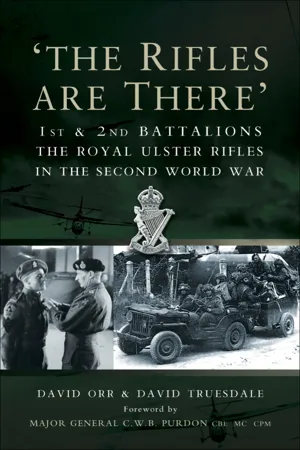
The Rifles Are There
1st & 2nd Battalions The Royal Ulster Rifles in the Second World War
- 240 pages
- English
- ePUB (mobile friendly)
- Available on iOS & Android
eBook - ePub
The Rifles Are There
1st & 2nd Battalions The Royal Ulster Rifles in the Second World War
About this book
Told by the men who lived it, this is a military history of two British Army battalions who landed at Normandy and fought in Europe during World War II.
This is the long overdue history of the two Royal Ulster Rifles battalions during the Second World War. Although there was a healthy rivalry between the battalions, both reserved their fighting skills for the luckless enemy. At the outbreak of the war the 1st Battalion was garrisoned in India whereas the 2nd went to France with the BEF. Indeed, the title of this book is credited to Major General Bernard Montgomery who was commanding 3rd Division during the retreat to Dunkirk. On hearing that the RUR were in the line, he reputedly exclaimed, 'it's alright then—the Rifles are there'.
After arduous training both battalions landed in Normandy on D-Day; the 1st by gliders as part of 6th Airlanding Brigade and the 2nd with 9th Brigade of 3rd Division on SWORD Beach. Indeed, the RUR have the unique distinction of being the only British regiment to be represented on D-Day by both regular battalions. In addition, numerous Riflemen were in 9th Parachute Battalion (commanded by Lieutenant Colonel Terence Otway, himself a Rifles' Officer) and there is a full description of the legendary assault on the Merville Battery.
This well-researched work goes on to describe the long slog through North West Europe to the heart of Germany. Of the many fierce engagements that the battalions fought, those in the Ardennes during the German counterattack and the massive Rhine Crossing Operation (VARSITY) deserve special mention. There were numerous battles, both major and minor, where the Rifles' legendary fighting skills and courage were put to the test.
Trusted by 375,005 students
Access to over 1.5 million titles for a fair monthly price.
Study more efficiently using our study tools.
Information
Print ISBN
9781844153497
Subtopic
Military & Maritime HistoryPART ONE
2nd Battalion
The Royal Ulster Rifles
The Royal Ulster Rifles
France, September 1939 to June 1940
The 2nd Battalion Royal Ulster Rifles received its orders to mobilize on 1 September 1939. Three days later a party of 208 reservists under the command of Lieutenant E.D.D. Wilson had arrived from the depot at Gough Barracks in County Armagh to bring the Rifles up to war strength. For the remainder of the month ‘old’ and ‘new’ soldiers trained together to form a battalion fit enough to take the field.
The Rifles on parade numbered 23 officers, 20 Warrant Officers and 674 other ranks. Like their predecessors of 1914–18, they wore khaki and carried the Lee Enfield .303 rifle as standard issue; the equipment had changed since the First World War, as had the design of the uniform. The Battalion was organized into a headquarters and five rifle companies, A, B, C, D and a Support Company. These were in turn organized into three platoons, each platoon having a headquarters and three sections commanded by either a corporal or lance corporal, with ten men armed with nine rifles and a Bren gun. Within the platoon headquarters of an officer and six men were an anti-tank rifle and a 2-inch mortar. An issue of the Boyes anti-tank rifle was made prior to embarkation for France, but few men had the opportunity to fire it before crossing the Channel. As the Riflemen assembled they began to form a cohesive unit from the mixture of ‘old soldiers’ from Palestine, many of whom were not so old, and the new recruits, recently enlisted.
Although this was the Royal Ulster Rifles the men who filled the ranks from 1939 to 1945 came from many places within the United Kingdom – there were ‘loyal’ Ulstermen, ‘neutrals’ from Eire, cockneys from the East End of London and men from the Home Counties. Both Protestants and Catholics were present in large numbers, plus enough men of the Jewish faith, to warrant a church parade on a Saturday. From the old sweats of Palestine to the new recruits, all trained together for the coming conflict.
Among the officers was Lieutenant Corran Purdon. Deemed too young to accompany the battalion to France, he applied for the Commandos and took part in the raid on St Nazaire on 28 March 1942, leading a demolition party with great success despite being wounded. Subsequently taken prisoner, he was awarded the Military Cross for his actions during the raid.
Charlie Alexander who came from County Antrim was reading medicine at Queen’s University, Belfast but he interrupted his studies to take a commission in 1940. ‘Billy’ Baudains, who had enlisted at the age of thirteen years as a band boy, had previously served in India and Palestine and was a first-class rifle shot. As a Sergeant he would be awarded the Military Medal for his actions at Louvain in 1940. He was later commissioned in the field in 1943 and would serve in Normandy as a Captain. Eric Boyd from County Tyrone had been educated at RBAI and was well known in amateur music circles in Belfast prior to his enlisting.
Not all riflemen would serve with the Regiment. John Ryan had been born in Dublin in 1909. On leaving school he went to Canada to seek his fortune only to find himself in the middle of a depression. One winter’s day while standing in a soup kitchen queue he, along with several other men, were approached by some people who were handing out blankets and clothing to help keep out the bitter cold. A young girl draped an ex-army greatcoat around John Ryan’s shoulders and wished him good luck. A few days later he boarded a ship and worked his passage to Belfast. On arriving in the city in September 1931, he made his way to the recruiting office at Clifton Street and asked to join the Regiment indicated by the buttons on his greatcoat. So John Ryan found himself in Palestine with the 2nd Battalion Royal Ulster Rifles. He was discharged to the Reserve on 18 September 1938 on completion of seven years service with the Colours, but John was recalled to the Colours on 14 December 1940 and was posted to the Maritime Artillery Regiment. He served on board various ships seeing action in the Atlantic, Mediterranean, Indian and Pacific Oceans. He eventually left the Army on 29 May 1950, one of the few riflemen to have earned the Pacific Star.
On 3 October 1939, the Rifles went to war under the command of an officer who had witnessed the horrors of 1914–18. Lieutenant Colonel Gerald Whitfeld had graduated from Sandhurst in April 1915 and was appointed as a Second Lieutenant in the 1st Battalion Royal Irish Rifles. For the following two years he experienced almost continuous severe fighting on the Western Front. During his time in the trenches he was wounded, awarded the Military Cross and received a Mention in Despatches, later being attached to the Royal Flying Corps as an observer.
Between the wars he saw the name of the regiment change and returned to Sandhurst as a member of Staff, he saw service in India before being posted to the regimental depot in Armagh. Promoted to Lieutenant Colonel in 1938, he led the 2nd Battalion to the Holy Land. Now he was returning to France, commanding a battalion that contained some men who were the sons of those he had served with over twenty years before.
The Rifles boarded their troop train at the market town of Sherborne in Dorset and travelled the 60 odd miles to Southampton. After a brisk march from the railway station to the harbour 717 officers and men crammed aboard the Mona’s Queen, a small, elderly Isle of Man packet boat. It quickly became evident that the ‘ship’ was unsuitable for the job in hand, there was little room to stand much less sit down and any chance of a hot meal was totally out of the question. Nevertheless, the crossing to Cherbourg went ahead, and after an uneventful voyage the Rifles disembarked, cold, wet and hungry. From the seafront another march brought them to another railway station and as darkness fell the Rifles boarded their second train of the day. Shortly afterwards they left the port for the town of Silly-le-Guillaume, a journey that lasted throughout the night. From here it was again a matter of boots on pavé until they reached their final destination at Parennes where billets were found for the men which were described as comfortable, but somewhat scattered for a unit supposed to be on active service.
The Rifles’ stay here was short lived and soon they were on the move again. Another train journey and they found themselves at Templemars, arriving on 12 October; two days later and it was on to Lezennes, a suburb of Lille. On 4 November the Rifles experienced their first air-raid warning as the sirens wailed out over the town.
Armistice Day dawned dank and misty and the men were informed that all leave had been cancelled – it was to be a Christmas away from home.
During this time the Rifles received a number of high-ranking visitors, but in December a very special one arrived – 6 December was the birthday of His Majesty King George VI and he elected to spend some of it with the officers and men of the Royal Ulster Rifles. While carrying out his inspection the King again met Second Lieutenant Charles Sweeny having previously done so when presenting him with the Military Cross in a muddy field in England. Charles Sweeny had been born in Limerick in 1917, was educated at Hailebury and attended Sandhurst. He was commissioned into the Regiment on 27 January 1938 and by the following May was involved in guerrilla warfare against the Arabs in Palestine. Here he first met Bernard Law Montgomery on whom he made quite an impression – Sweeny is probably the only man in the British Army to receive a congratulatory birthday telegram from the future Field Marshal. It was also in Palestine that Sweeny had earned the Military Cross, one of five awarded to the Rifles; to this must be added four awards of the Military Medal and eighty-seven Mentions in Despatches.
The following day brought home to the Riflemen just how cold this winter was to become. Overnight the temperature had dropped considerably and now the ground was frozen making digging difficult.
The Rifles celebrated Christmas in the usual manner and held a party for some 375 French schoolchildren. In the aftermath of this some men were heard to mutter that facing the Germans would be a piece of cake!
On 7 January the Rifles suffered their first officer casualty when Captain Philip Ashton from London was killed in a road accident, his car skidding on ice.
February and March were spent in Lezennes carrying out various exercises, including withdrawal from prepared positions and a course of night driving for the benefit of the drivers of twenty-five TCVs (Troop Carrying Vehicles), which arrived with the Rifles on 5 March. The course covered some 20 miles in darkness with only the leading vehicle using headlights, the rest following the dim red tail light of the lorry in front.
Lieutenant Colonel Whitfeld received word on 4 May that he had been appointed as AAG, GHQ and with a heavy heart he said goodbye to the riflemen, wishing them good luck for the forthcoming campaign, but assuring them they were to be left in good hands. Two days later Major Fergus ‘Gandhi’ Knox was promoted to Lieutenant Colonel and took command. Fergus Knox was another veteran of the First World War having served with the 2nd Battalion Royal Irish Rifles from 1916. He had quickly come to notice as an officer with a natural gift for leadership and promotion was assured. After the First World War he served in Egypt and had demonstrated his abilities while leading his platoon during the various bouts of street disturbances. He had spent some time with the 1st Battalion before accompanying the Rifles to France; now he was being given the chance of command.
The following three days were spent on long country route marches, which were to prove of great value sooner than anyone could expect.
On 9 May there was considerable enemy air activity and despite a prodigious expenditure of ammunition from British anti-aircraft guns, the Luftwaffe was able to inflict considerable damage on the local RAF and French airfields.
The next day the Duty Officer was approached by a number of the local French population who inquired if he had heard ‘it’ on the wireless. This ‘it’ was the official news broadcast at 0800hrs, local time, that Germany had invaded Belgium and Holland. At 0815hrs, the Rifles were put on four hours’ notice to move. The phoney war was over and now the killing was to begin.
On 11 May, the Rifles crossed the frontier into Belgium at about midnight and were met by crowds of dejected civilian onlookers, doubtless remembering a similar incident some twenty-six years earlier.
This advance was made in conjunction with the remainder of 9 Brigade, which in turn was part of the British 3rd Division, commanded by Major General Bernard Law Montgomery. Each man wore on his sleeve the new divisional patch, three black triangles surrounding an inverted red triangle, signifying the three battalions making up the three brigades that made up the 3rd Division. 9 Brigade consisted of the 2nd Royal Ulster Rifles, 1st King’s Own Scottish Borderers and 2nd Lincolns. Montgomery called it his ‘International Brigade’.
The advance across Belgium took the riflemen through towns such as Roubaix, Oudenarde and Alost, names familiar to their fathers and those with a historical bent. The Rifles were positioned in the woods approximately 2 miles to the west of Louvain, while a reconnaissance was carried out of the defences to the east and west of the city.
That morning Louvain was dive-bombed by the Luftwaffe, a foretaste of things to come. At 1130hrs, Lieutenant Colonel Knox led Tactical HQ, A and D Companies into Louvain and occupied the prepared defence line along the main railway line on the eastern side of the city. A short time later Headquarters, B and C Companies moved into positions to the west of the city.
This was a time of rumour and counter rumour, of parachuting nuns, fifth columnists and strange signals that were supposed to be indicating British troop positions. Most of these were quickly laid to rest by responsible officers, but one rumour did affect the Rifles as they made their way into the city that day.
Gas! Its very mention brought back memories of the horrors of the First World War. As the Rifles approached their positions reports arrived from Corps HQ that the Germans were using chlorine gas and despite the best reassurances of some officers the majority of the Rifles arrived in the city wearing their respirators. Not only did this lower morale, there was the physical effort of carrying out a route march while wearing a respirator on men already suffering a degree of fatigue. The apparent source of the ‘gas’ was the smell of fumes from a local factory that made electric batteries and had been visited previously by the Luftwaffe!
The front covered by the Rifles at Louvain extended for some 2,200 yards. On their right were the 2nd Lincolns and on the left was 7 Guards Brigade. Lieutenant Garstin’s platoon was selected to garrison the railway station. Patrick Bannister Garstin was the son of a Dublin family and a born soldier, as the coming battle would prove.
All bridges in Louvain were prepared for demolition, those to the front of the Rifles being completed as a Belgian cycle unit arrived and dug in to the flank.
On 13 May it appeared that the entire Belgian Army was withdrawing through the city. The Rifles spent the day improving their defences, trenches were dug, landmines laid and fighting patrols sent out. RQMS Cadden and a party of men returned from leave in the UK, having been involved in what was described as a ‘nasty’ accident on the way. In England the blackout was in force and driving conditions during the hours of darkness extremely hazardous.
The Commanding Officer and his second in command, with memories of the First World War, knew what to expect within the next twenty-four hours, while the remainder of the Rifles sat tight, the majority allowing their imaginations to run wild.
During the following day Belgian units continued their withdrawal through Louvain. Accompanying them were some British reconnaissance units, including the armoured cars of the Inniskilling Dragoons, who were maintaining their tradition of ‘first in and last out’.
Situated immediately on A Company’s front was a small antitank minefield. A Belgian ammunition lorry, the driver doubtless exhausted by many hours on the move, left the road at this point and crashed through the fence surrounding the minefield. As the vehicle ploughed into the field the resulting explosion killed not only the driver of the truck, but also Corporal John Moore from Manchester, with five further riflemen being injured by flying shrapnel.
The blazing lorry with its intermittently exploding ammunition successfully blocked the road for the next two hours. A German fighter later strafed Battalion Headquarters and Rifleman Ritchie Matthews from Belfast was killed. By 1500hrs, all withdrawing Belgian and British troops had passed through the Rifles’ position and the town was now deserted, the majority of the civilian population having also gone west. At 1600hrs two explosions signalled the destruction of the bridges across the River Dyle.
There now came the introduction to the German machine gun known as the MG34, which would become known to both British and American soldiers by the generic name, the Spandau. With its high rate of fire due to being belt fed as opposed to the Bren gun’s thirty-round box magazine it was superior in firepower, if not accuracy, to anything the British had at the time.
The Germans also showed their prowess with the mortar, their counter-battery fire being both quick and accurate. Nevertheless, first blood went to the riflemen when a German motorcycle combination slowly nosed around a bend in the road and was quickly despatched by a burst from a Bren gun. Shortly after this came the mortar bombs and long bursts of fire from MG34s. The firing in both cases was extremely accurate and both the Rifles and the Belgian bicycle unit suffered casualties.
As darkness fell the Riflemen saw that the innocent bushes in front of their position had taken on a life of their own and shadows both real and imaginary began to cause some alarm. There was nothing imaginary about the withdrawal of the Belgian cycle unit at 2150hrs, which retired in good order, despite having at least twenty men killed. It is said you should not judge a man until you have walked a mile in his shoes, or in this case bicycle saddle. As nothing was known of the morale or training of the Belgian unit, perhaps they should not be judged too harshly.
One hour before midnight, C Company, under the command of Captain A.W. Ward, was ordered to move into Louvain to act as a reserve and be available for any required counter-attack. The following morning Lieutenant Arthur Davis and B Company were also moved up into reserve, while Lieutenant Colonel Knox established his Headquarters in Louv...
Table of contents
- Cover
- Title Page
- Copyright
- Contents
- Foreword
- Preface
- Acknowledgements
- Introduction
- Part One: 2nd Battalion, The Royal Ulster Rifles
- Part Two: 1st (Airborne) Battalion, The Royal Ulster Rifles
- Roll of Honour
- Glossary
- Bibliography
Frequently asked questions
Yes, you can cancel anytime from the Subscription tab in your account settings on the Perlego website. Your subscription will stay active until the end of your current billing period. Learn how to cancel your subscription
No, books cannot be downloaded as external files, such as PDFs, for use outside of Perlego. However, you can download books within the Perlego app for offline reading on mobile or tablet. Learn how to download books offline
We are an online textbook subscription service, where you can get access to an entire online library for less than the price of a single book per month. With over 1.5 million books across 990+ topics, we’ve got you covered! Learn about our mission
Look out for the read-aloud symbol on your next book to see if you can listen to it. The read-aloud tool reads text aloud for you, highlighting the text as it is being read. You can pause it, speed it up and slow it down. Learn more about Read Aloud
Yes! You can use the Perlego app on both iOS and Android devices to read anytime, anywhere — even offline. Perfect for commutes or when you’re on the go.
Please note we cannot support devices running on iOS 13 and Android 7 or earlier. Learn more about using the app
Please note we cannot support devices running on iOS 13 and Android 7 or earlier. Learn more about using the app
Yes, you can access The Rifles Are There by David Orr,David Truesdale in PDF and/or ePUB format. We have over 1.5 million books available in our catalogue for you to explore.