- 120 pages
- English
- ePUB (mobile friendly)
- Available on iOS & Android
eBook - ePub
Torpedo Bombers
About this book
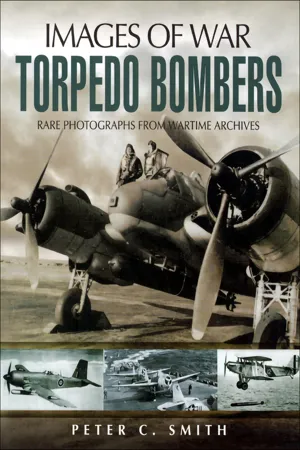
This is a highly illustrated history one of the most deadly types of atta aircraft. The torpedo bomber first appeared during the later years of World War One but served their most useful role in the Second World War. The most famous attas include Taranto, where Fairey Swordfish destroyed the Italian Battle fleet and the infamous surprise atta on Pearl Harbor by the Japanese. In both these cases the attas were against ships laying in harbor and therefore stationary. Heavy defensive anti-aircraft fire was the greatest danger to the torpedo bombers in those circumstances but ships under way in the open sea had far more room to take evasive action. The lengthy time it took a torpedo to reach its target allowed many ships to escape destruction. However notable exceptions were the sinking HMS Prince of Wales and HMS Repulse by the Japanese during the early stages of the war in the Far East. During the hunt for the Bismar it was an air-launched torpedo from a Swordfish that severely damaged the ships steering gear and enabled the Royal Navy to close in for the final kill. Some of the types included are the Fairey Swordfish, Bristol Beaufort, Fairey Albacore, Bristol Beaufighter, Heinkell He 115, Marchetti SM.79, Fokker T.VIII, Grumman Avenger and the Nakajima B5N.
Trusted by 375,005 students
Access to over 1.5 million titles for a fair monthly price.
Study more efficiently using our study tools.
Information
Chapter One
Early Developments
The Origins
At the beginning of the twentieth-century seapower was supreme, being epitomised by the Royal Navy in particular, which possessed an overwhelming superiority over all the other nations of the world in size, expertise and tradition. The strength and kingpin of any national battle-fleet lay in the numbers, size and power of the ultimate arbiter of sea-warfare, the battleship. And yet toward the second half of the nineteenth century that ultimate power had seemed threatened by the introduction of underwater weapons, which could strike unseen at the vulnerable underbelly of the battleship, below her armoured protective belt and untroubled by her mighty guns; the mine, which posed a static threat, and the torpedo, which could be deployed against moving ships in battle. Delivery of the torpedo had been by special lightly built and speedy ships, named torpedo-boats, and the weaker powers like France and Russia built huge numbers in the hope they would mitigate their inferiority in the larger ships category. But Britain had countered that threat, seemingly, by the introduction of the quick-firing gun that could destroy the torpedo-boats at long range by smothering them with shells, or at least make their approach so hazardous as to be suicidal. The Royal Navy also invented the direct counter to the torpedo-boat, in effect a larger, more powerful armed and faster ship, known initially as the torpedo-boat destroyer, but soon, universally known simply as the destroyer.
It seemed that the balance had been re-established. But the Wright brothers introduced a new factor into the age-old scheme of things when they made their first flight. The new aeroplanes were an exciting but fragile novelty when they first appeared, seemingly fireflies against the armoured hides of the battleships. But it was not very long before man’s ingenuity coupled the destructive power of the torpedo with the new versatility and manoeuvrability of the aeroplane, and a whole new weapon system was born, one which, within fewer than forty years, was to consign the battle fleet to the history books – the torpedo bomber. This is its story.
Italy
The Italians were among the first pioneers in the field of torpedoes in the late nineteenth century and later were also prominent in the art of torpedo-dropping from aircraft. In 1912, a lawyer named Pateras Pescara approached the Italian Ministry of Marine with the proposal that launching torpedoes from an aeroplane was practical. In the restricted waters of the Mediterranean such an idea showed high promise for future operations against shipping. The Italian Navy ordered Lieutenant Allessandro Guidoni to assist in the design and testing of the devices.
Initial tests were carried out by Guidoni flying a Farman biplane on floats equipped with Forlinini vanes. Take-offs and landings were carried out in Venice harbour. As no available Italian aircraft were suitable for carrying a torpedo payload, reaction from designers and pilots was far from enthusiastic. Therefore, Guidoni, working closely with Pescara, designed his own aircraft especially for the task. This aircraft, the Pateras Pescara, had a wingspan of 71 feet 6 inches and was a monoplane, again on two floats equipped with hydro-vanes. It was powered by a Gnome 18-cylinder rotary engine of 160 horsepower. This aircraft was completed in 1914 and Guidoni flew it on its maiden flight. During the tests that followed a torpedo of about 820 pounds was successfully launched.

In 1912, Lieutenant Guidoni of the Italian Navy, flew a Farman biplane to conduct the first torpedo dropping experiments. Ufficio Storico, Roma

The Pateras Pescara monoplane, first flown by Guidoni in 1914, was the first aircraft actually designed from the first as a dedicated torpedo bomber. Ufficio Storico, Roma

The Caproni 33 was used as a torpedo bomber by the Italians during World War One. Ufficio Storico, Roma

The Italian Caproni CA.44 made its first appearance in August 1917. It was designed for work in the Adriatic Sea against the Austro-Hungarian Navy. Ufficio Storico, Roma
When World War I broke out in August 1914, Italy was initially neutral, and Guidoni using the Italian hydroplane-carrying ship Elba, moored in Venice harbour, continued with his experiments. Soon, however, the involvement of Italy in the war forced the Elba to leave for Taranto. As a result, the Pescara monoplane was left to rot in a corner of the Navy Arsenal at Venice, and plans for torpedo-launching aircraft were abandoned for a time.
After Italy entered the war on the Allied side in 1915, her major opponent was Austro-Hungarian. The Italians revived the development of the torpedo bomber in order to attack the Austro-Hungarian fleet across the Adriatic Sea. Effective launchings were carried out during August 1917 from the Caproni Ca.33, and the Ca.34 and these were followed by the tri-motor Caproni Ca.46 and Ca.47. On 24 September 1917, an ammunition base at Pola was attacked by an Italian torpedo bomber piloted by Ridolfi with Pacchiarotti as his navigator. In 1918, Gabriele D’Annunzio formed the first torpedo bomber unit and thus the famed Aerosilurante had its beginnings.

The Torpedo and under wing mounting with fins of a CA.44. Ufficio Storico, Roma
Great Britain
The Royal Navy was not backward in developing the torpedo bomber. Lieutenant A.M. Longmore, later to become Air Chief Marshal Sir Arthur Longmore, made a successful torpedo drop at Calshot on 28 July 1914 in a 160-horsepower Gnome-powered Short seaplane during experiments with the 14-inch, 850-pound Whitehead torpedo. A leading British advocate of the torpedo bomber was Commodore Murray F. Sueter, and after the outbreak of World War I, he pressed his point with the firm of Short Brothers at Rochester in Kent. As a result of the collaboration between Sueter and Short Brothers the famous Short 184 seaplane was developed. This was a two-seater biplane powered by a 225-horsepower Sunbeam engine. It had a wingspan of 63 feet, 6¼ inches, an overall length of 40 feet 1½ inches and a height of 13 feet 6 inches. The maximum speed was 88½ mph at 2000 feet and it could carry a single 14-inch torpedo. In service it was to be known as the ‘225’ after its engine power.
The Royal Navy made its first successful torpedo-bombing attacks during the Dardenelles campaign in 1915. The first deliveries of the Short 184 were made to the Royal Naval Air Service at Mudros in June 1915. They began operations from the seaplane carrier Ben-my-Chree. On 12 August, Flight-Commander C.H.K. Edmonds flying one of these aircraft from the Gulf of Xeros was over the Sea of Marmora when he sighted a large steamer. He glided down to within 300 yards’ range before releasing his torpedo, which struck the vessel abreast the mainmast. He could not confirm that the ship was sunk but there was no doubt when, on 17 August, he made an attack on a convoy of three vessels heading for Aki Bashi Liman. One steamer was hit and set on fire, and although towed to Constantinople it was burnt out as a total loss. Flight Lieutenant G.B. Dacre had also scored a similar success with the ‘225’ sinking a tug. He made his attack while taxiing across the water after engine failure and subsequently made his escape under fire from Turkish coastal batteries.
Germany
The Imperial German Navy sponsored the design of a torpedo bomber on floats early in the war, but there were few actual operations by torpedo-carrying aircraft on the German side. In the main these aircraft were used for scouti...
Table of contents
- Front Cover
- Copyright Page
- Contents
- Dedication
- Foreword
- Acknowledgements
- Chapter One: Early Developments
- Chapter Two: The Inter-War Years
- Chapter Three: The Early War Years
- Chapter Four: Triumph in Battle
- Chapter Five: Decline and Abandonment
- Select Bibliography
Frequently asked questions
Yes, you can cancel anytime from the Subscription tab in your account settings on the Perlego website. Your subscription will stay active until the end of your current billing period. Learn how to cancel your subscription
No, books cannot be downloaded as external files, such as PDFs, for use outside of Perlego. However, you can download books within the Perlego app for offline reading on mobile or tablet. Learn how to download books offline
Perlego offers two plans: Essential and Complete
- Essential is ideal for learners and professionals who enjoy exploring a wide range of subjects. Access the Essential Library with 800,000+ trusted titles and best-sellers across business, personal growth, and the humanities. Includes unlimited reading time and Standard Read Aloud voice.
- Complete: Perfect for advanced learners and researchers needing full, unrestricted access. Unlock 1.5M+ books across hundreds of subjects, including academic and specialized titles. The Complete Plan also includes advanced features like Premium Read Aloud and Research Assistant.
We are an online textbook subscription service, where you can get access to an entire online library for less than the price of a single book per month. With over 1.5 million books across 990+ topics, we’ve got you covered! Learn about our mission
Look out for the read-aloud symbol on your next book to see if you can listen to it. The read-aloud tool reads text aloud for you, highlighting the text as it is being read. You can pause it, speed it up and slow it down. Learn more about Read Aloud
Yes! You can use the Perlego app on both iOS and Android devices to read anytime, anywhere — even offline. Perfect for commutes or when you’re on the go.
Please note we cannot support devices running on iOS 13 and Android 7 or earlier. Learn more about using the app
Please note we cannot support devices running on iOS 13 and Android 7 or earlier. Learn more about using the app
Yes, you can access Torpedo Bombers by Peter C. Smith in PDF and/or ePUB format, as well as other popular books in History & Military & Maritime History. We have over 1.5 million books available in our catalogue for you to explore.