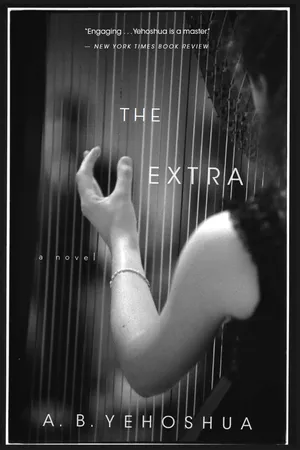
After her father's death, a musician must go home to Israel to confront the relationships she left behind in this novel by the author of
The Retrospective
Noga, forty-two and divorced, is a harpist with an orchestra in the Netherlands. Upon the sudden death of her father, she is summoned home to Jerusalem by her brother to help make decisions in urgent family and personal matters. Returning also means facing a former husband who left her when she refused him children, but whose passion for her remains even though he is remarried and the father of two. For her imposed three-month residence in Israel, her brother finds her work as an extra in movies, television, and opera. These new identities undermine the firm boundaries of behavior heretofore protected by the music she plays, and Noga, always an extra in someone else's story, takes charge of the plot.
The Extra is Yehoshua at his liveliest storytelling best—a bravura performance.
"Engaging…Yehoshua is a master in his visual sketches of scenes."—
The New York Times Book Review
"[A] finely etched new novel…A marvel of a book."—
Haaretz
"Four and a half decades after his first book's publication, his twentieth shows Yehoshua's writing chops are undiminished and his content fearlessly topical."—
New York Journal of Books
"Rich in reflection and personal truth…Masterful."—
Kirkus Reviews, starred review
"Award-winning Israeli novelist Yehoshua gives moral force, even grandeur, to the inevitable push-pull of one family's life."—
Library Journal, starred review
- 258 pages
- English
- ePUB (mobile friendly)
- Available on iOS & Android
eBook - ePub
About this book
Trusted by 375,005 students
Access to over 1.5 million titles for a fair monthly price.
Study more efficiently using our study tools.
Information
Subtopic
Literature GeneralIndex
LiteratureThirty-Two
A COMPLICATION OF HIS GRANDSON’S illness has prevented Elazar, Noga’s driver to the film site, from reaching the Ashdod port until late afternoon. Amid the labyrinth of poles, pulleys, forklifts and cranes that glitter in the sinking sunlight, the practiced eye of the retired police commander quickly locates the giant warehouse repurposed as a fictitious hospital, which in the weeks to come will turn into cinematic reality.
Standing at the entrance are several extras awaiting assignment, based on personal choice or the needs of the production. The “eternal extra” is recognized at once, but no one asks his preference.
“Elazar, you go to the morgue. Sorry, no way will your face appear in this series.”
“But they’ll s-s-see my face as that of a dead man!”
“And when they see you’re finally dead, it’ll be a relief.”
Elazar sighs. “If that’s your decision.”
“But you won’t be bored. There’ll be a story line in the morgue, a medical debate about your death, possibly ending in an autopsy.”
“Most entertaining.”
Now they ask his companion what she would like to be: a patient or the relative of one? If a patient, chronic or recovering?
Elazar jumps in: “Patient, but not critical, just ill.”
But the casting people are not about to hide such a pretty face between blankets and pillows, and so that the camera can caress her femininity, a compromise is suggested: a patient in a wheelchair, hooked up to a colorful intravenous bag.
Elazar is taken to the morgue, and Noga is led through a maze of thin white plywood partitions to an unidentified woman who asks her to change into a floral nightgown. Then she is seated in a wheelchair and taught how to operate it. Her clothes are placed in a plastic bag and hung on the chair, and an IV pole is added on, with a bag filled with blood-red fluid, its tube attached securely to her arm. From here on, she is told, she is free to go about as she wishes. They will find her when she is needed.
The night is not far off, and through the few windows, installed in the warehouse for the film production, the setting sun pours the remains of its day, a potion of copper and gold. Noga wheels herself amid medical equipment, beds and gurneys, occasionally encountering mobile cameras and fuzzy microphones. Despite its transient, improvisational quality, she finds the set to be believable and well suited to its purpose. From time to time she rolls into one of the rooms, where patients bedecked with medical devices greet the guest with friendly waves and invite her to take an interest in their imaginary ailments.
But she mainly sticks to the corridor, to check if there is a back exit from imagination into reality, and perhaps along the way to peek into the morgue and check up on the smiling policeman, missing his protective presence.
The corridor gets darker, seemingly narrower, due perhaps to some mysterious intent of its planners or merely to the evening that envelops the world. This entire huge and forbidding warehouse—it occurs to her suddenly—is a metaphor for humanity, and we are all extras in its story, not knowing if a credible and satisfying resolution awaits us at the end. If only, she sighs, it were set to the right music.
People have to press themselves against the walls to make way for her wheelchair, some of them patients, some relatives, others extras or actors, medical staff and production staff—who can tell the difference between the real and the fictitious? There are those who smile sympathetically and inquire about her disability, and others who pass by in silent sadness. But she keeps rolling along, determined to find that back exit, which suddenly dazzles her with a glimpse of the gray-blue Mediterranean.
The door leads to a small platform of facilities for workers at the port, with two sheds, one for storage and the other for changing clothes, as well as a small cafeteria, and the doorway is blocked by a large man—the retired judge, a familiar and amiable extra whose uniform, baseball cap and pistol establish him as the hospital security guard.
“What can you do?” he says merrily to the wheeling harpist in her brightly colored nightgown. “They haven’t given up on me, asked me to be the guard at the hospital door, so my character will be a regular fixture in the series, a way to fatten my pension.”
“No need to apologize,” Noga assures him. “You’re an Israeli Hitchcock. The audience can’t relax till they spot his cameo. Meanwhile, our friend Elazar has been taken to the gallows. He won’t be able to show his smiling face anymore.”
The judge laughs. “Don’t worry, the stuttering policeman will rise like a daisy from the dead and fill important roles. And you, dear Noga, have you concluded your experiment?”
“Mine? You mean my mother’s.”
“Yours too, because you’re part of it.”
“True.”
“What’s the verdict?”
“Mother is still up in the air, but my sense is she won’t abandon Jerusalem.”
“Bravo! That’s how a brave secular woman should act. And you, dear?”
“In ten days’ time I report for duty in Europe beside my harp, to begin rehearsals of Berlioz’s Fantastique.”
“That way, you’ll be leaving Israel without appearing as an extra in a TV commercial and not just in a fictional story.”
“What’s the difference?”
But as the judge-cum-security-guard tries to explain the essential difference, her attention strays to the cafeteria and its customers. These are mainly men, no longer young, presumably dock workers and customs clerks, gray-haired and bald, but she imagines them as seagoing folk at a Mediterranean port, and is seized by a fierce nostalgia, as if they retained something precious that she had lost, some feeling that has no substitute.
“You’re not listening.”
“You’re right, because I’m burned out, with no one around to explain to me how the devil I got talked into this. And you, my honored friend, where do you find the strength to hop from story to story? Your family doesn’t miss you?”
“On the contrary, it’s good that I’m not at home. Ever since I retired they’ve complained that I never stop judging them.”
And as the blood of the vanished sun is soaked into the clouds, the cafeteria’s lights go out to hasten the exit of the customers, a weaker light is turned on, a tall Sudanese appears and proceeds to set the chairs upside down on the tables, and in the fading twilight there emerge from the cafeteria not humans but silhouettes, headed for a rear gate of creaky revolving bars that ejects them from the port one by one. One figure remains standing on the platform as if lost in thought. Instead of exiting the revolving gate with the others, the figure turns around and heads toward the sea, past huge containers and enormous cranes, walking slowly, dreamily, alongside a gigantic, dark ship, as if hoping to draw strength from it, or inspiration. The unhurried, hesitant steps, halting from time to time, unsettle the woman watching, as if she has seen it before. Her gaze persists until the figure is swallowed in the darkness, and at the edge of the breakwater the lighthouse begins flashing its beam, three short blinks and a pause.
“What are you staring at, young lady?”
“How did the twilight in Israel become so short?”
“Become? When?” The judge laughs. “You’ve been in Europe too long and you forget how fast darkness falls in your homeland.”
“Apparently.”
“So what do you say?”
“About what?”
“About the possibility that before leaving you participate as an extra in an interesting commercial, which I’ve already signed up for.”
“No,” she protests, “I’m done being an extra. I won’t be in any more made-up stories, not in commercials and not in reality, and so I am saying goodbye forever to you too, mighty watchman. You must be strict. No one must be allowed to enter and no one to escape. And now I am going to resign and give up my chair.”
She mischievously pulls down the brim of the judge’s cap until it covers his eyes, and spins her wheelchair around and back into the corridor, which is not as dark now, for at the far end two spotlights have been turned on to shoot a scene that calls for her participation.
Even as she rises from her wheelchair to announce her departure and request that she be liberated from the intravenous tube stuck to her arm, a young man wearing an ID tag gently seizes her arm and seats her back in the chair.
“We need you in a specific scene that will be happening soon, and then you can decide what you want to do.”
“What kind of scene?”
“Permit us not to reveal it in advance, because the director wants to create a surprise, to capture an initial, spontaneous look, frightened, maybe shocked.”
“Shocked by what?”
“No, please, I’ve already said too much, but you can be sure we won’t ask anything that an extra like you can’t handle. We only want your presence as a disabled patient who enters her hospital room and is suddenly agitated by an intimate scene.”
“Intimate?”
“I just let slip another unnecessary word. Intimate in the broadest sense of the word.”
“But wait. I came to tell you I was leaving.”
“We heard you, and we’re sorry to see you go, but only after we finish this scene.”
“Why don’t you find someone else to be shocked?”
“Because you’re the best, in terms of age, looks and especially your cultured quality. You’re a musician, no?”
“A harpist.”
“So please, Noga,” the young man sweetly pronounces her name, “don’t say no.”
She agrees halfheartedly. A makeup artist rushes over and cleans her face and neck of the day’s sweat, and with a thin brush tries to revive lines of beauty that had faded or were forgotten, and an assistant brings her a cold beer and snack, and above her head the IV is switched from red to blue, and the young man with the tag stands behind her and wheels her expertly to the center of the giant warehouse.
“If the intimacy you’re talking about is happening in the morgue,” she warns, “you should know I have a good friend there.”
“The morgue? Where’d you get that idea?”
“There’s no morgue in this hospital?”
“I haven’t heard of it, but maybe”—the young man laughs—“we’ll need something like that later on, for the victims of the film shoot.”
Now she is troubled and unsmiling—where have they sent Elazar? But there is no way back. Her chair comes to a halt in front of a heavy door, tightly shut, on whose other side a scene will take place, or is taking place, that is meant to frighten her.
Silence. Not a sound from beyond the door. The young man grabs the handles of the chair as if fearing a last-minute refusal. A few minutes pass, the door opens and a doctor exits, visibly upset. He is about forty, wearing a white gown and a stethoscope around his neck. Obviously an actor, not an extra.
His handsome face is serious, almost tormented, and she sees something familiar in his look, of humiliation, of passion crushed by hatred. He notices the wheelchair-bound extra in a nightgown, nods cordially and moves down the corridor. The door opens again and a man comes out, older and bearded, with an ID tag and a small walkie-talkie attached to his belt. The young man who wheeled her takes the man aside and whispers in his ear, and the older man turns to Noga, takes her hand and introduces himself as the director of the series. “I know,” he says, “that you were reluctant to do the scene we’re about to shoot, and I thank you for agreeing to do it. Rest assured that we won’t involve you in anything undignified. Who knows, you might change your mind after this scene and stay with us for the duration.”
“No. I’m sick of all this.”
The director touches her arm gently, as if she were a child. He approaches the actor, pulls him aside for a confidential talk, but a sharp musical ear can overcome the distance. “She’s tough,” grumbles the actor. “She doesn’t inspire me . . . not a bit of passion in her. All technical.”
The director goes back into the room to have a tête-à-tête with the actress, leaving the actor with the extra at the closed door. The hem of his gown brushes the wheel of her chair, and he nervously plays with the stethoscope, putting it suddenly to the test. He plugs in the earpieces and smiles sheepishly at the extra, who fears for a moment that he wants to listen to her heartbeat. But the make-believe doctor wishes to examine only himself, undoing the buttons of his gown and running the disk over his bare chest. He closes his eyes as he strains to interpret the beating of his heart, but when he sees the smiling extra, he stops and mumbles, something about the chilly actress he will soon have to make love to, and then the door opens and he is summoned inside.
Deep silence. The young assistant standing behind her, quiet and attentive, grips the handles of the wheelchair. Noga’s eyes close in despair. What is happening to me in Israel? she wonders. How, in just a few weeks, have I turned from a professional musician to a movable movie extra? Where will my mother and brother wheel me next in their pointless experiment?
The door opens and the director comes out and silently rolls her inside, navigating the cables, cameras, monitors and lights, stopping at the edge of the action.
“So, Noga,” he calls her by name, “you’re a disabled patient. You’re returning to your room, to your bed. Please wheel yourself in there, just two or three meters, and stop, taken aback, shocked if possible, because in the next bed, something is happening that you didn’t expect, and you definitely don’t like, and the camera will tell us what you’re thinking and feeling.”
She does as he says, wheeling herself into a dark, scrupulously replicated hospital room with two beds, an empty one for her and a second bed, and alongside it the doctor, who can no longer restrain himself. He rips away his stethoscope, and instead of checking the heart and lungs of the half-naked patient, he brushes her sternum with his lips and kisses her breasts and shoulders, all with the complete consent of the patient, perhaps in the belief that the touch and kisses of a licensed physician will speed her recovery. As the astonished extra tries to distinguish between the lust of the actor and the lust of the man, she hears a whisper behind her: “Get closer, so they’ll know you’re there.”
The doctor, now alarmed by his deed, comes to his senses and stands upright, his bare chest heaving inside the open medical gown. With a savage gaze he studies the disabled woman who has intruded on his passion, and with no warning, in a brisk and aggressive turn, he tears her from the wheelchair, lifts her in his arms and carries her to the vacant bed, laying her down and quickly covering her body and face with a sheet. And as she wonders whether that action was scripted or is a spontaneous move by an imaginative actor, the voice of the director shouts “Cut!” followed by the cheers of the crew.
Someone hurries to remove the sheet and help her out of the bed, as if she were in fact disabled and needing assistance. The actress—a young, slender woman with big, beautiful eyes—waves at her warmly from the next bed, as if they were partners in an adventure, and begins to dress, slowly and carelessly.
“Should we do that one again?” the cameraman pipes up.
“No,” shouts Noga, “I’ve done my part. I don’t work here anymore.”
The extra’s declaration halts the filming. Someone wheels in a tea cart stocked with sandwiches and bottles of juice and soda, and the hungry crew scatter around the set, eating and drinking, talking only about themselves. As Noga is having her makeup removed, the actor comes over and says, “I hope I didn’t hurt you.” “No,” says Noga. “At first you scared me, but I also felt your fear that I would report you to management.”
She is determined to get out of there and heads for the exit, but the director intercepts her, grateful for her participation. “Thank you. We got from you what we hoped and more,” he says. “What were you hoping?” she asks tartly. “We were hoping for just anger and pity,” he says. “And when the doctor surprised us too and carried you to the bed, we were afraid you would resist, but were happy to see you act with dignity and wisdom.”
“So I’m not such an amateur after all,” she compliments herself, and hurries to find her way back to the world.
The corridors that had been desolate before the filming are now filled with new extras who arrived for the evening. She is surprised that many of th...
Table of contents
- Title Page
- Contents
- Copyright
- Dedication
- One
- Two
- Three
- Four
- Five
- Six
- Seven
- Eight
- Nine
- Ten
- Eleven
- Twelve
- Thirteen
- Fourteen
- Fifteen
- Sixteen
- Seventeen
- Eighteen
- Nineteen
- Twenty
- Twenty-One
- Twenty-Two
- Twenty-Three
- Twenty-Four
- Twenty-Five
- Twenty-Six
- Twenty-Seven
- Twenty-Eight
- Twenty-Nine
- Thirty
- Thirty-One
- Thirty-Two
- Thirty-Three
- Thirty-Four
- Thirty-Five
- Thirty-Six
- Thirty-Seven
- Thirty-Eight
- Thirty-Nine
- Forty
- Forty-One
- Forty-Two
- Forty-Three
- Forty-Four
- Forty-Five
- Forty-Six
- Forty-Seven
- Forty-Eight
- Forty-Nine
- Fifty
- Fifty-One
- Fifty-Two
- Fifty-Three
- Fifty-Four
- About the Author
- Connect with HMH
Frequently asked questions
Yes, you can cancel anytime from the Subscription tab in your account settings on the Perlego website. Your subscription will stay active until the end of your current billing period. Learn how to cancel your subscription
No, books cannot be downloaded as external files, such as PDFs, for use outside of Perlego. However, you can download books within the Perlego app for offline reading on mobile or tablet. Learn how to download books offline
Perlego offers two plans: Essential and Complete
- Essential is ideal for learners and professionals who enjoy exploring a wide range of subjects. Access the Essential Library with 800,000+ trusted titles and best-sellers across business, personal growth, and the humanities. Includes unlimited reading time and Standard Read Aloud voice.
- Complete: Perfect for advanced learners and researchers needing full, unrestricted access. Unlock 1.5M+ books across hundreds of subjects, including academic and specialized titles. The Complete Plan also includes advanced features like Premium Read Aloud and Research Assistant.
We are an online textbook subscription service, where you can get access to an entire online library for less than the price of a single book per month. With over 1.5 million books across 990+ topics, we’ve got you covered! Learn about our mission
Look out for the read-aloud symbol on your next book to see if you can listen to it. The read-aloud tool reads text aloud for you, highlighting the text as it is being read. You can pause it, speed it up and slow it down. Learn more about Read Aloud
Yes! You can use the Perlego app on both iOS and Android devices to read anytime, anywhere — even offline. Perfect for commutes or when you’re on the go.
Please note we cannot support devices running on iOS 13 and Android 7 or earlier. Learn more about using the app
Please note we cannot support devices running on iOS 13 and Android 7 or earlier. Learn more about using the app
Yes, you can access The Extra by A. B. Yehoshua in PDF and/or ePUB format, as well as other popular books in Literature & Literature General. We have over 1.5 million books available in our catalogue for you to explore.