This ultimate guide for tech makers covers everything from hand tools to robots plus essential techniques for completing almost any DIY project.
Makers, get ready: This is your must-have guide to taking your DIY projects to the next level. Legendary fabricator and alternative engineer Chris Hackett teams up with the editors of
Popular Science to offer detailed instruction on everything from basic wood- and metalworking skills to 3D printing and laser-cutting wizardry. Hackett also explains the entrepreneurial and crowd-sourcing tactics needed to transform your back-of-the-envelope idea into a gleaming finished product.
In The Big Book of Maker Skills, readers learn tried-and-true techniques from the shop classes of yore—how to use a metal lathe, or pick the perfect drill bit or saw—and get introduced to a whole new world of modern manufacturing technologies, like using CAD software, printing circuits, and more. Step-by-step illustrations, helpful diagrams, and exceptional photography make this book an easy-to-follow guide to getting your project done.
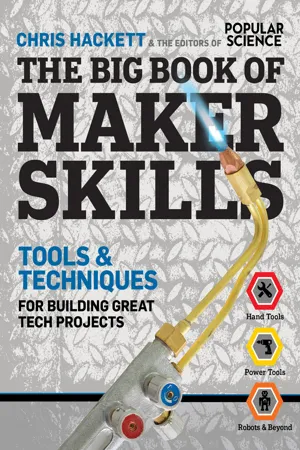
eBook - ePub
The Big Book of Maker Skills
Tools & Techniques for Building Great Tech Projects
- 208 pages
- English
- ePUB (mobile friendly)
- Available on iOS & Android
eBook - ePub
The Big Book of Maker Skills
Tools & Techniques for Building Great Tech Projects
About this book
Trusted by 375,005 students
Access to over 1.5 million titles for a fair monthly price.
Study more efficiently using our study tools.
Information
Subtopic
Civil Engineering
85 PICK A POWER SAW
Where the power of handsaws is limited by the power of your hands, these saws get their juice from longer-lasting sources like batteries or a wall socket. Letting them do the hard work can save you a lot of pushing and pulling.
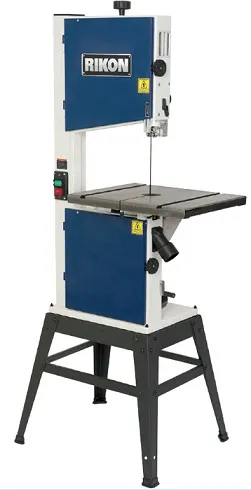
BANDSAW Consists of a strip of toothed metal passing over two wheels, which feed the material under the blade. What it lacks in portability, it makes up for in utility, cutting curves and straight lines through materials thick and thin.
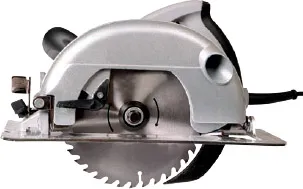
CIRCULAR SAW Essentially a motor, saw blade, handle, and base plate with a guide. Versatile cutting tool, as long as you’re cutting in a straight line. Choosing the right blade for the job is essential.

RECIPROCATING SAW Most often used in construction, remodeling, and demolition. Cuts with a blade that moves back and forth. Good for cutting numerous materials in hard-to-reach places.
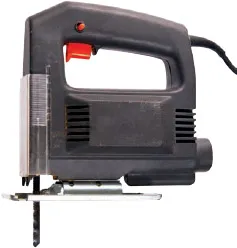
JIGSAW Something of a tiny reciprocating saw. Can be used to cut straight lines, but really intended to cut curves. The thinner and narrower the blade, the tighter the curve.
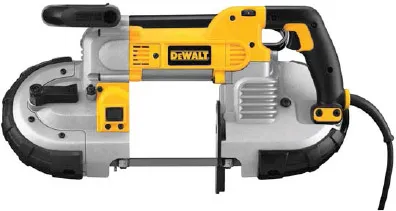
PORTABLE BANDSAW Works well for smaller projects, cutting through anything from pipes to rebar, from plastic to wood. Some come in variable speeds for greater control and cut accuracy.
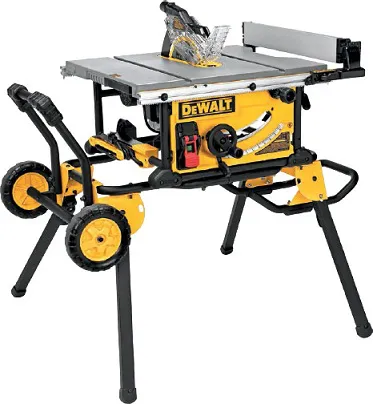
BENCH SAW Also called a table saw. It’s basically a circular saw that protrudes up through a table or bench. It comes with adjustable blade height and angle, making it great for long cuts.
86 MAKE MASTERFUL CURVES WITH A JIGSAW
Excellent for custom parts and stencils, horrible for sticking to a straight line, the power jigsaw dates from the 1940s. Jigsaws ride light on top of the work, anchored only by the oscillating blur of the blade and you.
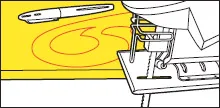
STEP 1 Plan your cut. Curves, stencils, oversize novelty glasses—transfer your design to the work surface with a writing utensil. Pro tip: Three teeth should be contacting the work at all times. Make thin materials like sheet metal thicker by firmly attaching them to plywood backing—spray adhesive will work well.
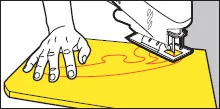
STEP 2 Don’t start the saw under load. Hit the material with the blade moving. To start an internal cut, drill holes slightly larger than the blade. Make the holes inside where the cut will go, and all evidence of them will disappear.
STEP 3 Continue working, keeping close to your drawn edge. Until your skills increase, don’t try for perfection on your first cut. Remember, you can always cut more—less, not so much.
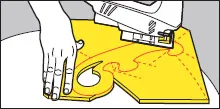
STEP 4 Break complicated cuts into smaller ones. Some tight turns are impossible—saw blades only cut in one direction.
STEP 5 Keep it tight. Jigsaws work best when all of their energy goes into the teeth hitting the material. Any looseness wastes energy and breaks blades. Push firmly, clamping as much as possible.
87 CHOOSE A CIRCULAR SAW BLADE
Simple and casually dangerous, the circular saw is the angle grinder of wood. Use the correct blade to leverage its might.



88 SLICE WITH A CIRCULAR SAW
Most electric tools have a manual ancestor, and the circular saw’s predecessor is the water-powered sawmill. While a lot of things are worth learning on your own, the ones that can cost you fingers or limbs are sometimes best read about.
STRAIGHT CUTS ONLY The saw blade is the only circular thing about this saw. Try to cut a curve and get a free lesson in the power of friction.
ADJUST THE SHOE The saw rides on the “shoe”—the plate at the saw’s bottom. Adjust the shoe angle for beveled cuts. For cleaner cuts, set the blade depth as close as possible to the thickness of the material.
EVERY SAW IS A SNOWFLAKE Every saw (even within brands) has different lines and guides on the shoe to indicate where you’re actually cutting. Do some test cuts when using an unfamiliar saw. Pro tip: Measure the distance between the blade edge and the side of the shoe. Write this on the saw with permanent marker or a label maker. Take some nail polish and draw a red arrow to mark the side of the blade. If it’s a borrowed saw, the owner will thank you.
USE A GUIDE If you’re using a circular saw, there’s a good chance straight lumber and clamps are nearby. Position the lumber, clamp it down, and just ride the shoe against the guide.

89 WORK WITH A PORTABLE BANDSAW
The portable bandsaw is primarily used on job sites for tasks like trimming rebar or conduit during construction. Imagine a hacksaw and an arm that never tires—just a little too powerful, teetering on the edge of power tool and lawsuit. To use:
SECURE THE WORK Portable bandsaws pack some serious torque. If the thing you’re cutting can move, lock it down in a vise or clamp it to something solid.
POSITION THE SAW AND YOU The bumper (flat sheet metal plate where the back side of the blade goes into the saw) is where all the real action happens. The work is jammed against the bumper, the only way out being through the blade. Make sure the bumper is in a position to do its job; otherwise, the saw will jump violently when...
Table of contents
- Front Cover
- Title Page
- Contents
- INTRODUCTION from Chris Hackett
- BASICS
- HAND TOOLS
- POWER TOOLS
- ROBOTS & BEYOND
- Glossary
- Index
- Acknowledgments
- Credits
Frequently asked questions
Yes, you can cancel anytime from the Subscription tab in your account settings on the Perlego website. Your subscription will stay active until the end of your current billing period. Learn how to cancel your subscription
No, books cannot be downloaded as external files, such as PDFs, for use outside of Perlego. However, you can download books within the Perlego app for offline reading on mobile or tablet. Learn how to download books offline
We are an online textbook subscription service, where you can get access to an entire online library for less than the price of a single book per month. With over 1.5 million books across 990+ topics, we’ve got you covered! Learn about our mission
Look out for the read-aloud symbol on your next book to see if you can listen to it. The read-aloud tool reads text aloud for you, highlighting the text as it is being read. You can pause it, speed it up and slow it down. Learn more about Read Aloud
Yes! You can use the Perlego app on both iOS and Android devices to read anytime, anywhere — even offline. Perfect for commutes or when you’re on the go.
Please note we cannot support devices running on iOS 13 and Android 7 or earlier. Learn more about using the app
Please note we cannot support devices running on iOS 13 and Android 7 or earlier. Learn more about using the app
Yes, you can access The Big Book of Maker Skills by Chris Hackett,The Editors of Popular Science in PDF and/or ePUB format, as well as other popular books in Technology & Engineering & Civil Engineering. We have over 1.5 million books available in our catalogue for you to explore.