- 169 pages
- English
- ePUB (mobile friendly)
- Available on iOS & Android
eBook - ePub
London Transport
About this book
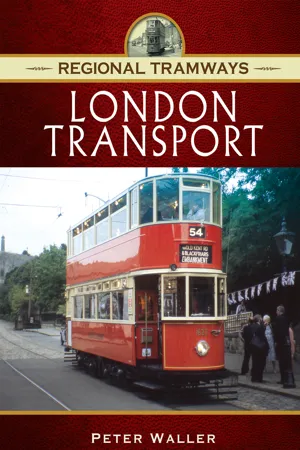
A history of London's horse, steam, cable, and electric tramways, and the operation that ended an era. Includes photos.
The final volume in the Regional Tramways series focuses on the history of tram operation in the London area. Starting the story with the pioneering horse tramways operated by George Francis Train in the 1860s, the book narrates how the various horse, steam, cable, and electric tramways evolved in the period leading up to the creation of the London Passenger Transport Board in 1933.
The primary focus of the book is the period immediately after World War II when, following the retention of the tramways for longer than anticipated, the process of conversion—codenamed Operation Tramaway—saw almost 1,000 trams eliminated from the streets of London in less than two years. Also covered are the two second-generation tramways—the Docklands Light Railway and Croydon Tramlink—which now serve parts of the Greater London area. The book concludes with an overview of those London trams that survive into preservation.
Trusted by 375,005 students
Access to over 1 million titles for a fair monthly price.
Study more efficiently using our study tools.
Information
LONDON TRANSPORT

At the end of the war, London Transport emerged – like the city it served – damaged but undefeated. There had been in terms of destroyed and damaged trams and much of the infrastructure had also been affected. It was not only the physical damage that the German assault had caused but the war had also resulted in the tramway’s life being extended longer than the LPTB had anticipated and there was also a significant backlog of maintenance. Despite the pre-war conversion programme, the London network was still significant, comprising some 102 route miles – 75 per cent conduit – with a fleet of some 900 trams. It was – after Glasgow – still the second largest tramway system in the country.

It’s 1945 and ex-Leyton UDC No 176 heads outbound across Westminster Bridge with a route 31 service whilst a ‘Feltham’ heads south onto the Embankment with a service towards Purley via Croydon. Ian L. Wright/Online Transport Archive
Although there was not as yet any formal conversion programme, the scrapping of surplus trams recommenced in November 1945; by the end of the year, more than 41 ex-LCC ‘E/1’ class cars plus one of the ex-Croydon cars – No 376 – had been disposed off. At this stage, trams were being scrapped at Hampstead depot. The process continued the following year when some 90 ‘E/1s’ were scrapped. In late 1946 a fire at premises adjacent to Hampstead depot resulted in a number of withdrawn trams being damaged. Although the LPTB had intended to sell some of the bodies as bungalows, the fire rendered them suitable only for scrap.
On 17 April 1946, route 42 was extended about quarter of a mile to the Coombe Road crossover; this extension used existing track and was designed to relieve congestion outside the Davis Theatre. Two months later, on 26 June, the all-night services were given route numbers. The most complex of these was route 1, which operated effectively a double figure of eight based on the Elephant & Castle from the Embankment. Other services were 3 (Battersea to Blackfriars), 5 (Downham to Savoy Street via Old Kent Road), 7 (New Cross Gate to Savoy Street, 26 (Clapham Junction to London Bridge) and 35 (Bloomsbury to Highgate).
With the return of peace, thoughts once again turned to the long-term future of public transport in London. The first post-war report issued in 1946 stated ‘The urgent necessity of replacing trams in South London with a more modern and attractive form of transport’; on 15 November 1946 the LPTB announced that this ‘modern and attractive transport’ was to be the diesel bus. However, the conversion was not anticipated to be imminent – largely as the greater priority was in the replacement of life-expired buses, the strengthening of existing services and the introduction of new bus routes – and so Lord Latham announced on 12 January 1948 a programme of some £1 million into the refurbishment of the tramway system. This work included a programme of overhauling the fleet, including, where necessary, the strengthening of bodies as well as the planned relaying of some fifteen miles of track. Amongst improvements to the fleet noted at the time was the appearance of ‘E/1’ No 1397 with flush-sided lowerdeck panelling and the use of skid-head trolleyheads on ex-Croydon Nos 378, 382 and 387. This was said to improve operation and reduce dewirements. Early 1948 also saw a tram featured in the shooting of the film London Belongs to Me starring Richard Attenborough

A wonderful period piece – note the two ‘Diddler’ trolleybuses in the background – sees ‘E/1’ class No 1581 standing at the terminus of route 4 in Wimbledon. This service – to Embankment via Blackfriars – was to be one of those converted to bus operation during Stage 2 of ‘Operation Tramaway’. Geoffrey Ashwell/ Online Transport Archive

On 11 May 1946 a pedestrian warily crosses the road at Vauxhall Cross as ‘E/1’ No 1312 stands behind him on route 24 towards Savoy Street whilst a Victoria-bound ‘Feltham’ is also visible. Geoffrey Ashwell/Online Transport Archive
The next major change for the system was organisational; following the Labour majority in the 1945 election, the nationalisation of major public transport operators was government policy. This was given effect by the Royal Assent 6 August 1947 to the Transport Act. One of the bodies to be nationalised was the LPTB. The new London Transport Executive, a subsidiary of the British Commission, officially took over on 1 January 1948. During 1947, the number of tramcars to be scrapped was reduced to 42; of these all bar two were again ‘E/1s’. The two exceptions were ex-West Ham No 325 and the first ‘Feltham’ to be scrapped post-war (No 2122 in May 1947). The pace of scrapping was further reduced in 1948 when only four trams – all ‘E/1s’ – were dispatched. Following the cessation of scrapping at Hampstead in early 1947, these cars were largely disposed of at Clapham High Street depot.

In a view taken from Thornton Heath depot, one of the ex-Croydon Corporation ‘E/1’- type cars, No 386, heads back to Croydon with a route 42 service. The 42, from Thornton Heath to Croydon, was the preserve of the ex-Croydon cars and was to survive through until Stage 3 of ‘Operation Tramaway’ in April 1951. Geoffrey Ashwell/Online Transport Archive
By the late 1940s the immediate struggles of the post-war recovery were largely behind the LTE and planning for the final conversion of the tramway system could commence. One issue was the disposal of large numbers of trams once withdrawn; in order to progress this, a lease was taken on land on Penhall Road, close to Charlton Works. Work to make the site suitable for scrapping was undertaken and, in July 1950, the first car – ‘E/1’ No 1322 – was disposed off there to test the local reaction.

A scene that could almost be re-enacted today save for the lack of a tram, given the survival of the Southampton Road exit...
Table of contents
- Cover
- Title
- Copyright
- Contents
- Abbreviations
- Preface
- Introduction
- CROYDON TRAMLINK
- DOCKLANDS LIGHT RAILWAY
- LONDON TRANSPORT
- PRESERVATION
- Bibliography
Frequently asked questions
Yes, you can cancel anytime from the Subscription tab in your account settings on the Perlego website. Your subscription will stay active until the end of your current billing period. Learn how to cancel your subscription
No, books cannot be downloaded as external files, such as PDFs, for use outside of Perlego. However, you can download books within the Perlego app for offline reading on mobile or tablet. Learn how to download books offline
Perlego offers two plans: Essential and Complete
- Essential is ideal for learners and professionals who enjoy exploring a wide range of subjects. Access the Essential Library with 800,000+ trusted titles and best-sellers across business, personal growth, and the humanities. Includes unlimited reading time and Standard Read Aloud voice.
- Complete: Perfect for advanced learners and researchers needing full, unrestricted access. Unlock 1.4M+ books across hundreds of subjects, including academic and specialized titles. The Complete Plan also includes advanced features like Premium Read Aloud and Research Assistant.
We are an online textbook subscription service, where you can get access to an entire online library for less than the price of a single book per month. With over 1 million books across 990+ topics, we’ve got you covered! Learn about our mission
Look out for the read-aloud symbol on your next book to see if you can listen to it. The read-aloud tool reads text aloud for you, highlighting the text as it is being read. You can pause it, speed it up and slow it down. Learn more about Read Aloud
Yes! You can use the Perlego app on both iOS and Android devices to read anytime, anywhere — even offline. Perfect for commutes or when you’re on the go.
Please note we cannot support devices running on iOS 13 and Android 7 or earlier. Learn more about using the app
Please note we cannot support devices running on iOS 13 and Android 7 or earlier. Learn more about using the app
Yes, you can access London Transport by Peter Waller in PDF and/or ePUB format, as well as other popular books in Technology & Engineering & Transportation & Navigation. We have over one million books available in our catalogue for you to explore.