- 336 pages
- English
- ePUB (mobile friendly)
- Available on iOS & Android
eBook - ePub
About this book
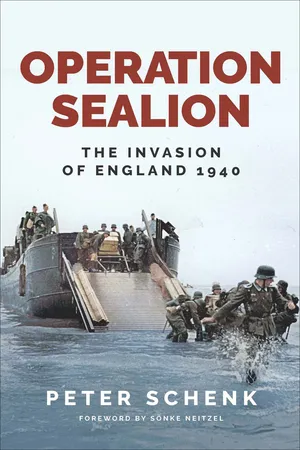
An in-depth analysis of Nazi Germany's unused strategy to invade the UK during the Battle of Britain in World War II.
It is hard to believe that in the summer of 1940, neither the Allies nor the Axis powers had any experience of large amphibious operations. German planning for Operation Sealion was concerned with pioneering new techniques and developing specialized landing craft. Remarkably, in only two months they prepared an invasion fleet of 4,000 vessels.
In Operation Sealion, Peter Schenk begins by examining the vessels that were developed and deployed for the operation: converted cargo vessels and steamers, more specialized landing craft, barges and pontoons, and auxiliary vessels such as tugs and hospital ships. He then goes on to outline the strategic preparations for the landing and looks at the operational plans of, in turn, the navy, army, and air force.
The planned invasion is described in full detail so that the reader can follow the proposed sequence of events from loading, setting sail, and the crossing of the English Channel, to the landing and the early advances into southern England. Schenk uniquely estimates the chances of success.
This absorbing account of Hitler's abortive mission, more detailed than anything written before, is of interest not just to the naval historian but to anyone with an interest in World War II or military strategy.
It is hard to believe that in the summer of 1940, neither the Allies nor the Axis powers had any experience of large amphibious operations. German planning for Operation Sealion was concerned with pioneering new techniques and developing specialized landing craft. Remarkably, in only two months they prepared an invasion fleet of 4,000 vessels.
In Operation Sealion, Peter Schenk begins by examining the vessels that were developed and deployed for the operation: converted cargo vessels and steamers, more specialized landing craft, barges and pontoons, and auxiliary vessels such as tugs and hospital ships. He then goes on to outline the strategic preparations for the landing and looks at the operational plans of, in turn, the navy, army, and air force.
The planned invasion is described in full detail so that the reader can follow the proposed sequence of events from loading, setting sail, and the crossing of the English Channel, to the landing and the early advances into southern England. Schenk uniquely estimates the chances of success.
This absorbing account of Hitler's abortive mission, more detailed than anything written before, is of interest not just to the naval historian but to anyone with an interest in World War II or military strategy.
Tools to learn more effectively

Saving Books

Keyword Search

Annotating Text

Listen to it instead
Information
Topic
StoriaSubtopic
Storia tedescaThe Invasion Plan
IN HIS DIRECTIVE NO. 16 of 16 July 1940, Hitler established the organisation of Operation Sealion and its chain of command: ‘The Commanders-in-Chief of the services are to deploy their forces under my command and in accordance with my general directives.’ The Führer Headquarters and the headquarters of the Commanders-in-Chief were to be combined, and Hitler intended to transfer his base to Ziegenberg near Giessen for the duration of the operation. Army Headquarters was to be at Giessen and the Navy Headquarters at Wildungen; the Luftwaffe was to relocate its headquarters train to Ziegenberg.
In addition, Army Group A headquarters, which during the autumn of 1940 was at St Germain near Paris, was to move to a barracks near Amiens three days before the start of the operation; there was also to be a forward base at Boulogne. The Sixteenth Army transferred its headquarters from Tourcoing on the Belgian– French border to Guines near Calais and the Ninth Army was headquartered that summer at Limesy near Rouen. Each army’s command staff was to be landed in England with the second echelon of the First Wave.
There were actually very few changes in the high command staffs for the operation; the only step taken was to establish a special staff in the Army High Command under the Chief Quartermaster for England, Kretschmer, who was to be responsible for supply after the landing, and who was given six ships for this purpose.
The Navy Prepares
The Navy had already had to make substantial changes in its command structure during the occupation of the western areas of the Continent, and Sealion brought further restructuring and the creation of entirely new positions. One of the new posts was that of Naval Commander West, filled by Vice-Admiral Lütjens, which was created on 3 August from Fleet Command in Trouville. He was responsible for the tactical command of warships and transports in Naval Group West before and during Sealion, as well as performing the duties of the Commander for Western Defence (BSW) until this post could be filled.

Admiral Otto Schniewind (foreground).
Another new position was that of Chief of Sea Transport, held by Captain Degenhardt in Paris, who oversaw the requisitioning and movement of ships in France. After the landing of the First Wave he was to function as the Special Commander of the Naval High Command in England. The requisitioning of ships in Germany was run by the Merchant Shipping Division, which set up a special staff for this purpose. The Main Naval Construction Office, K III M, directed the conversion of these vessels in Germany and designated shipyard officials supervised the work outside the country.
The Naval War Staff of the Naval High Command in Berlin and the Army General Staff were jointly responsible for the operational side of the invasion, the embarkation harbours and landing zones, as well as for the procurement and equipping of ships. Admiral Saalwächter, Commander-in-Chief of Naval Group West, was responsible for the planning and implementation of the naval side of the operation. Naval Group West was to operate jointly with Army Group A and Air Fleet Commands (Luftflottenkommandos) 2 and 3; his subordinate, Naval Commander West, was to liaise with Army Commands (AOK) 9 and 16.
The Commander for North Sea Defence (Befehlshaber der Sicherung der Nordsee, BSN) was responsible for shipping in German harbours as far north as the island of Texel. The commanders of Transport Fleets B, C, D and E were given operational command during the actual crossing and command of combined training with the army groups before the operation. They were also to oversee the composition of the tow formations and convoys and were to be given technical support by the naval bases (KMD) at the embarkation harbours. Commanders of the transport fleets were authorised to issue orders to these naval bases in regard to preparations for the invasion.
The KMDs in Germany were responsible for the requisitioning of German ships and for their transfer to the yards where they were to be converted. KMD Bremen set up a new office in Koblenz for this work from where it was easy to monitor inland shipping. Outside Germany, equipping, distributing and the loading of the ships at the embarkation harbours was performed by the various Naval Equipment Offices which reported to the Commanding Admiral France.
Harbour commandants and captains had to ensure the readiness of the ports and of the loading facilities as well as the supply and accommodation of troops.
The Commanding Admiral France, in Paris, was responsible for the overall coordination of preparations, delivery and completion of the ships. Engineer staff under his command carried out special tasks such as the maintenance of inland waterways, assisted by Fortress Construction HQ Units 22 and 9, a Director of Construction, a supervisor for the yard and a resupply group.
The Naval Commanders of the Netherlands (at the Hague), of the Channel Coast (at Wimille, near Boulogne) and of Northern France (at Trouville) were to ensure the safe passage of vessels through their command areas to the embarkation ports. The Harbour Commanders reported to them. The Chief Quartermasters of Belgium/Northern France and of Paris oversaw the operation and local security of the canals and inland waterways in Belgium and France.
When the invasion was postponed in September 1940, a special staff of the BSW at Trouville under Captain Brocksien assumed the duties of Naval Group Commander West in regard to Sealion effective from 27 October. Their staff report of 23 November indicated that the top command for this operation was inadequate because of the lack of an overall commander of the armed forces. Areas of responsibility in the Navy were vague, particularly at the embarkation ports, where transport fleet commanders under the Chief of Sea Transport would receive orders from the Commander-in-Chief of the KMD in regard to preparations, but who generally received all types of orders from the Merchant Shipping Division, the Commanding Admiral France and his naval commander as his superior. Thus the Naval Group Commander West and the transport fleet commanders were circumvented. There was a plethora of others entitled to issue orders: naval and harbour commandants, harbour captains, supply directors, harbour department chiefs, commanders of the patrol and minesweeping flotillas, and newly formed transport units.
It was suggested that a Wehrmacht staff be formed under the operational supreme commander of Sealion in order to put all of these commands under one roof. He would also deputise for the OKW and be authorised to command all three armed services. In addition, a top command at each embarkation harbour was proposed which would report directly to the Wehrmacht staff.
The Naval High Command was not long in rejecting a Wehrmacht staff from all three services; in its report of 22 December it argued that such a staff would undermine the authority of Group West in implementing the entire operation and that of the BSW for transport. The Navy pointed out that the contradictions and vague lines of command would require the intervention of the Naval War Staff and the Army General Staff. Perhaps bad experience in the past made the Naval High Command reluctant to co-operate with the other armed services, especially with the Luftwaffe, but the main reason was their negative attitude to the whole operation.
Preparing the Transports
The Navy faced far more daunting problems with Sealion than did the Army or the Luftwaffe. After all, the invasion fleet had to be produced virtually out of thin air, a fact emphasised in a paper submitted by the OKM at the Führer Conference on 26 July:
1. Requisitioning the majority of inland barges and the tugs required to tow them to the conversion yards, and transporting them to their embarkation ports will bring inland shipping to a virtual halt. It is not possible to assess the exact effect upon the defence industry, food industry, retail trade and transport, but it is considered that the implications will be very serious. The Reich Economics Ministry and the Reich Transport Ministry support this view.
2. Material required
a) 30,000 tons iron and steel. This will require rolling mills to work on this project exclusively for ten days, thus postponing work for other contracts accordingly.
b) 40,000 cubic metres of lumber must be available which will have serious effects on the building sector and the armaments industry.
c) concrete: 75,000 cubic metres must be provided; negative impact on entire construction industry.
3. Shipyards
a) Inland yards: full capacity of all inland shipyards on the Rhine and in the Netherlands/Belgium needed for at least four weeks; all repair work and new construction will have to be postponed for that time.
b) Coastal yards: a substantial portion of their capacity will be needed for the preparation of ocean-going ships (coasters, transports, freighters, etc.); this will have priority over submarine construction. Moreover, several hundred auxiliary ships and transports with degaussing systems are to be fitted out. This work will require the use of the workshops in all German dockyards for approximately four weeks, and will take priority over the submarine programme. This will mean, for example, that work on the Tirpitz will also have to be postponed for four weeks.
4. The German cable industry [Drahtseilverband] will be heavily taxed with completion of the approximate 1,000 sets of towing equipment, taking precedence over other production such as of mining cables, submarine nets, etc. for about three weeks. Furthermore, many workers from harbour construction projects are required, so that these must be postponed for four weeks.
5. Movement of materials between the manufacturers and the processing plants (dockyards, etc.) will require a great deal of transport, most of which is supervised by the Todt organisation. Its other work will necessarily suffer.
In order to perform this work, which will have serious implications for the armaments industry, trade...
Table of contents
- Cover
- Title Page
- Copyright
- Contents
- Preface
- Foreword by Professor Sönke Neitzel
- Introduction
- Prelude to a Landing
- The Invasion Fleet
- The Invasion Plan
- British Resistance
- The Fate of Operation Sealion
- Glossary of German Terms and Abbreviations
- Key to Symbols
- Sources
Frequently asked questions
Yes, you can cancel anytime from the Subscription tab in your account settings on the Perlego website. Your subscription will stay active until the end of your current billing period. Learn how to cancel your subscription
No, books cannot be downloaded as external files, such as PDFs, for use outside of Perlego. However, you can download books within the Perlego app for offline reading on mobile or tablet. Learn how to download books offline
Perlego offers two plans: Essential and Complete
- Essential is ideal for learners and professionals who enjoy exploring a wide range of subjects. Access the Essential Library with 800,000+ trusted titles and best-sellers across business, personal growth, and the humanities. Includes unlimited reading time and Standard Read Aloud voice.
- Complete: Perfect for advanced learners and researchers needing full, unrestricted access. Unlock 1.4M+ books across hundreds of subjects, including academic and specialized titles. The Complete Plan also includes advanced features like Premium Read Aloud and Research Assistant.
We are an online textbook subscription service, where you can get access to an entire online library for less than the price of a single book per month. With over 1 million books across 990+ topics, we’ve got you covered! Learn about our mission
Look out for the read-aloud symbol on your next book to see if you can listen to it. The read-aloud tool reads text aloud for you, highlighting the text as it is being read. You can pause it, speed it up and slow it down. Learn more about Read Aloud
Yes! You can use the Perlego app on both iOS and Android devices to read anytime, anywhere — even offline. Perfect for commutes or when you’re on the go.
Please note we cannot support devices running on iOS 13 and Android 7 or earlier. Learn more about using the app
Please note we cannot support devices running on iOS 13 and Android 7 or earlier. Learn more about using the app
Yes, you can access Operation Sealion by Peter Schenk in PDF and/or ePUB format, as well as other popular books in Storia & Storia tedesca. We have over one million books available in our catalogue for you to explore.